
5 Therapist Backed Couples Conversation Scripts to Use Tonight

Below are ready-to-copy conversation scripts for de-escalating a fight, repairing after a blowup, checking in, setting a boundary, and showing appreciation. Each one draws on therapist-backed frameworks from Couples Fight School, founded by Carlos Todd, and on published research on receptive listening and emotion regulation. If a conversation keeps turning into a crisis despite these tools, that is a sign to bring in a professional rather than keep scripting it alone.
TL;DR:
- Scripts are most effective when used to prepare for calm conversations or to interrupt escalation, rather than during intense venting.
- Using a break with clear timing helps regulate emotions and ensures both partners return to the discussion more calmly and receptive.
- Consistent practice of daily check-ins and weekly repair sessions can make scripted techniques feel natural and improve communication over time.
- Receptive listening and echoing your partner’s feelings are more critical than your good intentions for fostering relationship trust and understanding.
- When conflicts or trust breaches persist despite scripting, seeking professional help is advisable to address underlying patterns.
Table of Contents
- 1. Ready scripts for five common goals
- How should you deliver a script so it actually helps?
- De-escalation scripts and how to regulate before you respond
- Conversation starters that build intimacy without starting a fight
- Build a short practice routine so the scripts stick
- Why these scripts work: the research and clinical thinking behind them
- Scripts for negotiating and naming unmet needs
- Moving from scripted language to natural conversation
- Scripts for rebuilding trust after a breach
- What usually goes wrong with these scripts
- How Couples Fight School can help you go further
- FAQ
- Sources
1. Ready scripts for five common goals
Pick the script that matches your moment. Say it close to word for word the first few times. You can loosen the language once the pattern feels natural.
De-escalate (heated moment).
- “I want to hear you, but I’m getting flooded. Can we pause for 20 minutes and come back to this?”
- “I’m not trying to shut you down. I need a minute to calm my body so I can actually listen.”
Repair (after the blowup).
- “I raised my voice earlier and that wasn’t fair to you. I’m sorry.”
- “When you said I don’t care about your day, I felt dismissed and I got defensive instead of asking what you meant.” (true I-statement: names the inner state, not the partner’s motive)
Check-in (calm use).
- “What felt heavy for you today?”
- “So you’re saying the week felt lonely because we barely talked, not because of anything specific I did.” (mirroring: reflecting back what you heard before responding)
Boundary (calm use, or firm in a heated moment).
- “I need us to not bring up past arguments when we’re trying to solve a new one.”
- “I’m willing to talk about this after dinner, not during it.”
Appreciation (calm use).
- “I noticed you handled the kids’ bedtime alone tonight. That mattered to me.”
- “Thank you for texting me when you were running late. It made me feel considered.”
Every goal above includes at least one true I-statement and one mirroring line, the two moves that practitioner guides on conflict resolution consistently point to as the core skills that make a script land instead of landing flat.
How should you deliver a script so it actually helps?
A script only works if the delivery matches the moment. Here is the order that keeps it useful instead of making things worse.
- Check the moment first. Use a script to prepare for a planned conversation or to interrupt an escalating one, never mid-sentence while someone is still venting.
- Keep your voice low and short. One idea per script. If you tack on a second complaint, you have turned a repair line into a new fight.
- Agree on turns before you start. Each partner gets uninterrupted time, usually two to three minutes, while the other listens without rebutting.
- Mirror before you respond. Repeat back the gist of what you heard in one sentence before adding your own point.
- Close with a next step. End with something concrete: a time to revisit the topic, a specific ask, or simply “thank you for listening.”
Run a thirty-second rehearsal together before a hard conversation: say the opening line out loud once, check that it sounds like you and not like a script, then start for real.
Pro Tip: Write your two or three go-to scripts on your phone’s notes app so you can glance at them mid-conversation instead of trying to recall the exact wording under stress.
De-escalation scripts and how to regulate before you respond
When a conversation starts to spike, the first job is not to win the point, it is to bring both nervous systems back down. The P.A.U.S.E. framework recommends a short regulation move, often a 10-second breathing or grounding pause, and when things are more heated, a break of sufficient length before returning to the topic.
Scripts to ask for and grant a break:
- “I need some time to settle down. I’m not leaving the conversation, I’m coming back.”
- “Okay, let’s take that break. I’ll check in with you at [specific time].”
- “I’m going to breathe for 10 seconds before I answer that.”
- “My voice is getting loud. Let me lower it and try again.”
Re-entry and repair once you have both cooled off:
- “Thanks for giving me that time. Here’s where I landed.”
- “I want to go back to what you said about feeling ignored.”
A partner’s sense of being heard predicts relationship quality more reliably than the regulator’s own intentions. Research on perceived emotion regulation found that it is the listener’s experience of feeling helped, not the speaker’s good intent, that moves the needle on how the relationship is rated. That is the practical reason mirroring matters more than explaining yourself well: your partner has to register that you heard them, not just that you tried.
If a fight regularly needs more than one break to settle, our guide to diffusing conflict with your partner walks through the pattern in more depth, a useful resource for mental health practices to support clients with therapist-delivered programs by a specialized counseling marketing agency.
Conversation starters that build intimacy without starting a fight
Curiosity works best in layers. Light questions warm up the conversation, mid-depth questions reveal preferences and values, and deep questions touch hopes and fears, usually only once the lighter layers feel safe.
Light:
- “What’s the best thing that happened to you this week?”
- “If we had a free Saturday with no plans, what would you want to do?”
Mid-depth:
- “What’s one thing you wish we did more of together?”
- “What does feeling supported look like for you right now?”
Deep:
- “What’s something you’re afraid to tell me but want me to know?”
- “What do you hope our relationship looks like in five years?”
Follow-up phrases that signal real curiosity rather than a checklist: “Tell me more about that,” “What made that stick with you,” and “I hadn’t thought of it that way, say more.”
Pace the climb. If your partner answers a mid-depth question with one word or changes the subject, that is a readiness signal to stay lighter for now rather than push toward the deep end. Safety, not speed, is what makes these conversations repeatable.
Build a short practice routine so the scripts stick
Scripts fade into habit faster with a fixed routine than with occasional, high-effort attempts. Two simple structures cover most couples.
- 5-minute daily check-in. Phones away, one question each (“what felt heavy or good today”), two to three minutes per partner, no problem-solving unless asked for.
- 20 to 30 minute weekly repair session. One topic only, timed turns of five minutes, close with one appreciation and one next step.
| Routine | Length | Core rule |
|---|---|---|
| Daily check-in | 5 minutes | One topic, no devices |
| Weekly repair session | 20-30 minutes | Timed turns, one agenda item |
Track progress loosely: notice whether breaks are getting shorter, whether repair lines come sooner after a conflict, or whether check-ins happen without being prompted. Those small shifts matter more than whether a single conversation goes perfectly. Our six therapist-backed communication exercises pair well with either routine if you want more structured variations.
Why these scripts work: the research and clinical thinking behind them
These scripts are not generic relationship advice. They are built around three repeatedly supported findings: receptive listening and feeling heard predict relationship quality more than the listener’s intent, true I-statements that describe your own inner state reduce defensiveness compared with disguised accusations, and short regulation routines like a 10-second pause or a 20-minute break support calmer re-entry into hard conversations. Carlos Todd, co-founder of Couples Fight School alongside Natasha Pemberton-Todd, built the F.I.G.H.T. Plan® around this same logic: structured steps for communication, regulation, and repair rather than open-ended advice to “communicate better.” The scripts above map directly onto that structure, pairing a regulation step with a mirroring step and a concrete next action.
Feeling heard, not just being heard correctly, is what moves a conversation from conflict toward connection.
— Carlos
Scripts for negotiating and naming unmet needs
De-escalation gets a conflict calm enough to talk. Resolving it usually means naming what you actually need and negotiating toward something workable, which is a different script entirely.
Naming an unmet need:
- “I’ve been carrying most of the evening routine, and I need us to split it more evenly.”
- “I feel unseen when big decisions get made without checking with me first.”
Negotiating a compromise:
- “Would it work if you took Tuesdays and Thursdays, and I take the rest?”
- “I can meet you halfway on this if we revisit it in a month and see how it’s going.”
Closing the negotiation:
- “So we’re agreeing you’ll text when you’re running late, and I’ll stop assuming the worst. Did I get that right?”
The communication-practice research on conflict resolution notes that picking the right time and place, and giving each person an uninterrupted turn, are as important to resolution as the words used. A negotiation script delivered during a rushed morning rarely lands the same way it would over a calm evening.
Moving from scripted language to natural conversation
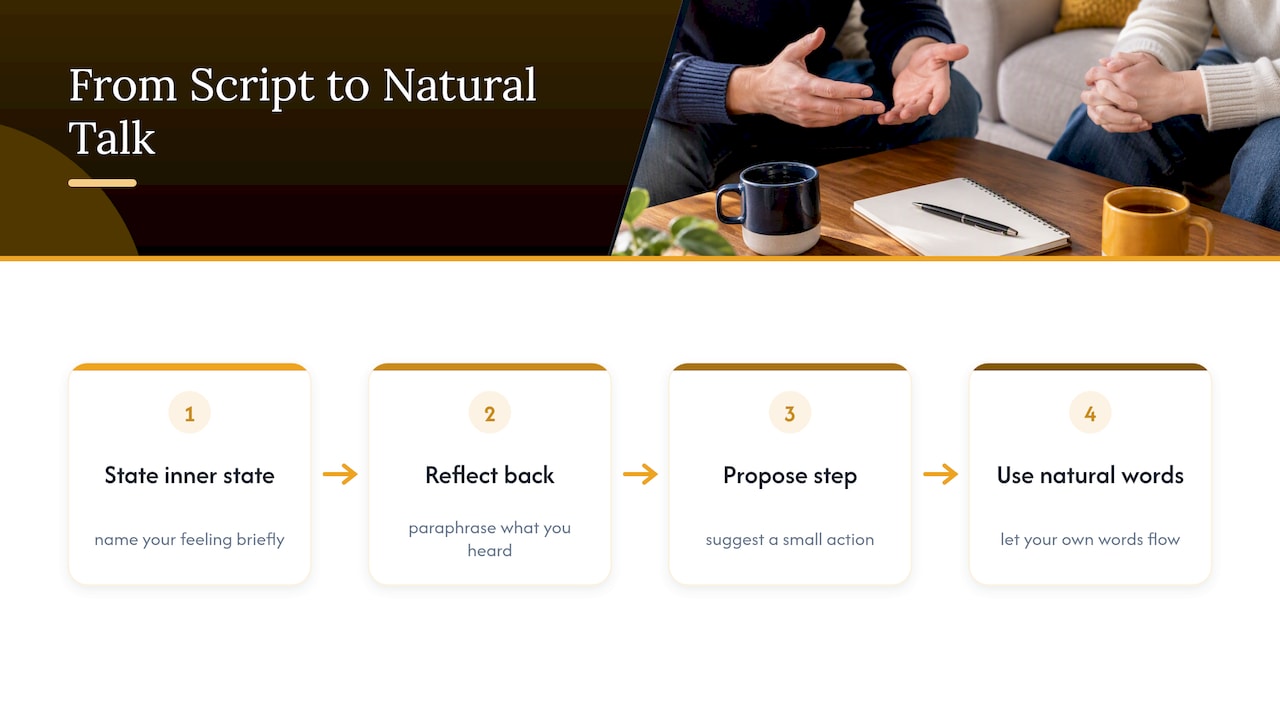
Scripts are training wheels, not a permanent communication style. Most couples lean on near-exact wording for the first several weeks, especially for repair and boundary conversations, and then notice the phrasing loosening on its own.
A few signs you are ready to drop the script: you catch yourself mirroring without thinking about it, your partner responds calmly to language that used to spark defensiveness, and repair happens within minutes instead of requiring a formal sit-down. At that point, keep the underlying moves, state your inner state, reflect back what you heard, propose a next step, and let your own words fill in the rest. If a particular topic (money, in-laws, intimacy) still reliably spins out, it is fine to keep the script for that specific subject longer than for others.
Scripts for rebuilding trust after a breach
Trust breaches, whether infidelity or a pattern of broken promises, need a different script than everyday conflict. The goal shifts from resolving a disagreement to re-establishing safety over time.
Opening the conversation (the hurt partner):
- “I need to understand what happened before I can decide how to move forward.”
- “I’m not asking you to fix this today. I need you to stay in this conversation with me.”
Responding with accountability (the partner who broke trust):
- “What I did hurt you and broke something important. I’m not going to defend it.”
- “I understand if you need to ask me the same question more than once. I’ll keep answering it honestly.”
Checking progress weeks later:
- “I want to tell you one thing that’s helped me trust more this week, and one thing that still feels shaky.”
These conversations typically need more structure and more time than a single script session can offer, which is where a workbook built specifically for this, rather than a general conflict script, tends to help.
What usually goes wrong with these scripts
The most common mistake is turning the timeout into a weapon, calling a break to end a conversation rather than to return to it calmer. The second is over-relying on scripts so heavily that every exchange feels rehearsed instead of felt, which can read as distant rather than caring. The fix for both is the same: use the script to get regulated enough to be honest, then let your own voice take over. If a pattern of hurt keeps resurfacing despite consistent practice, that is a signal worth bringing to a licensed couples therapist rather than another round of scripting.
— Carlos
How Couples Fight School can help you go further
If these scripts help but you want a fuller system behind them, our Stop the Fighting: The Couples Communication & Conflict Resolution Course ($149.00) walks through the full F.I.G.H.T. Plan® with guided practice beyond single scripts. For couples working specifically on trust after a breach, our R.E.S.T.O.R.E Workbook was built for that exact situation.

- Want a short, focused entry point: The F.I.G.H.T. Plan – Couples Conflict Toolkit ($27.00) packages conflict scripts and reflection exercises in one place.
- Want live guidance: our VIP Private Coaching Session, 4 sessions works through your specific patterns with a coach.
- Want an intensive reset: the 6 Hours Couples Intensive is built for couples who need a concentrated block of structured work.
Browse the full lineup, including the Christian F.I.G.H.T. Plan Workbook and the F.O.R.E.V.E.R. Workbook for premarital couples, in our shop.
FAQ
Do therapist-backed scripts actually work for real arguments?
Scripts work best as a starting structure, not a substitute for listening. Research on perceived emotion regulation found that a partner’s sense of being heard, which a good mirroring script supports, predicts relationship quality more reliably than the speaker’s intent alone.
What’s the difference between an I-statement and just saying “I feel” before a complaint?
A true I-statement describes your own inner state without assigning motive to your partner, while a disguised accusation like “I feel like you never listen” is still blame wearing a soft opener. The communication-practice guide on conflict resolution outlines how to tell the two apart.
How long should a timeout be during a heated conversation?
The key is agreeing on a specific return time before stepping away. See the framework.
When should a couple stop using scripts and see a professional instead?
If the same conflict keeps resurfacing despite consistent practice, or if a trust breach feels too large to navigate with scripts alone, that is a reasonable point to bring in a licensed couples therapist. Scripts can prepare a couple for therapy, but they are not a replacement for it when patterns feel stuck.
Can scripts be adapted for different communication styles or cultural backgrounds?
Yes. The core moves, stating your own state, mirroring back what you heard, and proposing a next step, hold across styles, but the specific wording should match how each partner naturally speaks, including more formal or more indirect phrasing where that fits the relationship or cultural context.
Sources
- Are we doing good? Perceived emotion regulation success and relationship quality in couples
- What helps to resolve conflict – Communication in Practice
- When Emotions Take Over: Learning to P.A.U.S.E. Before You React
Recommended
- Six Therapist Backed Communication Exercises Couples Can Do Tonight
- 6 Research Backed Conflict De-escalation Techniques with Ready Scripts
- Four Part Conflict Conversation Starters for Couples That Stop Fights
- Imago Dialogue Steps: 10–15 Clinician Backed Scripts for Couples