
Therapy Backed Behavior First Steps to Repair an Emotional Affair

Yes, recovery from an emotional affair is possible, but it’s not automatic and it’s not guaranteed. It requires ending the outside relationship immediately, replacing concealment with full disclosure, and sustaining transparent behavior over time. Therapy meaningfully raises the odds of success. Deep trust repair typically takes months, often 18 months to three years of consistent effort.
TL;DR:
- Immediate cessation of contact with the third party and full disclosure are essential in the first 72 hours to stabilize trust.
- Trust rebuilding requires months of consistent, transparent behavior, with notable phases including crisis stabilization, understanding the breach, and long-term reconstruction.
- Trust is mainly restored through repeated small actions over time, not single conversations or promises, often taking 18 months to three years.
- Therapy, especially approaches like EFT or structured infidelity-specific work, significantly improves long-term relationship satisfaction.
- Non-sexual closeness, gradual reintroduction of touch, and clear boundaries are crucial before considering sexual intimacy again.
Table of Contents
- What Does Emotional Affair Recovery Actually Require in the First 72 Hours?
- The Three Phases of Recovering From an Emotional Affair
- Why Does an Emotional Affair Hurt So Much, Even Without Sex?
- What Boundaries and Transparency Practices Should You Set Right Now?
- How Do You Rebuild Trust After an Affair Through Daily Behavior?
- Does Therapy Actually Help After an Emotional Affair?
- When Is It Safe to Rebuild Sexual Intimacy After Betrayal?
- How Do You Handle Setbacks, Triggers, and Anniversaries?
- How Does the F.I.G.H.T. Plan® Apply to Affair Recovery?
- A Clinician’s Honest Note on What This Work Actually Takes
- Ready to Work Through Recovery With Structured Support?
- Where This Guidance Comes From
- Sources
What Does Emotional Affair Recovery Actually Require in the First 72 Hours?
The first three days after discovery set the trajectory for everything that follows. Couples who move fast on a few specific actions tend to stabilize faster than couples who freeze or argue in circles.
Here’s the priority order that matters most right now:
- End contact with the third party completely. If total elimination isn’t possible (a coworker, a family friend), restructure the relationship with strict, written boundaries: no private messaging, no one-on-one meetings, no reaching out “just to explain.”
- Stop the trickle truth. Partial confessions followed by new revelations weeks later do more damage than one hard, honest conversation. Therapists who work with betrayed couples consistently point to full disclosure as the moment therapy starts actually working, rather than one delayed admission after another.
- Handle the practical basics. Sleep, food, and physical safety come before any deep conversation. A betrayed partner running on four hours of sleep and adrenaline cannot process a nuanced apology.
- Set a short-term transparency agreement. Phone access, a shared calendar, and a daily ten-minute check-in (not an interrogation, a brief status update) give the betrayed partner something concrete to hold onto while bigger repair work begins.
- Consider a short structural pause, not a permanent decision. A few nights in separate spaces can lower the temperature. Filing for divorce or making permanent separation calls in week one, while emotions are at their peak, usually needs revisiting later with a clearer head.
- Delay major decisions for at least a few weeks. This isn’t about avoidance. It’s about not making irreversible choices while the nervous system is still in crisis mode.
Pro Tip: Write the transparency agreement down, even if it feels formal or unromantic. A verbal promise made during a crisis conversation is easy to misremember three weeks later. A one-page written agreement, reviewed weekly, removes the “I thought we said” arguments that eat up early recovery.
Notice what’s missing from this list: grand romantic gestures, long emotional speeches, or promises about the future. None of that matters yet. What matters is whether the betraying partner can demonstrate, in concrete and checkable ways, that the outside relationship is over and the truth is finally on the table. Everything else in emotional affair recovery builds on that foundation.
The Three Phases of Recovering From an Emotional Affair
Recovery doesn’t move in a straight line, but it does move through recognizable stages. Knowing which phase you’re in helps you set realistic expectations instead of measuring progress against an imaginary finish line.
Phase 1: Crisis stabilization (roughly the first several weeks). This is triage. The priority is ending contact, establishing immediate boundaries, and managing emotions that feel too big to sit with. Betrayed partners often cycle through disbelief, rage, and numbness within a single afternoon. Betraying partners often oscillate between guilt and defensiveness. Neither reaction is a character flaw; both are normal responses to acute relational shock.
Phase 2: Understanding the breach (roughly several months after the initial crisis). Once the immediate danger has passed, couples shift into a harder, slower kind of work: understanding what actually happened and why. This is where a structured formulation helps, mapping the Deficits, Emotions, Enablers, and Patterns (a DEEP-style framework) that allowed the emotional affair to take root. It’s not an excuse-making exercise. It’s diagnostic. A betraying partner who understands the loneliness, unmet need, or avoidance pattern that made the outside connection appealing is far less likely to repeat it. This phase also demands real accountability: not “I’m sorry you feel that way,” but specific ownership of specific choices.
Phase 3: Rebuilding (roughly several months after the initial crisis and often continuing much longer). This is where new trust actually gets built, not through apology but through repetition. Consistent behavior, shared rituals (a nightly check-in, a weekly date, a Sunday planning conversation), and gradual intimacy work all belong here. This phase has no fixed endpoint. Some couples feel steady again by month nine. Others need two full years before the vigilance fades.
A few patterns show up often enough to be worth naming in advance:
- A “second wave” of grief and anger frequently appears around the three to six month mark, often catching couples off guard because the initial crisis has passed and they expected to feel better by now instead.
- Full trust rebuilding, according to clinical guidance on affair recovery, commonly takes 18 months to three years of sustained, transparent behavior.
- Anniversaries of the discovery date, or of the affair’s start, often trigger renewed distress even a year or more into recovery.
- Couples who address the affair quickly, with shorter outside involvement and full disclosure, tend to move through these phases faster than couples dealing with a longer or repeated pattern of betrayal.
None of this means recovery drags on forever. It means the timeline is measured in seasons, not weeks, and couples who expect a six week resolution often mistake normal phase two friction for failure.
Why Does an Emotional Affair Hurt So Much, Even Without Sex?
Because the brain doesn’t distinguish neatly between “physical” and “emotional” betrayal. An emotional affair, sustained secret intimacy, flirtation, or confiding in someone outside the relationship, triggers the same alarm system a physical affair does, because the threat your nervous system registers isn’t about sex. It’s about exclusivity and safety.
At the moment of discovery, the amygdala fires like a smoke alarm and cortisol floods the bloodstream. That’s not an exaggeration; it’s the physiological signature of acute betrayal, and it explains symptoms that otherwise seem disproportionate: nausea, shaking, an inability to eat, waking at 3 a.m. with your heart pounding. Your body is treating this the way it would treat a physical threat, because to your attachment system, it is one.
There’s a second layer to the pain that’s specific to emotional affairs: the comparison wound. A betrayed partner doesn’t just learn that their partner lied. They learn that their partner chose to give someone else the vulnerability, the inside jokes, the late-night texts, the feeling of being truly seen, that used to belong exclusively to them. That’s an attachment injury, not just a trust injury. It can feel like being emotionally replaced, even when no physical infidelity occurred.
This is also why the repetitive questioning and phone checking that show up in early recovery aren’t signs of an unstable or controlling partner. They’re trauma responses. The brain, having been blindsided once, starts scanning constantly for the next threat. That hypervigilance is exhausting for both people, but it’s not irrational; it’s the nervous system trying to protect itself after being caught off guard. It eases, gradually, as new evidence of safety accumulates, which is exactly why consistent transparent behavior over months matters more than any single reassuring conversation.
What Boundaries and Transparency Practices Should You Set Right Now?
Vague promises (“I’ll do better”) don’t rebuild trust. Specific, checkable agreements do. The couples who move through recovery fastest tend to negotiate concrete terms early rather than relying on goodwill alone.
Ending contact looks different depending on who the third party is. If it’s a coworker, that might mean requesting a schedule change, moving to a different team, or, at minimum, agreeing that all communication happens through documented channels only. If it’s a mutual friend or family member, it might mean a direct, honest conversation where the betraying partner states plainly: “This relationship needs to end, and here’s why.” Ambiguity here, staying “friendly,” keeping the door cracked open “for closure”, is where recovery quietly stalls.
Transparency agreements work best when they’re specific and time-limited, not permanent surveillance:
- Full phone and message access for an agreed period, reviewed and renegotiated every few weeks rather than left open-ended forever.
- A daily check-in of ten minutes or less: not a cross-examination, just “here’s my day, here’s where I was.”
- A set weekly time (same day, same hour) to discuss the affair directly, so it doesn’t hijack every dinner conversation.
- A shared understanding of what “full disclosure” includes: how it started, how long it lasted, what was said, without gratuitous detail that serves curiosity more than healing.
Full disclosure should be honest without being punishing. There’s a real difference between telling the truth about what happened and providing every explicit detail simply because the betrayed partner is asking in a moment of pain. A skilled therapist can help draw that line; a good rule on your own is to answer the question that’s actually being asked (Did you tell them things you don’t tell me? Did you plan to see them again?) rather than volunteering details that will replay on a loop for months without adding anything useful to the healing process.
Amends need to be concrete, not symbolic. Flowers and apologies feel good in the moment but don’t move the needle on trust. What does: voluntarily sharing a location app for a while, proactively mentioning when the former contact comes up rather than waiting to be asked, following through on small promises consistently enough that the betrayed partner starts to notice a pattern.
Pro Tip: If the third party is unavoidable, like a coworker on the same project, write a joint statement together (a script, essentially) for how the betraying partner will handle any unavoidable interaction, and review it before it happens rather than improvising in the moment.
How Do You Rebuild Trust After an Affair Through Daily Behavior?
Trust doesn’t come back because of one good conversation. It comes back because a pattern of small, repeated actions slowly overwrites the brain’s prediction that this person is unsafe. Rebuilding trust after an affair is a math problem as much as an emotional one: enough consistent data points, over enough time, eventually outweigh the one catastrophic data point that broke things.
Micro-behaviors matter more than most people expect. Showing up when you say you will. Answering texts promptly instead of going quiet for hours. Being where you said you’d be. None of these sound significant individually. Stacked over sixty days, they become the evidence a betrayed partner’s nervous system is actually looking for.
How you answer hard questions matters as much as what you did. A betrayed partner will ask the same question more than once, sometimes the exact same question three different ways in the same week. That’s not a trap. It’s the brain double checking for consistency. A steady, patient answer (“I understand why you’re asking again, and here’s the same honest answer”) builds trust. Defensiveness, eye-rolling, or “I already told you that” tears it back down, even if the original answer was completely honest.
Repair rituals give the process structure instead of leaving it to chance:
- A weekly fifteen-minute check-in specifically about how recovery is going, separate from daily logistics.
- Written commitments (not vague intentions) that both partners can refer back to.
- A third-party agreement, sometimes a therapist, sometimes a trusted mutual friend, when direct conversations keep spiraling into old arguments.
Monitoring can start to ease once specific markers show up consistently, not on a fixed calendar date. Watch for: the betraying partner volunteering information before being asked, curiosity about the affair’s roots settling into calm rather than panic, and the betrayed partner noticing they’ve gone a few days without the urge to check a phone. Those are real signals. An arbitrary “it’s been six months, you should be over it” timeline is not, and pushing that framing usually backfires. If defensive withdrawal patterns keep resurfacing, they’re worth addressing directly rather than waiting for them to resolve on their own.
Does Therapy Actually Help After an Emotional Affair?
Yes, and the research backs it up more specifically than most people assume. Infidelity is common in couples therapy: roughly 30% of couples in therapy are dealing with some form of it. Among those couples, the ones who disclose the affair and end it, either before therapy starts or early within it, show meaningfully better improvement in relationship satisfaction over the course of treatment than couples still concealing details.
There’s also a longer-term finding worth sitting with: among couples who stayed together and did the work, satisfaction five years later showed little difference between couples who’d experienced infidelity and those who hadn’t. Recovery doesn’t just patch things up. Done seriously, it can bring couples to a genuinely equal footing with couples who never faced this at all.
Several therapy approaches show up repeatedly in infidelity recovery work:
- Emotionally Focused Therapy (EFT), which targets the attachment fear underneath the anger.
- PACT (Psychobiological Approach to Couple Therapy), which focuses on nervous system regulation between partners.
- Integrative infidelity-specific therapy, built around staged disclosure and structured accountability.
- EMDR, useful when the betrayed partner shows intense trauma symptoms like flashbacks or intrusive imagery.
Couples work is usually the right starting point, but individual therapy has its place too, particularly for a betraying partner working through the vulnerabilities that fed the affair, or a betrayed partner processing trauma symptoms that need space outside the shared room. Specialized infidelity recovery programs can help when general couples counseling feels too broad for the specificity this situation demands.
When vetting a therapist, ask directly: How many infidelity cases have you handled? Do you use a specific disclosure framework? What’s your view on full disclosure versus limiting details? Online counseling has become a legitimate option here too, particularly useful for couples who want flexible scheduling or who feel more comfortable processing sensitive material from home rather than a waiting room.
When Is It Safe to Rebuild Sexual Intimacy After Betrayal?
Not before non-sexual closeness is solid. That’s the order almost every credible source on this topic agrees on, and it’s counterintuitive to a lot of betraying partners who assume sex will “prove” they’re committed. It doesn’t. Sex is not a repair tool, and using it as one, or pressuring for it before the betrayed partner feels safe, often retraumatizes rather than reconnects.
Start smaller than feels necessary:
- Timed presence practice. Sit together for ten uninterrupted minutes with no phones, no agenda, just being in the same space without needing to perform connection.
- Eye contact exercises. A minute or two of sustained, silent eye contact sounds awkward on paper and often is at first. It also happens to be one of the more reliable ways to rebuild a felt sense of safety without words getting in the way.
- Non-sexual touch rituals. Holding hands during a walk, a hand on the shoulder while talking, physical closeness with zero expectation attached.
- Reintroduce touch gradually, with explicit check-ins at each stage. “Is this okay?” isn’t a mood killer here; it’s the entire point. Consent checks rebuild the sense of agency that betrayal takes away.
- Let sexual intimacy return only when both partners actually want it, not when enough time has “technically” passed.
Mismatched desire is common and normal during this stretch. One partner may crave physical reconnection as reassurance while the other needs more time. Naming that gap out loud, rather than pushing through it silently, prevents resentment from building underneath the surface.
Pro Tip: If sexual intimacy feels forced or transactional even weeks into trying, that’s useful information, not failure. It usually means the safety-building work in the earlier phases needs more time before physical intimacy can mean what it’s supposed to mean.
How Do You Handle Setbacks, Triggers, and Anniversaries?
Setbacks aren’t proof recovery is failing. They’re close to guaranteed, especially around anniversaries of the discovery date, run-ins with the third party, or even a song or restaurant that carries unexpected weight. Social media is a particularly common trigger source, an old photo resurfacing, a mutual connection liking the wrong post.
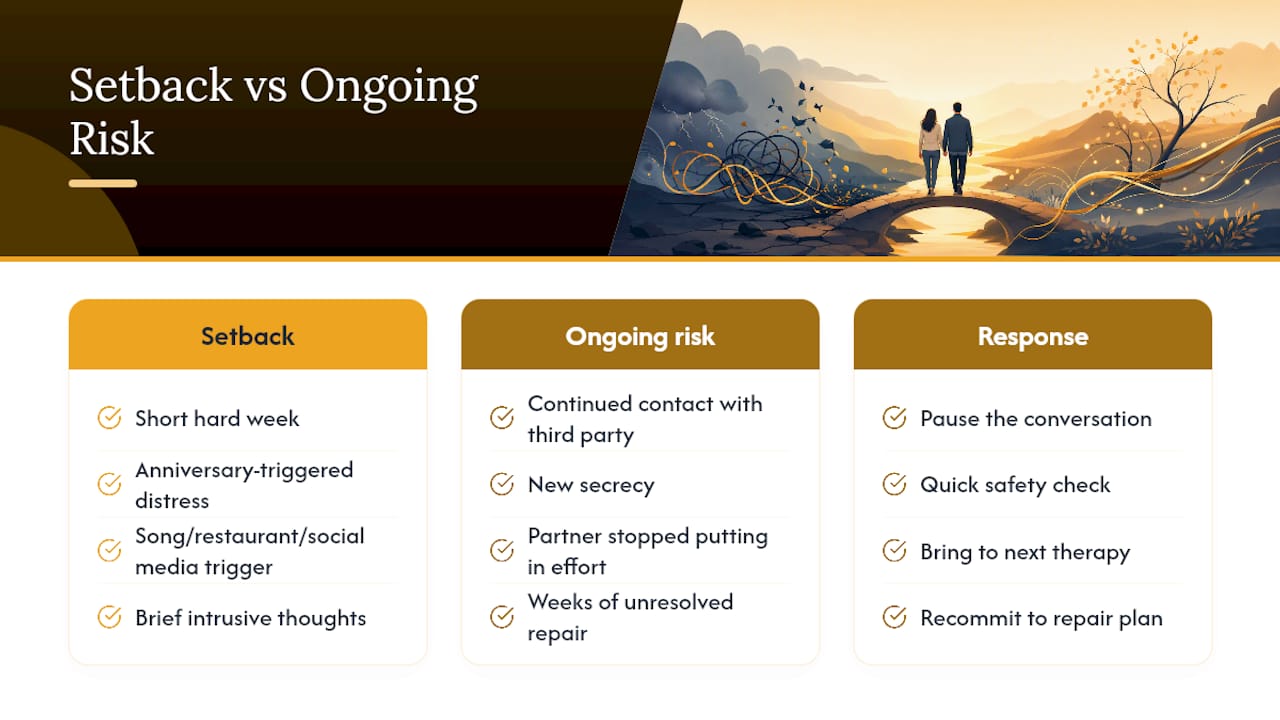
The real skill isn’t avoiding triggers. It’s telling the difference between a normal setback and a genuine warning sign. A setback looks like a hard week, a wave of old anger, a night of bad sleep after an anniversary date. Ongoing risk looks like continued contact with the third party, new secrecy, or a betraying partner who’s stopped putting in effort weeks into what should be active repair. Those aren’t the same problem, and they don’t call for the same response.
When a setback does hit, a simple sequence helps: pause the conversation before it spirals, run a quick safety check (“are we actually okay, or does this need a real conversation”), bring it to the next therapy session if one’s coming up soon, and recommit out loud to the plan you’ve already built together. This isn’t starting over. It’s course correction within a process that was always going to have rough patches.
Clinically, “better” doesn’t mean the affair is forgotten. It means the intrusive thoughts have space between them, the checking behaviors have eased, and the couple has more good days than hard ones. That’s a realistic marker of progress, not a finish line.
How Does the F.I.G.H.T. Plan® Apply to Affair Recovery?
Carlos Todd, co-founder of Couples Fight School® alongside licensed mental health professional Natasha Pemberton-Todd, built the F.I.G.H.T. Plan® around one core idea: couples don’t need more motivation to fix their relationship. They need a repeatable structure for the hard conversations they keep avoiding or mishandling.
That structure maps cleanly onto affair recovery. The plan’s early steps, focused on emotional regulation and slowing down reactive conflict, apply directly to crisis stabilization. The middle steps, built around understanding underlying needs and communication patterns, mirror the accountability and formulation work of phase two. The later steps, centered on consistency and repair rituals, are functionally identical to the trust rebuilding work of phase three.
Trust doesn’t return through one honest conversation. It returns through hundreds of small, boring, consistent choices that finally convince a wounded nervous system it’s safe to stop scanning for danger.
What Couples Fight School® actually provides is structure: practice scripts for the conversations couples keep botching, guided reflection exercises for identifying what led to the affair, and coaching for couples who want a professional walking alongside them rather than figuring it out alone. None of it replaces trauma-informed therapy when that’s clinically needed. It’s a practical skill-building layer on top of the clinical work, not a substitute for it.
A Clinician’s Honest Note on What This Work Actually Takes
If you’re the betrayed partner reading this at 2 a.m. because you can’t stop checking a phone, that reaction makes complete sense. Your nervous system got blindsided once and it’s not going to trust easily again just because someone said sorry. Give yourself permission to not be okay yet.
If you’re the partner who had the emotional affair, the work ahead isn’t glamorous. It’s not one big gesture that fixes everything. It’s showing up the same steady way on the boring Tuesday three months from now that you did in the dramatic first week, when everyone was watching. Patience and repetition do more here than any apology ever will.
One more thing worth saying plainly: if there’s ever violence, threats, or coercive control tangled up in this situation, that’s a different problem than infidelity, and it needs a domestic violence professional, not a recovery workbook. For everyone else doing this hard, ordinary work of rebuilding, professional support isn’t a sign you’ve failed. It’s usually the thing that makes the difference.
— Carlos
Ready to Work Through Recovery With Structured Support?
Reading about recovery phases is useful. Actually practicing the conversations, under guidance, tends to move couples through them faster and with fewer painful missteps along the way. Couples Fight School® built its RESTORE® infidelity recovery program specifically for couples navigating this exact situation, whether the breach was emotional, physical, or both.

A typical commitment looks like structured sessions covering disclosure conversations, boundary-setting language, and the trust-rebuilding behaviors covered above, paired with a couples therapy workbook for practice between sessions. Some couples working through blended families, faith-based marriages, or high-conflict dynamics tend to benefit from having scripts ready before the hard conversation starts, rather than improvising while emotions run high. For couples who suspect the betrayal extended into physical infidelity and want additional clarity, some choose to pair recovery work with independent verification options, though that’s a personal decision separate from the relational repair work itself.
If in-person sessions don’t fit your schedule, online coaching for couples offers the same structured approach with more flexibility. Start with a consultation to talk through where you are in the process and which format fits your situation.
Where This Guidance Comes From
The clinical claims here draw from published relationship science and infidelity recovery resources: the American Psychological Association’s relationship topics, Psychology Today’s reporting on restoring intimacy after infidelity, and therapist-authored guides on rebuilding trust after an emotional affair.
Sources
- Restoring intimacy after infidelity | Psychology Today
- Rebuild trust after an emotional affair | Dr. Prerna Kohli
- Sexual intimacy after betrayal: healing through safety | Resilient Mind Counseling
- Marriage and relationships | American Psychological Association
Recommended
- Benefits of Couples Therapy After Betrayal: What to Expect
- How to Deal With Issues in a Relationship Right Now
- RESTORE® Infidelity Recovery Counseling
- How to Break the Emotional Withdrawal Cycle in Couples