
6 Research Backed Conflict De-escalation Techniques with Ready Scripts

The fastest way to stop a fight from spiraling is to slow your tone and pace, listen and validate before you defend, name the emotion in the room, and offer a structured pause with a clear time to come back. Add a firm, calm boundary when needed. These moves are backed by conflict research and practiced daily inside structured frameworks designed for relationship communication and conflict resolution.
TL;DR:
- Slowing speech, lowering tone, and validating feelings can interrupt the physiological stress response before logic is available.
- Recognizing early physical cues like clenched fists or rapid speech helps de-escalate conflicts before they intensify.
- Practicing de-escalation scripts and techniques when calm builds muscle memory, making them more effective under real stress.
- Setting clear boundaries and scheduling follow-up conversations help prevent recurring disagreements and reinforce resolution.
- Tailoring approaches to personality, cultural background, and context ensures de-escalation methods land effectively and respect personal differences.
Table of Contents
- Why Conflicts Escalate in the First Place
- Techniques That Actually Slow a Fight Down
- Scripts to Use When Things Get Heated
- Setting Boundaries Without Shutting Down the Conversation
- How to Practice Until It Becomes Automatic
- Your Before, During, and After Checklist
- What Escalation Looks Like Before Words Even Change
- Staying Steady When Everything in You Wants to React
- Applying These Techniques Beyond the Living Room
- Reading the Room: Personality and Cultural Differences
- What Your Body Says Before You Do
- Why the Conversation Isn’t Over When the Yelling Stops
- What I’ve Learned From Watching This Play Out
- Guided Practice for Couples Ready to Go Deeper
- Sources
Why Conflicts Escalate in the First Place
Escalation isn’t a character flaw. It’s biology working exactly as designed, just at the wrong moment. When someone feels attacked, the amygdala triggers a stress response before the thinking brain gets a vote. Heart rate spikes, the body prepares to fight or flee, and the capacity for nuanced reasoning drops fast. That’s why a calm, logical argument almost never works on someone mid-escalation. You’re talking to a nervous system, not a debate partner.
Three cognitive patterns make this worse:
- Egocentrism: each person assumes their perspective is the obvious, reasonable one, so the other person’s pushback feels irrational rather than just different.
- Escalation of commitment: once someone has taken a position, backing down feels like losing, so they dig in even when the original point stops mattering.
- Overconfidence: people consistently overestimate how clearly they’ve communicated, which fuels frustration when the other person “still doesn’t get it.”
Here’s the piece most people miss: the instinct to correct the other person’s thinking is usually what drives the fight higher, not what resolves it. Research from the Program on Negotiation at Harvard points out that effective resolution starts with acknowledging the other person’s internal logic, not immediately correcting their facts. That single shift, acknowledging logic before correcting content, is the psychological hinge behind almost every technique in the next section.
Techniques That Actually Slow a Fight Down
Not every de-escalation tactic carries equal weight. Some interrupt the physiological spiral immediately. Others matter more once the initial heat has dropped. Here’s the order that tends to work, based on how the nervous system responds under stress.
- Lower your tone and slow your pace. A softer, slower voice signals safety to the other person’s nervous system before you’ve said a single reassuring word. Crisis Prevention Institute’s guidance on de-escalation lists tone and pacing among the top immediate actions in any high-stress interaction, precisely because it works faster than logic does.
- Listen first, validate second, defend last. Validation isn’t agreement. It’s telling the other person, “I see why you’d feel that way,” which lowers their defensiveness enough that problem-solving becomes possible again.
- Name the emotion, not just the facts. Saying “You sound really hurt right now” does more to de-escalate than restating what actually happened. Facts invite debate. Emotions invite connection.
- Call a structured pause, with a return time attached. “I need fifteen minutes, then let’s come back to this,” works because it removes the fear of being abandoned mid-conflict, which is what makes most pauses fail.
- Set a boundary or yield strategically. Some conflicts need a firm line. Others need someone to let go of a minor point to protect the relationship. Knowing which is which is its own skill.
- Solve the problem together instead of trying to win. Shift the frame from “who’s right” to “what do we do now.” That reframe alone diffuses more fights than any clever rebuttal ever will.
Standard conflict management strategies from dispute resolution literature back this same hierarchy: collaborative problem solving, negotiation, and strategic yielding consistently outperform combative approaches, whether the conflict is in a boardroom or a bedroom.
Pro Tip: Pick one technique to master this month instead of trying all six at once. Muscle memory for de-escalation builds the same way any other skill does: through repetition under low stakes, not through willpower during a crisis.
Couples working through recurring arguments often find the fastest gains from a short, structured resource rather than trial and error. Couples Fight School’s guide on therapist-designed de-escalation tools breaks these six moves into specific phrasing for romantic conflict.
Scripts to Use When Things Get Heated
Memorized phrases work better than improvised ones during conflict because your working memory is already taxed. Have two or three ready before you need them.
- “Help me understand what this feels like from your side.” This invites explanation instead of triggering defense, which is exactly what psychologists recommend when someone is yelling: asking open questions and offering to listen, rather than demanding they settle down.
- “That makes sense given what you’re feeling.” A validation line that doesn’t concede the actual argument.
- “I want to keep talking, but I need ten minutes first.” A pause request with a built-in return commitment.
- “I hear you. I need this specific thing to change.” A boundary phrase, direct and non-accusatory.
Avoid saying “calm down,” “you’re overreacting,” or “you always do this.” Each one tells the other person their emotional response is invalid, which almost guarantees the opposite effect. Two memorable de-escalation phrases worth keeping on your phone can turn a spiraling exchange around in under a minute, according to Couples Fight School’s short-script guide.
Setting Boundaries Without Shutting Down the Conversation
De-escalation cools a conflict down. Disengagement ends it. Confusing the two is how people end up either staying in unsafe conversations too long or walking away from ones that just needed a breather. A useful framework for stopping a fight draws this line clearly: de-escalation restores the conditions for talking, disengagement ends an interaction that has become unsafe or unproductive.
- State the boundary plainly. “I won’t continue this conversation if you raise your voice.” No lecture attached.
- Follow through immediately if it’s crossed. A boundary without follow-through is just a suggestion, and repeated violations call for actual disengagement, not another warning.
- Reopen later with a specific script. “I’m ready to talk about this now, if you are.” Keep it short and free of blame.
Strategic yielding fits here too: letting go of a minor point isn’t losing, it’s one of the accepted conflict management strategies precisely because not every hill needs defending.
How to Practice Until It Becomes Automatic
Nobody de-escalates well on the first try under real stress. The skill has to be rehearsed before it’s needed, the same way pilots train for emergencies they hope never to face.
- Practice slow breathing for sixty seconds, twice a day, so it’s accessible when your heart rate actually spikes.
- Rehearse one pause phrase, one validation phrase, and one repair phrase out loud, with a timer running, so the words come out fast under pressure. This micro-practice method trains the response the same way you’d drill a fire escape route.
- Run short role-plays with a partner or friend, swapping who plays the escalated person.
Training that includes role-play and rehearsal measurably improves real-time performance and speeds recovery after conflict, according to research on de-escalation training in high-stakes clinical settings. Couples who want structured repetition rather than guesswork often move to guided drills, like the ones in Couples Fight School’s practice exercises, which turn these micro-practices into a repeatable weekly habit.
Pro Tip: Practice when you’re calm, never during an actual argument. Trying to “learn” a new script mid-fight almost always backfires because the nervous system isn’t in a learning state.
Your Before, During, and After Checklist
- Before: Set an intention for the conversation, take three slow breaths, and pick one phrase you’ll lead with.
- During: Slow your pace, validate before defending, name the emotion out loud, and offer a pause if things climb.
- After: Use a short repair script (“I’m glad we worked through that”) and schedule a calmer follow-up conversation within a day or two.
Keep this sequence somewhere accessible. The value isn’t in memorizing it perfectly. It’s in having something to reach for when your own thinking brain temporarily goes offline.
What Escalation Looks Like Before Words Even Change
Most fights show their hand before anyone raises their voice. A clenched jaw, crossed arms, a sudden step backward, or a voice that gets faster and higher are all physiological tells that the stress response has already kicked in. Catching these cues early is often the difference between a five-minute disagreement and a two-hour blowup.
Watch for a shift from full sentences to short, clipped responses. That’s usually a sign the thinking brain is losing ground to the stress response. Reddening skin, a tightening throat, or restless hands and feet often show up before someone even registers they’re upset.
The same cues apply to your own body. If you notice your chest tightening or your hands curling into fists, that’s your cue to slow down before you speak, not after. Catching your own escalation early gives you the chance to use a technique instead of needing one after the damage is done.
Staying Steady When Everything in You Wants to React
Your own regulation has to come first. You cannot de-escalate someone else while your own nervous system is in overdrive, no matter how good your script is. Slow, deliberate breathing (in for four counts, hold for four, out for six) tells your body it’s safe faster than any pep talk you could give yourself.
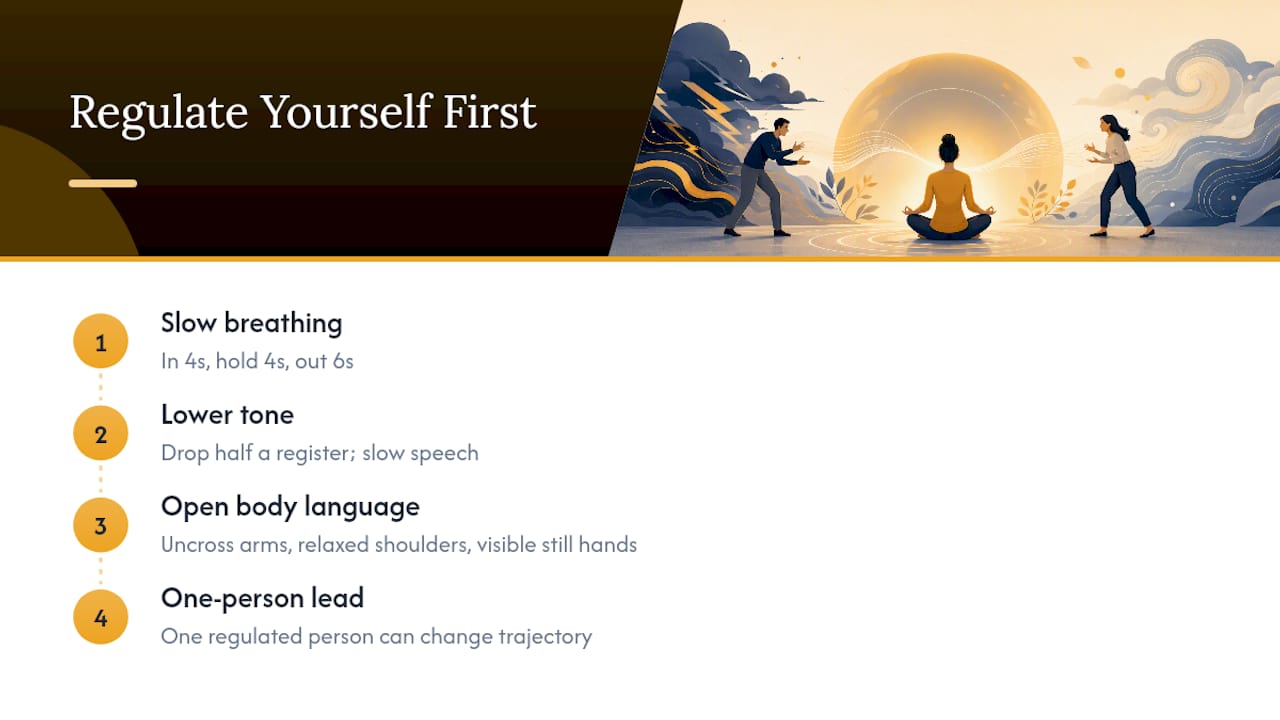
Tone does double duty here. Dropping your voice half a register and slowing your speech doesn’t just calm the other person. It gives your own body a physical cue to match. Open body language matters just as much as what comes out of your mouth: uncrossed arms, relaxed shoulders, hands visible and still.
Interestingly, one person’s shift in tone and pacing can sometimes de-escalate a conflict even when the other person hasn’t calmed down yet. You don’t need both people regulated to change the trajectory of the conversation. You just need one person to go first.
Applying These Techniques Beyond the Living Room
The same core moves work in a conference room, a customer service line, or a grocery store parking lot, but the specifics shift depending on the setting.
In the workplace, tone matters as much as content, and personal space becomes a bigger factor since coworkers rarely have the built-in physical closeness that couples do. A raised voice from a manager reads differently than one from a peer, so hierarchy shapes how validation lands.
In domestic settings, safety comes first. If a disagreement carries any physical risk, disengagement takes priority over any de-escalation script, no exceptions.
In public settings, like a heated exchange with a stranger, brevity wins. You have less relational trust to draw on, so short, respectful phrases (“I hear you, let’s figure this out”) do more work than a long explanation ever could.
Reading the Room: Personality and Cultural Differences
De-escalation isn’t one-size-fits-all. Someone who processes emotion out loud will experience silence as stonewalling, while someone who needs quiet to think will experience rapid-fire questions as pressure. Matching your pace to the other person’s processing style often matters more than the specific words you choose.
Cultural background shapes this too. Direct eye contact reads as respectful and engaged in many Western contexts, but can feel confrontational in others. Volume and directness that seem normal in one household or region can seem alarming in another. The safest approach is to treat your usual instincts as a starting hypothesis, not a rule, and adjust based on how the other person is actually responding, not how you’d expect them to.
What Your Body Says Before You Do
Eye contact and physical space do heavy lifting that most people underestimate. Sustained, unblinking eye contact can feel like a challenge in a tense moment, while looking away entirely can read as dismissal. Soft, intermittent eye contact tends to land as attentive without feeling confrontational.
Distance matters just as much. Stepping half a step back during a heated exchange signals you’re not a threat and gives the other person’s stress response room to settle. Squaring up directly, even without meaning to intimidate, often reads as confrontational simply because of how much space it removes.

Small physical cues, a nod, an open palm, a slight tilt of the head, all signal “I’m listening” without a single word.
Why the Conversation Isn’t Over When the Yelling Stops
Ending a fight and repairing the relationship are two different jobs, and skipping the second one is how the same argument comes back a week later wearing a different outfit. A short check-in within a day or two, even just five minutes, tends to prevent recurrence far more effectively than assuming the issue resolved itself because the volume went down.
A simple repair script works here: “I want to revisit what happened, not to relitigate it, but to understand it better.” This isn’t about assigning blame after the fact. It’s about closing the loop before the unresolved feeling calcifies into resentment. Couples who build this follow-up habit tend to report fewer repeat arguments over the same issue, because the underlying need actually gets addressed instead of just going quiet.
What I’ve Learned From Watching This Play Out
Most people treat de-escalation as damage control, something you do after a fight has already gone sideways. The couples who actually change their patterns treat it as a rehearsed skill, practiced when calm, not invented in the heat of the moment. Structured rehearsal doesn’t just work faster. It causes less collateral damage, because the first instinct under stress is no longer to defend, it’s to reach for the phrase you already practiced.
— Carlos
Guided Practice for Couples Ready to Go Deeper
Reading about de-escalation and actually doing it under pressure are two different skills, and most couples hit a ceiling trying to self-teach through trial and error alone. If you’ve tried the scripts and pauses on your own and still find the same argument resurfacing, structured coaching closes that gap faster than repeated attempts to wing it.

Couples Fight School’s online coaching for couples pairs you directly with guidance built around the F.I.G.H.T. Plan®, the same framework referenced throughout this article, for couples who want real-time feedback instead of another book on the shelf. For those who prefer working at their own pace first, the conflict resolution practice course walks through the exact drills and role-plays described above, with exercises designed for two people to work through together. If you’re not sure which fits, start with a look at relationship counseling options to see what level of support matches where you are right now.
Sources
- Conflict resolution strategies — Program on Negotiation (PON)
- Promoting Workplace Safety: Teaching Conflict Management and De-Escalation Skills in Graduate Medical Education — PMC
- What to do when someone yells at you, according to psychologists — Time
- Conflict management strategies — Syracuse iSchool
Recommended
- 9 Step Partner Anger Debrief: Ready Scripts and F.I.G.H.T. Plan®
- Conflict Escalation Patterns Couples Repeat: 8 Cycles