
How to Express Your Needs in Marriage Without a Fight

To express your needs in marriage, work out what you actually need first. Then make one specific request at a time, at a calm moment, starting with your own feelings rather than your spouse’s faults. Then listen to the answer and agree on something you can both live with. That sequence is learnable, and most couples who struggle with it were never taught it.
This guide walks through each step with wording you can use tonight. If you want a structured path, the F.I.G.H.T. Plan toolkit at Couples Fight School is a therapist-created set of communication and conflict tools priced at $27.
TL;DR
- Name the need before you raise it. “I need more attention” is vague. “I need twenty minutes of phone-free time with you after dinner” is something a spouse can do.
- Pick a calm, unhurried moment, and bring one request at a time.
- Open with your own feeling and the positive thing you want, not with your spouse’s character.
- Listen to the reply, check that you understood each other, and aim for a decision both of you can accept.
- If the talk heats up, pause by agreement and come back to it. Pausing is not the same as shutting down.
Table of Contents
- What it means to express a need in marriage
- Step 1: Work out what you need before you talk
- Step 2: Choose the moment
- Step 3: Start soft
- Step 4: Be specific and explain why it matters
- Step 5: Listen when it is your spouse’s turn
- Step 6: Land on something you can both live with
- When your spouse does not understand or follow through
- A worked example
- Where our approach fits
- Tools to practice with
- FAQ
- Sources
What it means to express a need in marriage
Expressing a need means telling your spouse, plainly and kindly, what you require in order to feel connected, respected and safe in the marriage, and asking for their help with it. It is different from complaining, hinting, testing or waiting to see whether they notice.
Most needs fall into a few familiar groups:
- Emotional: to feel like a priority, to be listened to, to hear appreciation, to feel safe being honest.
- Practical: a fair share of the household work, follow-through on what was promised, shared decisions about money.
- Physical: affection, touch, a satisfying sex life.
- Time and companionship: regular time together, shared fun, conversation that goes beyond logistics.
- Personal: time alone, room for friends, faith or hobbies.
Needs also change. A new baby, a job loss, a move or a loss in the family can all shift what each of you needs, so the conversation is not a one-time event. It works better as a regular check-in than as a confrontation after months of silence.
Step 1: Work out what you need before you talk
Most arguments about needs start with a feeling that has not been translated into a request. You feel lonely, so you snap about the dishes. You feel unappreciated, so you go quiet and wait.
Before you raise anything, spend ten minutes with a notebook and answer three questions:
- What am I feeling? Use a feeling word: lonely, overlooked, anxious, tired, disconnected.
- What is underneath it? Connection, respect, rest, reassurance, help?
- What would one small, visible change look like? Be concrete enough that a video camera could record it.
This is also the point to look at your expectations. A marriage and family therapist in a Utah State University Extension marriage webinar discusses how to examine your expectations and why unmet ones strain a relationship. Her advice is to understand yourself and your relationship and to build shared expectations rather than assume good intentions mean you both see things the same way.
If you find it hard to tell what you expect from your marriage, writing intentions down can help. A guide on relationship intention setting shows one way to examine expectations together instead of assuming your spouse reads your intentions the way you do.
Turn a complaint into a need
| The complaint | The feeling | The need | A request your spouse can act on |
|---|---|---|---|
| “You never help around here.” | Overwhelmed | Shared load | “Can you take over bath time and bedtime on Tuesdays and Thursdays?” |
| “You’re always on your phone.” | Lonely | Attention | “Can we put phones in the drawer from 8 to 8:30 and talk?” |
| “You don’t care what I think.” | Dismissed | Respect in decisions | “Before we commit to big purchases, can we sit down and decide together?” |
| “We never do anything fun.” | Disconnected | Shared enjoyment | “Can we pick one date night a month and put it on the calendar?” |
The right-hand column is the goal. A request names an action, a time and a size. A complaint names a failure.
Step 2: Choose the moment
Timing decides a lot. Guidance from the Healthy Relationships Initiative’s couples toolkit is to make one clear, specific request at a time, when distractions are minimal and there is plenty of time to talk without feeling rushed.
In practice that rules out:
- The minute your spouse walks in the door from work.
- Bedtime, when both of you are depleted.
- The middle of an argument about something else.
- Public settings and in front of the children.
A simple opener works: “There’s something I’d like to talk about that matters to me. Is now a good time, or would after dinner be better?” Offering a choice shows respect and makes it harder for your spouse to feel ambushed.
Step 3: Start soft
How you open the conversation tends to set how it ends. The University of Georgia’s ELEVATE couples material describes a softened start-up as raising an issue without criticism, blame or contempt. Its example is “I am lonely when we don’t make time to do things together,” which describes a feeling instead of attacking a person.
A UC Berkeley Greater Good interview with a leading marriage researcher makes the same point: begin by describing your own feelings and the positive thing you need, rather than blaming your partner’s character. A gentler opening centered on your own experience helps reduce defensiveness.
A useful pattern has four parts:
- Appreciation: “I know you’ve been working hard, and I appreciate how much you do for us.”
- Feeling: “Lately I’ve been feeling disconnected.”
- Why it matters: “Feeling close to you is what makes the rest of the week easier for me.”
- Request: “Could we have twenty minutes together after the kids are in bed, most nights this week?”
Compare that with “You never talk to me anymore.” The first version gives your spouse something to say yes to. The second gives them something to defend against.
Words that help, words that hurt
| Instead of | Try |
|---|---|
| “You always…” / “You never…” | “This week I noticed…” |
| “Why can’t you just…” | “Would you be willing to…” |
| “You don’t care.” | “It matters a lot to me that…” |
| “Fine. Forget it.” | “I need a few minutes. Can we come back to this at 7?” |
Step 4: Be specific and explain why it matters
The most common reason a request fails is that it is too vague to act on. “Be more romantic” could mean flowers, a text at noon or a weekend away. Your spouse may try, guess wrong, and feel like a failure.
To sharpen a request, check it against these four points:
- One thing. Do not bundle three needs into one speech.
- Observable. Someone could tell whether it happened.
- Time-bound. “This week” or “on weekday evenings” beats “more often.”
- Reasoned. One sentence on why it matters to you turns a demand into an invitation.
The Healthy Relationships Initiative toolkit also suggests asking whether your partner understands the request. You can do this naturally: “Does that make sense? Tell me how it sounds to you.” Many couples find they thought they were saying one thing and their spouse heard another.
Also avoid expecting too many major changes at once. If you have several needs, rank them and start with the one that matters most this month. Success on one request builds trust for the next.
Step 5: Listen when it is your spouse’s turn
Expressing needs works in both directions. Your spouse has their own, and the way you receive their request shapes whether they keep making them.
The Berkeley interview describes small listening habits that help partners understand one another and work together: nodding, brief acknowledgments, curiosity, summarizing and validating. The University of Georgia material adds listening to the emotions and needs being expressed, giving full attention, and trying to see the partner’s point of view.
A short script for the listener:
- “What I’m hearing is that you feel alone in the evenings and you’d like us to spend time together. Did I get that right?”
- “That makes sense. I can see why that would be hard.”
- “Tell me more about what that would look like for you.”
Then answer honestly. The Healthy Relationships Initiative advises the person receiving a request to listen carefully, consider it, and be honest about what they will or will not do. An honest “I can do three evenings, not five” is far better than a quick yes that quietly turns into resentment.
Step 6: Land on something you can both live with
A request is not an order. The goal is a decision that works for both of you. The toolkit calls for a mutually agreeable, win-win outcome, and that often means a partial yes or a trial period.
Try this:
- Restate the need in one sentence so you both agree on what you are solving.
- Each offer one thing you can do.
- Agree on a trial: “Let’s try it for two weeks and see how it feels.”
- Set a time to check in, such as Sunday evening.
Write the agreement down if it helps. A note on the fridge is not romantic, but it settles “I thought we said…” arguments before they start.
When your spouse does not understand or follow through
Sometimes the request lands badly, or it is agreed to and then forgotten. Here is what to do.
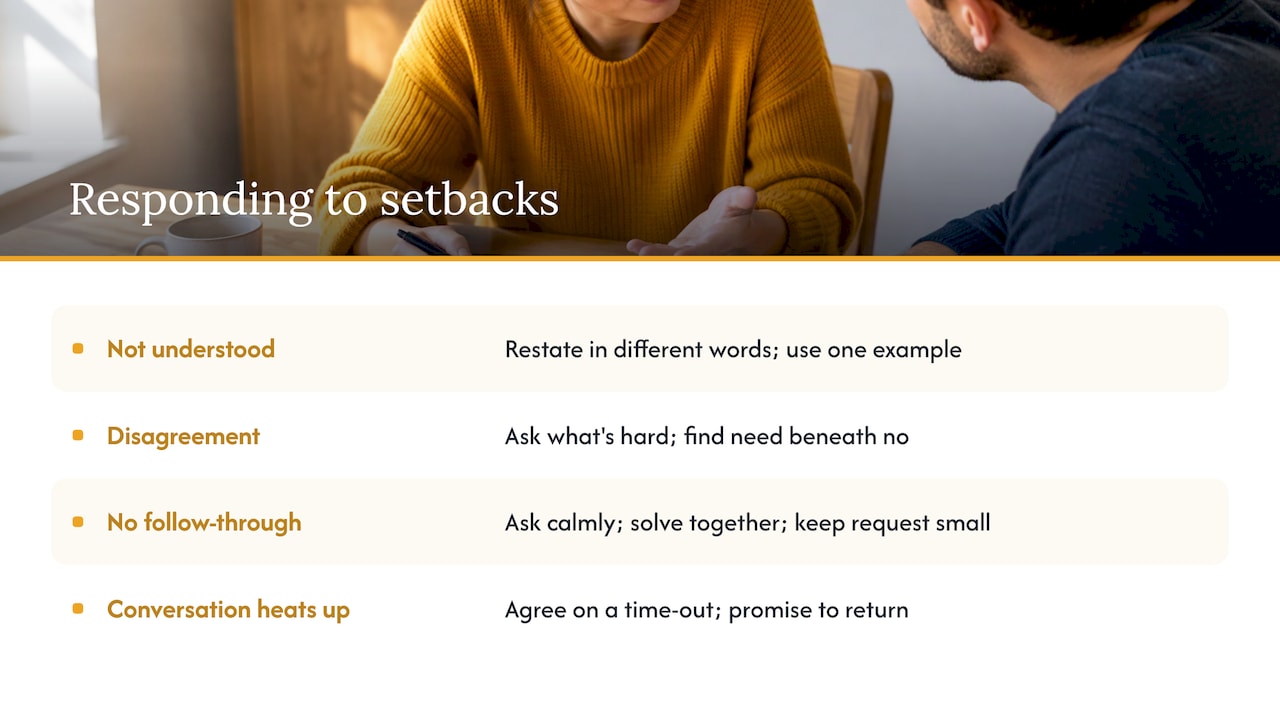
If they did not understand: Check what they heard and restate it in different words. Tie it to a single example instead of a pattern.
If they disagree: Ask what part is hard for them. Look for the need underneath their no. Often both of you want the same thing, such as feeling valued, and are asking for it in different ways.
If they agree and do not follow through: Wait for a calm moment and ask without accusing: “We agreed on Thursday bath time. What got in the way?” Treat it as a problem to solve together, and keep the request small enough to be achievable.
If the conversation heats up: The ELEVATE material says a mutually agreed time-out can help partners calm down before re-engaging, and it distinguishes this from stonewalling or emotional disengagement. The difference is the promise to return. Say: “I want to get this right and I’m too worked up. Can we take twenty minutes and come back?” Then actually come back. We cover this in more detail in our guides on time-outs for couples and taking space after an argument.
If you keep reaching the same impasse, it may help to learn how to agree to disagree respectfully on the things that will not change.
A worked example
Maya feels like she handles everything at home. For weeks she has been sighing, clearing plates loudly and saying “I guess I’ll do it.” Her husband, Daniel, has noticed tension but has no idea what it is about.
Maya takes ten minutes to think. The feeling is overwhelmed and unappreciated. The need is shared load and acknowledgment. The request is that Daniel handle dinner cleanup on weeknights.
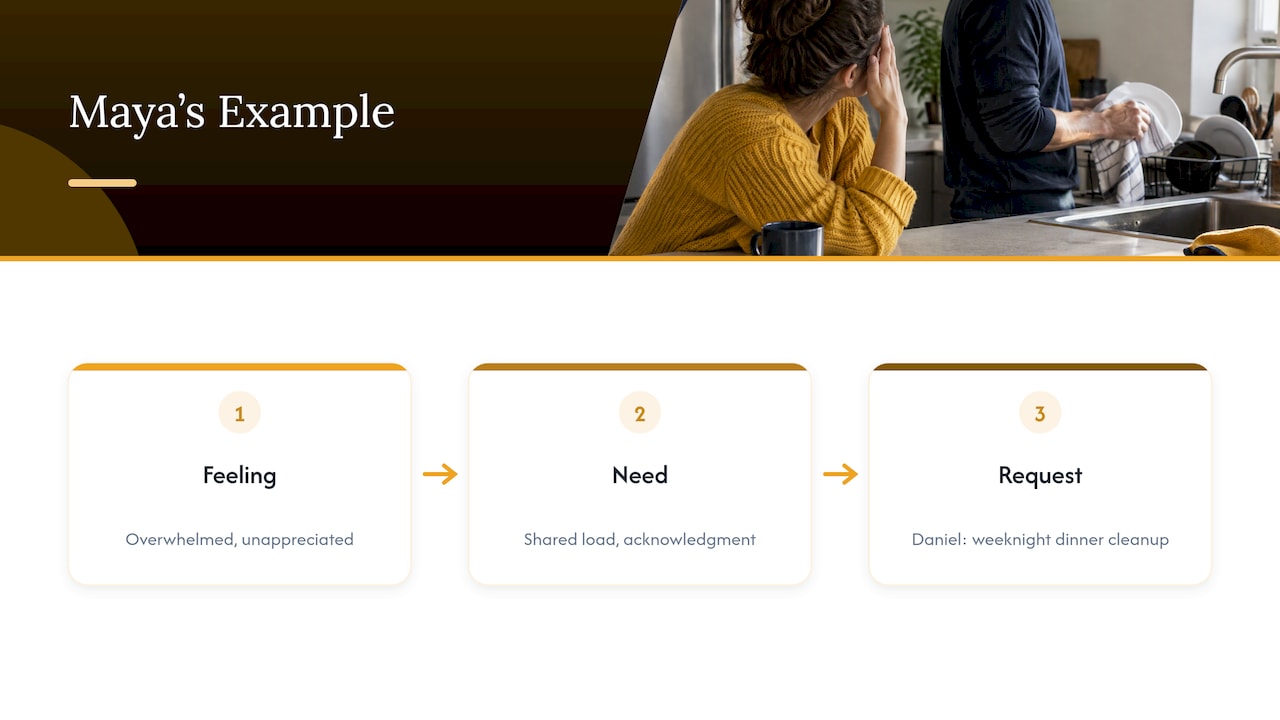
On Saturday morning she says: “Daniel, I’d like to talk about something that matters to me. Do you have twenty minutes?” Then: “I appreciate how hard you work. Lately I’ve been feeling overwhelmed with the house, and it’s wearing on me. Would you be willing to take dinner cleanup on weeknights? It would give me an hour back, and I think I’d feel closer to you.”
Daniel is surprised. “I thought you liked doing it your way.” Maya does not escalate: “I can see why it looked that way. Honestly I just never said anything.” They settle on Monday through Thursday, for two weeks, and a check-in the following Sunday.
Nothing dramatic happened. A hint became a request, and a request became an agreement.
Where our approach fits
How we see it
Couples rarely fight because they want to hurt each other. They fight because a need went unspoken, got translated into a criticism, and came out as an attack. Then both of them defend instead of listening.
We built the F.I.G.H.T. Plan® as a structured, step-by-step system because we believe couples need more than good intentions. They need a sequence they can follow when emotions run high: how to regulate yourself, how to say what you feel, how to hear your spouse, and how to repair when it goes wrong. That is why our materials are created by licensed mental health professionals and include conversation scripts and guided reflection exercises you can use in real conversations.
Expressing a need is a skill, not a personality trait. If you were taught to keep quiet, or if your spouse learned to hear every request as a complaint, you can learn another way. Start small, practice often, and give each other credit for trying.
Carlos
Tools to practice with
Reading about this is the easy part. Doing it on a tired Tuesday is harder, and that is where structure helps. Our offers are priced as published on our shop page:
- The F.I.G.H.T. Plan Couples Conflict Toolkit ($27): a practical set of conflict tools to start with.
- The F.I.G.H.T. Plan workbook ($14.99 to $25.00): a communication and conflict resolution workbook for couples to work through together.
- Stop the Fighting course ($149): our full communication and conflict resolution course.
- The Christian F.I.G.H.T. Plan Workbook ($9.99 to $20.00): a faith-centered guide to conflict resolution for couples.
If you would like a therapist alongside you, online couples coaching is available, with a four-session VIP private coaching package at $997.

You do not have to wait until things feel desperate. Engaged couples can build these habits early too, as we explain in why engaged couples need conflict skills before marriage.
FAQ
What are the basic needs in a marriage?
Most spouses name some version of emotional connection, appreciation, physical affection, fair partnership in daily life, shared time and a sense of safety. The exact mix differs for each person and shifts over the years, which is why it helps to ask each other regularly instead of guessing.
How do I ask for what I need without nagging?
Make one specific request, at a calm time, and say why it matters to you. Then let it go for a while and check in at an agreed time instead of repeating it daily. Nagging usually grows from vague requests that never got a clear answer, so agree on what, when and how long.
How do I tell my husband he disappointed me?
Describe what happened and how it felt, without labeling him. For example: “When the plans changed without a call, I felt unimportant. Next time, could you text me?” Naming the behavior and the feeling, then asking for a specific change, gives him room to listen rather than defend.
What if my spouse says my needs are too much?
Slow down and narrow the request to one concrete item. Ask what feels heavy to them and look for a smaller version you can both manage. If every attempt ends in an argument, working through it with a structured program or a coach can give both of you a shared method.
Is it selfish to ask for what I need?
No. A marriage runs better when both spouses say what they need and hear each other’s needs too. Asking clearly gives your spouse a real chance to meet you, which hints and silence do not.
Sources
- Managing Expectations: How to Effectively Communicate in Marriage, Utah State University Extension
- HRI Toolkit for Couples, Healthy Relationships Initiative (2020)
- Manage, University of Georgia ELEVATE couples material (2013)
- How to Fight Without Hurting Your Relationship, UC Berkeley Greater Good (January 22, 2024)
- Relationship Intention Setting: A Practical Guide
Recommended
- 5–10 Minute Check Ins Therapists Use to Fix Unmet Needs in Marriage
- Argument Boundaries in Marriage: 6 Steps to Practice Before a Fight
- Stop Arguing With Your Husband in 10 Minutes Using Therapist Scripts
- Sexless Marriage Communication: Scripts to Use Tonight for Couples