
Forgiveness After Infidelity: A Practical Plan for Healing

Forgiveness after infidelity is possible, but it is conditional. Three things have to be present: genuine remorse from the person who cheated, a physically and emotionally safe environment, and enough time for the betrayed partner’s nervous system to stabilize. Without all three, what looks like forgiveness is usually suppression, and suppression breaks down. Psychology Today’s framing is useful here: forgiveness is an internal act of releasing the betrayal’s emotional hold on you. It is not a verdict on the relationship. You can forgive and still leave. You can stay and still need months before trust feels real again.
If you found out recently, here are some important steps to take soon after.
- Check your physical safety first. If there is any threat of emotional or physical harm, contact the National Domestic Violence Hotline (1-800-799-7233) before anything else.
- Regulate your nervous system. Sleep, eat something, and move your body, even briefly. Mayo Clinic guidance on infidelity recovery treats these as clinical necessities, not optional self-care.
- Set one boundary around information-gathering. Decide what you need to know right now and what can wait. Compulsive checking of phones, emails, and location data in the first 72 hours tends to deepen trauma rather than resolve it.
Key Takeaways
Forgiveness after infidelity is an internal act of releasing the betrayal’s emotional hold on you, and it is possible when genuine remorse, safety, and time are all present.
| Point | Details |
|---|---|
| Forgiveness vs. reconciliation | Forgiveness is personal and internal; reconciliation is relational and requires observable change from both partners. |
| Safety comes first | If abuse, ongoing deception, or coercion is present, prioritizing separation is the right move before any forgiveness work begins. |
| Nervous-system care is clinical | Sleep, nutrition, and movement are foundational to recovery, not optional, per Mayo Clinic guidance on infidelity healing. |
| Partner accountability is non-negotiable | Forgiveness gains traction only when paired with consistent, observable behavior change from the unfaithful partner. |
| Couplesfightschool’s RESTORE® program | A structured, clinician-led program built specifically for betrayal recovery, using the F.I.G.H.T. Plan® framework for communication repair and trust rebuilding. |
Table of Contents
- What does forgiveness actually mean after an affair?
- What makes forgiveness more or less likely in your situation?
- Practical steps for the betrayed partner: processing, boundaries, and daily recovery
- What the unfaithful partner must do to make forgiveness possible
- How to rebuild trust and create a “Relationship 2.0”
- Red flags: when forgiveness is not safe or realistic
- How to tell you’re genuinely healing
- Couples Fight School’s RESTORE® program and the F.I.G.H.T. Plan®
- What I’ve seen in this work, and what I want you to know
- Couplesfightschool’s RESTORE® program: what to do next
- Sources
What does forgiveness actually mean after an affair?
The most common mistake people make is treating forgiveness and reconciliation as the same decision. They are not. Forgiveness is internal and personal. Reconciliation is relational and optional. You can do one without the other.
Forgiveness is an internal decision to stop letting the betrayal run your emotional life. Psychologist Karina Schumann describes it as a moral process of letting go of negativity toward the person who hurt you, one that can restore inner peace without necessarily restoring the relationship. It is gradual, non-linear, and does not require forgetting what happened or excusing it. Reconciliation, by contrast, requires observable change from the partner who cheated, a rebuilt sense of safety, and a mutual decision to rebuild. One person can forgive. Two people have to reconcile.
| Dimension | Forgiveness | Reconciliation |
|---|---|---|
| Who it’s for | The betrayed partner, primarily | Both partners |
| What it requires | Internal processing, grief work, time | Safety, accountability, behavior change |
| Timeline | Months to years; non-linear | Typically longer; tied to observable trust |
| Can happen without the other? | Yes | No — reconciliation requires prior forgiveness |
| Outcome | Personal emotional freedom | Rebuilt relational bond |
Common myths, corrected:
- Forgiving means condoning the affair. No. Forgiveness is a statement about your own emotional freedom, not a verdict on what happened.
- If I forgive, I have to trust again immediately. Trust and forgiveness follow completely different timelines and workstreams. Forgiveness can happen while trust is still at zero.
- Forgiveness means forgetting. Forgetting is not a realistic or healthy goal. What changes is the emotional charge attached to the memory.
- I have to forgive to heal. Forgiveness tends to support healing, but forced forgiveness, pushed by family, faith communities, or a partner who wants to move on fast, typically produces brittle results that collapse under trigger stress.
What makes forgiveness more or less likely in your situation?
Not every situation has the same odds, and being honest about that early saves a lot of pain.
Factors that make forgiveness more likely:
- The unfaithful partner shows sustained, consistent remorse, not just immediate regret when caught.
- Full transparency is offered without being demanded piece by piece.
- There is no ongoing deception. The affair has genuinely ended.
- The unfaithful partner is actively working on the underlying issue, whether that is emotional avoidance, addiction, or unmet needs, through therapy or structured support.
- The betrayed partner feels physically and emotionally safe in the home.
- Both partners are willing to engage with professional support.
Factors that make forgiveness significantly harder:
- Active addiction that is untreated. Addiction and secrecy reinforce each other, and without treatment, the pattern tends to repeat.
- Repeated affairs or a pattern of deception over years.
- The unfaithful partner minimizes, deflects, or blames the betrayed partner for the affair.
- The betrayed partner is being pressured to forgive quickly, by the partner, family, or a faith community.
- Emotional or physical abuse is present in the relationship.
- The affair is ongoing or the unfaithful partner refuses to end contact.
On timeline: Recovery from infidelity is not linear. Triggers can produce strong emotional returns months or even years after the initial discovery. A rough working frame: the first three to six months are typically the most acute, characterized by shock, grief, and physiological dysregulation. Months six through eighteen often involve the harder cognitive work of deciding what the relationship is and what you want from it. Subsequently, for couples who stay together, trust may gradually either solidify or reveal its remaining gaps. None of these phases arrive on schedule.
Practical steps for the betrayed partner: processing, boundaries, and daily recovery
This section is for you, the person who was cheated on. The steps below are not a prescription. They are a framework you can adapt to your own pace.
Start with your nervous system, not the conversation
Before any productive conversation about the affair can happen, your body needs to be out of crisis mode. Mayo Clinic’s guidance is direct: consistent sleep, adequate nutrition, and regular movement are not optional extras during infidelity recovery. They are the biological foundation that makes emotional processing possible. Without them, every conversation becomes a fight, and every trigger feels unsurvivable.

Grounding practices, such as the 5-4-3-2-1 sensory technique, box breathing, or a short daily walk, can interrupt the body’s threat response long enough for you to think clearly. These are not about feeling better immediately. They are about staying regulated enough to make decisions you will not regret.
Grief before decisions
The affair represents a loss, sometimes multiple losses at once: the relationship you thought you had, the future you planned, your sense of safety, and your self-image. Grief is the appropriate response. Skipping it in favor of immediate problem-solving tends to delay healing rather than accelerate it.
Journaling can help. Try prompts like: What did I lose that I haven’t named yet? What do I need from my partner right now that I haven’t asked for? What am I most afraid of? A structured couples therapy workbook can provide guided prompts if open-ended journaling feels too unstructured.
Boundaries and information
Decide early what information you need to process the betrayal and what information will only deepen the wound without helping you heal. Some people need a full account of what happened. Others find that graphic details become intrusive thoughts that are hard to dislodge. There is no universally right answer.
Sample boundary script: “I need you to answer my questions honestly when I ask them. I also need you to stop volunteering details I haven’t asked for. If I ask something and you don’t know the answer, say that rather than guessing.”
Pro Tip: Avoid compulsive checking of your partner’s phone, location, or email in the early weeks. It rarely provides the reassurance you’re looking for and tends to keep your nervous system in a state of chronic alert. If transparency is needed, agree on a structured check-in instead.
Build your support network deliberately
A therapist who specializes in betrayal trauma is the single most useful resource you can access. What to ask of a therapist: help processing grief and anger, nervous-system regulation tools, and support in clarifying what you want from the relationship. What to ask of your partner: honesty, patience, and behavioral consistency. These are different roles. Mixing them, expecting your partner to also be your primary emotional support right now, usually creates more conflict.
Daily and weekly practices:
- Morning: one grounding exercise before checking your phone.
- Daily: one physical activity, even a ten-minute walk.
- Weekly: one session with a therapist or support group.
- Weekly: one structured check-in with your partner (not an open-ended argument, a scheduled conversation with a start and end time).
- As needed: call one trusted friend who is not going to tell you what to do.
Track your emotional state in a simple journal: rate your distress from 1–10 each morning. Over weeks, the pattern tells you more than any single day does. You can also explore emotional triggers in relationships to better understand what’s driving your reactions and how to manage them.
What the unfaithful partner must do to make forgiveness possible
Forgiveness is the betrayed partner’s work. Creating the conditions for it is yours.
The most common mistake unfaithful partners make is treating the initial confession or discovery as the hardest part. It is not. The sustained, consistent behavior change required over the following months is harder, and it is what actually determines whether trust can be rebuilt. Forbes’ psychologist-authored guide is clear: forgiveness paired with observable, consistent accountability is what gives it traction. Accountability without consistency is just performance.
Core accountability checklist:
- End all contact with the affair partner completely and immediately, and be willing to demonstrate this.
- Offer full transparency about what happened, without minimizing or omitting details the betrayed partner has asked about.
- Stop defending the behavior. Explaining context is different from defending the choice.
- Enter individual therapy to address the underlying issue, whether that is avoidance, loneliness, addiction, or something else.
- Do not pressure your partner to forgive on a timeline that suits you.
- Accept that your partner’s triggers are not attacks. When they ask the same question for the fifteenth time, that is trauma, not manipulation.
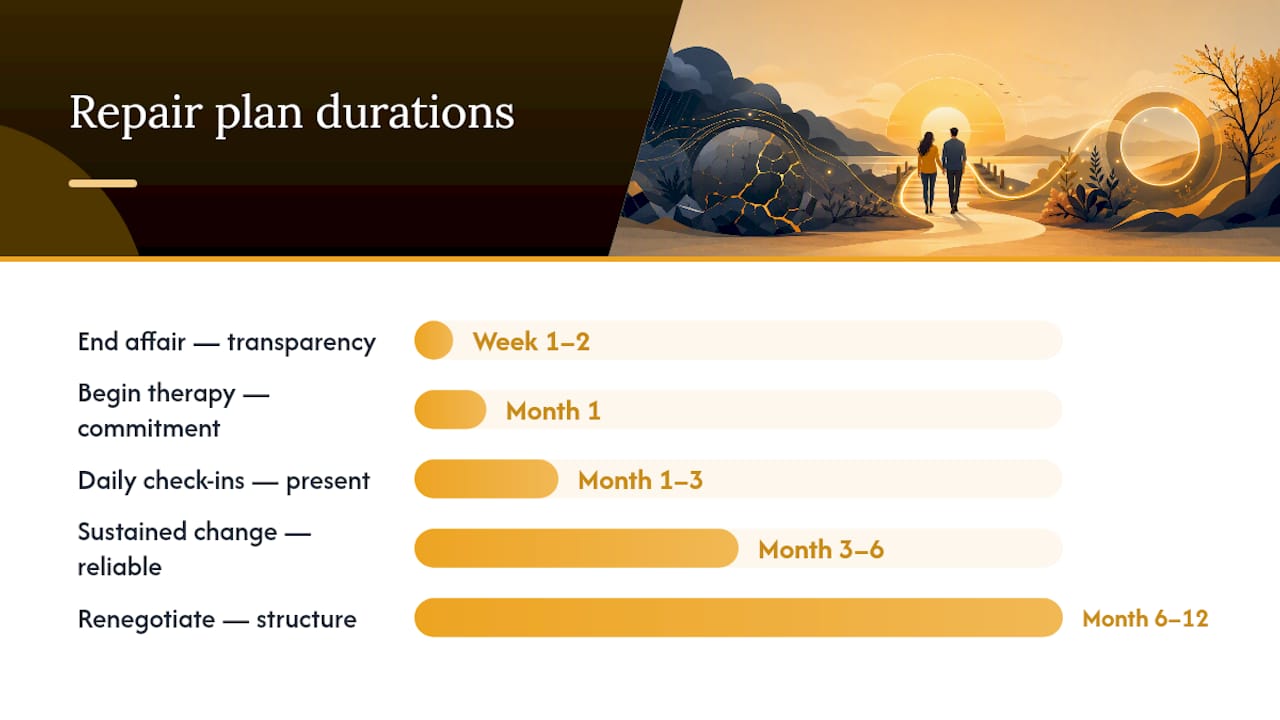
Repair plan milestones:
| Timeframe | Observable action | What it demonstrates |
|---|---|---|
| Week 1–2 | End affair contact; share account access if requested | Immediate transparency |
| Month 1 | Begin individual therapy; attend couples sessions | Commitment to understanding the why |
| Month 1–3 | Consistent daily check-ins; no defensive responses | Emotional availability |
| Month 3–6 | Sustained behavior change; no new deception | Reliability |
| Month 6–12 | Ongoing therapy; renegotiated relationship agreements | Long-term structural change |
If addiction is part of the picture, the repair plan cannot move forward meaningfully until treatment is underway. Addiction and affair recovery are parallel tracks, not sequential ones.
How to rebuild trust and create a “Relationship 2.0”
If both partners choose to stay, the goal is not to get back to where you were. The relationship that existed before the affair had vulnerabilities, whether or not either of you could see them clearly at the time. The goal is something better: what clinical commentators call a Relationship 2.0, a new structure built on honest communication, renewed emotional connection, and carefully paced intimacy.
The four pillars of Relationship 2.0:
- Safety rituals: predictable, low-stakes moments of connection that rebuild the sense that your partner is reliable. A morning check-in text. A ten-minute debrief at the end of the day. Small, consistent, and non-negotiable.
- Transparent communication: not just honesty about the affair, but honesty about current emotional states, needs, and fears. Communication agreements that both partners have explicitly agreed to reduce the guesswork that breeds suspicion.
- Renegotiated boundaries: the old relationship’s implicit agreements clearly did not hold. New ones need to be explicit, discussed, and revisited as circumstances change.
- Paced intimacy: physical and romantic reconnection cannot be rushed. Pressure to resume sexual intimacy before the betrayed partner is ready tends to retraumatize rather than reconnect.
A weekly rebuilding ritual
Step 1: Each partner writes down one thing they appreciated about the other this week and one thing they need more of. (Five minutes, separate, written down.)

Step 2: Share them without interruption. The listener’s only job is to hear, not to respond immediately.
Step 3: Agree on one small, specific action each partner will take before the next check-in.
Step 4: Close the check-in with a physical gesture of connection, a hug, a hand on the shoulder, whatever feels safe for the betrayed partner right now.
This ritual works because it is structured, time-limited, and low-stakes. It builds the neural association between your partner and safety, which is exactly what the affair disrupted. For practical intimacy-building activities that support this phase, Couplesfightschool has a dedicated resource worth bookmarking.
Trust and forgiveness follow different timelines. Forgiveness can precede trust by months. What matters is that trust is being built through consistent, observable behavior, not promised through words alone.
Red flags: when forgiveness is not safe or realistic
Forgiveness is a personal good. It is not a moral obligation, and it is not always the right choice. Some situations make the pursuit of forgiveness genuinely unsafe.
Red flags that indicate stepping back is the right move:
- The affair is ongoing, or the unfaithful partner refuses to end contact with the affair partner.
- Active addiction is present and untreated.
- There is a pattern of repeated affairs, not a single incident.
- The unfaithful partner uses emotional manipulation, gaslighting, or blame-shifting to avoid accountability.
- Physical or emotional abuse is present, regardless of whether it is connected to the affair.
- You are being pressured by your partner, family, or community to forgive before you are ready.
- You feel afraid in your own home.
If you feel unsafe this week: Contact the National Domestic Violence Hotline at 1-800-799-7233 or text “START” to 88788. The Crisis Text Line is available 24/7 by texting HOME to 741741. These resources are free, confidential, and staffed around the clock.
Decision checklist:
- Indicators you can safely continue exploring repair: the affair has ended, the unfaithful partner is in therapy, you feel physically safe, and you are not being pressured to forgive on a timeline.
- Indicators it is time to prioritize separation: any of the red flags above are present, or your gut consistently tells you that staying is making you smaller, not stronger.
Pro Tip: Forgiveness and staying are separate decisions. You can forgive someone and still choose to leave. Clarity on this distinction often reduces the pressure that makes the decision harder than it needs to be.
Understanding what betrayal actually looks like in its many forms can also help you name what happened and decide what you need next.
How to tell you’re genuinely healing
Healing from infidelity does not announce itself with a clear before-and-after moment. It tends to show up quietly, in small shifts you might not notice until you look back.
Signs that forgiveness and healing are progressing:
- Intrusive thoughts about the affair are becoming less frequent and less intense.
- You can go through a full day without the betrayal being the first thing you think about.
- Triggers still happen, but your physiological response to them is less overwhelming than it was.
- You can discuss what happened without it turning into a weapon in an argument.
- You feel moments of genuine connection with your partner (if you are staying) or with your own life (if you are not).
- You are making decisions based on what you want, not purely on fear or anger.
Recovery occurs in waves. A good week followed by a terrible one does not mean you have lost ground. It means you are human, and the nervous system processes trauma on its own schedule. Mayo Clinic’s guidance on infidelity recovery explicitly frames this non-linearity as normal rather than as a sign of failure.
When to reassess: if persistent resentment is still dominating your daily experience after a year of genuine effort, including therapy, that is information worth taking seriously. Resentment that does not shift over time is a signal, not a character flaw. It may mean the relationship is not repairable, or it may mean the work needs a different approach.
Couples Fight School’s RESTORE® program and the F.I.G.H.T. Plan®
Structured professional support changes the odds of recovery in a meaningful way. Couplesfightschool’s RESTORE® Infidelity Recovery Counseling is built specifically for couples navigating affair recovery, not as a general couples therapy add-on but as a dedicated program designed around the specific dynamics of betrayal.
The RESTORE® program works through Couplesfightschool’s F.I.G.H.T. Plan® framework, a structured system covering communication repair, emotional regulation skills, nervous-system stabilization, and relationship rebuilding. The program is designed and delivered by licensed mental health professionals, including clinicians credentialed as LMFTs and LCSWs, who specialize in betrayal trauma and affair recovery.
What to expect from a structured recovery program:
- A clear intake process that assesses both partners’ readiness and safety.
- Individual and joint sessions that address both the betrayed partner’s trauma and the unfaithful partner’s accountability work.
- Communication training using specific scripts and frameworks, not just general advice.
- Nervous-system regulation tools integrated into the session structure.
- A defined program arc with milestones, so you know what progress looks like at each stage.
Questions to ask any provider before you commit:
- How long is the program, and what does a typical session look like?
- What is the evidence basis for the approach you use?
- Do you work with both partners individually as well as together?
- How is confidentiality handled, especially if we separate during the process?
- What is the fee structure, and do you offer sliding scale or payment plans?
The benefits of couples therapy after betrayal are well-documented: structured support reduces the time couples spend in destructive conflict cycles and increases the likelihood that the decisions they make, whether to stay or separate, are grounded rather than reactive.
What I’ve seen in this work, and what I want you to know
The couples who make it through infidelity are not the ones who felt the least pain. They are the ones who stayed honest about what they were feeling, even when that was inconvenient, and who refused to let shame or pressure rush them into a decision they were not ready to make.
Forgiveness is not a gift you give your partner. It is something you do for yourself, so that the betrayal stops having a claim on your future. That distinction matters more than most people realize when they are in the middle of the worst of it.
If you are reading this and wondering whether your relationship is worth saving, that question deserves a real answer, not a generic one. The work of figuring that out, with a clinician who knows this territory, is some of the most important work a person can do. Couplesfightschool’s programs exist precisely for that moment.
Couplesfightschool’s RESTORE® program: what to do next
Couplesfightschool offers a concrete alternative to navigating affair recovery alone or through general couples therapy that was not built for betrayal. The RESTORE® Infidelity Recovery Counseling program, the F.I.G.H.T. Plan® framework, online coaching, and therapist-created workbooks are all designed for exactly the situation you are in: the acute, disorienting aftermath of infidelity, where you need structure, not just support.
The next step is straightforward. If you are ready to work with a licensed professional who specializes in betrayal recovery, book a counseling session or explore private online coaching to find the format that fits your situation. Both options are available without a long-term commitment upfront.
Sources
- Infidelity: How to cope with the emotional fallout and rebuild when possible | Mayo Clinic
- After Infidelity: Can You Forgive? | Psychology Today
- How to Forgive a Cheating Partner (If You Choose To) | Advisiore
- The 8 Step Process Of Rebuilding Trust After Cheating—By A Psychologist | Forbes
This article is general information, not a substitute for advice from a qualified doctor. Consult a qualified healthcare professional about your own circumstances before acting on anything here.
Recommended
- Trinity Player
- Benefits of Couples Therapy After Betrayal: What to Expect
- RESTORE® Infidelity Recovery Counseling – Couples Fight School