
Free Online Marriage Counseling: What to Try First

Free online marriage counseling exists in the U.S., but the quality and structure vary widely. The most reliable no-cost options are crisis and support hotlines, university training clinics, federally funded relationship education programs, faith-based premarital programs, employer-sponsored Employee Assistance Programs (EAPs), peer-support groups, and free self-guided courses or downloadable workbooks. For couples whose goal is structured relationship education, free resources can start the work, but they rarely replace a sequenced curriculum with professional feedback.
Quick options to try right now:
- Crisis support: The 988 Suicide and Crisis Lifeline (call or text 988) and the National Domestic Violence Hotline (1-800-799-7233) for safety concerns
- University training clinics: Graduate psychology and counseling programs often offer free or very low-cost teletherapy supervised by licensed faculty
- Federally funded programs: SAMHSA’s treatment locator and local community health centers frequently offer free relationship education workshops
- Faith-based programs: Many churches and denominations offer free premarital or marriage enrichment programs; Focus on the Family maintains a counselor referral network
- EAPs: Check your employer’s benefits portal — many EAPs include 3–8 free counseling sessions per year
- Self-guided workbooks and courses: Free downloadable workbooks and structured online modules are widely available through nonprofit relationship education organizations
Table of Contents
- What free online marriage counseling actually looks like in the U.S.
- Counseling vs. relationship education: which one do you actually need?
- How to evaluate free online programs before you commit
- What a 4–8 session evidence-based course looks like
- When free resources aren’t enough and how to find paid help
- Key Takeaways
- Why free help is a starting point, not a destination
- Couplesfightschool offers what free resources can’t
- Useful sources and further reading
What free online marriage counseling actually looks like in the U.S.
Each free option has a different access path, and knowing which door to knock on saves time.
Crisis lines and hotlines are available 24/7 and are the right first call when safety is a concern. They are not therapy, but trained counselors can stabilize a situation and refer couples to local services.
University training clinics are one of the most underused free resources. Schools like those in the COAMFTE-accredited marriage and family therapy programs run supervised telehealth clinics where graduate students provide sessions under licensed faculty oversight. Search “[your state] university counseling clinic couples therapy” to find local options. Expect a waitlist of 2–6 weeks and a brief intake screening.

Federally funded and nonprofit programs include community health centers funded under the Health Resources and Services Administration (HRSA) and nonprofits like the National Healthy Marriage Resource Center. These often run structured group workshops, which are closer to relationship education than individual therapy.
Faith-based programs range from free church-run premarital classes to denomination-specific curricula. When theological fit matters, filtering by faith tradition is worth the extra step. For couples navigating faith and marriage conflict, the alignment between a counselor’s worldview and the couple’s beliefs can significantly affect how advice lands. For broader context on life transitions and pastoral support, this resource from Divergent Church is worth a read.
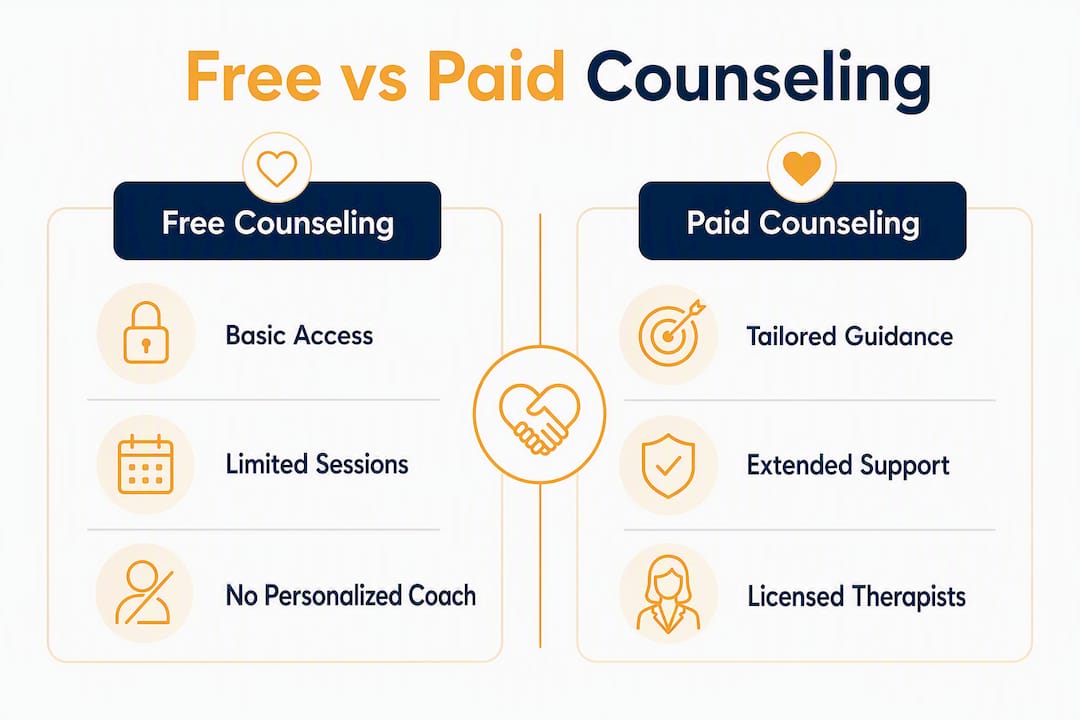
EAPs are the most overlooked free benefit most employed Americans already have. Log into your HR portal or call the number on your insurance card and ask specifically whether couples counseling is covered. Many EAPs provide between 4 and 8 sessions at no cost, with a licensed therapist, before any out-of-pocket cost kicks in.
Pro Tip: When contacting a university clinic or nonprofit program, ask upfront whether the sessions follow a structured curriculum or are open-ended. Structured programs produce faster, more measurable results for couples who want skill-building rather than open-ended processing.
Counseling vs. relationship education: which one do you actually need?
These two terms are often used interchangeably, but they describe different services with different goals.
Relationship education is proactive and skill-focused. It teaches communication strategies, conflict patterns, and emotional regulation through structured modules, often without a clinical diagnosis or crisis as the entry point. Education programs are shorter, more accessible, and frequently available at low or no cost.
Counseling or therapy is a licensed clinical intervention. It addresses deeper psychological patterns, trauma, attachment wounds, and diagnosable conditions that affect the relationship. A licensed marriage and family therapist (LMFT), licensed professional counselor (LPC), or licensed mental health counselor (LMHC) provides this work.
| Dimension | Relationship education | Couples counseling/therapy |
|---|---|---|
| Goal | Skill-building, prevention | Treatment, healing, crisis resolution |
| Scope | Communication, conflict, values | Trauma, mental health, deep patterns |
| Format | Courses, workbooks, workshops | Licensed sessions (individual or joint) |
| Duration | multiple sessions typical | multiple sessions required for meaningful change |
| Cost | Often free or low-cost | typically a fee per session |
| Best timing | 3–6 months before major milestones | When patterns have calcified or safety is at risk |
Premarital counseling is valuable even for couples in strong relationships. A focused 4–8 session program helps clarify values, sharpen communication, and surface friction points before they become entrenched. Current clinical guidance is consistent: start several months before a wedding, major move, or other significant life transition.
How to evaluate free online programs before you commit
Not every free resource is worth your time, and some can actually make things worse.
Check these before starting any free program:
- Credentials: Who created the curriculum? Look for licensed mental health professionals (LMFT, LPC, LMHC, PhD) or accredited academic institutions, not just “relationship coaches” with no verifiable training
- Evidence base: Does the program cite a recognized framework (Gottman Method, Emotionally Focused Therapy, PREPARE/ENRICH)? The PREPARE/ENRICH assessment has over 1,200 published research articles supporting its validity
- Scope clarity: Does the program explicitly state it is education, not therapy? Blurring that line is a red flag
- Privacy practices: Free peer forums and apps may store or share your data; read the privacy policy before disclosing anything sensitive
- Reasonable expectations: Any program promising to “fix” your marriage in a weekend is overselling
Red flags to walk away from: guaranteed outcomes, pressure to purchase immediately after a free session, anonymous forums presented as therapeutic support, and programs that encourage airing grievances without structured facilitation.
Clinicians note that neutral, evidence-based guidance matters most when couples want practical skill-building rather than advice filtered through a single theological or ideological lens. That does not mean faith-based programs are inferior; it means knowing what you are signing up for.
Pro Tip: Before your first session, ask the provider two questions: “What framework does this program use?” and “What are the limits of confidentiality here?” A credible program will answer both clearly.
What a 4–8 session evidence-based course looks like
A well-structured relationship education course follows a clear arc. Here is a sample framework couples can use to evaluate any free program or as a template for self-guided work.
Sessions 1–2: Communication foundations. The focus is on listening patterns, speaker-listener roles, and identifying how each partner typically responds under stress. Homework: each partner writes down one recurring argument and their own role in how it escalates.
Sessions 3–4: Conflict cycles and triggers. Couples map their specific conflict cycle, identify emotional triggers, and practice de-escalation techniques. Standardized assessments, when available, surface hidden friction points around finances, family of origin, and expectations. Homework: use a structured check-in format three times before the next session.
Sessions 5–6: Values, expectations, and shared vision. Couples discuss non-negotiables, life goals, and areas of genuine difference. This is where many couples discover they have been arguing about symptoms rather than the underlying value gap. The premarital counseling topics checklist is a practical tool for this phase.
Sessions 7–8: Repair and intimacy. The final sessions focus on rebuilding emotional safety, practicing repair attempts after conflict, and creating a shared agreement for how the couple will handle future disagreements. Homework: schedule one low-stakes “practice conflict” conversation using the skills from earlier sessions.
The 3–6-month timing window applies here too. Starting this arc well before a major milestone gives couples time to practice between sessions rather than cramming skills into a stressful period.
When free resources aren’t enough and how to find paid help
Some situations call for a licensed professional, and recognizing the signs early prevents months of wasted effort.
- The same argument cycles back every few weeks despite genuine effort to change
- Either partner has experienced trauma, abuse, or significant mental health challenges affecting the relationship
- Substance use is present and affecting daily functioning or safety
- One partner has emotionally withdrawn to the point of minimal engagement
- Infidelity, major betrayal, or a trust rupture has occurred
When any of these apply, the path forward is a licensed therapist, not a free course. To find a marriage counselor, Psychology Today’s therapist directory lets you filter by specialty, insurance, and telehealth availability. Ask any prospective therapist: “What modality do you use with couples?” and “Do you have experience with [your specific concern]?”
Cost barriers are real. Sliding-scale fees, out-of-network reimbursement from your insurer, EAP sessions, and community mental health centers all reduce the price. Online couples therapy is also generally less expensive than in-person work and produces comparable outcomes for most relationship concerns. Short-term coaching (typically 4–8 sessions with a structured focus) costs less than open-ended therapy and works well for couples who are not in crisis but want faster skill development.
Safety reminder: if there is any threat of violence or self-harm, call 988 or 911 before scheduling a therapy appointment.
Key Takeaways
Free relationship education is most effective when couples treat it as structured, scheduled work rather than passive content consumption, and when they know exactly when to escalate to paid professional support.
| Point | Details |
|---|---|
| Start with EAPs and clinics | Employer EAPs and university training clinics offer the most structured free help available in the U.S. |
| Education vs. therapy | Relationship education (usually 4–8 sessions) builds skills proactively; therapy addresses deeper clinical issues. |
| Timing matters | Starting a structured course 3–6 months before major milestones produces the best outcomes. |
| Escalate when needed | Persistent conflict cycles, safety concerns, or betrayal require a licensed therapist, not a free course. |
| Couplesfightschool | Couplesfightschool’s structured courses and coaching fill the gap between free resources and long-term therapy. |
Why free help is a starting point, not a destination
Free resources are genuinely useful. A university clinic session, an EAP benefit, or a well-designed self-guided workbook can give a couple real tools they did not have before. The problem is that most couples underestimate how much structure matters. Open-ended conversations about “communication” without a framework tend to drift into the same argument the couple was already having, just with a facilitator present.
What actually moves the needle is a sequenced curriculum, consistent practice between sessions, and someone who can give feedback on what the couple is doing. Free peer forums cannot do that. A hotline cannot do that. Even a skilled therapist working without a structured framework often takes longer to produce results than a focused 4–8 session education program.
The couples I see make the fastest progress are the ones who treat their course like a standing appointment, not a resource they dip into when things get bad. They show up on schedule, do the homework, and bring specific examples to each session. That discipline matters more than whether the program is free or paid. What matters most is whether it is structured, evidence-based, and actually used.
Couplesfightschool offers what free resources can’t
Free options are a real starting point, but they leave gaps: no standardized assessment, no coach to review your progress, and no curriculum designed to build one skill on top of the last.
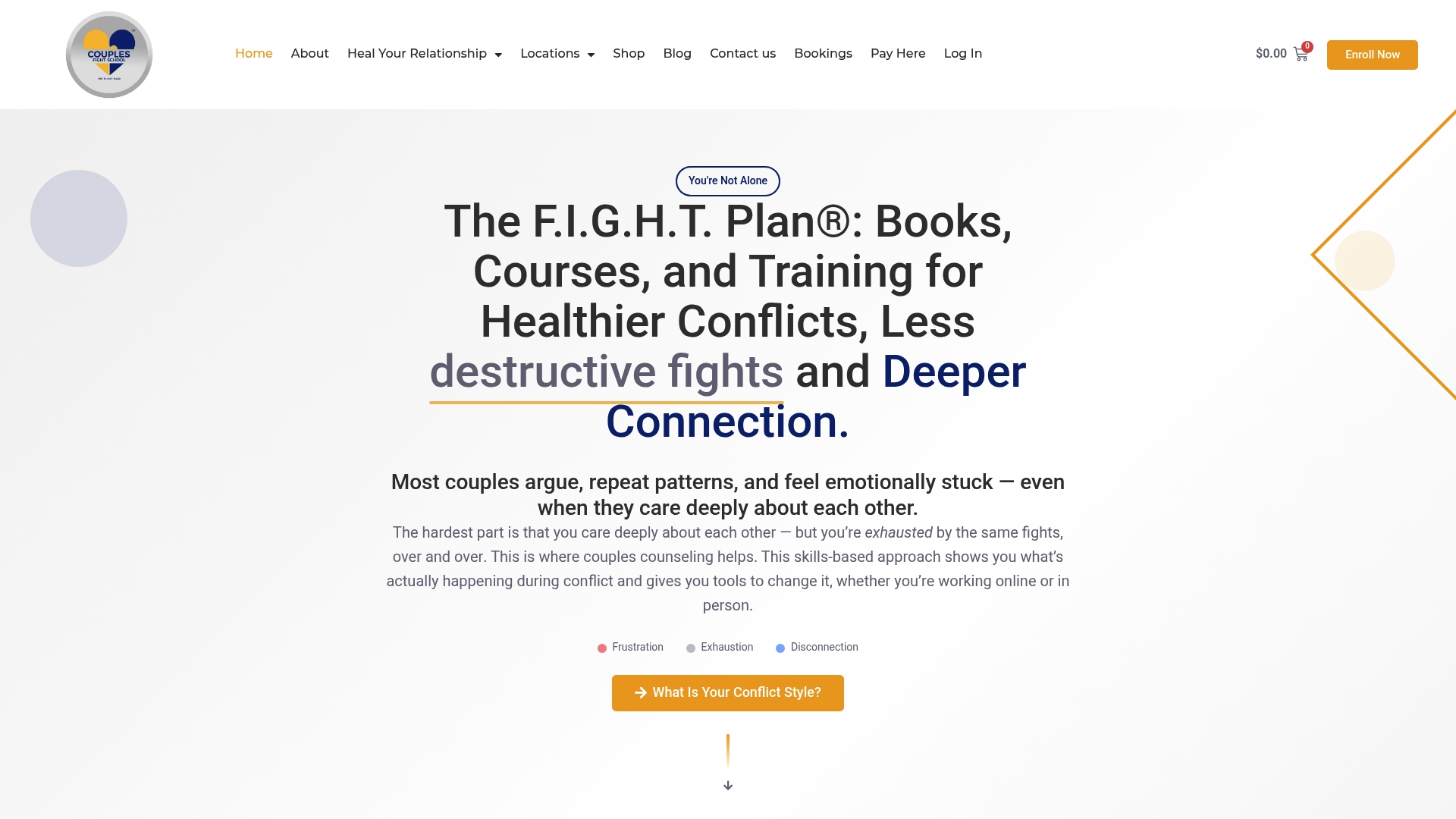
Couplesfightschool was built by licensed mental health professionals Carlos Todd and Natasha Pemberton-Todd specifically to fill those gaps. The F.I.G.H.T. Plan® framework gives couples a repeatable system for communication, emotional regulation, and conflict repair, structured across a clear session arc. Whether you are working through recurring arguments, rebuilding after a rough patch, or preparing for marriage, the Stop the Fighting course gives you a sequenced curriculum with practical scripts and guided exercises you can use immediately. Couples who want more direct support can book private online coaching for personalized guidance. Start with the free resources above, then take the next step when you are ready for something structured.
Useful sources and further reading
| Source | Why it’s relevant |
|---|---|
| Therapy Group of DC: Premarital Counseling | Clinical guidance on 4–8 session structure and 3–6 month timing recommendation |
| Serenity Psychotherapy Group: Premarital Guide | Teletherapy effectiveness and common mistakes that reduce counseling value |
| Psychology Today: Is Premarital Counseling Worth It? | Evidence for neutral, clinician-led guidance over officiant-only counseling |
| Focus on the Family: Finding a Marriage Therapist | Guidance on vetting faith-based counselors and theological fit |
| PREPARE/ENRICH Assessment | The most researched premarital and marriage assessment tool, with 1,200+ supporting studies |
| Psychology Today Therapist Directory | Searchable U.S. directory for licensed marriage counselors, filterable by specialty and telehealth |
| New York Times: How to Find the Right Couples Therapist | Practical guidance on selecting a couples therapist and what to expect in early sessions |
This article is general educational information, not professional mental health advice. For your specific situation, consult a licensed mental health professional or contact your state’s licensing board to verify credentials.
Recommended
- How to Convince Spouse to Take Marriage Course with You
- Benefits of Therapy Before Marriage: Engaged Couples’ Guide