
Alternatives to integrativecouplestherapy.com: Best Picks

If you’re searching for integrativecouplestherapy.com alternatives, the short answer is this: Couplesfightschool’s structured conflict-resolution courses are the top recommended pick for couples who want practical, clinician-developed tools without committing to weekly therapy. Other strong options include IBCT-based online programs, private marriage intensives, therapist-led weekend workshops, structured relationship-education courses, and self-guided workbooks.
Three reasons Couplesfightschool stands out: it’s built by licensed clinicians, grounded in the F.I.G.H.T. Plan® framework, and accessible online at a fraction of the cost of private intensive therapy.
Top alternatives at a glance:
- IBCT-based online course (e.g., OurRelationship model): 8-hour online program with coach touchpoints, backed by a randomized controlled trial
- Private marriage intensive: 2–3 day immersive session for couples in acute conflict
- Therapist-led weekend workshop: group format, lower cost, good for enrichment
- Structured relationship-education course: self-paced, skills-first, clinician-designed
- Self-guided workbooks and practice plans: lowest cost, highest flexibility
Pro Tip: If your conflict has escalated to the point where you can’t finish a conversation without shutting down, start with a structured course that includes emotional regulation tools before attempting an intensive.
Table of Contents
- What are the best integrativecouplestherapy.com alternatives?
- Short profiles of the top alternatives
- How do you choose the right format for your relationship?
- What non-traditional approaches actually help couples?
- Key Takeaways
- Why the format matters more than the brand name
- Couplesfightschool gives you a practical, clinician-built path forward
- Sources and further reading
What are the best integrativecouplestherapy.com alternatives?
| Format | Evidence base | Best for | Time to results | Cost bracket | Accessibility |
|---|---|---|---|---|---|
| IBCT-based online course | IBCT (Christensen) | Communication breakdown, moderate conflict | 8 hours over multiple weeks | Low to mid | Fully online |
| Private marriage intensive | Various (EFT, Gottman, IBCT) | High conflict, crisis interruption | 2–3 days | High ($1,500–$5,000+) | In-person, some hybrid |
| Therapist-led weekend workshop | Gottman, Imago, general | Enrichment, premarital | 1–2 days | Mid ($200–$600) | In-person or hybrid |
| Structured relationship-education course | Gottman, IBCT, F.I.G.H.T. Plan® | Skills-building, premarital, faith-based | 4–8 weeks | Low to mid | Fully online, self-paced |
| Self-guided workbook | General, Gottman-informed | DIY learners, maintenance | Ongoing | Low (under $50) | Fully online or print |
| Prepare/Enrich program | Empirically validated inventory | Premarital, blended families | 4–8 sessions | Mid (facilitator fee) | In-person or online |
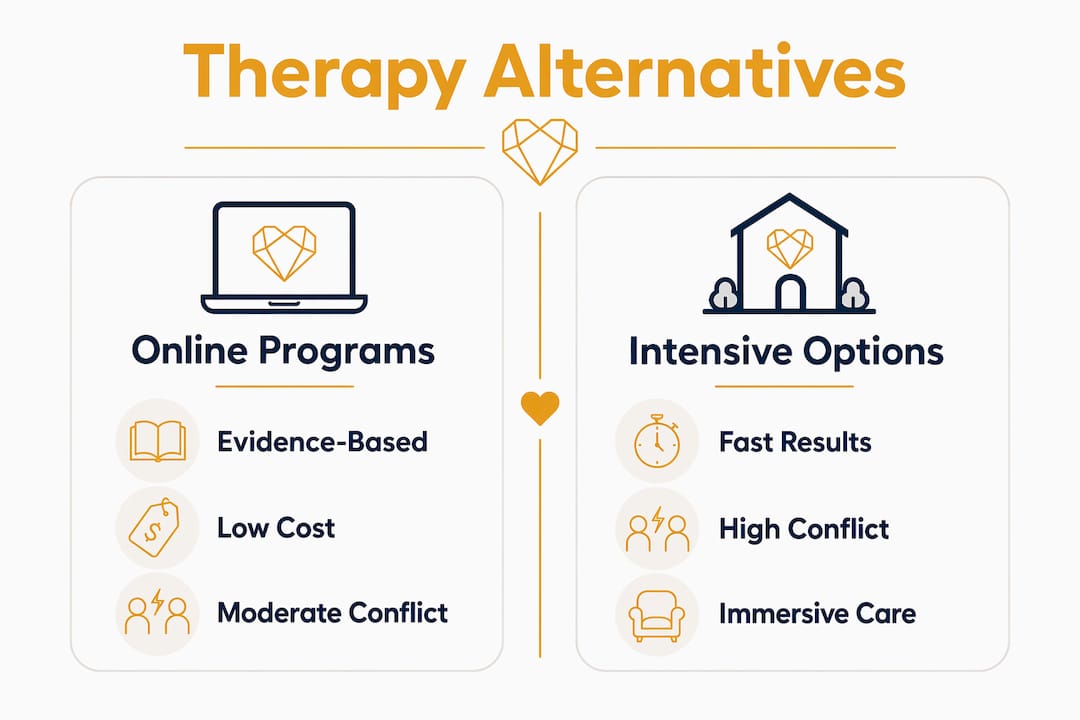
A nationwide randomized controlled trial of an IBCT-based online program reported a high completion rate and significant improvements in relationship satisfaction. That’s a meaningful benchmark for any online format you’re evaluating.
Format trade-offs:
- IBCT online courses mirror the acceptance-and-change model that integrativecouplestherapy.com draws from, making them the closest structural match
- Intensives move fastest but demand concentrated emotional energy and strong follow-up
- Workbooks work best when paired with a coach check-in or structured course, not as a standalone fix for high-conflict couples
Short profiles of the top alternatives
IBCT-based online programs
The OurRelationship program is the most-studied example of this format. It translates Integrative Behavioral Couple Therapy into three structured phases with up to four brief coach calls. Dr. Andrew Christensen’s model emphasizes acceptance alongside change, using evocative interventions rather than pure skill drills. That distinction matters for couples who’ve tried communication scripts and found them hollow.

Best for: Couples with moderate conflict who want a clinician-grounded online experience.
Pros: Evidence-backed, low cost, fully online, coach accountability built in.
Cons: Less personalized than one-on-one therapy; not suited for active safety concerns.
Private marriage intensives
A 2–3 day private intensive can reach the root causes of distress faster than months of weekly sessions. Clinicians describe them as a relational circuit breaker that stops negative momentum before it becomes irreversible. The cost is significant, typically $1,500–$5,000 or more depending on the provider and location.
Best for: High-conflict couples, affair recovery, couples on the verge of separation.
Pros: Fast, immersive, clinician-led.
Cons: Expensive, emotionally demanding, requires strong follow-up to hold gains.
Therapist-led weekend workshops
Group workshops normalize relationship struggles and cost far less than private sessions. They work well for enrichment and premarital preparation. However, they’re not recommended for couples dealing with active betrayal or imminent separation, where individual attention is critical.
Best for: Premarital couples, couples wanting a tune-up, faith-based communities.
Pros: Affordable, community-building, structured curriculum.
Cons: Limited personalization; group setting isn’t right for every couple.
Structured relationship-education courses
This is where Couplesfightschool sits. Clinician-designed courses with homework, practice conversations, and progress markers deliver structured growth at a fraction of therapy costs. The F.I.G.H.T. Plan® framework gives couples a repeatable system for communication and emotional regulation, not just a list of tips. For couples who want to build relationship skills without a weekly therapy commitment, this format consistently outperforms passive reading.
Best for: Couples at any stage who want practical, repeatable tools.
Pros: Self-paced, affordable, clinician-developed, works for faith-based and blended families.
Cons: Requires self-discipline; best results come with accountability.
Self-guided workbooks
Workbooks and structured prompts are the lowest-cost entry point. They work best as a starting tool or maintenance practice, not a primary intervention for serious conflict. Couples who hit a stuck point usually need an objective third party, which is why a planned escalation path (workbook → coach check-in → therapist) tends to produce better outcomes than workbooks alone.
Pro Tip: Pair any workbook with at least one coaching session every four weeks. The accountability gap is where most self-guided efforts stall.
How do you choose the right format for your relationship?
Match your need to the format: crisis interruption calls for an intensive; skills-building calls for a course or workbook; enrichment fits a workshop.
Decision criteria:
- Urgency: If you’re in active conflict that’s escalating daily, an intensive or online coaching with a clinician is the faster path.
- Depth of conflict: Moderate, recurring arguments respond well to structured courses. Severe distress, trauma history, or safety concerns require a licensed therapist.
- Budget: Courses and workbooks run $20–$200. Workshops run $200–$600. Intensives run $1,500 and up.
- Scheduling: Fully online, self-paced courses remove the biggest barrier most couples cite: finding a shared weekly appointment slot.
- Faith alignment: Christian couples or those wanting faith-integrated content should look for programs that explicitly address that context. Couplesfightschool offers faith-based materials alongside its core curriculum.
Questions to ask any program provider:
- Are facilitators licensed clinicians or certified coaches?
- What’s the evidence base or theoretical model?
- Is there structured follow-up after the program ends?
- How is progress measured?
- What’s the refund or satisfaction policy?
Red flags that mean you need licensed therapy instead: active safety concerns, untreated trauma, substance use affecting the relationship, or one partner threatening to leave without any willingness to engage. No course or workbook replaces clinical care in those situations. For affair recovery specifically, online marriage counseling with a licensed clinician is the appropriate starting point.
What non-traditional approaches actually help couples?
Talk-based formats don’t work for every couple. Some partners shut down verbally under stress. Others connect more easily through shared physical experience than through structured conversation. Non-verbal and experiential approaches fill that gap.
Four formats worth knowing:
- Mindfulness-based couples work: Guided breathing, present-moment awareness exercises, and shared meditation reduce reactivity before conflict escalates. Stress reduction is the mechanism; improved communication is the outcome.
- Art and movement therapy: Drawing, painting, or dance therapy lets couples express emotion without words. Particularly useful for partners who are avoidant or have difficulty naming feelings. Art therapy is one of the modalities integrated into broader integrative relationship therapy training programs.
- Nature and adventure retreats: Hiking, wilderness experiences, and outdoor challenges build teamwork and shared accomplishment outside the therapy room. The change of environment alone reduces the defensive posturing that indoor sessions can trigger.
- Animal-assisted therapy: Working with therapy animals builds patience and non-judgmental presence, which transfers to how partners treat each other.
How to pair these with a skills program:
- Complete a weekend nature retreat, then follow it with a structured 4-week course to anchor what you experienced.
- Use mindfulness exercises from a resource like intimacy-building practices as a daily warm-up before your weekly practice conversation.
- Add intimacy exercises from a guided PDF to reinforce the emotional connection built during experiential sessions.
Key Takeaways
Couplesfightschool’s clinician-built courses are the most practical, accessible alternative for couples who want evidence-informed communication and conflict-resolution tools without weekly therapy.
| Point | Details |
|---|---|
| Match format to urgency | Crisis needs an intensive; skills-building needs a course; enrichment fits a workshop. |
| IBCT online programs are research-backed | An 8-hour online IBCT trial showed 86% completion and significant improvements in relationship satisfaction. |
| Red flags require licensed therapy | Safety concerns, trauma, substance use, or active separation threats go beyond what any course can address. |
| Workbooks need accountability | Self-guided tools work best with a planned escalation path: workbook, then coach check-in, then therapist if needed. |
| Couplesfightschool | Clinician-built courses using the F.I.G.H.T. Plan® framework cover communication, conflict resolution, and emotional safety for couples at any stage. |
Why the format matters more than the brand name
Most couples spend time comparing provider names when they should be comparing formats. The research on IBCT-based online programs is compelling precisely because the structure does the work: short modules, scheduled partner conversations, brief coach touches, and clear progress markers. Those design features predict adherence far better than any brand’s marketing copy.
What I’ve seen consistently is that couples who struggle with traditional weekly therapy don’t fail because they lack motivation. They fail because the format doesn’t match how they actually live. A 50-minute weekly session assumes you can hold the emotional thread from one week to the next, process it in a clinical setting, and then apply it at home without support. Most couples can’t. A structured course with built-in practice conversations and a repeatable framework like the F.I.G.H.T. Plan® removes that gap. The accountability is baked into the design, not left to willpower.
The non-traditional options covered here, including mindfulness, art therapy, and nature retreats, are genuinely useful, but they work best as complements to a skills-based program, not replacements. Emotional connection without communication skills tends to fade. Skills without emotional connection feel mechanical. The programs worth your time build both.
Couplesfightschool gives you a practical, clinician-built path forward
If you’ve been comparing online relationship therapy options and want something built by licensed clinicians with a clear framework and real practice tools, Couplesfightschool is the direct answer. The Stop the Fighting course covers communication, conflict interruption, and emotional regulation using the F.I.G.H.T. Plan® framework. It’s self-paced, fully online, and designed for couples who want structured lessons and guided practice conversations, not just theory.
Couplesfightschool serves married couples, engaged couples, blended families, Christian couples, and high-conflict relationships. Coaching add-ons are available for couples who want live clinician accountability alongside the course. Start with the conflict resolution techniques guide as a free entry point, or go straight to the course if you’re ready to commit to a structured program. Either way, you’ll have a concrete next step today.
Sources and further reading
- IBCT OurRelationship trial: PMC full text — Randomized controlled trial evidence for the 8-hour online IBCT program, including completion rates and effect sizes on relationship satisfaction.
- APA overview of Integrative Behavioral Couple Therapy — Dr. Andrew Christensen explains IBCT’s acceptance-and-change model and evocative intervention approach.
- Marriage Restoration Project: alternatives to couples therapy — Practitioner overview of private intensives and group workshops, including guidance on when each format is and isn’t appropriate.
- Sage and Vine Counseling: practical alternatives list — Clinician resource covering workbooks, coaching caveats, and the distinction between coaching and licensed therapy.
- Integrative Relationship Therapy certification training (Tammy Nelson, PhD) — Overview of how IRT integrates Gottman, EFT, Imago, and IFS into a unified couples framework; useful for understanding the integrative model.
When choosing any resource, prioritize programs tied to licensed clinicians or peer-reviewed trials. A program that can name its theoretical model and show you its structure is almost always a better bet than one that leads with testimonials alone.
Recommended
- Top 4 DeeperConnecting.com Alternatives 2026
- StripeM-Inner
- Best Online Couples Therapy Alternatives for Long-Distance Relationships – Couples Fight School