
Anxious Attachment Style: Causes, Signs, and How to Heal

Anxious attachment style is an insecure relationship pattern defined by a persistent fear of abandonment, a negative self-view, and a chronic need for reassurance from a partner. Researchers John Bowlby and Mary Ainsworth first mapped this pattern in their foundational attachment work, and contemporary clinical summaries estimate that around 20% of people develop this style. If you recognize yourself in the description, this article covers what causes it, how to spot it in your daily behavior, how it shapes your relationships, and what actually works to shift it, including therapy options, self-help exercises, and structured programs like Couples Fight School®.
Quick self-screen: you may have anxious attachment if you:
- Frequently worry your partner will leave, even without clear evidence
- Need repeated reassurance that the relationship is okay
- Feel intense distress when a partner is slow to respond or seems distant
- Struggle to self-soothe when relationship anxiety spikes
Table of Contents
- What is anxious attachment style, and where does it come from?
- What causes anxious attachment to develop?
- How to identify anxious attachment in yourself
- How anxious attachment affects romantic relationships
- What triggers attachment anxiety, and what to do in the moment
- Can anxious attachment actually change?
- Practical exercises you can start today
- How structured relationship education can support your progress
- When to seek professional help
- Key Takeaways
- The part most guides get wrong about anxious attachment
- Couplesfightschool can help you put this into practice
- Useful sources and further reading
What is anxious attachment style, and where does it come from?
Attachment theory holds that the bond between a child and their primary caregiver creates a mental template, what Bowlby called an “internal working model,” that shapes how a person expects relationships to work for the rest of their life. Ainsworth’s Strange Situation experiments in the 1970s identified the original infant patterns, and researchers later extended the framework to adult romantic relationships.
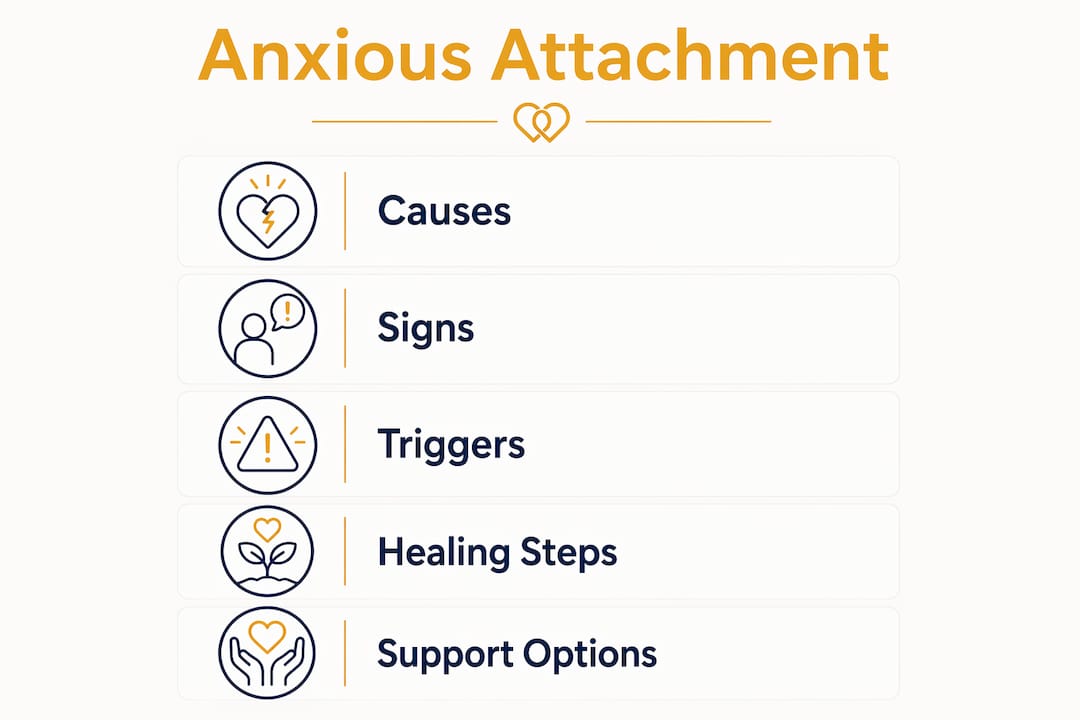
The four adult attachment styles sit on two dimensions: anxiety (how much you fear rejection or abandonment) and avoidance (how much you suppress closeness). Anxious attachment scores high on the anxiety dimension and low on avoidance. The table below shows how the four styles compare across the dimensions that matter most in relationships.
| Dimension | Secure | Anxious/Preoccupied | Avoidant/Dismissive | Fearful/Disorganized |
|---|---|---|---|---|
| Self-view | Worthy, capable | Unworthy, doubting | Worthy but self-reliant | Unworthy and distrustful |
| View of others | Trustworthy, available | Idealized but unreliable | Unreliable, intrusive | Frightening or unavailable |
| Typical relationship behavior | Comfortable with closeness and independence | Seeks closeness, fears distance | Pulls back, values independence | Unpredictable, approach-avoid |
| Regulation strategy | Internal self-soothing | Partner-dependent co-regulation | Emotional suppression | Dysregulated, no consistent strategy |
A concrete example: Maya texts her partner at noon and gets no reply by 2 PM. A securely attached person might assume he is busy. Maya, with anxious attachment, spends the next two hours re-reading the last conversation for signs something is wrong, drafts and deletes three follow-up texts, and feels her heart rate climb. By the time he replies, she is either flooded with relief or already hurt. That cycle, repeated across months, is what anxious attachment looks like in a modern adult relationship.
What causes anxious attachment to develop?
The primary driver is inconsistent, unpredictable, or misattuned caregiving in infancy and early childhood. When a caregiver is sometimes warm and responsive and sometimes emotionally unavailable or dismissive, the child cannot form a reliable prediction about whether their needs will be met. The result is an internal working model built around the assumption that love is available but not guaranteed, which keeps the attachment system in a state of chronic low-level alarm.
Several risk factors amplify this baseline:
- Childhood emotional neglect or inconsistent emotional validation — a parent who was physically present but emotionally absent
- Parental mental health struggles — depression, anxiety, or substance use that made a caregiver’s availability unpredictable
- Repeated separations or losses in early childhood (hospitalizations, parental absence, frequent moves)
- Family instability — high-conflict households, divorce, or economic stress that disrupted caregiving routines
- Temperament — some children are neurologically more sensitive to social threat, which makes inconsistent caregiving more disruptive for them than for a less reactive sibling
One clarification worth making: a single difficult event, a parent’s brief illness, a move to a new city, does not automatically produce a lifelong attachment pattern. What shapes the internal working model is the repeated, sustained quality of early caregiving, not any one incident. Patterns typically solidify in the first few years of life, but later experiences, including adult relationships and therapy, can meaningfully modify them.
How to identify anxious attachment in yourself
Adults with anxious attachment tend to hyperactivate their attachment system, meaning they amplify emotional signals (crying, anger, clinging) to pull a partner closer rather than using internal self-soothing. The core features are a fear of abandonment, a negative self-view, and a high need for external reassurance. Here is what that looks like day to day:
- Fear of abandonment — a persistent, low-level dread that the relationship will end, even when things are going well
- Hypervigilance to partner cues — scanning tone of voice, facial expressions, and response times for signs of withdrawal
- Constant reassurance-seeking — asking “Are you okay with me?” or “Do you still love me?” more than the situation warrants
- Clinginess or difficulty with separations — feeling disproportionately distressed when a partner travels or spends time with friends
- Jealousy — triggered by perceived rivals or a partner’s independent social life
- Ruminative thinking — replaying conversations to find evidence of rejection or hidden meaning
- Low self-esteem and feelings of unworthiness — a sense that you are “too much” or not enough to keep a partner’s interest
- Difficulty setting or holding boundaries — prioritizing the partner’s comfort to avoid conflict or abandonment
- Distress when relationships end — breakups can feel catastrophic and disproportionately destabilizing
A quick micro-example: Jordan’s partner says “I need some space tonight.” A person with secure attachment hears a normal request. Jordan hears a warning sign, spends the evening catastrophizing, and sends six texts before midnight. That is not neediness as a character flaw; it is an attachment anxiety response running on an old script.
The red-flags-versus-normal-needs distinction matters here. Wanting closeness, needing occasional reassurance, and feeling hurt by rejection are universal human experiences. Anxious attachment is not about having those needs; it is about the intensity, frequency, and the degree to which they override your ability to function independently. If reassurance provides only minutes of relief before the anxiety returns, that is the pattern worth addressing.
Pro Tip: Keep a one-week log of moments when you sought reassurance from your partner. Note the trigger, what you did, and how long the relief lasted. The pattern in that log is more informative than any single incident.
How anxious attachment affects romantic relationships
The most common dynamic is the pursue-distance cycle, sometimes called the anxious-avoidant trap. Anxious attachment and avoidant attachment tend to pair together more often than chance would predict, partly because the avoidant partner’s self-sufficiency initially reads as strength, and the anxious partner’s warmth initially reads as care. Over time, the anxious partner’s bids for closeness trigger the avoidant partner’s withdrawal, which triggers more anxious pursuit, which triggers more withdrawal. Both partners end up getting exactly what they fear most.

A typical cycle looks like this: the avoidant partner needs a quiet evening alone. The anxious partner interprets the request as emotional withdrawal and escalates contact. The avoidant partner, now feeling crowded, pulls back harder. The anxious partner, now convinced something is wrong, pushes harder still. Eventually the avoidant partner gives in and offers reassurance, the anxious partner calms down, and both feel temporary relief. But nothing structural changed, so the cycle repeats. Understanding why couples fight about the same things repeatedly often comes down to exactly this dynamic.
The reinforcement loop has a neurological dimension. Research on anxious attachment and the brain suggests that the spike of relief when reassurance finally arrives involves dopamine, which makes the pattern feel rewarding and sometimes compulsive despite the long-term cost to both partners.
Beyond romance, anxious attachment shows up in friendships (over-investing, fear of being dropped from the group), family relationships (difficulty differentiating from parents), and workplaces (needing frequent approval from managers, difficulty tolerating ambiguous feedback). The same internal working model runs across all of them.
When anxiety spikes mid-conflict, a short do/don’t script helps:
- Do: Name what you are feeling (“I’m feeling anxious right now, not angry at you”) before making a request.
- Do: Ask for a specific, time-limited check-in (“Can we talk for ten minutes after dinner?”).
- Don’t: Send multiple texts in quick succession when a partner goes quiet.
- Don’t: Demand immediate reassurance during a heated argument, when neither partner is regulated.
What triggers attachment anxiety, and what to do in the moment
Certain situations reliably activate the anxious attachment system. Knowing your triggers in advance is the first step toward interrupting the cycle before it escalates.
Common triggers:
- A partner’s delayed response to a text or call
- Perceived emotional withdrawal or a partner seeming “off”
- Ambiguous messages that could be read as criticism or disinterest
- Conflict or criticism from the partner
- A partner spending time with someone you perceive as a rival
- Relationship anniversaries or high-stress periods that heighten vulnerability
- Transitions (new job, moving, a partner’s travel) that disrupt routine
First-aid steps when anxiety spikes:
- Ground yourself physically. Name five things you can see, four you can touch. This interrupts the amygdala’s threat response before it fully hijacks your thinking.
- Name the feeling out loud or in writing. “I’m feeling scared that he’s pulling away.” Labeling the emotion reduces its intensity.
- Breathe. Four counts in, hold for four, six counts out. Do this three times before reaching for your phone.
- Check the evidence. Ask: “What do I actually know right now?” versus “What am I assuming?”
- Use a one-line ‘I need’ script. “I’m feeling anxious and I need a quick check-in when you get a chance.” Direct, non-blaming, and specific.
Pro Tip: Reassurance-seeking is not inherently harmful, but the way you ask for it matters. A specific, time-limited request (“Can you let me know you’re okay when you’re done with your meeting?”) is far less likely to create dependency than an open-ended plea for general validation. Specificity keeps the request manageable for your partner and gives you a clear answer to work with.
Can anxious attachment actually change?
Yes. Attachment tendencies are not fixed personality traits. They are learned expectations built from early experience, and they can shift toward what researchers call “earned security” through sustained work and corrective relational experiences. A peer-reviewed review confirms that therapy and corrective relational experiences can shift attachment tendencies, with the most durable change coming from interventions that combine skills training with new relational input.
The most effective therapeutic approaches for anxious attachment include:
- Emotionally Focused Therapy (EFT): Works directly with attachment needs and the pursue-distance cycle; strong evidence base for couples.
- Cognitive Behavioral Therapy (CBT): Targets the catastrophic thinking patterns and hypervigilance that fuel anxious reactivity.
- Attachment-based therapy: Explicitly uses the therapeutic relationship as a corrective relational experience.
- Mentalization-Based Treatment (MBT): Builds the capacity to accurately read your own and your partner’s mental states, which reduces misattunement.
- Couples therapy: Particularly useful when the pursue-distance cycle is entrenched and both partners need to shift their patterns simultaneously.
Realistic timeline: Short-range coping skills (grounding, scripts, breathing) can reduce acute anxiety within weeks. Rewiring the underlying internal working model typically takes months to years of consistent practice and relational experience. That is not discouraging; it is accurate. Progress is not linear, and setbacks are part of the process.
Questions to ask a prospective therapist:
- “Do you have specific training or experience in attachment-based work or EFT?”
- “How will we measure progress, and what does a realistic timeline look like?”
- “Do you work with couples as well as individuals, if that becomes relevant?”
Practical exercises you can start today
The goal of these exercises is to build internal self-soothing capacity so that your nervous system does not require a partner’s reassurance to regulate. Clinicians report that the most durable progress comes when anxious individuals move from hyperactivating strategies toward explicit skill use, including self-soothing and direct request scripts.

Core exercises
Breathing and grounding (daily, 5 minutes): Box breathing (four counts in, four hold, four out, four hold) practiced daily, not just during crises, lowers baseline cortisol and makes the technique available when you actually need it.
Self-soothing script: When anxiety spikes, say to yourself: “I feel scared right now. That feeling is real, but it is not evidence that something is wrong. I can tolerate this discomfort for the next ten minutes without acting on it.”
Cognitive reframe for catastrophic thoughts: When you catch yourself in a worst-case spiral, write down the thought (“He hasn’t texted back — he’s losing interest”), then write two alternative explanations that are equally plausible (“He’s in a meeting,” “He’s driving”). The goal is not to force positivity but to interrupt the brain’s habit of treating one interpretation as fact.
Communication scripts
- Asking for reassurance: “I’ve been feeling a little anxious today. Can you tell me one thing that’s going well for you in our relationship right now?”
- Naming a need without blaming: “When I don’t hear from you for a few hours, I start to worry. I’m not saying you’re doing anything wrong. I just need a quick check-in once a day.”
- Repair language after an outburst: “I got flooded earlier and said things I didn’t mean. I’m sorry. Can we try that conversation again when I’m calmer?”
A two-week daily practice plan
Days 1–3: Practice box breathing once in the morning and once before bed. No crisis required.
Days 4–7: Add the cognitive reframe exercise. Each evening, write down one anxious thought from the day and two alternative explanations.
Days 8–10: Practice one communication script in a low-stakes conversation. Start with the reassurance request.
Days 11–14: Combine all three. After each practice, rate your anxiety level (1–10) before and after. Track whether the gap narrows over the two weeks.
For couples working on these skills together, building intimacy through structured exercises can reinforce the individual work and create the corrective relational experiences that make change stick.
How structured relationship education can support your progress
Therapy is the gold standard for deep attachment work, but structured relationship-education programs serve a distinct and complementary role. They translate clinical concepts into repeatable skill drills, give both partners a shared vocabulary, and provide practice assignments that create the corrective relational experiences research identifies as central to lasting change.
Features worth looking for in any program:
- Evidence-based communication frameworks (not just general advice)
- Emotion regulation tools built into the curriculum
- Concrete practice assignments with measurable check-ins
- Facilitator credentials (licensed mental health professionals or certified relationship educators)
- Follow-up support or community access after the core program
Couplesfightschool is an example of a program built around these criteria. Founded by licensed mental health professionals Carlos Todd and Natasha Pemberton-Todd, it uses the F.I.G.H.T. Plan® framework to give couples a structured system for communication, emotional regulation, and repair. The curriculum includes practical conversation scripts, guided reflection exercises, and tools specifically designed for high-conflict and emotionally reactive patterns, the kind that anxious attachment tends to produce. Premarital counseling research consistently shows that structured education leads to better relationship outcomes, and the same principle applies when couples use it to address existing patterns rather than just prevent future ones.
Disclosure: Couplesfightschool is the publisher of this article. The program features described above reflect its actual curriculum.
When to seek professional help
Some situations call for a licensed therapist rather than self-help tools or a relationship-education program alone.
Seek professional help promptly if:
- Anxiety is interfering with your ability to work, maintain friendships, or function day to day
- You or your partner are experiencing symptoms of depression alongside relationship distress
- There is any history of relationship violence, emotional abuse, or controlling behavior
- You are engaging in self-harm or having thoughts of harming yourself
- Repeated attempts at self-help have not produced any reduction in anxiety over several months
What to expect from an initial therapy session focused on attachment: Most therapists will begin with a history of your early relationships and current relationship patterns. You will not be expected to have everything figured out. The first session is largely assessment. Come prepared to describe what triggers your anxiety and what you typically do in response.
Three practical questions to ask:
- “What is your approach to working with attachment anxiety specifically?”
- “Do you use EFT, CBT, or another evidence-based model?”
- “How will I know if I’m making progress?”
To verify a therapist’s licensure in the U.S., check your state’s licensing board directly. The Psychology Today therapist directory allows filtering by specialty (attachment, anxiety, couples) and insurance. For couples who want professional support alongside structured learning, online marriage counseling and online coaching for couples are accessible options that do not require in-person availability.
This article is general educational information, not professional mental health advice. For your specific situation, consult a licensed mental health professional or verify current clinical guidelines with a qualified provider.
Key Takeaways
Anxious attachment style is a learned pattern, not a fixed trait, and it can shift toward earned security through consistent skills practice, corrective relational experiences, and professional support.
| Point | Details |
|---|---|
| Core definition | Anxious attachment involves fear of abandonment, a negative self-view, and chronic reassurance-seeking rooted in inconsistent early caregiving. |
| Prevalence | Around 20% of people develop an anxious attachment style, making it one of the more common insecure patterns. |
| Change is possible | Therapy and corrective relational experiences can shift attachment tendencies; EFT, CBT, and attachment-based therapy show the strongest evidence. |
| Start today | Box breathing, cognitive reframes, and direct communication scripts reduce acute anxiety while longer-term rewiring takes place. |
| Couplesfightschool | Couplesfightschool offers the F.I.G.H.T. Plan® framework, structured scripts, and licensed-professional-led programs that complement individual therapy for anxious attachment. |
The part most guides get wrong about anxious attachment
Most articles treat anxious attachment as a problem to be fixed in the anxious person. That framing misses something clinically important. The pursue-distance cycle is a system, not a solo performance. The anxious partner’s escalation and the avoidant partner’s withdrawal are two halves of the same loop, and changing only one side rarely produces lasting change. Telling an anxious person to “just self-soothe more” without addressing what their partner does when anxiety spikes is like treating one lung and calling it respiratory therapy.
The second thing most guides understate is the neurological grip of the reassurance cycle. When reassurance finally arrives after a period of anxiety, the dopamine release is real and measurable. That is not a metaphor. It is why the pattern can feel compulsive even when the person intellectually knows it is not working. Willpower alone rarely breaks a dopamine-reinforced loop. Skill substitution does. You replace the reassurance-seeking behavior with a self-soothing behavior that produces a different but tolerable form of relief, and you do it enough times that the new pathway becomes the default.
The third underrated point: earned security is not the same as becoming a securely attached person from scratch. It means developing enough skill and enough corrective experience that your attachment system stops running the old script automatically. You may still feel the pull toward hyperactivation under stress. The difference is that you catch it earlier, you have tools to interrupt it, and you have a partner or therapist who responds in ways that gradually update the internal working model. That is a realistic, achievable goal. It is not a personality transplant.
Couplesfightschool can help you put this into practice
Understanding anxious attachment is the first step. Changing the patterns that come with it requires practice, repetition, and a partner who is learning alongside you.
Couplesfightschool was built by licensed mental health professionals specifically for couples who are stuck in the same cycles and want a structured way out. The Stop the Fighting course gives you the F.I.G.H.T. Plan® framework, ready-to-use conversation scripts, and guided exercises you can work through together at your own pace. For couples who want live guidance, online coaching connects you directly with a trained professional. Both options complement individual therapy rather than replace it. If you are ready to move from understanding the pattern to actually breaking it, explore the relationship skills programs at Couplesfightschool and take the next concrete step today.
Useful sources and further reading
The sources below informed this article and offer reliable starting points for deeper reading. Where a source is from the publisher of this article, that is noted.
-
Bowlby’s foundational attachment research (ERIC) — The primary source for Bowlby’s internal working model concept and the developmental origins of attachment patterns. Essential reading for anyone who wants the theoretical foundation.
-
Hazan & Shaver (1994), Adult Attachment Lab, Cornell — The landmark paper extending attachment theory to adult romantic relationships. Explains how infant patterns map onto adult love and why anxious-avoidant pairings are so common.
-
Greater Good Science Center, UC Berkeley: How to Stop Attachment Insecurity from Ruining Your Love Life — An accessible, research-grounded overview of how attachment insecurity operates in adult relationships and practical steps toward earned security.
-
PubMed: Attachment and adult relationships (33871327) — A peer-reviewed study on attachment patterns and relationship outcomes; useful for readers who want clinical evidence behind the claims in this article.
-
PubMed: Attachment-based interventions (25990818) — Reviews evidence for attachment-focused therapeutic interventions; supports the therapy recommendations in the “Can anxious attachment change?” section.
-
Cleveland Clinic: Attachment Styles — A clinically reviewed consumer overview of all four attachment styles, including signs of anxious attachment and guidance on seeking help.
-
Simply Psychology: Anxious Attachment Style — A well-cited academic summary covering developmental origins, prevalence estimates, and adult manifestations.
-
Verywell Health: How to Recognize Anxious Attachment — A consumer-facing guide with practical examples and myth-busting on the “neediness” label; useful for readers in the self-identification stage.
-
PMC peer-reviewed review on attachment interventions — The primary clinical source for the article’s claims about therapy effectiveness and the role of corrective relational experiences in producing durable change.
-
Couplesfightschool: Emotional safety in relationships (publisher resource) — Explains the emotional-safety principles that underpin effective work with anxious attachment patterns. Disclosed as a resource from the article’s publisher.
Recommended
- How to Choose the Right Partner and Fight Less
- What Is Codependency in Relationships: Signs and Recovery
- StripeM-Inner