
Is Arguing Normal in a Relationship? Healthy Signs vs Red Flags
|
Getting your Trinity Audio player ready...
|

If you’re worried that your disagreements mean something is wrong with your relationship, take a deep breath.
The answer to “Is arguing normal in a relationship?” is a resounding yes!
In fact, not arguing at all can be a greater cause for concern. Every couple, from newlyweds to golden anniversaries, encounters conflict.
Why?
Because you are two unique individuals with different backgrounds, personalities, expectations, and communication styles. These differences aren’t flaws; they’re opportunities for growth and deeper connection.
The key isn’t to eliminate arguments but to learn how to manage them constructively.
Distinguishing between healthy arguments in relationships and toxic, damaging fights is the most important skill you can develop. Research confirms that conflict is a standard part of partnership.
About 30 percent of Americans in serious relationships report arguing once a week or more, while only 3 percent say they never argue. This data immediately normalizes the experience you’re having.
Even renowned relationship researcher Dr. John Gottman found that 69% of relationship conflicts are about perpetual, unsolvable differences; meaning the goal isn’t to “win,” but to manage disagreements with respect and understanding.
Why Couples Argue: Common Triggers You Shouldn’t Ignore
Conflict doesn’t appear out of thin air. Understanding the common triggers behind normal fights couples have can help you address the root cause, not just the surface-level frustration.
Household Chores & Mental Load
One of the most frequent battlegrounds is the division of labor. An argument about who does the dishes is rarely just about the dishes. It’s about perceived fairness, respect, and the invisible mental load of managing a household.
When one partner feels they are carrying an unequal burden, resentment builds and spills over into what seem like petty disputes about trash or laundry.
Communication Styles & Emotional Intimacy Conflicts
We all have different ways of expressing and processing emotions. A classic pattern is the pursuer-withdrawer dynamic, where one partner wants to talk things out immediately (communication during disagreements), and the other needs space to cool down.
Conflicts arise when these styles clash, with each person misinterpreting the other’s needs as rejection or nagging.
Trust Issues & Jealousy in Relationships
Arguments fueled by insecurity, past betrayals, or jealousy in relationships are particularly corrosive. They can involve questioning a partner’s whereabouts, social media activity, or friendships.
These disputes often point to deeper wounds that need healing, whether from past relationship trauma or current breaches of trust.
Money & Future Plans
Finances are a powerhouse trigger for common couple arguments. Differing values about spending, saving, and financial security can lead to intense disagreements about daily choices and long-term dreams.
The tension is so predictable it’s quantifiable: the average couple argues about money 58 times per year, highlighting how frequent and routine disagreements can be in relationships.
Healthy Arguing vs Unhealthy Fighting: How to Tell the Difference
Knowing whether your conflict is productive or destructive is crucial. Here’s how to spot the difference between arguing vs fighting partners.
Signs an Argument Is Healthy
- The Goal is Understanding, Not Winning: You’re trying to see your partner’s perspective and find a solution together.
- You Stay on Topic: You discuss the current issue without constantly dragging in old, unrelated grievances.
- Respect is Maintained: There’s no name-calling, contempt, or character assassination. You criticize a behavior, not the person.
- You Can Take a Break and Return: Either partner can call for a time-out to cool off, and you reliably return to finish the discussion.
- You Feel Closer Afterwards: The argument leads to a resolution, a compromise, or simply a better understanding, which strengthens your bond.
Red Flags Showing the Conflict Is Harmful
- The Four Horsemen are Present: Gottman’s predictors of divorce (Criticism, Contempt, Defensiveness, and Stonewalling) dominate the conversation.
- You Fight to Inflict Pain: The goal shifts from resolving an issue to hurting or punishing your partner.
- There’s No Emotional Safety: You fear bringing things up. One or both partners shut down emotionally or physically.
- Issues Never Get Resolved: You have the same exact argument repeatedly with no progress, leading to hopelessness.
- It Escalates to Threats or Abuse: Any threat of abandonment, violence, or coercive control is a major red flag.
Why Completely Avoiding Arguments Can Hurt Your Relationship
While constant fighting is harmful, so is constant avoidance. If you pride yourself on “never arguing,” you may be creating a conflict debt.
Unspoken resentments, unmet needs, and minor irritations don’t disappear; they accumulate beneath the surface.
This emotional hiding starves the relationship of authenticity and emotional intimacy, as you’re only sharing part of yourself.
Over time, this can lead to a polite but distant partnership where the spark of true connection has faded. Apathy, not anger, is often the final stage of a dying relationship.
When Arguing Becomes a Sign of a Healthy Relationship
When done well, conflict is not a sign of trouble but a tool for building a stronger union.
Using Arguments to Build Emotional Intimacy
Arguments force you to be vulnerable. They reveal your core values, deep-seated fears, and unmet needs. When you share these raw parts of yourself and your partner responds with empathy (even amid disagreement), you build profound emotional intimacy.
You learn who your partner truly is under stress, which can foster deeper trust than if you only ever experienced smooth sailing.
Arguing as a Path to Relationship Growth
Think of an argument as a pressure test for your relationship’s communication skills. Each time you successfully navigate a disagreement (repairing hurt feelings, finding a compromise) you strengthen your relationship conflict resolution muscles.
These “repair moments” are the building blocks of long-term resilience, proving to each other that your bond can withstand challenges.
How to Communicate During Disagreements Without Making Things Worse
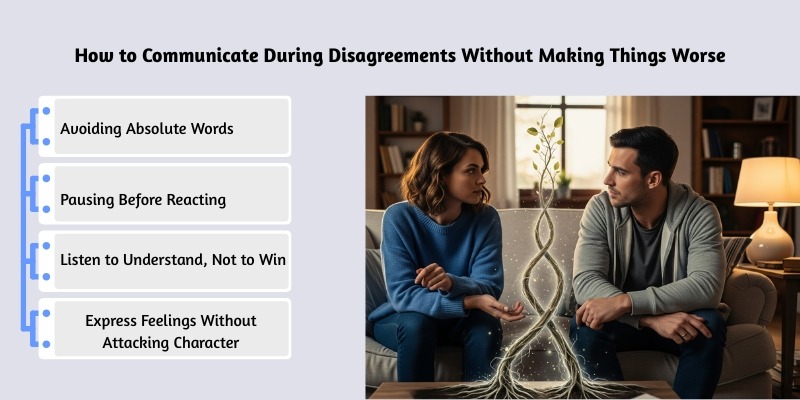
Transforming conflict starts with changing how you communicate in the heat of the moment.
Avoiding Absolute Words (“Always,” “Never”)
Words like “You never listen!” or “You always do that!” are global criticisms that are almost never true. They immediately put your partner on the defensive and escalate the conflict. Stick to specific behaviors and recent examples instead.
Pausing Before Reacting
When emotions flood your system, your ability to think rationally plummets. Practice a self-regulation technique: take three deep breaths, count to ten, or physically leave the room for 5 minutes with a promise to return. This breaks the cycle of reactive, hurtful exchanges.
Listen to Understand, Not to Win
Stop formulating your rebuttal while your partner is talking. Instead, practice reflective listening: “So what I’m hearing is that you felt ignored when I was on my phone during dinner. Is that right?” This simple act of validation can defuse tension dramatically.
Express Feelings Without Attacking Character
Use “I” statements to own your experience. Instead of “You are so selfish!” (an attack), try “I felt hurt and unimportant when plans were changed without consulting me” (a feeling). This frames the issue around your emotional experience, which is harder for your partner to argue against.
Step-by-Step Conflict Resolution Framework for Couples
Follow this practical framework to turn fights into productive discussions couples can learn from.
Step 1: Identify the Real Issue
Ask yourself: “What is this really about?” An argument about loading the dishwasher might be about feeling unappreciated or carrying an unfair mental load. Identify the core need or fear beneath the surface complaint.
Step 2: Share Perspectives Without Interrupting

Set a timer if needed. Each partner gets 2-3 minutes of uninterrupted time to share their perspective on the issue. The listener’s only job is to understand, not to respond or defend.
Step 3: Validate Each Other’s Emotions
Validation is magical. You don’t have to agree with your partner’s point of view to validate their feelings. Say, “I can understand why you’d feel frustrated in that situation,” or “It makes sense that you were hurt.”
Step 4: Brainstorm Solutions Together
Shift from “me vs. you” to “us vs. the problem.” Collaboratively brainstorm potential solutions. Be open and silly at first; no idea is a bad one. Then, discuss which ideas feel workable for both of you.
Step 5: Create a Repair Moment
After the problem-solving, intentionally reconnect. This could be a hug, a kind word (“Thank you for working through that with me”), or a shared activity. This ritual signals that the argument is over and your connection is intact.
When Arguments Point to Bigger Relationship Problems
Sometimes, frequent or intense arguments are symptoms of a deeper issue that needs dedicated attention.
Infidelity and Relationship Disputes
After a betrayal, arguments often loop endlessly around details, pain, and blame. These are infidelity relationship disputes that traditional communication during disagreements tools can’t fix.
They require a specific focus on trauma, transparency, and rebuilding trust, often supported by a structured program or professional help.
Jealousy or Control-Based Conflicts
If arguments are frequently about who your partner sees, where they go, or what they wear, it may signal deep insecurity or controlling behavior.
This goes beyond normal jealousy in relationships and can indicate unhealthy power dynamics or a lack of secure boundaries.
Emotional Neglect or Avoidance
A pattern where one partner consistently shuts down, refuses to engage, or dismisses the other’s concerns points to emotional neglect.
The arguing partner is often desperately pursuing any form of emotional engagement, while the avoidant partner sees the pursuit itself as the problem.
How to Argue Fairly: Rules All Couples Should Follow
Establishing ground rules can keep your disagreements in the realm of healthy arguments in relationships.
- No Name-Calling or Contempt: This includes eye-rolling, sarcasm, and mockery. Attack the problem, not the person.
- Stick to One Issue: Don’t “kitchen sink” the argument by throwing in every grievance from the last five years.
- No Bringing Up the Past: Resolved issues are off-limits. Using them as ammunition destroys trust.
- Take a Time-Out When Flooded: If either partner feels emotionally or physically overwhelmed, they can call for a 20-30 minute break. The breaker must specify when they will return to continue the talk.
- Maintain Safety: No threats (of leaving, divorce, etc.), no throwing things, and no blocking exits. The argument must happen in an environment of physical and emotional safety.
FAQs
Is arguing normal in a relationship?
Yes, arguing is completely normal. Research shows most couples argue regularly, with about 30% arguing weekly. The presence of conflict is less important than how you manage it. Healthy arguing can strengthen your bond.
How often is it normal for couples to argue?
There’s no “correct” number. Some couples have lively debates daily, others only have major disagreements a few times a year. The quality of the argument( whether it’s respectful and leads to resolution) matters far more than the quantity.
When should arguing be a concern?
Be concerned if arguments are characterized by contempt, criticism, defensiveness, stonewalling, or a lack of emotional safety.
If you feel worse about yourself or your relationship after every fight, or if you’re having the same argument with zero progress, it’s time to seek new tools or support.
How can couples argue without damaging trust?
Focus on using “I” statements, listening to understand, avoiding absolutes, and taking breaks when flooded. Most importantly, prioritize the repair process after the argument. A successful repair can actually build trust.
How do you repair after a fight?
Initiate a repair attempt. This can be an apology, a touch, a kind gesture, or simply saying, “I don’t like being at odds with you.” The goal is to reconnect and affirm that your relationship is bigger than the disagreement.
Following the step-by-step framework above ensures you don’t leave issues unresolved.
Conclusion
So, is arguing normal in a relationship? Absolutely. It’s not the presence of conflict that defines your relationship’s health, but how you navigate it.
View your disagreements not as threats, but as opportunities: to understand your partner more deeply, to express your own needs, and to build a stronger, more intimate partnership through productive discussions.
By learning to argue fairly and repair effectively, you can transform tension into trust and conflict into connection. Your journey to healthier communication starts with the next conversation.
Ready to understand your unique conflict style and transform your arguments? Discover your profile with our expert-designed Conflict Style Quiz and get personalized tips to start communicating better today.