
Best Alternatives to lakeeriecentercounseling.com for Couples

If you’re looking for alternatives to lakeeriecentercounseling.com, four categories cover most couples’ needs: local licensed practices, therapist directories like Psychology Today, structured online programs, and relationship coaching or workshops. The single most practical starting point for many couples is CouplesFightSchool, which offers a structured, skills-first curriculum built around the F.I.G.H.T. Plan® framework founded by licensed clinicians Carlos Todd and Natasha Pemberton-Todd.
Before you book anything, check two things first:
- Format: Can you attend in person, or do you need telehealth or a self-paced course?
- Scheduling: Does the provider offer evening or weekend slots, and what’s the typical wait time?
Those two filters alone will cut your shortlist in half.
Table of Contents
- What are the best alternatives to lakeeriecentercounseling.com?
- Key differences that affect your choice: format, cost, and specialization
- How to choose the right alternative: questions to ask and red flags
- When should you choose in-person therapy, telehealth, or a structured program?
- Why Couplesfightschool is a recommended alternative for many couples
- Key Takeaways
- What I’ve learned from helping couples choose the right path
- Couplesfightschool: a structured alternative you can start today
- Useful sources and where to learn more
What are the best alternatives to lakeeriecentercounseling.com?
| Alternative | Format | Cost & Insurance | Specialization | Provider Credentials | Accessibility |
|---|---|---|---|---|---|
| Local licensed practices | In-person + telehealth | Per-session; many accept major insurance or provide superbills | Couples, individual, faith-based | Licensed therapists (LMFT, LPC, LCSW) | Evening/weekend varies; local practices often list availability online |
| Psychology Today directory | In-person or telehealth | Per-session; filter by insurance accepted | Broad: couples, EFT, Gottman, trauma-informed | Verified licensed clinicians | Search by zip code; wait times vary widely |
| BetterHelp | Telehealth (text, video, phone) | Subscription-based; no insurance accepted | General therapy; couples add-on available | Licensed therapists | Fast matching; no in-person option |
| Talkspace | Telehealth | Subscription or per-session; some insurance accepted | General therapy; couples plans available | Licensed therapists | App-based; async messaging available |
| Couplesfightschool | Online courses, workbooks, coaching, workshops | Course purchase or coaching session; no insurance required | Couples: premarital, high-conflict, faith-based, blended | Licensed-clinician-designed; F.I.G.H.T. Plan® curriculum | Immediate access; self-guided or coached |
Beyond these five, evidence-based alternatives to traditional talk therapy include somatic approaches, structured group workshops, and peer-led community models, so your options are genuinely wide.
Key differences that affect your choice: format, cost, and specialization
In-person vs. telehealth vs. self-guided programs
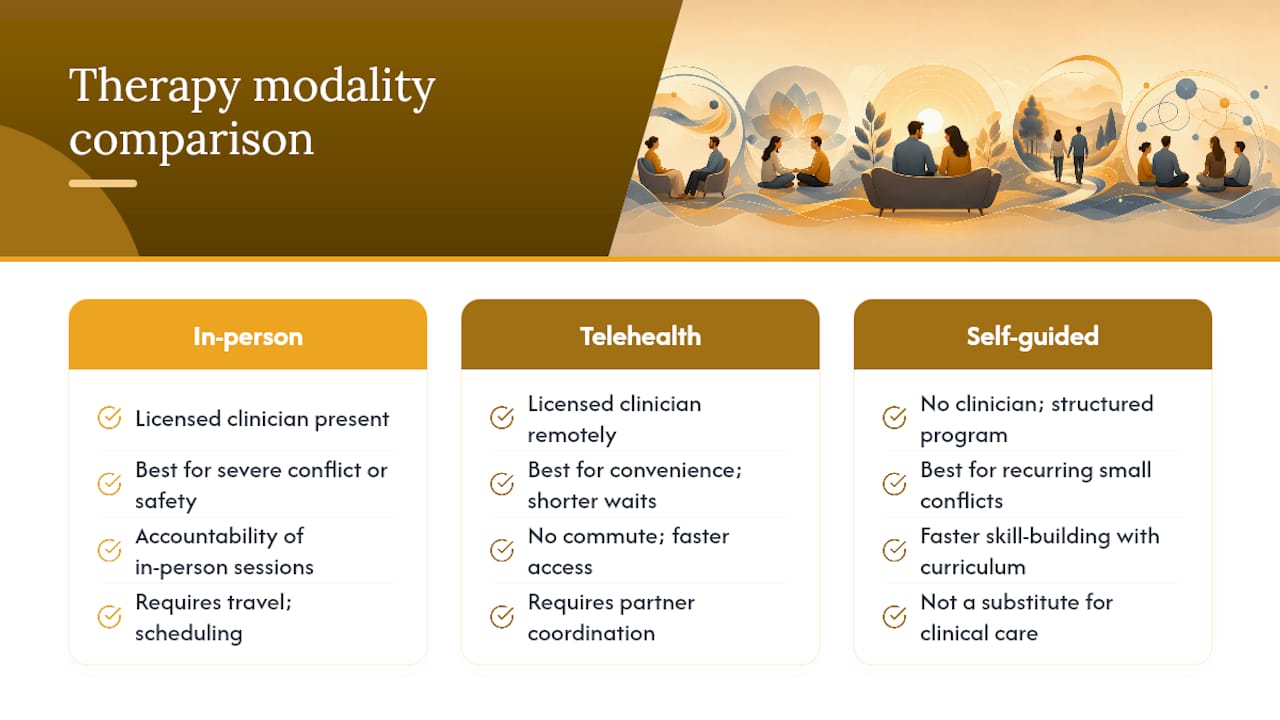
In-person therapy gives you a licensed clinician in the room, which matters most when conflict is severe, safety is a concern, or one partner is resistant and needs the accountability of a physical appointment. Telehealth through platforms like BetterHelp or Talkspace removes the commute and often shortens wait times, but couples therapy via video requires both partners to be in the same space or coordinate separate devices, which gets awkward fast.
Self-guided programs and structured online courses sit in a different lane entirely. They’re not a substitute for clinical care when you need it, but for couples who fight about the same three things on a loop and need practical communication tools, a structured curriculum often delivers faster skill-building than weekly 50-minute sessions. Matching the modality to your actual goal improves outcomes.
How to choose the right alternative: questions to ask and red flags
Questions to ask before you book
- Are you licensed in my state, and what is your specific training in couples therapy?
- How many couples have you worked with, and what modalities do you use?
- Do you accept my insurance, and what is your cancellation or refund policy?
- What does a typical session look like, and how do you handle it when one partner is more reluctant?
- How do you measure progress, and what does success look like after 8–10 sessions?
Red flags to walk away from
- No verifiable license or credential listed anywhere on the site
- Promises of guaranteed results or fixed timelines (“save your marriage in 30 days”)
- No privacy policy or HIPAA statement for telehealth services
- Vague or evasive answers about fees and cancellation terms
- A therapist who takes sides early or dismisses one partner’s concerns
Verify credentials through your state’s licensing board website, the American Counseling Association (ACA), or the American Association for Marriage and Family Therapy (AAMFT). Psychology Today’s directory confirms licensure as part of its listing process, which makes it a reliable starting point for finding local counseling services near you.
When should you choose in-person therapy, telehealth, or a structured program?
Choose in-person therapy when:
- Conflict has escalated to the point where safety is a concern
- One or both partners has a trauma history that needs clinical containment
- You’ve tried self-guided resources and the patterns haven’t shifted
Choose telehealth when:
- Geographic distance, disability, or work schedules make in-person sessions impractical
- You want faster access to a licensed therapist without a long waitlist
- Both partners are comfortable with video and have a private space at home
Choose a structured program or workshop when:
- Your core issue is communication skills, not acute crisis
- You’re premarital and want to build a conflict toolkit before problems compound
- You’re a faith-centered couple looking for a program that integrates your values
- You want to practice techniques between sessions rather than wait a week to try something new
Online couples therapy works well for long-distance couples or those with demanding schedules. Community-based and peer-led models offer a lower-stigma entry point for couples who aren’t ready for clinical therapy but want structured support.
Why Couplesfightschool is a recommended alternative for many couples
Couplesfightschool was founded by Carlos Todd and Natasha Pemberton-Todd, both licensed mental health professionals. The platform’s core framework, the F.I.G.H.T. Plan®, is a structured system covering communication, emotional regulation, conflict repair, and intimacy rebuilding. That structure is what separates it from generic relationship advice.
What the platform offers:
- Self-guided courses with conversation scripts and guided exercises couples can work through at their own pace
- A couples therapy workbook designed for use independently or alongside a clinician
- Private coaching sessions for couples who want direct, personalized guidance
- Workshops and seminars for groups, including faith-based and premarital formats
- Resources specifically built for high-conflict relationships, blended families, and Christian couples
Pro Tip: If you’re not sure where to start, the workbook is the lowest-commitment entry point. Many couples use it to identify their core conflict pattern before deciding whether they need coaching or a full course.
Couplesfightschool is best suited for couples who are motivated to do the work, want immediate tools rather than a waitlist, and prefer a structured program over open-ended weekly sessions.
Key Takeaways
The best alternative to lakeeriecentercounseling.com depends on your format preference, budget, and whether you need clinical care or skills-based relationship education.
| Point | Details |
|---|---|
| Check format first | Decide between in-person, telehealth, or self-guided before comparing providers. |
| Verify credentials | Confirm licensure through your state board, ACA, or AAMFT before booking. |
| Insurance is inconsistent | Many plans don’t cover couples therapy; ask about sliding scale or course-based options. |
| Timeline expectation | Meaningful progress typically takes 6–8 sessions or a 4–8 week structured course. |
| Couplesfightschool | Offers courses, workbooks, and coaching built around the F.I.G.H.T. Plan® framework for immediate, skills-first support. |
What I’ve learned from helping couples choose the right path
The most common mistake couples make when searching for a counseling alternative is optimizing for convenience instead of fit. They pick the first therapist with an opening or the cheapest subscription, sit through a few sessions that don’t click, and then conclude that “therapy doesn’t work for us.” It usually wasn’t therapy that failed. It was the match.
The second mistake is waiting for a crisis. Couples who seek structured help when the conflict is still manageable, before contempt sets in, get dramatically better results than those who wait until they’re in survival mode. A skills-first program like the F.I.G.H.T. Plan® is most effective when both partners still want to be in the room together. If you’re past that point, a licensed local clinician who specializes in high-conflict couples is the right call, and no online program should replace that.
For severe situations, including domestic violence, active addiction, or acute mental health crises, please contact a licensed clinical professional or crisis line directly. General relationship education is not a substitute for clinical intervention.
Couplesfightschool: a structured alternative you can start today
Most couples searching for therapy alternatives don’t need another waitlist. They need tools they can use this week. Couplesfightschool offers relationship counseling resources built by licensed clinicians, structured around the F.I.G.H.T. Plan®, and available immediately in multiple formats: self-guided courses, a couples therapy workbook, private online coaching, and workshops for faith-based, premarital, and high-conflict couples. No waitlist. No insurance forms. The Stop the Fighting course is a good first step for couples whose main issue is recurring conflict and communication breakdown. Browse the full program options at Couplesfightschool and pick the format that fits where you are right now.
Useful sources and where to learn more
- Beyond Talk Therapy: 18 Alternatives for Mental Health
- FRACTAL HOUSE | Join the Movement for Mad-Centered Healing
- Therapy & Psychiatry Covered by Insurance | PAWC
- One Small Step
- Bergen Counseling Collective – Therapy In Chicago
- Couples Fight School®
- couplesfightschool.com | couples therapy workbook
Recommended
- Alternatives to integrativecouplestherapy.com: Best Picks
- Top 4 DeeperConnecting.com Alternatives 2026
- Best Online Couples Therapy Alternatives for Long-Distance Relationships – Couples Fight School