Best Colorado Couples Clinic Alternatives for Denver Couples

If you’re looking for coloradocouplesclinic.com alternatives, the short answer is this: your best options fall into three categories. Local Denver-area clinics that specialize in EFT, sex therapy, or non-monogamy-friendly work. National telehealth platforms when scheduling flexibility matters more than geography. And Couplesfightschool’s courses and coaching when you want structured, skills-based work you can start this week without a waitlist.
Colorado Couples Clinic is a well-regarded Denver practice, but it’s not the only strong option, and it may not be the right fit for every couple’s approach, budget, or schedule. Here’s where to look next:
- Local specialty clinic: Contact a Denver-area practice with ICEEFT-certified or Gottman-trained clinicians if your issues involve attachment injuries, sexual concerns, or relationship structures outside monogamy.
- National telehealth platform: Try BetterHelp or a similar platform for evening/weekend availability and same-week access, especially if one partner travels or works irregular hours.
- Skills-first alternative: Start a Couplesfightschool online course or coaching program if you want immediate conflict-resolution tools, lower cost, and flexible pacing.
Table of Contents
- What are the best coloradocouplesclinic.com alternatives at a glance?
- Which alternative options actually fit your situation?
- How do you choose the right alternative for your relationship?
- What therapy approaches will you encounter?
- Why Couplesfightschool is a strong alternative worth considering
- Key Takeaways
- What actually matters when you’re choosing a couples therapist
- Couplesfightschool: a skills-first alternative you can start this week
- Sources and further reading
What are the best coloradocouplesclinic.com alternatives at a glance?
| Category | Format | Primary approaches | Credentials to look for | Cost shape | Best for |
|---|---|---|---|---|---|
| Local Denver specialty clinics | In-person, some telehealth | EFT, sex therapy, non-monogamy-friendly, trauma-informed | LMFT, LCSW, LPC, PsyD; ICEEFT certification, Gottman Level 2–3 | Typical session fee; limited insurance | Attachment injuries, sexual concerns, polyamory/ENM |
| Licensed private practitioners (Denver) | In-person or hybrid | Gottman-informed, IBCT, integrative | LMFT, LCSW, LPC; Gottman training levels | Typical session fee; some in-network | Moderate distress, flexible approach preference |
| National telehealth platforms | Fully remote | Integrative, CBT-informed, some EFT | Licensed in your state; verify couples-specific training | Subscription-based with weekly fees | Scheduling flexibility, long-distance, one partner reluctant |
| Low-cost directories / sliding-scale | In-person or telehealth | Varies widely | LMFT, LCSW, LPC; verify couples training | $30–$80/session sliding scale | Budget constraints, uninsured couples |
| Relationship education / coaching | Online, self-paced or live | Skills-based, F.I.G.H.T. Plan®, conflict resolution | Licensed mental health professionals as authors/coaches | One-time course or per-session coaching | Immediate skills, pre-therapy prep, complement to clinical work |
One-line fit guide:
- Local specialty clinic: best when your issue requires a specific clinical specialty (sex therapy, trauma, ENM).
- Private practitioner: best when you want a personal referral and a single consistent therapist.
- Telehealth platform: best when you need evening or weekend sessions and can’t commit to a fixed location.
- Low-cost directory: best when cost is the primary barrier.
- Couplesfightschool: best when you want structured skills work you can start immediately, at a fraction of the cost of weekly sessions.
Which alternative options actually fit your situation?
Local Denver-area specialty clinics
Denver has a real concentration of clinicians trained in Emotionally Focused Therapy (EFT) and Gottman Method work. If Colorado Couples Clinic wasn’t the right fit, look for practices that list ICEEFT certification or Gottman Level 2 or 3 training on their clinician profiles. Practices that explicitly serve LGBTQ+ couples, polyamorous and ethically non-monogamous (ENM) relationships, or couples dealing with sexual concerns are worth prioritizing if those are your needs. Most operate on a typical session length model, with some offering intensive formats over a weekend or two-day block.
Format: In-person (Denver/Lakewood/Aurora area), some hybrid telehealth.
Specialties: EFT, Gottman Method, sex therapy, trauma-informed, ENM-affirming.
Action: Search the ICEEFT therapist directory or the Gottman Referral Network filtered to Denver, CO, then call to confirm couples-specific training and current availability.
The Relationship Center of Colorado / Colorado Relationship Therapy
This Lakewood-based group practice is one of the more established Denver-area alternatives. Clinicians there work with a range of relationship structures and often carry Gottman training. It’s worth calling directly to ask about current waitlist times and whether they offer telehealth sessions for Colorado residents.

Licensed private practitioners in Denver
Solo practitioners often have more scheduling flexibility than group practices and may carry in-network insurance contracts that group practices don’t. The Psychology Today therapist finder, filtered to “couples” and your zip code, is the fastest way to build a list. Verify that any practitioner you contact has completed postgraduate couples-specific training, not just general licensure. A licensed counselor (LPC) or marriage and family therapist (LMFT) with no couples-specific training is a different thing from one who has completed a full EFT externship or Gottman training sequence.
National telehealth platforms
BetterHelp offers couples therapy through its platform with licensed therapists in Colorado. The subscription model runs lower per-session than most Denver clinics, and same-week matching is common. The tradeoff: you have less control over which specific therapist you’re matched with, and verifying couples-specific credentials takes a direct message to the therapist before your first session. For couples where one partner travels frequently or where both partners have demanding schedules, online couples therapy through a telehealth platform often removes the single biggest barrier to starting.
Open Path Collective (low-cost directory)
Open Path Collective is a nonprofit therapist directory that connects clients with licensed therapists offering sessions at reduced rates, typically $30–$80 per session for individuals and couples. Therapists list their specialties, so you can filter for couples work and EFT or Gottman training. It’s one of the most practical options for couples who need clinical therapy but face a cost barrier.
Couplesfightschool (relationship education and coaching)
Couplesfightschool is built around the F.I.G.H.T. Plan® framework, developed by licensed mental health professionals Carlos Todd and Natasha Pemberton-Todd. It’s not a therapy replacement for couples in acute crisis, but it’s a strong fit for couples who want structured communication tools, conflict-resolution skills, and coaching-compatible resources. The couples therapy workbook and online courses let you work at your own pace. The RESTORE® infidelity recovery program addresses one of the most common reasons couples seek specialized help. Coaching sessions are available for couples who want live guidance without committing to weekly clinical therapy.
Format: Online, self-paced courses; live coaching; workbooks; workshops.
Specialties: Conflict resolution, communication, emotional safety, infidelity recovery, premarital, Christian couples, blended families.
Action: Enroll in a course or book a coaching session directly at couplesfightschool.com.
How do you choose the right alternative for your relationship?
The single most important factor is therapeutic alliance: how safe, heard, and comfortable both partners feel with the provider. Research consistently shows this predicts outcomes better than credentials alone. That said, credentials and couples-specific training still matter. A general license without specialized couples training is a real gap.
Practical checklist when vetting a provider:
- Licensed in Colorado (LMFT, LCSW, LPC, PsyD, or PhD)
- Completed postgraduate couples-specific training (EFT externship, Gottman Level 2+, IBCT training)
- Explicitly lists couples therapy as a primary service, not a side offering
- Experience with your specific concern (sex therapy, ENM, infidelity, trauma, premarital)
- Clear fee structure and insurance/sliding-scale policy stated upfront
- Offers an initial consultation (free or paid) before committing to ongoing sessions
- Both partners feel neutral or positive about the therapist after the first session
Questions to ask in your first contact call:
- What is your specific training in couples therapy, beyond your general license?
- Are you ICEEFT-certified or Gottman-trained, and at what level?
- Have you worked with couples dealing with [your specific issue]?
- How do you handle it when one partner feels the sessions are biased toward the other?
- What does your first session look like, and do you meet with us together or separately first?
- What is your fee, and do you accept insurance or offer a sliding scale?
- Is your initial consultation free or paid, and how long is it?
- How do you define success in couples therapy, and how will we know if it’s working?
- What happens if one partner wants to stop and the other doesn’t?
- Do you have evening or weekend availability?
Red flags that should stop the process:
- Takes a clear side with one partner in early sessions
- Dismisses safety concerns or minimizes conflict patterns
- Pressures you to commit to a long package without clear goals
- Cannot name a specific couples-therapy training or certification
- Sees couples therapy as an extension of individual therapy with two people in the room
On fees: Ask directly. “Do you accept insurance for couples therapy?” is worth asking because many insurers cover individual therapy but not couples therapy specifically. Ask about out-of-network reimbursement (a superbill), sliding-scale availability, and whether the initial consult is billed. Harvard Health guidance recommends treating therapy as a proactive investment rather than a last resort.
Pro Tip: Ask the therapist how they handle confidentiality if one partner discloses something privately. A clear policy here tells you a lot about how they manage the complexity of working with two clients at once.
What therapy approaches will you encounter?
Most Denver-area clinicians and national telehealth therapists draw from a handful of well-researched models. Knowing what each does helps you match a provider’s stated approach to your actual problem.
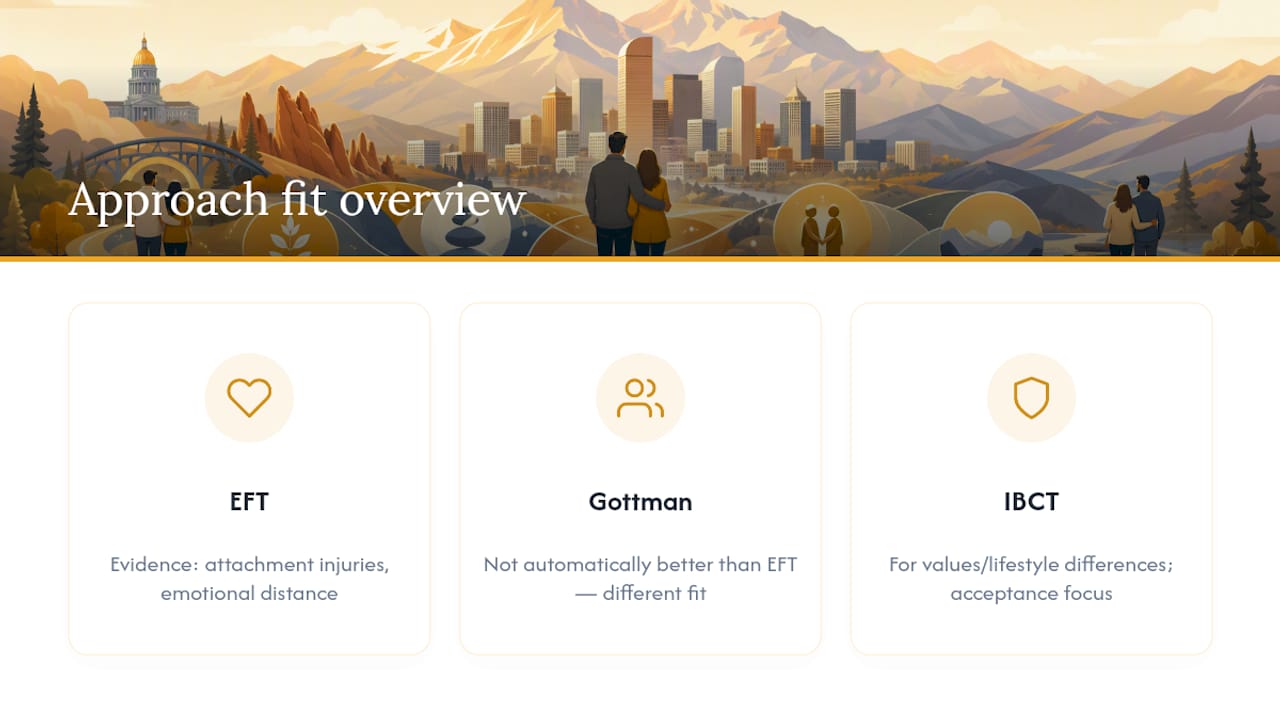
Research on evidence-based couple therapies identifies EFT and IBCT as among the strongest-supported approaches for relationship distress.
- Emotionally Focused Therapy (EFT): Targets the attachment bond between partners. Works by identifying negative interaction cycles (pursue-withdraw, for example) and helping partners express underlying emotional needs. Strong evidence for attachment injuries, affairs, and persistent emotional distance. Look for ICEEFT certification.
- Integrative Behavioral Couples Therapy (IBCT): Combines behavior change with acceptance strategies. Particularly useful when partners have fundamental differences that need to be accepted rather than resolved. Less focused on attachment, more on patterns and tolerance.
- Gottman Method: Built on decades of observational research. Focuses on friendship, conflict management, and shared meaning. The Gottman Institute trains and certifies therapists at multiple levels. Gottman-informed work is common in Denver practices.
- Sex therapy: A specialty that requires additional training beyond a general couples-therapy credential. If sexual concerns are central to your relationship distress, prioritize a therapist with AASECT certification or equivalent.
- Integrative/common-factors practice: Most experienced clinicians blend models rather than applying one rigidly. The field has moved toward this approach, and a therapist who draws from EFT, Gottman, and CBT-informed techniques is not being inconsistent. What matters is that they have couples-specific postgraduate training, not that they follow one model exclusively.
Research also supports brief, structured relationship-education programs as effective for mild to moderate distress, which is where Couplesfightschool’s courses and coaching fit.
Why Couplesfightschool is a strong alternative worth considering
Couplesfightschool is a practical, evidence-informed option for couples who want skills-based work, flexible pacing, and coaching-compatible resources. It works alongside clinical therapy or independently for couples who aren’t ready for, or don’t need, weekly sessions with a clinician.
What’s available and what it addresses:
- Couples therapy workbook: — guided reflection and communication exercises couples can work through between sessions or independently.
- RESTORE® infidelity recovery program: — a structured program for couples navigating betrayal and rebuilding trust.
The F.I.G.H.T. Plan® framework gives couples a repeatable system for conflict, emotional regulation, and reconnection. That kind of structured framework is what most couples lack when they first seek help. Understanding why a conflict resolution framework matters is often the first step toward real change.
Couplesfightschool complements clinical therapy well. Therapists assign homework; Couplesfightschool’s workbooks and courses are exactly the kind of structured practice that makes that homework stick. For couples on a waitlist, starting a course now means you arrive at your first therapy session with a shared vocabulary and some early wins.
Book a coaching session or enroll in a course to get started.
Key Takeaways
The strongest alternatives to Colorado Couples Clinic are local Denver specialty clinics with ICEEFT or Gottman credentials, national telehealth platforms for scheduling flexibility, and Couplesfightschool for immediate skills-based work at a lower cost.
| Point | Details |
|---|---|
| Therapeutic alliance first | Research shows comfort and trust with the provider predicts success more than credentials alone. |
| Verify couples-specific training | A general license (LMFT, LCSW, LPC) without postgraduate couples training is a meaningful gap. |
| 60–80% improvement rate | Meta-analyses show most distressed couples improve after structured therapy over 3–12 months. |
| Telehealth fills the gap | National platforms offer same-week access and evening availability when Denver clinics have waitlists. |
| Couplesfightschool | Offers courses, coaching, and the RESTORE® program as a skills-first alternative or therapy complement. |
What actually matters when you’re choosing a couples therapist
Most articles about couples therapy alternatives spend too much time on brand names and not enough on the thing that actually determines whether therapy works: whether both partners feel safe enough to be honest in the room. A therapist with an impressive credential list who subtly sides with one partner will produce worse outcomes than a less-decorated clinician who holds both partners with genuine neutrality.
The shortlist in this article is organized around approach fit and format, not reputation. That’s deliberate. A Gottman-trained therapist is not automatically better than an EFT-trained one. They’re better for a different problem. If your core issue is emotional distance and an attachment injury, EFT has the stronger evidence base. If your core issue is a fundamental difference in values or lifestyle that needs acceptance rather than resolution, IBCT is the better fit. Matching the model to the problem is the decision most couples skip because they don’t know enough to ask.
Couplesfightschool exists for couples who want to do that skills work without waiting for a therapy slot, or who want to keep practicing between sessions. The F.I.G.H.T. Plan® isn’t a substitute for clinical care when clinical care is what’s needed. It’s a way to stay in motion.
Couplesfightschool: a skills-first alternative you can start this week
If you’ve been comparing relationship counseling options and want something you can act on today, Couplesfightschool offers a direct path. The Stop the Fighting course gives couples a structured, session-by-session framework for breaking recurring conflict cycles, built by licensed mental health professionals and grounded in the same evidence base as clinical couples therapy.
No waitlist. No insurance forms. You work through it at your own pace, together or with a coach. For couples who need a Denver-area clinic, Couplesfightschool works as a bridge while you wait for an opening, or as a standalone resource if weekly therapy isn’t the right fit right now. Book a coaching session or enroll in the course and start building the skills your relationship needs.
Sources and further reading
- How long are therapy sessions? | Headway Care
- Couple therapy and systemic interventions for adult‐focused problems: The evidence base – Journal of Family Therapy
- Could couples therapy be right for you? | Harvard Health
- Therapeutic alliance and treatment outcomes – PMC
- Trends toward integrative and common-factors approaches in couples therapy | PubMed
- Couple therapy and systemic interventions for adult‐focused problems: The evidence base – Family Process
- Meta-analyses on couples therapy outcomes | PubMed
- Couples Therapy: How It Works, What to Expect, and When to Go (2026) | Simply Psychology
Recommended
- Best Online Couples Therapy Alternatives for Long-Distance Relationships – Couples Fight School
- Alternatives to integrativecouplestherapy.com: Best Picks
- StripeM-Inner