
Relationship Counseling for Couples: Skills to Stop the Fighting

Relationship counseling, as used here, means coach-led education: structured programs, workbooks, and online courses that teach couples real communication skills, conflict tools, and intimacy habits. Not open-ended clinical therapy. If your relationship is safe but stuck, the most direct path forward is Couples Fight School® and its F.I.G.H.T. Plan® framework, built by licensed mental health professionals and designed around the same research that shows healthy couples maintain roughly a 5:1 ratio of positive to negative interactions. Start with a starter course or workbook and you can be practicing new tools within a week.
Table of Contents
- What does relationship counseling actually teach you?
- What formats and timelines should you expect?
- How do you pick the right program for your relationship?
- What does the research say about outcomes?
- What relationship education helps with — and when to stop and get clinical help
- Why Couplesfightschool — and what the F.I.G.H.T. Plan® actually does
- Key Takeaways
- What most couples get wrong about relationship education
- Where to start with Couplesfightschool
What does relationship counseling actually teach you?
The core of any good coach-led program is skill transfer, not just insight. Couples leave knowing how to do something differently, not just why they fight.
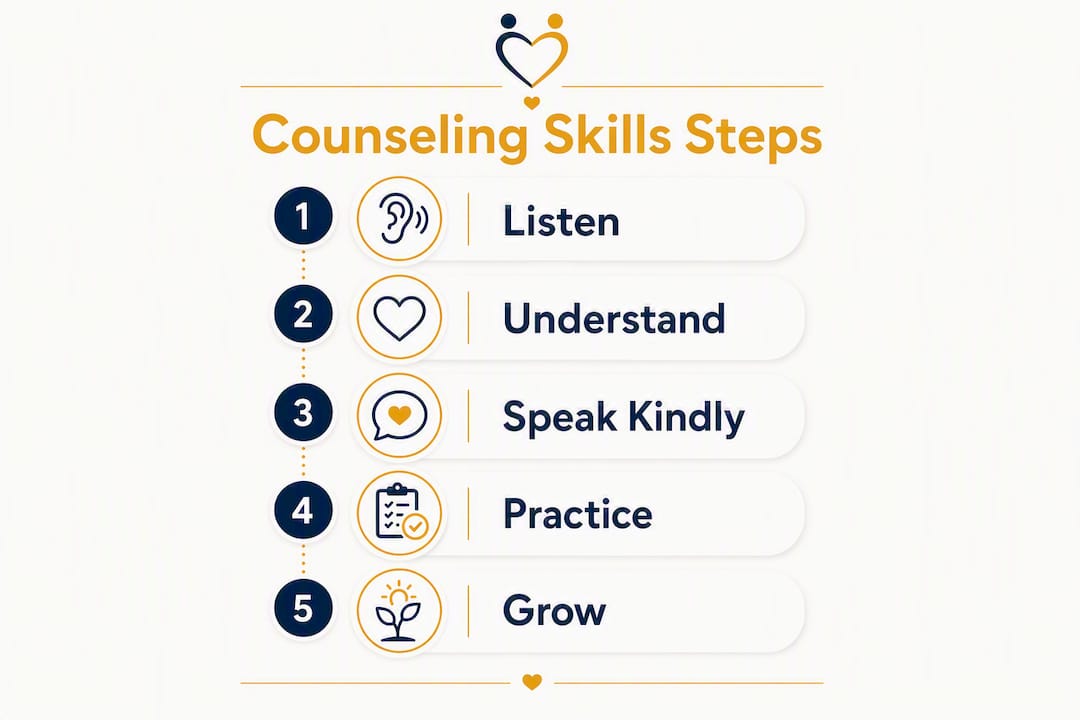
The main skill categories covered in quality relationship education:
- Structured communication frameworks: Conversation protocols that slow escalation, including softened start-ups. Research shows the first three minutes of a conflict strongly predict whether it resolves or blows up.
- Emotional regulation: Recognizing flooding before it shuts down productive conversation, and using pause-and-return techniques.
- Repair attempts: Learning to spot and accept micro-repair bids (a joke, a soft apology, a hand on the shoulder) even when emotions are running high.
- Boundary and agreement setting: Creating shared rules for conflict so neither partner feels ambushed.
- Intimacy-building habits: Weekly maintenance routines and intimacy-building activities that rebuild the emotional bank account between hard conversations.
The 5:1 positive-to-negative ratio is not a feel-good statistic. It is a behavioral target. Programs translate it into concrete daily practices: appreciation rituals, check-in scripts, and timed exercises couples can run in under ten minutes. That specificity is what separates education from generic relationship advice.
What formats and timelines should you expect?
Coach-led relationship education comes in several shapes, and the right one depends on how much accountability you need.

Self-guided workbooks are the lowest barrier to entry. A therapist-created couples therapy workbook gives you structured exercises to work through at your own pace, typically over four to eight weeks. Good for couples who are disciplined and want a low-cost starting point.
Self-paced online courses add video instruction and guided reflection. Most run four to eight weeks of content. The risk is the same as any self-paced learning: life interrupts, and completion drops without external accountability.
Coach-supported online programs pair curriculum with short coach check-ins. Studies of programs like ePREP and OurRelationship found that roughly six to seven hours of online content delivered over six weeks, combined with about one hour of coach contact spread across short calls, produced measurable improvements in relationship satisfaction six months later. Completion rates in those trials ranged from the low to high 60 percent range, with coach presence consistently trending toward higher engagement.
Live workshops and coaching intensives compress the work into one to three days or a small number of focused sessions. These suit couples who want fast traction or are navigating a specific transition (engagement, blended family formation, post-affair recovery).
Pricing across the U.S. market follows three basic models: one-time course fees, per-session coaching fees, and bundled workbook-plus-coach packages. Exact amounts vary by provider and program depth.
Pro Tip: If you know you will procrastinate without structure, choose a program with scheduled coach check-ins. Research from the Administration for Children and Families confirms that structured coach contact materially increases both completion and engagement in online relationship education.
How do you pick the right program for your relationship?
Start with one decision rule: if the relationship is safe and you want skills, relationship education fits. If there is active trauma, a mental health condition driving the conflict, or any safety concern, pause and seek couples therapy first. Education and therapy can run in parallel when providers coordinate, but education alone is not a substitute for clinical care.
Once you have confirmed education is the right fit, work through this checklist:
- Relationship state: Are both partners willing and safe? Education requires voluntary, good-faith participation from both people.
- Learning style: Do you learn better through video, reading, or live conversation? Match the format to how you actually absorb information.
- Accountability needs: Be honest about whether you will finish a self-paced course. If the answer is probably not, prioritize coach contact.
- Evidence base: Ask whether the curriculum is grounded in peer-reviewed research or a proprietary framework with documented outcomes.
- Faith compatibility: If faith shapes your values, look for programs with explicitly faith-based materials. Couplesfightschool offers Christian-focused resources.
- Budget and scheduling: Confirm the time commitment per week and total cost before enrolling.
Questions worth asking any program or coach before you buy:
- What are the coach’s credentials and training?
- How many coach contacts are included, and how are they scheduled?
- What is the weekly time commitment?
- Is there a refund or pause policy?
- How is session content kept confidential?
- What happens if we need a referral to clinical care?
Red flags to walk away from: programs that promise guaranteed results, coaches with no referral policy for clinical needs, curricula with no measurable milestones, and any program that discourages you from also working with a therapist if you need one.
What does the research say about outcomes?
The evidence base for relationship education is real, though it is worth understanding the scale of likely change before you start.
A meta-analysis of marriage and relationship education found effect sizes in the small-to-moderate range for relationship quality (small-to-moderate range) and larger effects for communication skills (larger effects). Those numbers mean most couples see genuine improvement, not dramatic transformation overnight.
| Outcome | Effect Size Range | Source |
|---|---|---|
| Relationship quality | small-to-moderate range | MRE meta-analysis |
| Communication skills | larger effects | MRE meta-analysis |
| Relationship satisfaction (ePREP/OurRelationship) | Measurable at 6 months | University of Miami evaluation |
| Program completion with coach contact | 60–68% | University of Miami evaluation |
Premarital education shows some of the strongest outcomes. Program evaluations have found that addressing expectations before marriage reduces later separation risk, which makes the NARME research particularly relevant for engaged couples.
Realistic expectations: couples who engage actively and complete the program tend to see modest to moderate improvements in how they communicate and how satisfied they feel. The gains are real. They are not magic.
What relationship education helps with — and when to stop and get clinical help
Relationship education reliably addresses:
- Communication breakdowns and stuck argument patterns
- Goal-setting and shared vision work
- Intimacy habits and emotional connection
- Transition planning (engagement, new baby, blended family)
- Identifying harmful communication patterns like criticism and stonewalling
It does not treat clinical mental health disorders, active trauma, addiction, or domestic violence. Those situations require licensed clinical care, not a workbook.
Stop and seek specialized help if any of these apply:
- Threats or physical aggression of any kind
- One partner is afraid of the other
- Active substance use is driving conflict
- Suicidal ideation or self-harm is present
- A diagnosed mental health condition is untreated
Education and therapy can be complementary when both providers know about each other and agree on the approach. That coordination matters.
Why Couplesfightschool — and what the F.I.G.H.T. Plan® actually does
Couplesfightschool was founded by Carlos Todd and Natasha Pemberton-Todd, both licensed mental health professionals. That credential matters because the curriculum is built on clinical knowledge, not just coaching intuition.
The F.I.G.H.T. Plan® is the organizing framework across all Couplesfightschool programs. It covers conversation structure, emotional regulation, repair, and follow-through in a sequence couples can return to every time conflict surfaces. Repeatable is the key word. You are not learning a one-time technique; you are building a habit.
Couplesfightschool offers workbooks, self-paced online courses, coach-supported programs, live workshops, seminars, and faith-based materials for Christian couples. The coach-supported track reflects the same design principle the research supports: accountability and human contact increase completion and results.
Key Takeaways
Coach-led relationship education gives couples a structured, evidence-informed path to better communication and less conflict, with the strongest results coming from programs that include coach contact and active participation.
| Point | Details |
|---|---|
| Education vs. therapy | Choose education when the relationship is safe but stuck; seek clinical care when trauma, safety, or mental health concerns are present. |
| Coach contact matters | Programs with structured coach check-ins show higher completion and engagement than fully self-paced options. |
| Realistic outcomes | Meta-analysis shows effect sizes of small-to-moderate range for relationship quality and larger effects for communication skills. |
| Start-up predicts escalation | The first three minutes of a conflict predict its trajectory; softened start-ups are a teachable, high-leverage skill. |
| Couplesfightschool | Offers the F.I.G.H.T. Plan® framework across workbooks, courses, and coach-supported programs for all couple types. |
What most couples get wrong about relationship education
Most people wait too long. They treat relationship education as a last resort, something you try after years of the same argument on loop. The research points the other way: premarital education reduces separation risk precisely because it works on expectations before resentment calcifies. The couples who get the most out of programs like the F.I.G.H.T. Plan® are not the ones in crisis. They are the ones who show up before the crisis, willing to practice.
The other mistake is treating insight as a substitute for skill. Understanding why you fight does not stop the fight. A structured framework you can reach for at 10 PM on a Tuesday, when you are flooded and your partner just said the thing, does. That is what a repeatable system gives you.
Where to start with Couplesfightschool
Couplesfightschool offers a clear entry point for every couple type. The Stop the Fighting course is the most direct starting point for couples who want structured, coach-informed curriculum they can work through together. For couples who want human accountability built in, the online coaching for couples track pairs curriculum with scheduled coach contact. Prefer to start with a physical tool? The therapist-created workbook gives you guided exercises without a screen.
In your first week, focus on one skill: the softened start-up. Before raising any issue, take thirty seconds to frame it around your experience rather than your partner’s behavior. That single shift, practiced consistently, changes the trajectory of most arguments.
Faith-based couples can explore Christian-focused materials built into the same F.I.G.H.T. Plan® framework. Engaged couples have a dedicated premarital track. Blended families and high-conflict relationships have resources designed for their specific dynamics.
Start where you are. The relationship skills resource is a good first read. Then pick a format and begin.
Recommended