
24 Hour Rule to Stop Checking Your Partner’s Phone: Therapist Backed

Stop checking your partner’s phone right now and replace that habit with one specific action: put your phone in a communal spot during trigger moments, and schedule a direct conversation with your partner this week about what is driving the urge. Carlos Todd and other therapist-founded resources exist precisely for this kind of work. This is not a one-day fix. Expect a mix of behavioral change and emotional repair that plays out over days to months.
TL;DR:
- Weaker trust, insecure attachment, and past betrayals typically fuel the urge to snoop, which rarely satisfies underlying anxiety or insecurity.
- Short-term fixes like creating phone-free zones, implementing delays, and tracking urges can help break the pattern within 24 hours.
- Addressing the root causes of distrust and insecurity through therapy and structured communication is essential for long-term trust rebuilding.
- Conversations about privacy and boundaries should be specific and collaborative to prevent further escalation and maintain relationship safety.
Table of Contents
- Why checking your partner’s phone harms relationships
- Short-term steps that stop the checking habit today
- Rebuilding trust means working on more than the habit
- How to talk to your partner about trust and privacy
- When to bring in professional support
- What I’ve seen work when people finally stop snooping
- Structured support if you want a guided path
- FAQ
- Sources
Why checking your partner’s phone harms relationships
Snooping feels protective in the moment, but the research runs the opposite direction. A PubMed indexed study on phone snooping and relationship outcomes followed 389 people and found that snooping had a direct effect on the intention to break up (β = .272, p ≤ .001). The behavior does not settle anxiety. It tends to generate the very outcome it was meant to prevent.
A related study of 329 married individuals, Influence of Lack of Trust on Romantic Relationship Problems: The Mediating Role of Partner Cell Phone Snooping, found that a lack of trust predicts relationship problems (β = .36, p < .01), and that snooping partially mediates the link between distrust and conflict or breakup intention. Distrust does not stay quiet. It leaks into behavior, and the behavior then does its own damage.
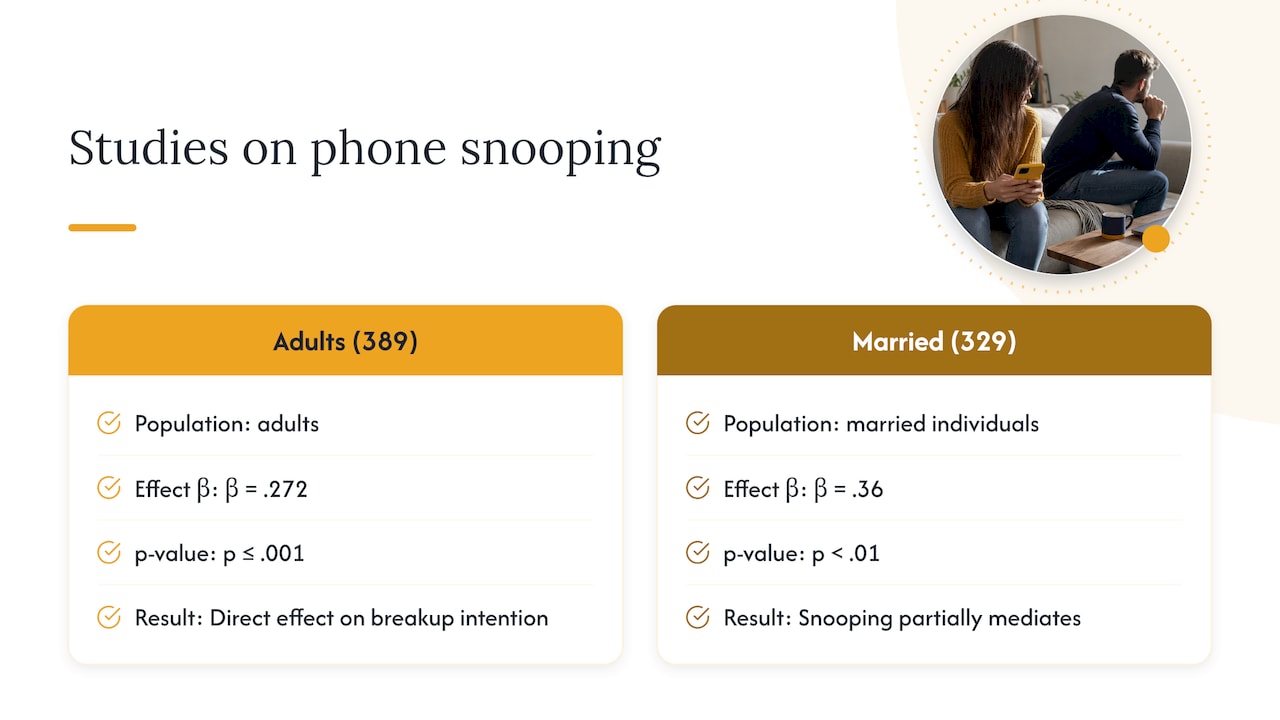
Snooping measurably raises breakup intention, with a direct effect of β = .272 (p ≤ .001) in a sample of 389 adults, according to the PubMed indexed study above. That is not a correlation you can shrug off as coincidence.
The psychological drivers behind the urge are usually insecure attachment, a past betrayal (in this relationship or an earlier one), or generalized anxiety that latches onto a phone as a stand-in for uncertainty. None of those make the behavior wrong to feel the pull toward. They do explain why checking a phone once rarely satisfies the anxiety. It tends to need checking again.
Frequent snooping often hides unresolved trauma or attachment wounds. Addressing those directly in therapy reduces the urge to surveil, not just the behavior itself.
It helps to separate privacy from secrecy. A Psychology Today piece on this distinction notes that healthy relationships can preserve privacy without deception. The useful test: does the withheld information change a shared obligation, is it something illegal or dangerous, and is there a pattern of repeated deception. If the answer to all three is no, what looks like secrecy may just be a reasonable boundary.
Short-term steps that stop the checking habit today
Breaking an ingrained checking habit works best with friction and structure, not willpower alone. These are changes you can start within the next 24 hours.
- Create a phone-free zone. Put both phones in a communal basket during dinner, the first hour home, and the last hour before bed.
- Add friction to access. Turn on a screen-time lock or move social and messaging apps off your home screen so a check requires deliberate effort, not a reflex tap.
- Set a 24-hour delay rule. When the urge hits, commit to waiting a full day before acting on it; most urges fade well before the deadline.
- Track the urge instead of acting on it. Keep a short log: time, trigger, intensity (1 to 10), and what you did instead.
- Tell one trusted person. A friend, a coach, or a therapist who knows you are working on this can hold you accountable when the urge spikes.
When an urge hits hard, a breathe-count technique works better than fighting it head-on: inhale for four counts, hold for four, exhale for six, repeat five times. Pair that with a two-minute journal entry naming what you were actually afraid of, which is almost never “what is literally on this screen” but something closer to “am I safe in this relationship.” For low-effort distraction, a short walk, a text to a friend, or even loading the dishwasher can absorb the three or four minutes an urge typically needs to pass.
For practical, day-to-day conflict reduction while you build these habits, our guide on dealing with relationship issues right now covers immediate steps that pair well with the urge-tracking above.
Pro Tip: Write your commitment on paper, not just in your head: “When I feel the urge to check, I will wait 24 hours and journal first.” A written script is easier to follow under stress than a mental note.
Rebuilding trust means working on more than the habit
Stopping the checking is the easy part compared to addressing what drives it. Insecure attachment, in particular, tends to generate catastrophic thinking: a delayed text reply becomes evidence of betrayal before any facts are in. Reducing that pattern takes deliberate practice, not just restraint.
- Label the emotion before reacting. Naming the feeling (“I feel anxious,” not “something is wrong”) slows the jump from sensation to accusation.
- Build a self-soothing routine you can use anywhere. A short walk, a call to a friend, or a grounding exercise works better in the moment than a scroll through someone else’s messages.
- Practice cognitive reframing. Ask yourself what else could explain the behavior you are reacting to, and list at least two alternatives to the worst-case story.
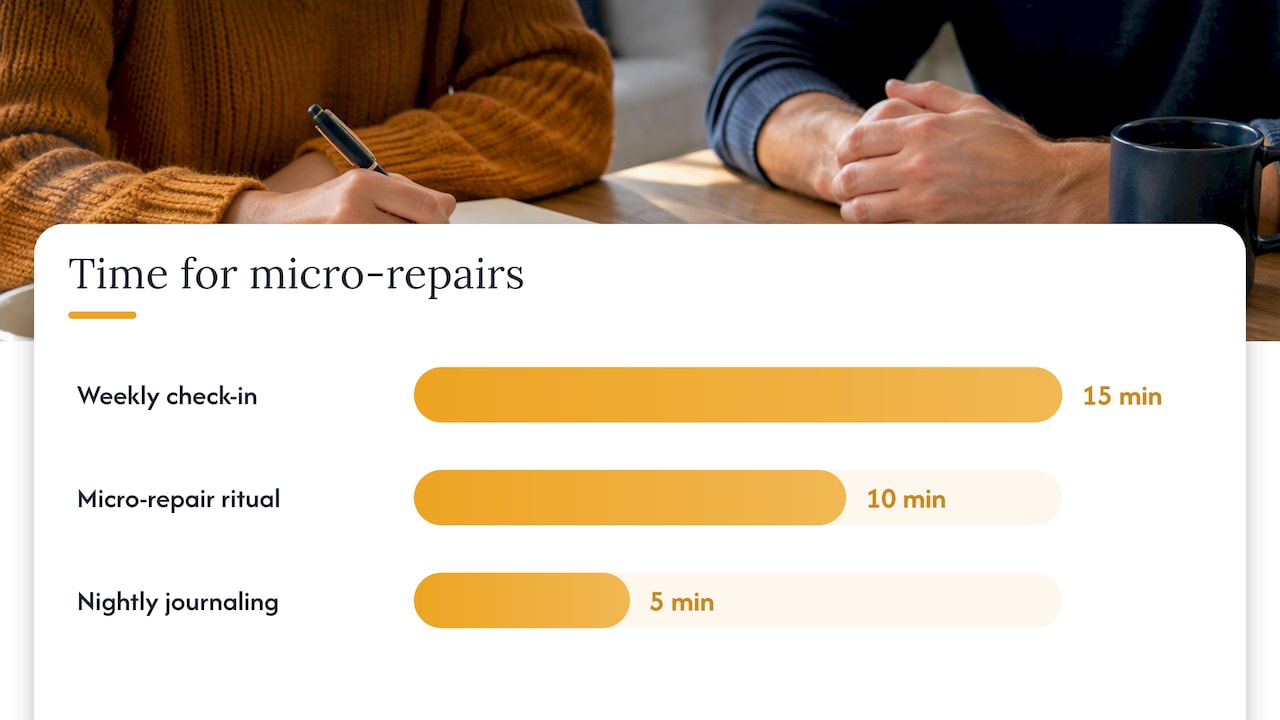
- Use weekly check-ins. A 15-minute conversation where each partner shares one worry and one appreciation keeps small issues from becoming hidden ones.
We use a framework that builds structured communication and emotional regulation into repeatable steps rather than leaving repair to chance in the heat of an argument. One piece worth borrowing on your own: a short “micro-repair” ritual after any boundary breach, where each partner states what happened, how it felt, and the next small step to restore safety. Ten minutes, done consistently, tends to prevent the kind of long-simmering resentment that fuels snooping in the first place.
Readers managing anxious attachment specifically may find it useful to start with a breakdown of anxious attachment style, its triggers, and healing practices, since the self-work above lands differently depending on your attachment pattern.
Pro Tip: Keep a running journal template with three prompts: what triggered me today, what story did I tell myself, and what is the evidence for and against that story. Five minutes a night builds the reframing skill faster than trying to do it only during a crisis.
How to talk to your partner about trust and privacy
The conversation matters as much as the behavior change. Vague complaints (“I just don’t trust you”) invite defensiveness. According to a Psychology Today piece on relationship communication, concrete, specific language reduces defensiveness and invites collaboration far more reliably than general accusations do.
Try opening with something close to this:
- “I’ve noticed I’ve been checking your phone, and I want to stop. Can we talk about what’s underneath that for me?”
- “When you were out late last week without a text, I felt anxious and started imagining the worst. I’d rather tell you that than check your phone.”
- “I want us to agree on what privacy looks like for both of us, so I’m not guessing.”
A simple phone and privacy agreement can lower the temperature on both sides:
- Agree on what stays private (personal journaling apps, unrelated friend chats) versus what affects the relationship directly.
- Set a review cadence, such as a monthly check-in on how the agreement is working, rather than ongoing surprise checks.
- Decide in advance what happens if either partner suspects a breach: a direct conversation first, not a unilateral search.
If a conversation about boundaries triggers coercion, surveillance of you in return, or retaliation, treat that as a red flag, not a communication failure on your part. That pattern calls for safety planning and professional support rather than more negotiation. For more on setting boundaries that hold up under pressure, this partner piece on the importance of setting boundaries offers a useful companion perspective, and our own guide to diffusing conflict with your partner covers de-escalation language for the moments the conversation gets tense.
When to bring in professional support
Self-directed work solves a lot of this, but not all of it. A few signals suggest it is time to involve a therapist or structured program rather than continuing to white-knuckle it alone.
- You’ve tried the behavioral steps and the urge keeps winning. Repeated relapse after weeks of genuine effort usually points to something deeper than habit.
- There’s a trauma history involved, yours or a past betrayal in this relationship, that keeps resurfacing regardless of reassurance.
- Your partner’s reaction raises safety concerns, including controlling behavior, retaliation, or escalating anger.
Individual therapy typically focuses on the anxiety and attachment piece directly. Couples therapy or a skills-based program addresses the shared communication patterns that let distrust take root in the first place. When choosing a therapist or program, ask about their approach to trust repair specifically, their expected timeline, and what homework or practice they require between sessions. For infidelity-specific situations, A RESTORE infidelity recovery counseling resource outlines what that process tends to involve.
What I’ve seen work when people finally stop snooping
Most people who snoop aren’t trying to control their partner. They’re trying to manage a fear they haven’t named out loud yet. The clients who make real progress aren’t the ones who grit their teeth through the urge forever. They’re the ones who swap the phone check for a direct, slightly uncomfortable conversation, over and over, until it stops feeling risky. Give it weeks of consistent practice before judging whether it’s working, and lean on structured help, like the F.I.G.H.T. Plan®, if you keep sliding back.
— Carlos
Structured support if you want a guided path
Breaking a snooping habit on your own is possible, and plenty of readers do it with the steps above. If you want a more guided path, we built our courses and coaching specifically around this kind of trust repair. The Stop the Fighting: The Couples Communication & Conflict Resolution Course teaches the communication skills behind the scripts in this article, while the 6 Hours Couples Intensive is built for couples who need faster, structured repair after a trust breach. For a more personalized plan, VIP Private Coaching walks you through this work with direct guidance.

These sit alongside, not instead of, individual or couples therapy when deeper trauma or safety concerns are involved. Start with our shop to see which course fits where you are right now.
This article is general information, not a substitute for advice from a qualified doctor. Consult a qualified healthcare professional about your own circumstances before acting on anything here.
FAQ
Is checking your partner’s phone a red flag?
Occasional checking driven by a specific worry is common, but a pattern of habitual snooping is linked with higher relationship conflict and breakup intention in peer-reviewed research. It is less a red flag about your partner and more a signal that the underlying trust or anxiety issue needs direct attention.
Is it unhealthy to check your partner’s phone?
Repeated, secretive checking is associated with worse relationship outcomes rather than better ones, according to research on phone snooping in married couples. A single moment of checking is less the issue than the ongoing pattern and what it replaces: an honest conversation.
What are the three signs a relationship won’t last?
There is no single, universally agreed list, but researchers point to persistent distrust, poor communication patterns, and recurring, unresolved conflict as factors tied to relationship breakdown. The study on trust and relationship problems specifically ties low trust to worse relationship outcomes when it goes unaddressed.
Can a relationship survive snooping?
Yes, many relationships recover after snooping is disclosed and addressed directly, especially when both partners work on the underlying trust issue rather than just stopping the behavior. A Psychology Today piece on the topic notes that snooping itself tends to worsen outcomes, which makes early, honest repair more effective than letting it continue unaddressed.
Sources
- PubMed indexed study on phone snooping and relationship outcomes
- Influence of Lack of Trust on Romantic Relationship Problems: The Mediating Role of Partner Cell Phone Snooping
Recommended
- Stop Escalation in 20–45 Min: Therapist Scripts for Couples’ Time Outs
- Boundaries After Betrayal: Therapist Tools and a 30–90 Day Plan
- 30–90 Day Behavior First Transparency Plan After an Affair
- Stop a Fight Tonight: Clinician Backed Emotional Regulation for Couples