
Submission and Respect in Marriage: What It Means

In a Christian marriage, submission is a choice to honor and support your spouse’s leadership out of trust in Christ. It is not a surrender of your voice, your judgment or your conscience. Respect is how that choice shows up in daily speech and decisions. Couples run into trouble when they hear these words as a ranking of who matters more. The words describe how two people treat each other, and the passage they come from asks both spouses to give something up.
This guide is for wives and husbands who want a clear, workable picture: what the key passage says, how well-known evangelical teachers define the terms, what mutual submission looks like in a real disagreement, and where healthy leadership ends and control begins.
TL;DR
- Submission in marriage is a freely chosen attitude of honoring a spouse’s leadership. Leading authors on the traditional view say it is not absolute surrender and never means following a spouse into sin.
- Ephesians 5:21 asks all believers to submit to one another, and the instruction to wives comes right after it.
- Respect is not agreement. You can respect your spouse and still say “I see this differently.”
- Healthy headship and submission leave both spouses heard. If one partner is silenced, frightened or controlled, that is a safety question, not a theology question.
- Couples can practice this with agreed conversation rules, a pause habit and a shared way of making decisions.
Table of Contents
- What submission means in a Christian marriage
- What the passage says about mutual submission
- Respect is not the same as agreement
- Everyday examples of submission and respect
- How to handle disagreements without silencing anyone
- Why Christian couples still struggle with it
- Submission is not control or abuse
- Practical habits that build submission and respect
- Our perspective
- Where to start if you want help
- FAQ
- Sources
What submission means in a Christian marriage
The most quoted passage is Ephesians 5:22-33. Wives are told to submit to their husbands “as to the Lord,” husbands are told to love their wives as Christ loved the church, and the passage closes by asking the husband to love and the wife to respect. Read quickly, it sounds like a chain of command. Read slowly, it describes two different gifts, each aimed at what the other spouse most needs.
John Piper and Wayne Grudem, two of the best-known voices for the traditional (complementarian) reading, define submission as a wife’s calling to honor and affirm her husband’s leadership and help carry it through according to her own gifts. In their account, it is not an absolute surrender of her will. Christ, not the husband, is her ultimate authority, and she should never follow her husband into sin.
Even on the most traditional reading, then, submission has limits. It sits under Christ, not under a person’s mood or preferences.
What the passage says about mutual submission
Many Christian couples ask whether the passage describes mutual submission. There is a real textual reason to ask. In the Greek, the instruction to wives in verse 22 depends on the verb in verse 21, “submitting to one another.” A review in the Evangelical Theological Society’s journal of Dong Wang’s book What About Headship? reports that the reciprocal wording of verse 21 points to submission running in both directions. The same review notes that in Greek usage before the New Testament the word for “head” (kephalē) often meant “source” rather than “authority,” and that Paul defines the husband’s headship in verse 23 by saving, self-giving love.
Godly people read this differently, and we are not here to settle that debate for you. What matters for a marriage is where the two readings overlap:
- Both say the husband’s role is defined by Christ’s sacrificial love, not by privilege.
- Both say the wife’s role is chosen, not extracted.
- Both ask each spouse to put the other’s good ahead of winning.
A couple who follows only that shared ground will already be far from the “he commands, she obeys” picture that makes many women wary of the word.
Respect is not the same as agreement
A common source of fights is confusing respect with silence. Respect is regard: tone, attention, assuming good intent, and not treating your spouse with contempt. It does not require you to hide a concern or pretend you agree.
Piper and Grudem say the same about leadership. In their account, headship is not unilateral decision-making. Good leadership mainly means taking responsibility to set a pattern of interaction that honors both spouses, and the family’s plans are shaped with the wife, who may well be the wiser one on a given matter.
Put simply: a wife who says “I don’t think this job move is wise, and here is why” is not being disrespectful. A husband who listens, asks questions and weighs her view is not being weak. Both are doing the work the passage describes.
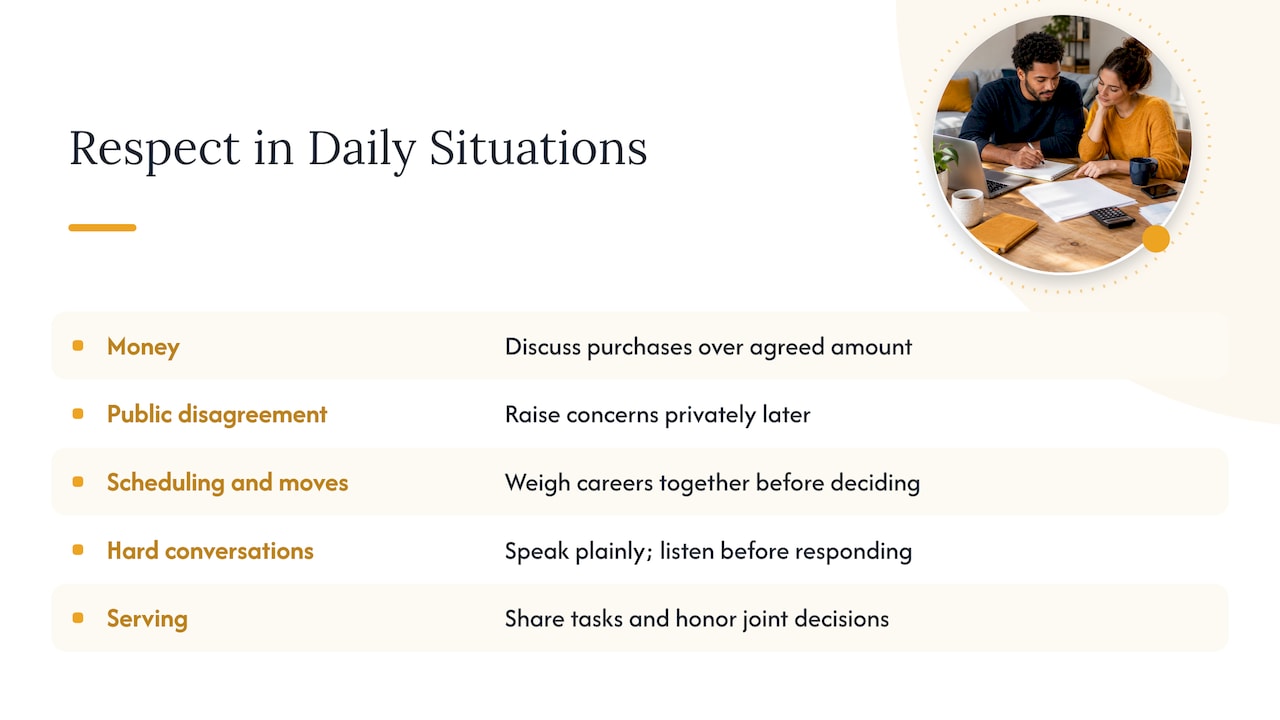
Everyday examples of submission and respect
The big words become real in small moments. Here is what they can look like when they work.
Money. Before a purchase over an amount you set together, you both pause and talk. One spouse may have the final word on a particular area, by agreement, but neither spends in secret.
Disagreement in front of others. You do not correct or mock your spouse in front of friends, children or relatives. You raise it privately that evening.
Scheduling and moves. One spouse’s career opportunity is weighed as a household decision. The spouse it affects most gets real time to speak, and the decision is not announced as settled.
Hard conversations. The person who feels hurt says so plainly, without name-calling. The other listens to the end before responding and repeats back what they heard.
Serving. A husband takes on a task that is usually left to his wife because she is exhausted. A wife follows through on a plan her husband made even though she would have chosen differently, because the decision was reached together.
Notice that each example has a pause, a listening step or a shared agreement in it. Submission and respect in practice are mostly habits of process, not feelings.
How to handle disagreements without silencing anyone
The real test of submission and respect is not the easy decision. It is the moment you disagree and both care. A workable pattern:
- Name the topic and the stakes. “I want to talk about moving. It matters to me because of my family and my work.” One topic at a time.
- Take turns, with a limit. Each spouse speaks for a few minutes while the other only listens. No interrupting, no eye-rolling.
- Reflect back. “What I heard is that you’re worried about the cost and the distance from your mother. Is that right?” Do this until the speaker says yes.
- Look for the shared goal. Usually both of you want security, peace or the family’s good. Say it out loud.
- Pray or reflect separately, then decide. Agree on a time to come back, so the conversation does not become a standoff.
- If you still disagree, agree on how you will decide. Some couples defer to the husband’s lead after full discussion. Some defer to whoever carries more responsibility for that area. Some wait. What matters is that you chose the method together and that no one is steamrolled.
- Review. Revisit the decision a few weeks later and ask what each of you learned.
If these conversations keep ending in criticism, shutdown or the same fight, the issue is usually skills, not conviction. Our guide on using Scripture for conflict resolution walks through putting faith and conflict skills together, and applying biblical principles to marriage conflict covers it in more detail.
Why Christian couples still struggle with it
Sincere couples often fight over these ideas because each spouse carries a different picture of what the words mean. One grew up in a home where the father decided everything. The other watched a mother silenced and swore never to repeat it. A husband may hear “leadership” as a duty to protect, while his wife hears it as a demand for control. Neither is lying about what they feel.
Before debating verses, it helps to ask each other three questions:
- What did submission look like in the home you grew up in?
- When have you felt unheard in our marriage?
- What would respect look like to you this week, in one specific action?
These questions move the conversation from doctrine to experience. Our article on why Christian couples still struggle with conflict looks at the patterns behind this, and a set of clear boundaries can keep both spouses safe while you work on it.
Submission is not control or abuse
Submission is something a person gives. Control is something one person takes. The difference is not subtle in practice.
Healthy submission looks like this:
- You can say no, disagree or raise concerns without fear of punishment.
- Your spouse asks for your input and takes it seriously.
- Neither of you uses Scripture as a weapon to end a conversation.
- You are free to see friends and family, and to keep your own money, phone and conscience.
Piper and Grudem argue that stressing headship and submission does not fuel abuse, because the picture they teach is Christlike, sacrificial headship that keeps the wife’s good in view and treats her as a joint heir of the grace of life (1 Peter 3:7), paired with thoughtful submission that does not make the husband an absolute lord.
If you are afraid of your spouse, are being threatened, monitored, isolated or hurt, or are told that God requires you to endure it, that is not submission. Please contact the National Domestic Violence Hotline at 1-800-799-7233, by live chat, or by texting START to 88788. It is free, confidential and open around the clock. If you are in immediate danger, call 911. Counseling and workbooks are not the right first step when safety is at risk.
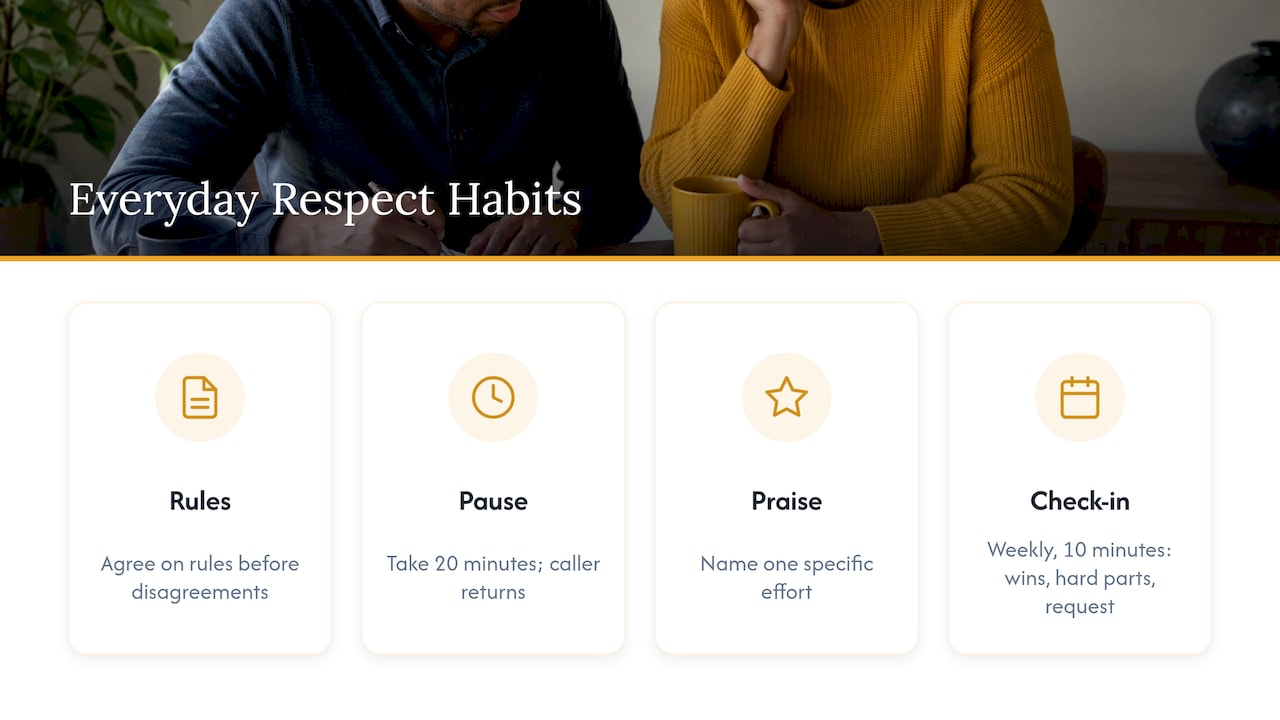
Practical habits that build submission and respect
These are small enough to start this week.
Agree on conversation rules. Decide in advance how you will talk when you disagree: no name-calling, no bringing up old failures, a pause when either of you asks for one. Written agreements work better than good intentions, and communication agreements are a good way to start.
Use a pause signal. When voices rise, either spouse can call a 20-minute break. The caller is responsible for returning to the conversation.
Praise the effort. Respect grows when you name what your spouse did well, in specific terms: “You asked what I thought before you answered. Thank you.”
Practice a short weekly check-in. Ten minutes: what went well, what felt hard, one request. Our communication exercises give you scripts for this, and the 10-minute worksheets give you a structure to follow.
Settle the big frameworks early. If you are engaged, talk through roles, money and decision-making before the wedding. The Christian premarital questions are written for that conversation.
Our perspective
We are licensed mental health professionals, and we have spent years helping couples who love Christ and still end up in the same argument at the same time every week. What we keep coming back to is that the problem is rarely the verse. It is what happens in the three minutes after one spouse says something that stings.
We think a marriage built on submission and respect needs two things at once: conviction about what you believe, and skill in how you speak. Without the first, you drift. Without the second, even a good conviction becomes a club.
That is why the F.I.G.H.T. Plan® is built as a step-by-step system for communication, emotional regulation and healing, and why we created a faith-centered version for Christian couples. A husband who wants to lead with love and a wife who wants to honor him both need the same tools: how to slow down, how to say what is true without contempt, and how to repair after a hurt.
If submission in your home has felt like silence, or respect has felt like walking on eggshells, you are not failing at faith. You are missing a process. A process can be learned.
Carlos
Where to start if you want help
If you want a structured way to put this into practice, start with The Christian F.I.G.H.T. Plan Workbook: A Faith-Centered Guide to Conflict Resolution for Couples, priced at $9.99 to $20.00 depending on format. It was created by therapists and gives couples shared exercises, so neither spouse has to carry the conversation alone. For couples who want a full program, Stop the Fighting: The Couples Communication & Conflict Resolution Course is $149.00. If you prefer guidance from a person, we offer online couples coaching. You can see every option in our shop.

If you are engaged and want to settle these questions before the wedding, the F.O.R.E.V.E.R. Workbook is our premarital guide. If you are rebuilding after a breach of trust, the R.E.S.T.O.R.E Workbook addresses healing after an affair. Both are in the same shop.
FAQ
What does submission mean in marriage?
In a Christian marriage, submission is a spouse’s chosen attitude of honoring and supporting the other’s leadership out of reverence for Christ. On the traditional reading, it is not blind obedience, and it never requires following a spouse into sin. Many readers also point out that Ephesians 5:21 asks everyone to submit to one another.
What is mutual submission in marriage?
Mutual submission means both spouses put the other’s good ahead of their own preferences. The wording of Ephesians 5:21 supports this, since the reciprocal phrase “to one another” comes right before the instructions to wives and husbands. In practice, it shows up as shared decisions, listening first and serving each other.
How is respect different from submission?
Respect is how you treat your spouse: your tone, your attention and your assumption of good intent. Ephesians 5:33 asks the wife to respect her husband and the husband to love his wife. Respect does not mean agreeing with everything, and you can voice a concern respectfully.
Can a husband make his wife submit?
Submission is a choice a wife gives, not something that can be forced. A husband who pressures, threatens or punishes is acting as a controlling partner, not as a leader in the way the passage describes. If you feel unsafe, contact the National Domestic Violence Hotline at 1-800-799-7233.
What if we disagree about what submission means?
This is common, and it is solvable. Start by sharing what each of you learned growing up, then agree on a decision-making method for the next disagreement. If you keep circling the same argument, faith-based counseling or coaching can give you a structure to work in.
Sources
- Recovering Biblical Manhood and Womanhood: overview of central concerns (Grudem and Piper)
- What about Headship? From Hierarchy to Equality, Evangelical Theological Society review
- Husbands and Wives as Analogues of Christ and the Church (Ephesians 5:21 and Colossians 3:18-19), Bible.org
- The National Domestic Violence Hotline
Recommended
- Spiritual Intimacy in Marriage: How to Build It Together
- Accountability in Marriage: What It Is and How to Practice It
- Stop Contempt in Marriage: A Therapist’s Plan for the Next Fight
- Empathy in Marriage: What It Is and How to Practice It