
When Your Partner Shuts Down: What to Do and Say

When your partner shuts down, the most useful move is to stop pushing for an answer, name the pause, and agree on a time to come back. Shutting down is usually a way to escape feeling overwhelmed, not proof that they don’t care. Chasing, demanding or going silent in return makes the wall thicker. A calm pause with a clear return time keeps both of you in the relationship. A therapist-built system like our F.I.G.H.T. Plan® gives you the exact words and steps for it, so you aren’t improvising in the middle of a fight.
TL;DR
- Shutting down (often called stonewalling) means withdrawing from a conversation emotionally or physically. It often builds up after criticism, defensiveness and contempt pile up.
- Don’t follow, corner or ultimatum your partner. Say that you want to continue, offer a pause, and name a time to return.
- A real time-out has a return time. Checking out for good, with no re-engagement, is the pattern that damages trust.
- Repair after the pause: a soft restart, an apology, appreciation and some light time together.
- If the same shutdown repeats, or the silence is being used to control or frighten you, get outside help.
Table of Contents
- What shutting down looks like
- Why a partner shuts down
- Shutdown, time-out and silent treatment are not the same
- How to respond in the moment
- What not to say to someone who has shut down
- If you are the one who shuts down
- Repair after a shutdown
- Set rules before the next fight
- When the pattern keeps repeating
- When silence is not just shutdown
- Where the F.I.G.H.T. Plan® fits
- Our perspective
- FAQ
- Sources
What shutting down looks like
You raise something that bothers you. Your partner’s face goes blank, answers shrink to one word, or they pick up their keys and leave. Maybe they say “fine” and stare at the TV. You feel more alone than if they had yelled.
Researchers at UC Berkeley’s Greater Good in Action project describe stonewalling as putting up a wall: withdrawing, shutting down, and distancing yourself physically and emotionally from your partner. Their examples include the silent treatment and abruptly leaving without saying where you’re going. They note it can come after criticism, defensiveness and contempt build up and become overwhelming, and that it leaves the other partner feeling abandoned and rejected.
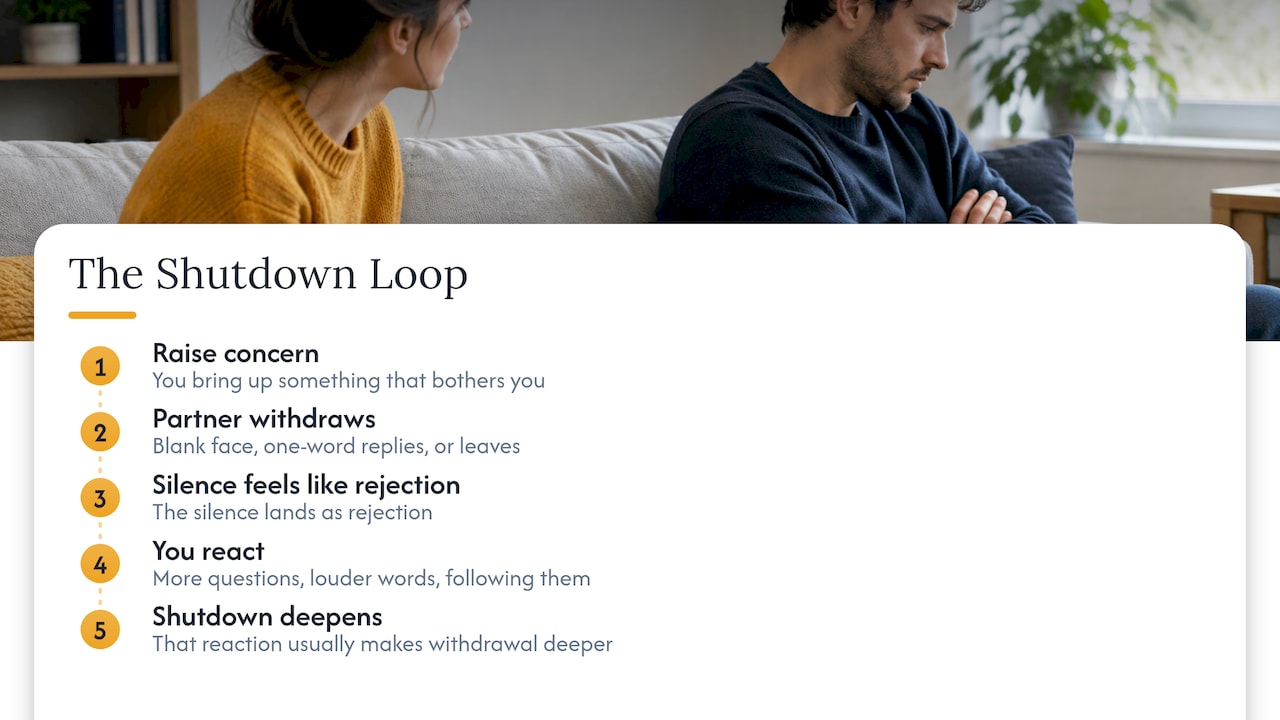
That last part matters for you as the person on the receiving end. The silence lands as rejection. Your reaction (more questions, louder words, following them from room to room) is a normal one. It is also the reaction that usually makes the shutdown deeper. The rest of this guide is about breaking that loop.
Why a partner shuts down
There is rarely one reason. These are the common ones, and more than one can be true at once.
Overwhelm
Some people shut down because the conflict feels like too much to process. Their body is in a stress response, and silence is the only way they know to stop saying something they’ll regret. From the outside it looks like indifference. From the inside it often feels like panic or numbness.
A pile-up of negativity
The Berkeley practice page points to an accumulation: criticism, defensiveness and contempt stacked up until withdrawal feels like the only exit. If your conversations tend to open with “you always” or “you never,” your partner may be shutting down before you finish the first sentence. This is worth noticing about the starts of your own conversations, without turning it into blame.
Habit and learned safety
Many people grew up in homes where speaking up made things worse, or where conflict meant yelling. Going quiet kept them safe. They carry that into adulthood and into your relationship.
Fear of failing
Some partners shut down because they believe they can’t get it right. When you bring up a problem, they hear “you are a failure,” and freezing feels safer than trying.
None of these reasons make the silence painless for you. They do change what response will work.
Shutdown, time-out and silent treatment are not the same
The distinction is one of the most useful ideas in this topic, and it is where most couples get stuck.
The University of Georgia’s family and consumer sciences extension guide explains that stonewalling means withdrawing physically or emotionally and refusing to communicate. It is different from conflict avoidance or agreed time-outs, which are proactive strategies. With stonewalling, a partner makes a habit of checking out and does not come back to manage or soothe the situation.
| What it sounds like | Return? | Effect on you | |
|---|---|---|---|
| Agreed time-out | “I’m too worked up. Can we pick this up at 8?” | Yes, at a named time | You know you haven’t been dropped |
| Shutdown | Goes quiet, leaves, one-word answers | Unclear, often no | Anxiety, rejection |
| Silent treatment | Deliberate silence to punish or control | Only on their terms | Fear, hypervigilance |
The Berkeley page makes the same point from the other side: if you need a time-out to breathe and collect your thoughts, tell your partner, then return to the conversation when you’re ready, so they understand you are taking care of yourself and not rejecting them. The announcement and the return are what make it a time-out.
This is also where the partner who shuts down has homework. If that’s you, the next step is not to try harder to stay in the room. It is to learn the sentence that says “I need a break and I’m coming back.” You can read more about that in our guide to time-outs for couples, and a short piece on how to agree when to resume a hard conversation applies whether or not a baby is involved.
How to respond in the moment
Here is the sequence we’d walk a couple through, written for the partner who is still talking.
1. Slow your own body first
You can’t bring calm to someone else while you are running hot. Take a few slow breaths, drop your shoulders, lower your voice. If you need to, step outside for a minute. Your tone is the first signal of whether this is safe.
2. Stop the pursuit
Don’t follow them to another room, block the door, take their phone, or fire more questions. Don’t deliver an ultimatum (“if you don’t talk to me, we’re done”). Pressure from you reads as more threat, which is exactly what a person in shutdown is trying to get away from.
3. Name the pause without blame
Say something short and steady:
“I can see this got to be too much. I don’t want to push. Let’s take a break, and I’d like to try again at 7:30. Does that work?”
Notice what’s in it: no diagnosis (“you’re shutting down again”), no accusation, a specific time and a question that invites agreement.
4. Let the break be a real break
For the break to help, both of you should do something that calms you, not something that rehearses the argument. Walk, shower, cook, listen to music, write your thoughts down. Rehearsing your best closing argument keeps your body in fight mode. Our guide to taking space after an argument lays out how long to take and what to say when you reconnect, and our de-escalation tools cover what to do in the first few seconds when tension spikes.
5. Come back when you said you would
This is the step that rebuilds trust. If you proposed 7:30, be there at 7:30. If your partner still can’t talk, ask for a new time rather than dropping the topic forever. A pause that never ends is not a pause, it is avoidance.
6. Restart softly
The UGA guide says a repair attempt is any statement or action that keeps negativity from escalating out of control, and gives examples: a soft voice, a smile, appropriate humor, non-defensive listening, a hug or an apology. It also says a soft startup, free from criticism, blame and contempt, makes a productive discussion far more likely.
Compare:
- Harsh startup: “You went cold on me again. You never care enough to finish a conversation.”
- Soft startup: “I felt lonely when we stopped talking earlier. I’d like to understand what was happening for you. Can we try again?”
The second one names a feeling, asks for understanding and leaves room for an answer. The first brings the same criticism that likely caused the shutdown.
What not to say to someone who has shut down
A few lines reliably deepen the wall:
- “Why won’t you just talk to me?” It’s a demand, and they can’t meet it right now.
- “You’re just like your father.” Contempt, and it will end the conversation.
- “Fine, I’ll give you the silent treatment too.” Matching silence turns a stalled conversation into a standoff.
- “We have to settle this tonight.” Urgency feels like pressure to someone already overloaded.
Swap each for a sentence that keeps the door open and sets a time. If you tend to pursue, practice ending a hard conversation on purpose before it escalates.
If you are the one who shuts down
You may be reading this because someone told you that you go silent. Three habits help.
- Notice your early signals. A tight chest, racing thoughts, wanting to leave, a blank feeling. These show up before you go quiet.
- Say a script out loud. “I’m getting overwhelmed and I want to handle this well. I need 20 minutes, and then I’ll come back.” Say it before you leave the room, not after.
- Return, even if you’re not ready. Coming back and saying “I don’t have all the words yet, but I’m here” is far better than letting the silence stretch for days.
Telling your partner what you need to feel safe enough to talk is a skill, and it can be learned.
Repair after a shutdown
A calm talk is not the end. The relationship also needs repair so the shutdown doesn’t leave a bruise. The Healthy Relationships Initiative e-book on managing conflict (Christine Murray, 2025) suggests intentionally reconnecting after conflict: enjoy light-hearted time together such as a funny movie, a favorite snack or a shared hobby, express appreciation (“I appreciated that you took time to listen”), and look back at positive memories such as old photos.
Some practical ways to do that:
- Thank your partner for coming back to the conversation, even if it went imperfectly.
- Name one thing they did well in the discussion.
- Do something small and warm together the same day.
- Give any follow-up issues their own time. The same e-book advises that if new or unresolved issues come up, you continue using positive communication and conflict-management skills, and it notes that some differences may never fully settle but can be worked around.
If repair after fights is where you tend to stall, our piece on why couples struggle to repair after fights goes deeper.
Set rules before the next fight
The easiest time to deal with shutdown is when you’re both calm. The UGA guide recommends couples set “rules of engagement” for conflict: agree that name-calling, insults and raised voices are not okay, give each other full attention, and agree that either of you can take a time-out and come back later if tensions rise, or agree to disagree.
A simple agreement could be:
- Either of us can call a pause by saying a chosen phrase.
- The pause lasts at least 20 minutes and no more than 24 hours.
- The person who called it restarts the conversation.
- We don’t use the pause to avoid the topic permanently.
- When we return, we start softly.
We walk through this kind of preparation in argument boundaries in marriage. Writing the agreement down matters: it turns a vague hope into something either of you can point to without it becoming an accusation.
When the pattern keeps repeating
One shutdown after a hard day is normal. A cycle, where you pursue, they withdraw, you pursue harder and they withdraw further, is different. It tends to run the same way each time, and pushing harder doesn’t change it. Our guide on breaking the emotional withdrawal cycle maps the loop, and our article on what stonewalling is and the signs covers how to spot it early. If you keep landing on the same topics, see also why couples repeat the same arguments.
Utah State University Extension’s Stronger Marriage blog advises that if you and your partner keep having the same arguments over and over, it’s time to get a professional to help break the cycle, since counselors can teach couples to tell which issues are situational and which are perpetual. Seeking help early is a sign you take the relationship seriously, not a sign it has failed.
When silence is not just shutdown
Shutting down out of overwhelm is a different thing from silence used to punish, control or frighten. Warning signs include silence that lasts days as a consequence for something you said, being made to apologize to end it, fear of bringing up any concern, or threats and intimidation alongside the silence.
The HRI e-book says that how someone behaves in conflict can guide your boundaries. If they show they are respectful and committed, it may be safe to allow more closeness. If they reveal hurtful qualities, you may need to share less personal information or spend less time together. If the relationship is unsustainable or abusive, the only reasonable boundary may be to end it, temporarily or permanently.
If you feel afraid of your partner, call a domestic violence hotline or, if you are in immediate danger, 911. A coaching or education program is not the right tool for an unsafe relationship.
Where the F.I.G.H.T. Plan® fits
Knowing what to do and doing it mid-argument are different things. Most couples we hear from know they should “communicate better.” What they lack is a structured set of words and steps that work when tempers are high.
Our F.I.G.H.T. Plan® is a therapist-created, step-by-step, skills-based framework for communication, emotional regulation and healing. It is built so couples can resolve conflict without escalation and make practical progress without traditional therapy. Here is how our products match where you are:
| If you want… | Start with | Price |
|---|---|---|
| A quick set of tools and scripts | The F.I.G.H.T. Plan Couples Conflict Toolkit | $27.00 |
| A guided workbook to work through together | The F.I.G.H.T. Plan workbook | $14.99 to $25.00 |
| A full course on communication and conflict | Stop the Fighting course | $149.00 |
| Faith-centered guidance | The Christian F.I.G.H.T. Plan Workbook | $9.99 to $20.00 |
| Help after a breach of trust | R.E.S.T.O.R.E Workbook | $9.99 to $20.00 |
| One-on-one guidance | VIP Private Coaching, 4 sessions | $997.00 |
| A deep, focused session | 6 Hours Couples Intensive | $1995 |
All prices are as published on our site. You’ll find the workbooks, toolkit and courses in our shop, and the coaching options on our online couples coaching page.

If you’re not sure where to start, the Stop the Fighting course is the most complete route for couples dealing with recurring conflict and withdrawal.
Our perspective
We have sat with many couples where one person talks more and faster and the other goes quiet. Almost every time, both are trying to protect the relationship in the only way they know. The talker pushes to reconnect. The quiet one retreats to avoid doing damage. Neither is the villain.
What changes the pattern is not more willpower. It is a shared structure. When both partners know there’s a way to pause, a time to return and a gentle way to restart, the fear drops. The person who pursues stops feeling abandoned. The person who withdraws stops feeling cornered.
That is why we built the F.I.G.H.T. Plan® as a step-by-step system with scripts and guided exercises, rather than a list of general tips. You can practice it in a workbook or course on a calm evening, so it is available when it counts. For couples who want more personal guidance, coaching gives you our attention on your specific pattern.
You don’t need to be a perfect communicator. You need a plan you both trust.
Carlos
FAQ
Why does my wife shut down during an argument?
Often because she feels overwhelmed, criticized or unsafe, and going quiet is how she copes. It may also be a long-held habit from earlier relationships or childhood. Ask about it later, during a calm moment, with curiosity instead of accusation.
Why do men shut down in a relationship?
Any partner of any gender can shut down. When men do, it is often tied to overwhelm, a fear of saying the wrong thing, or never having learned to put feelings into words. Soft startups and agreed pauses help most.
How long should a break last?
Long enough to calm down, and short enough that it doesn’t feel like abandonment. We suggest at least 20 minutes, with a named time to return, and no more than a day. The point is that both of you know when the conversation resumes.
Is shutting down the same as the silent treatment?
No. Shutting down is usually a way to cope with overwhelm, while the silent treatment is silence used to punish or control. Both hurt, but they call for different responses, and if the silence frightens you, seek support from a professional or a hotline.
Sources
- Avoiding the “Four Horsemen” in Relationships, UC Berkeley Greater Good in Action
- Manage, University of Georgia Family and Consumer Sciences extension
- HRI E-Book: Managing Conflict in Close Relationships, Healthy Relationships Initiative, 2025
- When to Seek Professional Help for Your Relationship, Utah State University Extension, 2023
Recommended
- Conflict Avoidant Partner: How to Talk and Be Heard
- Silent Treatment in Marriage: What It Does and How to End It
- Stop Escalation in 20–45 Min: Therapist Scripts for Couples’ Time Outs
- 9 Step Partner Anger Debrief: Ready Scripts and F.I.G.H.T. Plan®