
What Does a Healthy Argument Look Like in Relationships?

A healthy argument in a romantic relationship is one where both partners stay engaged with the problem rather than attacking each other. It involves listening to understand, not just to respond. Both people express their feelings without blame, stay focused on the actual issue, and work toward resolution or at least mutual understanding. Nobody needs to “win.” The goal is connection, not conquest.
Several core elements define what constructive conflict actually looks like in practice:
- Respect stays intact even when emotions run high. Partners disagree without contempt or cruelty.
- Emotional regulation keeps the conversation from spiraling. Both people can feel angry and still choose their words deliberately.
- Active listening means each partner genuinely hears the other’s perspective before responding.
- Intent to understand replaces the drive to be right. The question shifts from “how do I win this?” to “what is my partner actually trying to tell me?”
- Repair attempts happen in real time: a touch, a pause, a “I hear you” that signals you’re still on the same team.
- Focus stays on the present issue, not a catalog of past grievances.
Couplesfightschool, founded by licensed mental health professionals Carlos Todd and Natasha Pemberton-Todd, built its entire platform around this kind of conflict. Their F.I.G.H.T. Plan® is a structured framework that guides couples through emotional regulation, communication, healing, and relationship transformation. Healthy conflict, practiced consistently, doesn’t just reduce tension. It builds intimacy.
Table of Contents
- How healthy arguments differ from harmful ones
- What you actually do differently during a healthy argument
- How to actually have a healthy argument: a step-by-step guide
- Destructive patterns that quietly wreck relationships
- What the research actually says about healthy conflict
- Key Takeaways
- Ready to argue better? Couplesfightschool can help
How healthy arguments differ from harmful ones
The difference between a healthy argument and a damaging one often comes down to a single variable: whether both partners feel emotionally safe. When safety disappears, the conversation stops being about the issue and starts being about survival.
Signs of a healthy argument
- Partners take turns speaking and listening without interrupting.
- Feelings are expressed as personal experience (“I felt dismissed when…”) rather than accusations.
- Both people stay curious about the other’s perspective.
- The tone stays firm but not hostile.
- There’s a shared sense that you’re solving a problem together.
- Disagreements end with some form of resolution or mutual acknowledgment, even if the issue isn’t fully resolved.
Signs of an unhealthy argument
- One or both partners resort to contempt: eye-rolling, sarcasm, mockery.
- Stonewalling kicks in, where one person shuts down completely and refuses to engage.
- The argument drifts from the original issue into a list of past failures.
- “You always” and “you never” statements replace specific, honest descriptions of what happened.
- The goal shifts from understanding to winning or punishing.
- Silence after the argument stretches on without any repair.
Tavistock Relationships, one of the UK’s leading couple therapy organizations, puts it plainly: in a relationship, if one person “wins” an argument, the couple often loses. Healthy disagreements build connection; destructive ones erode it, sometimes permanently. The pattern you establish in conflict is the pattern your relationship learns to live inside.
What you actually do differently during a healthy argument

Knowing what healthy conflict looks like in theory is one thing. Doing it in the middle of a heated moment is another. These specific behaviors are what separate a productive argument from one that leaves both partners feeling worse.
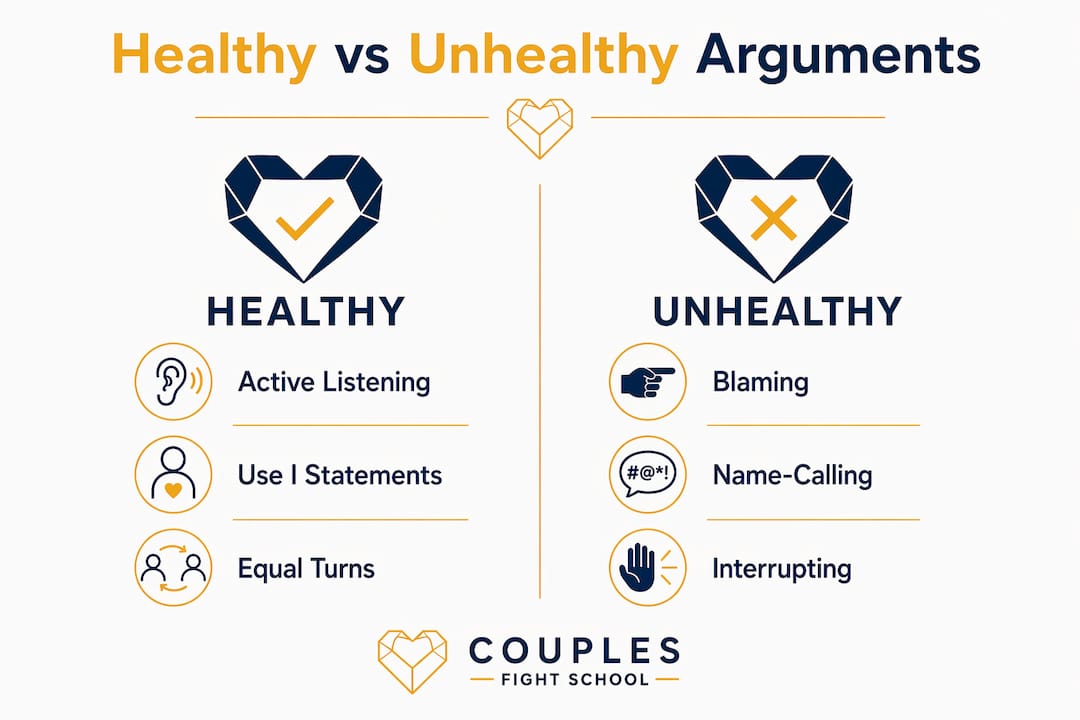
Use “I” statements, not “you” accusations. Saying “I felt hurt when you canceled our plans” is fundamentally different from “You never prioritize me.” Research confirms that using “I” statements reduces defensiveness and keeps the conversation in problem-solving mode rather than attack-and-defend mode.
Practice active listening. This means reflecting back what your partner said before you respond. “So what I’m hearing is that you felt left out, is that right?” That one habit alone changes the entire texture of a disagreement.
Validate without necessarily agreeing. You can say “I understand why you’d feel that way” without conceding your own position. Validation tells your partner their feelings make sense. It doesn’t mean you’re wrong.
Make repair attempts early. Couples who use repair attempts during conflict, whether that’s a light touch, a moment of humor, or a simple “I don’t want to fight with you,” reduce emotional intensity before it becomes overwhelming. These small gestures signal that the relationship matters more than the argument.
Take equal turns. Healthy arguments aren’t monologues. Each partner gets space to speak fully before the other responds. When one person dominates the conversation, the other stops feeling heard, and the argument stops being a conversation at all.
Avoid blaming and name-calling. Once you call your partner selfish or lazy, the argument is no longer about the dishes or the schedule. It’s about their character. That’s a much harder thing to come back from.
How to actually have a healthy argument: a step-by-step guide
Therapists and researchers agree that how an argument starts largely determines how it ends. Structure matters more than most couples realize.
-
Choose the right moment. Don’t launch into a difficult conversation when either of you is hungry, exhausted, or already stressed about something else. Timing isn’t avoidance; it’s strategy.
-
Start with a soft startup. Research by Julie and John Gottman shows that a gentle opening to a conflict discussion predicts a more constructive outcome and less defensiveness throughout. Begin with how you feel, not what your partner did wrong. “I’ve been feeling disconnected lately and I want to talk about it” lands very differently than “You’ve been ignoring me.”
-
State the specific issue. Name one thing. Not three. Not a pattern going back two years. One specific situation that you want to address right now.
-
Listen fully before responding. Let your partner finish. Don’t rehearse your rebuttal while they’re still talking. Ask a clarifying question if you’re unsure what they mean.
-
Watch for flooding. When your heart rate spikes and your thinking narrows, you’re physiologically flooded. At that point, you cannot process empathy or solve problems effectively. Recognize the signs: shallow breathing, tunnel vision, the urge to say something you’ll regret.
-
Take a break if needed. When flooding hits, a break of 20–30 minutes allows your nervous system to regulate. Agree in advance that a break is not abandonment; it’s a tool. Set a specific time to return to the conversation, and actually return.
-
Stay on topic. Resist the pull to bring in unrelated grievances. If a second issue comes up, acknowledge it and agree to address it separately. One argument at a time.
-
Work toward a resolution or agreement. This doesn’t always mean full consensus. Sometimes the healthiest outcome is agreeing to disagree on a low-stakes issue while affirming that you both feel heard.
-
Repair after the argument. Once things cool down, come back together. Acknowledge what happened. Apologize for anything that crossed a line. This step is what prevents arguments from leaving permanent marks.
-
Reflect and learn. After the dust settles, ask yourself: did we handle that well? What would we do differently? Couples who treat conflict as a skill they’re building together get better at it over time.
The Couplesfightschool F.I.G.H.T. Plan® structures this entire process, giving couples a repeatable system for moving through conflict without losing each other in it. It’s not about suppressing the argument. It’s about having it in a way that actually works.
Pro Tip: Before any difficult conversation, agree on a signal word or gesture that either partner can use to call a break without it feeling like rejection. Something as simple as a hand signal or the word “pause” can prevent a flooded argument from becoming a damaging one.

Destructive patterns that quietly wreck relationships
Some argument habits feel satisfying in the moment and cause serious damage over time. Knowing what to avoid is just as important as knowing what to do.
- Contempt is the single most corrosive pattern in couple conflict. It communicates disgust rather than disagreement. Eye-rolling, mockery, and condescension don’t just hurt; they signal that you see your partner as beneath you.
- Stonewalling shuts the conversation down entirely. One partner withdraws, goes silent, or leaves the room. It feels like protection but reads as abandonment.
- The demand-withdraw pattern is particularly damaging: one partner pushes for resolution while the other pulls away, creating a loop that never resolves anything. Research identifies contempt, stonewalling, and demand-withdrawal as among the strongest predictors of relationship breakdown.
- “Always” and “never” statements are almost never accurate and always feel like an attack. They invite defensiveness rather than dialogue.
- Topic drift happens when an argument about tonight’s dinner becomes an argument about your partner’s relationship with their family. Stay anchored to the original issue.
- Emotional scorekeeping means tracking who has apologized more, who started the last fight, who gave in last time. It turns the relationship into a competition nobody wins.
- Rehashing old grievances prevents any single argument from ever actually closing. If something was resolved, it stays resolved. If it wasn’t, address it separately and directly.
Recognizing escalation early is the most effective de-escalation tool you have. The moment you notice your voice rising, your chest tightening, or your thoughts narrowing to “I just need to win this,” that’s the signal to slow down, not speed up. Learning to diffuse conflict before it peaks is a skill, and it’s one that gets sharper with practice.
Unmanaged anger in relationships also carries real physical costs. Frequent outward anger expression in couples correlates with higher heart disease risk, while suppressed negative emotion links to chronic back and muscle pain. How you argue isn’t just a relationship issue; it’s a health one.
What the research actually says about healthy conflict
The science on couple conflict is more specific than most people realize, and it points clearly toward what works.
The first three minutes of a conflict discussion predict the outcome of that interaction 96% of the time. That figure comes from decades of observational research on couples. How you open the conversation is not a small thing. It is almost everything.
Emotional flooding is a physiological event, not just a feeling. When it occurs, the brain’s capacity for empathy and problem-solving narrows significantly. Tunnel vision, accelerated heart rate, and an inability to process nuance are all physical symptoms of flooding. This is why the 20–30 minute break recommendation isn’t soft advice; it’s grounded in how the nervous system actually works.
The University of Miami Health System notes that emotional intelligence plays a central role in healthy conflict, including the ability to accept that some disagreements won’t resolve neatly. Agreeing to disagree, when done with genuine respect, is a sign of relational maturity, not defeat.
Repair attempts are another well-documented predictor of relationship health. Couples who use them consistently during conflict show lower emotional intensity and better long-term outcomes. The repair doesn’t have to be elaborate. A hand on the arm, a moment of shared humor, or a simple “I still love you even when we disagree” can shift the entire trajectory of an argument.
Couplesfightschool’s approach integrates all of this research into the F.I.G.H.T. Plan®, a practical framework built by licensed mental health professionals to help couples move from reactive, damaging conflict toward communication agreements that actually hold. The goal isn’t to eliminate disagreement. It’s to make disagreement something your relationship can handle, and even grow from.
Key Takeaways
Healthy arguments are built on emotional regulation, mutual respect, and the shared goal of understanding, not winning.
| Point | Details |
|---|---|
| How arguments start matters most | The first three minutes of a conflict predict its outcome 96% of the time, so begin calmly and specifically. |
| Flooding requires a real break | When physiologically overwhelmed, take a 20–30 minute break before continuing, then actually return to the conversation. |
| “I” statements reduce defensiveness | Framing feelings as personal experience rather than accusations keeps arguments in problem-solving mode. |
| Repair attempts protect the relationship | Small gestures during conflict, like a touch or a check-in, lower emotional intensity and predict long-term relationship health. |
| Healthy conflict builds intimacy | Practiced consistently with the right tools, like the F.I.G.H.T. Plan®, constructive arguments deepen connection rather than damage it. |
Ready to argue better? Couplesfightschool can help
Knowing what a healthy argument looks like is the first step. Actually doing it under pressure is where most couples get stuck. Couplesfightschool was built for exactly that gap.
Founded by licensed mental health professionals Carlos Todd and Natasha Pemberton-Todd, Couplesfightschool offers courses, workshops, coaching, and digital tools grounded in psychology and designed for real relationships. The conflict resolution skills course gives couples a structured path from recurring arguments to genuine understanding. If you want practical techniques you can start using today, the conflict resolution techniques guide is a strong starting point.
Conflict isn’t the enemy of a good relationship. Unmanaged conflict is. There’s a difference, and Couplesfightschool helps you learn it.
Recommended