
What Is Codependency in Relationships: Signs and Recovery

Codependency in relationships is a dysfunctional pattern where one person excessively relies on another for their sense of self-worth, identity, and emotional stability. The term originated in addiction treatment circles, where clinicians noticed that partners of people struggling with alcohol or drug dependence often organized their entire lives around managing, rescuing, or enabling the person with the addiction. Over time, researchers recognized the same pattern showing up in relationships with no substance use at all, wherever one person’s emotional needs consistently swallow the other’s.
At its core, codependency plays out between two roles: the “giver,” who derives meaning from rescuing and caretaking, and the “taker,” who depends on being helped to function. According to Mental Health America, codependency is a learned behavior, not a clinical diagnosis, and it can be passed from one generation to the next through observation and imitation. That distinction matters because learned behaviors can be unlearned.
A few features define codependent relationships at a glance:
- One person consistently sacrifices their own needs for the other’s
- Identity and self-worth become tied to the partner’s moods or outcomes
- Boundaries are blurred, ignored, or nonexistent
- Helping feels compulsive rather than freely chosen
- Fear of abandonment drives most decisions in the relationship
Table of Contents
- How do you recognize codependency signs in yourself or your relationship?
- What causes codependency to develop in the first place?
- Practical strategies for managing and overcoming codependency
- Psychology-backed communication strategies to heal codependent relationships
- Key Takeaways
How do you recognize codependency signs in yourself or your relationship?
Codependency rarely announces itself. It tends to look like devotion, loyalty, or love until the weight of it becomes impossible to ignore.
The most telling codependency signs include a chronic need for external approval, difficulty making decisions independently, and an exaggerated sense of responsibility for another person’s feelings and choices. People in the giver role often feel hurt when their efforts go unacknowledged, yet keep giving anyway. They confuse love with pity, gravitating toward people they can rescue rather than people who meet them as equals.

On the other side, the taker role is not simply passive. According to James Madison University’s Counseling Center, the taker often remains helpless in ways that reinforce the giver’s need to rescue, creating a self-sustaining cycle where both people’s roles are locked in place. Neither person is growing. Both are stuck.
Common codependent behavior examples include:
- Feeling responsible for your partner’s emotions and trying to “fix” them
- Saying yes when you mean no, repeatedly, to avoid conflict or rejection
- Losing track of your own preferences, hobbies, and friendships
- Monitoring your partner’s moods and adjusting your behavior accordingly
- Staying in a relationship out of fear rather than genuine desire
- Feeling anxious, guilty, or resentful when you prioritize yourself
Codependent vs. healthy relationship behaviors
| Behavior area | Codependent relationship | Healthy relationship |
|---|---|---|
| Identity | Self-worth depends on partner’s approval | Each person maintains a separate sense of self |
| Boundaries | Blurred or nonexistent | Clearly communicated and respected |
| Decision-making | One partner defers constantly | Decisions are shared and mutual |
| Emotional support | One person carries all emotional labor | Both partners give and receive support |
| Conflict | Avoided at all costs or explosive | Addressed openly with respect |
| Independence | One or both partners feel they “can’t function” alone | Both partners have independent lives and friendships |
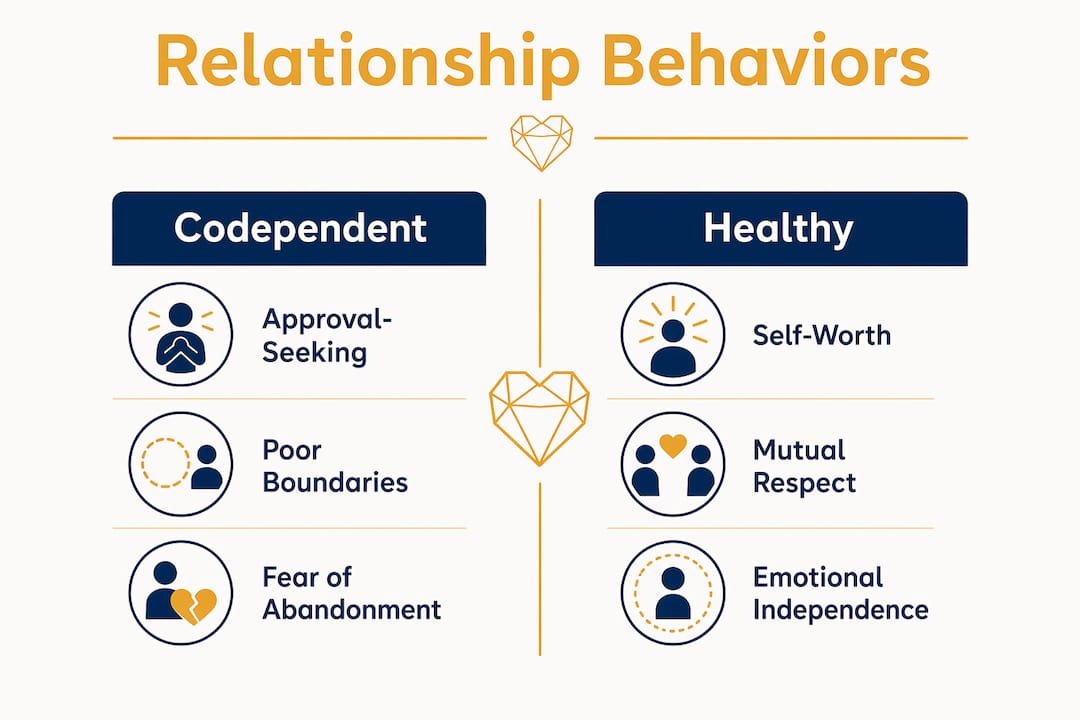
The contrast between codependency and interdependency is worth holding onto. Healthy relationships involve mutual support, independence, and equitable emotional contribution. Interdependency means you can rely on each other without losing yourself in the process. Codependency means one person has effectively disappeared into the relationship.
What causes codependency to develop in the first place?
Codependency does not appear out of nowhere. It grows from specific conditions, most of them rooted in early life experiences and family environments.
Dysfunctional family dynamics are the most common origin. When a child grows up in a home where a parent struggles with addiction, mental illness, or emotional immaturity, that child often learns to manage the parent’s moods and needs as a survival strategy. The caretaking role becomes so familiar that it feels normal, even necessary, in every relationship that follows. Mental Health America notes that codependent behavior is learned by watching and imitating family members who display it, which is why the pattern tends to repeat across generations.
Attachment style plays a significant role too. Children who develop anxious or insecure attachment, often because their early caregivers were inconsistent, unavailable, or unpredictable, grow up hypervigilant about relationships. They learn to equate love with effort and sacrifice. As adults, they may unconsciously seek out partners who need rescuing because that dynamic feels like love.
Common causes of codependency include:
- Growing up with a parent who had addiction, chronic illness, or untreated mental health issues
- Childhood trauma, including emotional neglect, abuse, or abandonment
- Insecure attachment formed in early caregiving relationships
- A family culture where expressing needs was discouraged or punished
- Repeated enabling dynamics in past or current relationships
- A partner’s emotional immaturity, addiction, or chronic dependence triggering the caretaker role
One thing worth understanding is how codependency deepens over time. What starts as genuine care and support can gradually shift into compulsive caretaking, especially when one partner’s struggles persist or worsen. Each rescue attempt reinforces the cycle. The giver feels needed; the taker remains dependent. Both people become more entrenched in roles that ultimately exhaust them.
If you are supporting a partner who is dealing with addiction, the line between healthy support and enabling can blur quickly. Resources like helping a loved one with addiction can help you understand where that line is and how to hold it without abandoning the person you care about.
Practical strategies for managing and overcoming codependency
Recovery from codependency is possible. The pattern is learned, which means it can be changed with consistent effort, the right support, and a willingness to tolerate discomfort along the way.
Setting boundaries is the foundation of that change. For someone who has spent years prioritizing another person’s needs, setting personal boundaries can feel selfish or even dangerous at first. It is neither. Boundaries are not walls; they are the terms under which you can genuinely show up in a relationship without losing yourself. Learning to say no, to name your own needs, and to let your partner experience the natural consequences of their choices are all part of rebuilding a healthier dynamic.

Professional therapy is often the most direct path forward. A licensed therapist can help you identify the roots of codependent patterns, rebuild a sense of individual identity, and develop communication skills that support genuine connection rather than compulsive caretaking. Cognitive behavioral therapy (CBT) and attachment-focused approaches are both commonly used. If you are unsure where to start, counseling for mental health can be a meaningful first step toward understanding how these patterns formed and what it takes to shift them.
The long-term effects of untreated codependency are real and serious. The giver typically ends up exhausted, resentful, and cut off from their own identity. The taker feels helpless and incapable of functioning independently. Both people end up basing their sense of self on how the other person is doing, which means neither person is ever truly stable. Physical health often suffers too, as chronic stress, anxiety, and emotional suppression take a toll on the body over time.
Steps you can take right now:
- Identify one area where you consistently override your own needs for your partner’s
- Practice naming your feelings without immediately trying to fix them
- Spend time alone doing something that has nothing to do with your relationship
- Notice when you feel responsible for your partner’s emotional state and pause before acting on it
- Reach out to a therapist, counselor, or support group focused on codependency recovery
- Read about enabling behavior and honestly assess whether you recognize it in your relationship
Pro Tip: The hardest part of recovery for most givers is learning to sit with the discomfort of not fixing things. When you stop rescuing, your partner may struggle, and that struggle will feel like your fault. It is not. Tolerating that anxiety without acting on it is one of the most important skills you can build, and it is exactly what allows your partner to develop their own capacity to cope.
Psychology-backed communication strategies to heal codependent relationships
Shifting from codependency to interdependency requires more than good intentions. It requires new communication habits, built deliberately and practiced consistently, ideally with professional guidance.
The work that Carlos Todd and Natasha Pemberton-Todd do at Couplesfightschool is grounded in exactly this kind of structured approach. Their F.I.G.H.T. Plan® framework teaches couples how to move through conflict without defaulting to the patterns that keep codependency alive: criticism, emotional withdrawal, defensiveness, and the compulsive need to fix or control. The goal is not to eliminate closeness but to replace enmeshment with genuine emotional safety, where both partners can be honest without fear of losing the relationship.
Breaking the emotional withdrawal cycle is one of the most practical places to start. Codependent couples often swing between over-involvement and emotional shutdown, with neither state allowing for real connection. Learning to stay present, express needs clearly, and listen without immediately problem-solving changes that pattern at its root.
Effective communication techniques for healing codependent dynamics:
- Express your needs directly, using “I” statements rather than complaints or accusations
- Practice active listening without preparing your response while your partner is still talking
- Resist the urge to manage your partner’s emotional reactions during conflict
- Name what you need from a conversation before it starts (“I need to vent, not advice”)
- Agree on a signal or pause word when conversations escalate, and use it without guilt
- Revisit difficult conversations when both people are calm, not in the heat of the moment
The shift from codependency to interdependency does not happen in a single conversation. It happens through repeated small choices: choosing honesty over appeasement, choosing your own needs alongside your partner’s rather than instead of them, and choosing to let your partner carry their own weight even when every instinct tells you to step in.
Pro Tip: If you are the helper in the relationship, pay close attention to when you offer support versus when you intervene to manage your own anxiety. Helping because your partner genuinely needs it is healthy. Helping because you cannot tolerate watching them struggle is enabling. That distinction, practiced consistently, is what breaks the cycle.
Couplesfightschool’s courses and coaching programs are built for couples who are ready to do that work together. Whether you are navigating conflict resolution skills or trying to understand why the same fights keep happening, the platform offers practical tools grounded in real psychology, not generic advice.
If you are ready to move from exhausting cycles toward a relationship built on genuine connection and mutual respect, Couplesfightschool’s resources give you a structured, evidence-based place to start. Explore the couples conflict resolution techniques available through the platform and take the first real step toward a healthier dynamic.
Key Takeaways
Codependency is a learned behavioral pattern, not a permanent condition, and recovery is achievable through boundary work, therapy, and consistent communication practice.
| Point | Details |
|---|---|
| Codependency is learned | The pattern develops from family dynamics and attachment history, which means it can be changed with intentional effort. |
| Giver and taker roles reinforce each other | Both roles sustain the cycle; breaking it requires one person to stop enabling, even when it causes temporary conflict. |
| Boundaries are the foundation of recovery | Setting and honoring personal limits is the first and most critical skill in shifting toward healthier relationship dynamics. |
| Therapy accelerates change | A licensed therapist helps identify roots of codependency, rebuild individual identity, and develop communication skills. |
| Interdependency is the goal | Healthy relationships involve mutual support and independence, where both partners maintain separate identities and shared connection. |
Recommended