
Why Conflict Avoidance Damages Relationships Over Time

Conflict avoidance is the deliberate act of steering clear of disagreements, and it is one of the most quietly destructive patterns in any relationship. It feels like peace. It looks like keeping the calm. But why conflict avoidance damages relationships becomes clear when you trace what actually happens beneath the surface: unresolved issues accumulate, emotional distance grows, and the connection you are trying to protect slowly erodes. Harvard’s Program on Negotiation, the University of Rochester Medical Center, and research published in Psychology Today all confirm that avoidance does not eliminate conflict. It delays it and makes it worse.
Why conflict avoidance damages relationships at the core
The primary mechanism is called the demand–withdraw pattern. One partner raises an issue and the other retreats. That retreat feels safe in the moment, but it signals to the pursuing partner that their concerns do not matter. Over time, the pursuer either escalates or gives up entirely. Both outcomes damage the relationship.

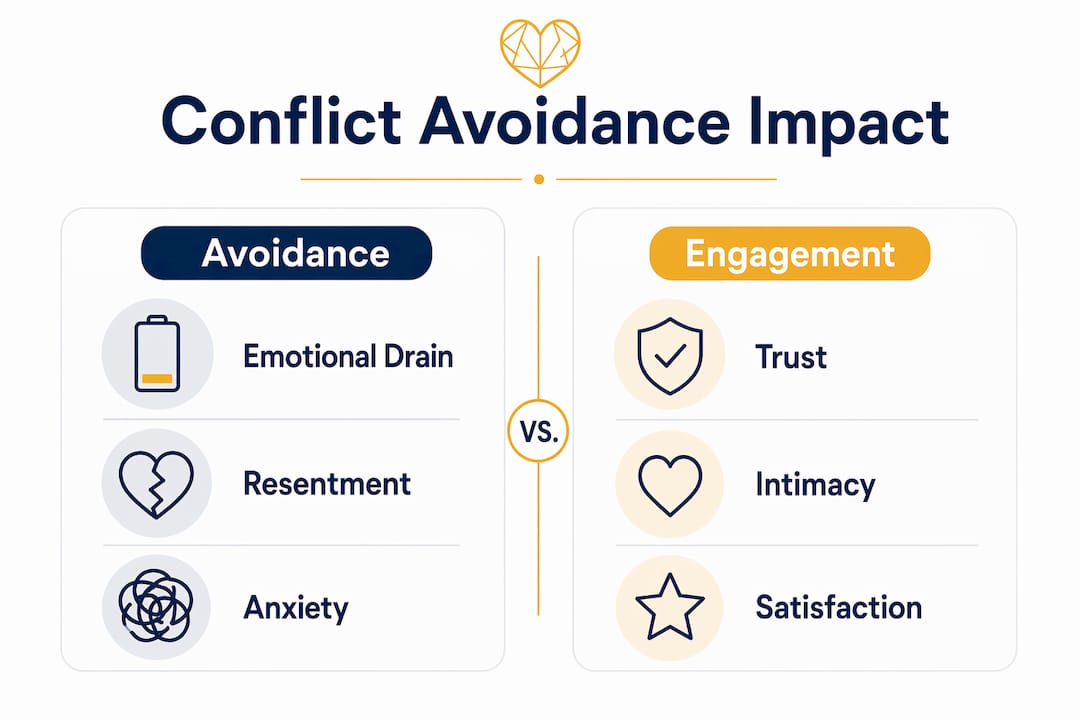
A 2014 meta-analysis of 74 studies covering more than 14,000 participants found that couples exhibiting the demand–withdraw pattern experience decreased satisfaction, reduced intimacy, and increased anxiety. That is not a minor side effect. That is the slow collapse of a relationship’s foundation.
Unspoken agenda items accumulate when one partner avoids conflict. The other partner begins to reduce direct bids for connection because they expect to be shut down. This explains why couples in avoidant patterns often report feeling like roommates rather than partners, even when they rarely argue.
Pro Tip: If you notice one partner consistently changing the subject or going quiet when a sensitive topic comes up, that is the demand–withdraw pattern in action. Naming it out loud, without blame, is the first step toward breaking it.
| Factor | Avoidance outcome | Engagement outcome |
|---|---|---|
| Relationship satisfaction | Decreases over time | Maintained or improved |
| Emotional intimacy | Erodes gradually | Deepens with resolution |
| Anxiety levels | Increases for both partners | Reduces after resolution |
| Communication quality | Deteriorates | Strengthens with practice |
| Trust | Weakens | Rebuilt through repair |
What does conflict avoidance do to your emotional health?
The psychological costs of avoiding conflict are real and measurable. The University of Rochester Medical Center notes that suppressed emotions contribute directly to depression, anxiety, and the risk of sudden verbal outbursts. Pushing feelings down does not make them disappear. It stores them under pressure.
Harvard’s Program on Negotiation explains that people avoid conflict because they anticipate confrontation and fear emotional vulnerability. That fear is understandable. But acting on it consistently reinforces the belief that conflict is dangerous, which makes the next conversation even harder to start.
There is also an important distinction that most people miss. Not all silence is harmful. A 2026 systematic review in Frontiers in Psychology found that intentional silence used as a reparative space differs fundamentally from the silent treatment, which functions as social exclusion and causes measurable psychological harm. Taking space to regulate your emotions is healthy. Using silence to punish or shut out your partner is not.
The emotional costs of chronic avoidance include:
- Persistent low-grade anxiety about unresolved issues
- Reduced self-esteem from not advocating for your own needs
- Depression linked to emotional suppression
- Fear of vulnerability that grows stronger the longer avoidance continues
- A growing sense of loneliness inside the relationship
Pro Tip: If you feel relief after avoiding a difficult conversation but dread the next time the topic might come up, that cycle is a signal. The relief is temporary. The dread is the cost.
How does avoidance escalate conflict instead of preventing it?
Avoidance does not neutralize conflict. It stores it. The University of Rochester Medical Center describes an avoidance–explosion cycle where suppressed emotions build pressure until they erupt, often over something small and unrelated to the original issue. The eruption is always more damaging than the original conversation would have been.
Psychology Today frames avoidance as a recurring costly pattern that protects underlying fears while steadily eroding intimacy. Each avoided conversation adds to a kind of relational debt. That debt does not disappear. It compounds.
Here is how the escalation typically unfolds:
- A concern goes unaddressed. One partner notices a problem but says nothing to avoid conflict.
- The issue repeats. Because it was never resolved, the same pattern recurs. Frustration builds.
- Resentment forms. The avoiding partner feels burdened. The other partner feels ignored. Both feel misunderstood.
- A minor trigger ignites the stored tension. An argument about dishes or scheduling becomes a fight about respect, love, and worth.
- Trust erodes. Both partners feel less safe raising issues in the future, reinforcing the avoidance cycle.
Harvard’s Program on Negotiation adds a counterintuitive insight: chronic avoidance causes partners to manage each other’s moods rather than resolve actual issues. The result is emotional loneliness despite fewer fights. Less conflict does not equal a healthier relationship. It can mean a more disconnected one.
Healthy conflict resolution vs. avoidance: what actually works
The antidote to avoidance is not fighting more. It is learning to engage conflict constructively. That requires specific skills, not just good intentions.
The University of Rochester Medical Center notes that avoiding conflict blocks the development of emotional regulation skills. Those skills are the same ones needed to tolerate discomfort in disagreement. The more you avoid, the less equipped you become to handle conflict when it inevitably arrives.
Practical steps that build conflict tolerance and communication health include:
- Name the pattern, not the person. Say “I notice we keep avoiding this topic” rather than “You always shut down.”
- Use structured check-ins. Set a regular time to discuss relationship concerns before they become crises. Couplesfightschool’s conflict resolution questions offer a guided starting point.
- Practice assertive communication. State your need clearly and directly without blame. “I need us to talk about finances this week” is more productive than hinting or hoping.
- Tolerate discomfort in small doses. Start with lower-stakes conversations to build the emotional muscle for harder ones.
- Repair after conflict. Healthy couples do not avoid ruptures. They repair them quickly and consistently.
Pro Tip: Emotional authenticity in conflict is not about saying everything you feel. It is about saying the right things clearly and at the right time. Emotional authenticity in relationships builds the trust that makes hard conversations feel safer over time.
Couples who engage conflict directly report stronger trust, deeper intimacy, and greater long-term satisfaction than those who avoid it. The discomfort of a difficult conversation is almost always less damaging than the slow erosion of connection that avoidance produces.
Key takeaways
Conflict avoidance damages relationships by replacing honest communication with emotional suppression, which compounds resentment, erodes trust, and ultimately produces more intense conflict than the original issue would have required.
| Point | Details |
|---|---|
| Demand–withdraw pattern | Avoidance triggers a cycle where one partner pursues and the other retreats, reducing satisfaction for both. |
| Emotional suppression costs | Suppressed emotions contribute to depression, anxiety, and sudden explosive arguments. |
| Silent treatment is harmful | Using silence as punishment causes measurable psychological harm and relational deterioration. |
| Avoidance compounds over time | Each avoided conversation adds relational debt that eventually erupts in more damaging ways. |
| Engagement builds connection | Couples who address conflict directly report stronger trust and deeper intimacy over time. |
What I have seen avoidance actually cost couples
After years of working with couples in conflict, the pattern I see most often is not the dramatic blow-up fight. It is the quiet, polite distance that builds when two people stop telling each other the truth.
Couples come to me convinced they are doing well because they rarely argue. But when I ask how often they feel truly understood by their partner, the answer is almost never. They have traded honesty for harmony, and they got neither. What they got instead is two people managing each other’s moods, walking on eggshells, and wondering why they feel so alone in a relationship that looks fine from the outside.
The misconception I push back on hardest is the idea that avoiding conflict protects the relationship. It does not. It protects the discomfort of the moment at the expense of the relationship’s long-term health. Courage in relationships is not the absence of fear. It is choosing to speak anyway, knowing the conversation might be hard.
The good news is that avoidance is a learned behavior. That means it can be unlearned. I have watched couples who spent years in silence learn to fight less and connect more once they had the right framework and the willingness to practice. The skill is learnable. The relationship is worth it.
— Carlos
Building conflict skills with Couplesfightschool
Recognizing the damage avoidance causes is the first step. Building the skills to do something different is the next one.
Couplesfightschool offers online coaching for couples designed specifically for partners who want to move from emotional distance toward real connection. Founded by licensed mental health professionals Carlos Todd and Natasha Pemberton-Todd, the platform combines psychology-backed tools with practical communication skills grounded in the F.I.G.H.T. Plan® framework. Whether you are dating, married, or engaged, the Fight Less, Love More course gives you a structured path from avoidance to honest, productive conversation. Real change in your relationship starts with one honest conversation at a time.
FAQ
What is conflict avoidance in a relationship?
Conflict avoidance is the deliberate act of steering clear of disagreements or difficult conversations with a partner. It provides short-term relief but causes long-term emotional distance and unresolved issues.
Why does avoidance lead to resentment?
Avoided issues do not disappear. They accumulate as unspoken grievances, and over time each partner feels unheard or dismissed, which builds resentment even in relationships with little overt fighting.
Is the silent treatment the same as conflict avoidance?
Not exactly. A 2026 systematic review in Frontiers in Psychology distinguishes silent treatment as a form of social exclusion from healthy silence used for emotional regulation. The silent treatment is a deliberate avoidance pattern with documented psychological harm.
Can conflict avoidance cause anxiety?
Yes. Research from the University of Rochester Medical Center links emotional suppression from avoidance directly to anxiety, depression, and the risk of sudden verbal outbursts.
How do couples break the avoidance cycle?
Couples break the cycle by building emotional regulation skills, practicing assertive communication, and using structured tools like conflict resolution frameworks to make difficult conversations feel safer and more productive.
Recommended