
Church Community’s Role in Marriage Support
The role of church community in marriage support is to act as a continuous source of spiritual guidance, relational encouragement, and practical help that builds resilience in couples over the long term. Church involvement is not a wedding-day service. It is a lifelong framework for relational formation, and the evidence shows it makes a measurable difference. Couples who participate actively in a faith community report stronger communication, deeper commitment, and lower rates of divorce. Whether you are newly engaged, newly married, or decades in, your church community is one of the most underused resources available to your marriage.
What is the role of church community in marriage support?
Church community support for marriages is defined as the ongoing relational, spiritual, and practical care a congregation provides to couples across every stage of married life. This goes well beyond a weekend retreat or a single premarital class. Churches are shifting from one-off teaching events to continuous relational pathways that move couples from survival to genuine growth. That shift is the most significant development in church-based marriage ministry today.
The church’s role in marriage is grounded in a theological conviction: marriage is not a private contract but a covenant lived out within community. The Brethren in Christ U.S. position states that church responsibility includes redeeming strained relationships through repentance, forgiveness, reconciliation, and truth spoken in love. That framing extends the church’s role well beyond the wedding ceremony into the daily work of sustaining a healthy marriage.
When a congregation builds a culture where relationships are a place of formation, conflict becomes a moment for discipleship rather than a reason for shame. Couples stop hiding their struggles and start seeking help earlier. That cultural shift alone reduces the damage that unaddressed conflict causes over time.
How do churches create intentional relational pathways for couples?
Intentional relational pathways are structured, ongoing systems that connect couples to mentors, small groups, and pastoral care at every stage of marriage. They differ from sporadic events because they are measurable, repeatable, and tied to a church-wide strategy for relational discipleship.
A church with a strong marriage culture does several things consistently:
- Trains and deploys mentor couples who walk alongside newer couples through the first years of marriage
- Runs small groups specifically for married couples, organized by life stage (newlyweds, parents of young children, empty nesters)
- Integrates marriage health into regular preaching and pastoral care rather than treating it as a specialty topic
- Provides a clear pathway from premarital preparation into ongoing community ties after the wedding
- Measures engagement so that couples who go quiet are noticed and reached out to
Pro Tip: If your church does not have a formal marriage ministry, ask your pastor about starting a mentor couple program. Two trained couples can serve six to eight newer couples per year with minimal overhead.
The difference between a church that hosts a marriage conference once a year and one that runs a relational discipleship culture is the difference between a single dose of medicine and a healthy daily routine. The conference may inspire. The culture sustains.
What church programs actually support couples before and after marriage?
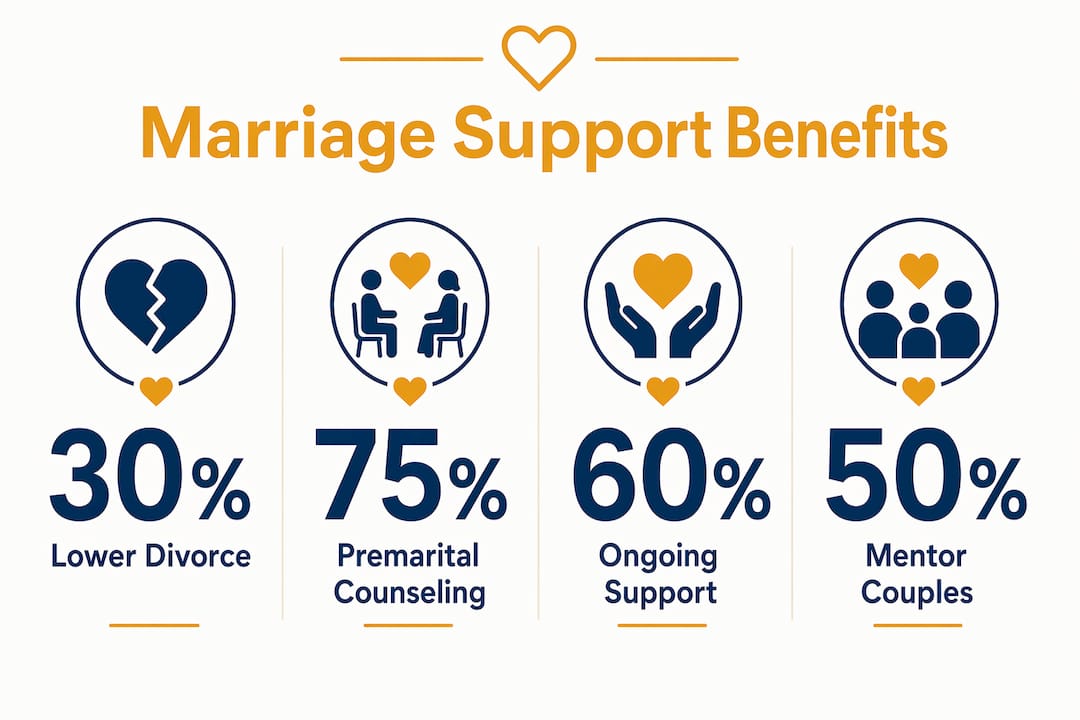
The most effective church programs combine structured preparation before marriage with ongoing accompaniment after the wedding. The Denver Catholic Archdiocese model is one of the most documented examples in current practice. Their marriage preparation program includes weekly sponsor couple meetings, priest-led sessions, and retreats spread over six months, with trained mentor couples who then accompany newly married small groups and become what the program calls “missionary multipliers.”
That model works because it does not end at the altar. Effective church support for couples follows a clear sequence:
- Premarital preparation with trained sponsor or mentor couples over multiple months, not a single weekend
- Sacramental and spiritual formation through programs like Pre-Cana, which incorporate prayer, Scripture, Theology of the Body, and confession to build what Catholic tradition calls a “domestic church”
- Post-wedding small group integration where newly married couples join an existing community rather than disappearing after the honeymoon
- Blended family and remarriage ministries that address the specific challenges of stepfamilies and couples entering second marriages
- Ongoing pastoral counseling that combines spiritual direction with practical communication support
Pre-Cana programs at institutions like St. Joseph’s Seminary focus on sacramental preparation that includes clergy talks and structured spiritual activities emphasizing household rhythm. This approach treats the home itself as a place of worship and formation. That framing gives couples a shared spiritual identity that strengthens their bond beyond romantic feelings.
“Marriage preparation is not content delivery alone. Spiritual practices and access to confession strengthen the domestic church in ways that no curriculum can replicate on its own.” — Insight from Pre-Cana formation research
Church leaders also provide discipleship and pastoral care for blended families and remarried couples, recognizing that these relationships carry unique pressures that generic marriage programs rarely address. A church that builds a blended-family ministry signals to those couples that they belong and that their marriage matters.
For couples exploring what premarital counseling covers, pairing church preparation with structured counseling topics produces the strongest foundation.
Does church involvement actually improve marriage outcomes?
Church attendance is directly linked to lower divorce rates. Analysis of couples who married young shows that non-attenders have over half divorce, while weekly attenders divorce at just over a third of the rate. That gap is not explained by demographics alone. It reflects the protective effect of community norms, accountability, and shared spiritual practice.
| Factor | Effect on marriage stability |
|---|---|
| Weekly church attendance | Significantly lower divorce rate across age groups |
| Mentor couple accompaniment | Stronger communication and conflict resolution skills |
| Small group participation | Increased sense of belonging and mutual accountability |
| Shared spiritual practices | Greater alignment on values, forgiveness, and long-term commitment |
Community norms matter because they set the standard for what couples expect of themselves. A congregation that talks openly about forgiveness, fidelity, and mutual service creates an environment where those values feel normal rather than exceptional. Couples absorb those norms through sermons, friendships, and shared rituals over years.
Healthy marriages need repeated relational accompaniment that extends well beyond preparation into ongoing community ties. That finding confirms what therapists and pastors have observed for decades: isolated couples are fragile couples. Connection is protective.
What safety practices should church marriage programs follow?
Church marriage mentor programs carry real responsibility. Mentor couples work with vulnerable people at sensitive moments in their relationships. Without proper structure, those programs can cause harm rather than help.
Marriage Australia’s program emphasizes that church-based marriage mentors must follow safe church protocols and clear reporting requirements to protect both couples and ministry integrity. The core safety practices include:
- Formal training for all mentor couples before they begin working with others
- Clear boundaries around confidentiality and the limits of peer mentoring versus professional counseling
- Mandatory reporting routes for situations involving abuse, mental health crises, or legal concerns
- Regular supervision or check-ins with a pastor or program coordinator
- Written agreements that define the scope and duration of the mentoring relationship
Pro Tip: If you are a mentor couple, never position yourselves as therapists. Your role is relational accompaniment and spiritual encouragement. When a couple’s needs exceed that, refer them to a licensed counselor or pastoral counselor immediately.
Pastoral counseling that integrates spiritual and emotional support is most effective when it operates within a clear structure. The combination of spiritual direction and evidence-based communication tools produces better outcomes than either approach alone. Couplesfightschool works alongside pastoral care to provide couples with the practical conflict resolution skills that church mentors are not trained to deliver.
For couples navigating a serious crisis, understanding pastoral counseling’s role in marriage crisis situations helps clarify when to seek additional professional support.
How can couples engage more deeply with their church community?
Deeper engagement with your church community for marriage support starts with a decision to stop attending passively and start participating actively. Most couples sit in services for years without ever connecting to the relational infrastructure their church has built.
- Attend consistently. Weekly attendance is the single most reliable predictor of the protective benefits church community provides. Sporadic attendance produces sporadic connection.
- Join a couples small group. Small groups create the relational depth that large services cannot. Look for groups organized by life stage so the conversations are relevant to where you are right now.
- Request a mentor couple. Many churches have mentor programs that are underused simply because couples do not know to ask. A trained mentor couple offers perspective, accountability, and lived experience that no book can replicate.
- Incorporate spiritual disciplines at home. Prayer together, reading Scripture, and practicing forgiveness as a daily habit build what faith traditions call the domestic church. These practices reinforce the values your community holds.
- Seek blended-family or recovery ministries if relevant. If you are in a stepfamily or recovering from a past relationship wound, find the ministry designed for your situation. Generic marriage programs often miss the specific pressures you face.
- Use professional resources alongside church support. Church community and faith-based marriage counseling work best when paired with structured communication tools. Programs like those at Couplesfightschool give couples practical skills that complement spiritual formation.
Understanding why premarital counseling improves outcomes also applies to couples already married. The same principles of structured reflection and skill-building apply at any stage.
Key Takeaways
Church community is the most consistently underused protective factor in marriage health, and intentional engagement with it produces measurable, lasting results.
| Point | Details |
|---|---|
| Ongoing support beats one-off events | Churches that build relational discipleship cultures sustain marriages better than those offering occasional programs. |
| Mentor couples multiply impact | Trained sponsor couples who accompany newlyweds create a multiplying effect across the congregation. |
| Weekly attendance lowers divorce risk | Couples who attend church weekly divorce at significantly lower rates than non-attenders. |
| Safety protocols protect everyone | Mentor programs require structured training, clear boundaries, and mandatory reporting routes to function safely. |
| Spiritual disciplines strengthen the home | Prayer, Scripture, and forgiveness practiced daily build the shared identity that holds marriages together through difficulty. |
What I have learned about church and marriage after years of working with couples
The church is the most underestimated marriage resource in most communities. Couples come to me after years of struggling in isolation, and when I ask about their church community, the answer is almost always the same: “We go, but we are not really connected.” That gap between attendance and genuine community is where marriages quietly deteriorate.
What I have seen work is not the big marriage conference or the annual retreat. It is the mentor couple who texts on a Tuesday to check in. It is the small group where a husband finally admits he does not know how to apologize without getting defensive. It is the pastor who follows up three months after a hard conversation. That kind of relational accountability is what the church does better than any therapy platform, including ours.
The uncomfortable truth is that most churches have the infrastructure for this kind of support. They have trained leaders, small group systems, and pastoral care. What they often lack is a culture that makes it normal for couples to ask for help before they are in crisis. Building that culture is the real work of church marriage ministry in 2026.
Faith and relational accountability together do something that neither can do alone. Faith provides the “why” for staying committed through difficulty. Community provides the “how” by modeling what repair, forgiveness, and growth actually look like in real marriages. Couples who have both are genuinely better equipped. I have watched it happen too many times to doubt it.
For Christian couples who still find themselves stuck in recurring conflict despite their faith, the truth about why Christian couples struggle is worth reading honestly.
— Carlos
Couplesfightschool: practical tools that work alongside your church
Church community provides the spiritual foundation and relational accountability your marriage needs. Couplesfightschool provides the practical communication and conflict resolution skills that turn good intentions into lasting change.
The F.I.G.H.T. Plan® framework, developed by licensed mental health professionals Carlos Todd and Natasha Pemberton-Todd, gives couples a structured system for navigating conflict without destroying connection. Whether you are newly engaged or years into a difficult marriage, the online coaching for couples at Couplesfightschool gives you direct access to expert guidance that complements everything your church community offers. You can also explore the Fight Less, Love More course for a self-paced path to better communication and deeper intimacy.
FAQ
What is the church’s role in supporting marriage?
The church’s role in marriage is to provide ongoing spiritual formation, relational accountability, and practical support through mentor programs, small groups, and pastoral counseling. This extends well beyond the wedding ceremony into every stage of married life.
Does church attendance really reduce divorce rates?
Weekly church attendance is linked to significantly lower divorce rates. Analysis shows that non-attenders who married young divorce at more than half the rate, while weekly attenders divorce at just over a third of that rate.
What is faith-based marriage counseling?
Faith-based marriage counseling integrates spiritual direction with evidence-based communication and conflict resolution tools. It is offered by trained pastoral counselors and works best when paired with ongoing church community support.
How do I find a mentor couple at my church?
Ask your pastor or marriage ministry leader directly. Many churches have mentor couple programs that go underused simply because couples do not know to request them. A trained mentor couple provides accountability and lived experience that formal counseling alone cannot offer.
Can church support help blended families and remarried couples?
Church leaders provide discipleship and pastoral care specifically for blended families and remarried couples, addressing the unique pressures of two-household parenting and stepfamily dynamics. Look for a church with a dedicated blended-family ministry for the most relevant support.
Recommended