
Why Couples Fight More Under Stress: What’s Really Happening

Stress is the single most reliable predictor of increased conflict frequency in romantic relationships. When external pressure mounts — from financial strain, job loss, health crises, or major life transitions — couples fight more because the brain shifts into survival mode, stripping away the patience and emotional flexibility that healthy communication requires. This isn’t a character flaw or a sign that your relationship is failing. It’s neuroscience. Understanding why couples fight more under stress is the first step toward breaking the cycle before it breaks your connection.
Why couples fight more under stress: the brain science
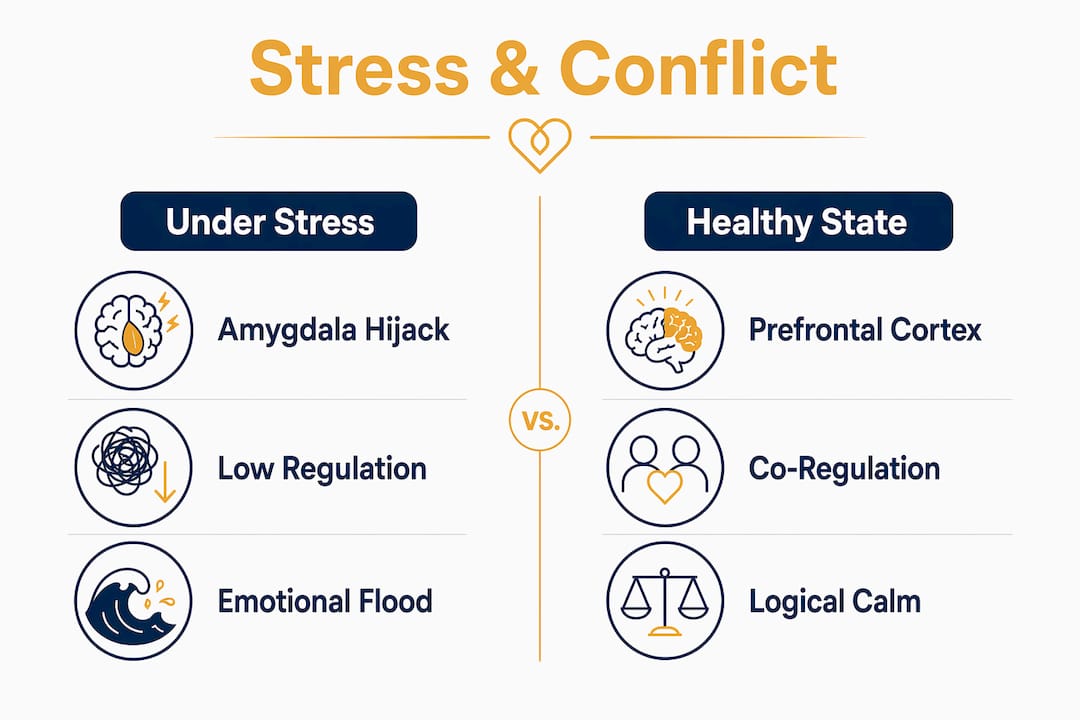
The clinical term for what happens to your brain under chronic pressure is amygdala hijack, a concept introduced by psychologist Daniel Goleman. The amygdala, the brain’s threat-detection center, takes over when stress levels stay elevated for too long. It floods the body with cortisol and adrenaline, and the prefrontal cortex, the part responsible for empathy, logic, and self-control, goes offline. You are left reacting instead of responding.
When the nervous system operates at 80 to 90% capacity due to external pressures, even a minor miscommunication pushes it into full survival mode. That means the patience and reflective listening you normally bring to a disagreement simply aren’t available. A comment about the dishes becomes a referendum on respect. A forgotten errand feels like abandonment.
When both partners are dysregulated, the prefrontal cortex cannot engage for logical problem-solving. This is why telling a stressed couple to “just communicate better” misses the point entirely. You cannot reason your way out of a neurological state. The brain must feel safe before it can think clearly.

Pro Tip: Before any difficult conversation, try 60 seconds of slow, deep breathing together. This activates the parasympathetic nervous system and signals to your brain that you are not under threat, making productive dialogue physically possible.
Chronic stress also creates what researchers call emotional flooding, a state where couples often don’t realize they’re emotionally flooded until they are already dysregulated. By that point, rational problem-solving is off the table. Recognizing the early signs of flooding, such as a racing heart, shallow breathing, or the urge to shut down, gives you a window to pause before the argument escalates.
Are you really fighting about what you think you’re fighting about?
The answer, most of the time, is no. Stress preps the brain for fight, amplifying sensitivity to any perceived threat or judgment from a partner. So when you snap at your spouse about the grocery list, you are rarely actually upset about groceries. You are protecting something more fragile: your sense of competence, your need to feel respected, or your fear of not being loved.
This pattern shows up in four predictable ways during high-stress periods:
- Competence threats. One partner feels criticized for how they handled a task, and the real wound is “you think I’m not capable.” The argument sounds like logistics but feels like an attack on identity.
- Demand-withdraw cycles. One partner pushes for resolution while the other pulls back. Research on couples fighting under pressure consistently shows this cycle intensifies when stress is high, because withdrawal feels like safety to one person and abandonment to the other.
- Invisible labor resentment. Research confirms satisfaction declines post-parenthood especially when labor division feels unfair. The fight about who forgot to schedule the pediatrician appointment is really about who carries the mental load, and whether that sacrifice is seen.
- Sideways stress release. Arguments are frequently sideways releases of external stress, targeting the safest person available: your partner. You cannot yell at your boss, so you come home and pick a fight about the thermostat.
Recognizing these patterns does not make the feelings less real. It makes them more workable. When you can say, “I think I’m actually scared, not angry,” the conversation shifts from combat to connection.
How co-regulation changes everything during high-stress times
Most couples assume that better communication is the solution to stress-driven conflict. It helps, but it is not enough on its own. Better communication alone isn’t enough during stress; partners need deliberate breaks and emotional safety to regulate and repair. The more powerful tool is co-regulation.
Co-regulation is the process by which one partner’s calm nervous system stabilizes the other’s. It is not about one person suppressing their feelings to manage their partner. It is about one person choosing to stay grounded so the relationship has an anchor. Here is how to practice it:
- Pause before you engage. When you notice tension rising, name it out loud: “I can feel this getting heated. Can we take ten minutes?” A deliberate pause is not avoidance. It is the most productive thing you can do.
- Offer presence before solutions. Genuine listening without agenda signals safety and reduces the charge of a fight significantly, even when the external stressor remains unresolved. Sit with your partner. Make eye contact. Say, “Tell me what’s going on for you.”
- Validate before you problem-solve. Mirror neurons enable empathy and validation in conflict, releasing oxytocin that lowers cortisol and promotes connection. Saying “That sounds exhausting” is not weakness. It is biology working in your favor.
- Avoid unsolicited advice. Offering solutions when your partner needs to feel heard is one of the most common communication issues in stress. It signals that you want the problem gone, not that you want to understand their experience.
Pro Tip: Ask your partner one question before offering any advice: “Do you want me to listen, or do you want help solving this?” That single question prevents more arguments than almost any other habit.
Learning emotional regulation skills is not just a personal growth exercise. For couples, it is a shared survival strategy. When you can regulate yourself, you give your partner the neurological space to do the same.
What happens when stress creates emotional distance instead of fights
Not every stressed couple fights loudly. Some go quiet. And that silence can be more dangerous than any argument. Emotional withdrawal or “roommate mode” occurs under chronic stress and can be more damaging than fighting, because it signals emotional inaccessibility without giving either partner a clear target to address.
The table below shows the difference between healthy distance and the kind of withdrawal that signals a rupture in emotional safety.
| Behavior | Healthy distance | Danger signal |
|---|---|---|
| Needing alone time | Communicated clearly, temporary | Unexplained, recurring, increasing |
| Reduced conversation | Acknowledged, with reconnection planned | Gradual, unnoticed, normalized |
| Physical affection | Decreased but still present | Absent without discussion |
| Conflict style | Disagreements still addressed | Issues avoided entirely |
| Emotional tone | Neutral or warm | Flat, detached, or cold |
Emotional disconnection caused by chronic stress can happen silently and gradually, requiring intentional repair to restore connection. The repair does not require a dramatic conversation. It starts with naming what is happening: “I feel like we’ve been distant lately, and I miss you.” That sentence, said without blame, opens a door that silence keeps shut.
Small rituals matter more than grand gestures during stressful seasons. A five-minute check-in before bed, a shared cup of coffee without phones, or a genuine “How are you really doing?” can rebuild the emotional thread that stress slowly unravels. The truth about relationship conflict is that disconnection rarely announces itself. It accumulates quietly until one or both partners feel alone inside the relationship.
Key takeaways
Couples fight more under stress because the brain’s survival response overrides emotional regulation, turning minor friction into major conflict rooted in deeper fears rather than surface issues.
| Point | Details |
|---|---|
| Stress triggers survival mode | The amygdala hijacks rational thinking, making small disagreements feel like serious threats. |
| Fights protect vulnerable emotions | Most stress-driven arguments are about identity, respect, or fear of abandonment, not the surface topic. |
| Co-regulation beats communication tips | One partner staying calm neurologically stabilizes the other, creating space for real dialogue. |
| Silence can be more dangerous than fighting | Roommate mode and emotional withdrawal quietly erode intimacy without giving couples a clear problem to solve. |
| Small rituals rebuild connection | Consistent, low-effort moments of presence repair the emotional distance that chronic stress creates. |
What I’ve learned after years of working with stressed couples
I have sat with hundreds of couples who came in convinced their relationship was broken. They were fighting constantly, or they had stopped fighting and started disappearing from each other. In almost every case, the relationship was not broken. It was stressed.
Here is what I know to be true: stress does not create conflict. It lowers the threshold for it. The arguments that surface during hard seasons are almost always arguments that were waiting to happen, because the underlying emotional needs were never fully addressed. Stress just removes the buffer.
What I advocate for, and what I have seen work consistently, is prioritizing presence over problem-solving. Most couples come to conflict wanting to win or wanting it to stop. What they actually need is to feel seen by the person they love most. When you offer that, even imperfectly, the fight loses most of its charge.
I also want to say something that most relationship content skips: be patient with yourself. When you are running on empty, you will not show up as your best self. That is not failure. That is being human. The goal is not to be a perfect partner under pressure. The goal is to stay curious about your partner’s experience and honest about your own.
Small rituals save relationships. A genuine check-in. A hand on the shoulder. Saying “I know this is hard for both of us.” These are not small things. They are the architecture of emotional safety, built one moment at a time.
— Carlos
Ready to fight less and connect more?
Stress will always be part of life. How you and your partner respond to it together is what defines the health of your relationship. At Couplesfightschool, Carlos Todd and Natasha Pemberton-Todd have built a platform specifically for couples navigating exactly what you are going through right now.
Through the F.I.G.H.T. Plan® framework, Couplesfightschool gives you the tools to move from reactive conflict to real connection. Whether you are fighting too much or drifting too far apart, the online coaching for couples program meets you where you are. You can also start today with practical strategies to diffuse conflict with your partner before stress does any more damage. The next step is yours.
FAQ
Why do couples argue more when stressed?
Stress activates the brain’s amygdala and suppresses the prefrontal cortex, reducing emotional regulation and patience. Minor disagreements trigger disproportionate reactions because the nervous system is already operating near its capacity.
Is it normal to fight more during hard times?
Yes. Increased conflict during periods of financial strain, health challenges, or major life transitions is a documented stress response, not a sign that the relationship is failing. The pattern becomes a problem only when it goes unaddressed.
What is co-regulation and how does it help couples?
Co-regulation is the process by which one partner’s calm nervous system helps stabilize the other’s. It is more effective than communication tips alone because it addresses the neurological state that makes productive conversation impossible in the first place.
How can couples stop fighting under pressure?
The most effective approach combines deliberate pauses before conflict escalates, validation before problem-solving, and small daily rituals that maintain emotional connection. Conflict resolution techniques practiced consistently during low-stress periods are far easier to access when pressure rises.
What does emotional withdrawal look like in a stressed relationship?
Emotional withdrawal, sometimes called roommate mode, shows up as reduced conversation, absent physical affection, and avoided conflict rather than resolved conflict. Unlike healthy alone time, this pattern is unacknowledged and gradually intensifies, quietly reducing intimacy and emotional safety.
Recommended