
Why Newlywed Conflict Is Normal: What Couples Must Know

Newlywed conflict is a predictable and healthy part of early marriage, not a warning sign that you chose the wrong person. The clinical term for this phase is relational adjustment, and it describes the shift couples make from romantic idealization to realistic partnership. This shift is driven by neurochemical changes in the brain, the hard work of blending two lives into one, and the surfacing of unresolved personal patterns. Understanding why newlywed conflict is normal does not just bring relief. It gives you a framework for turning disagreements into the building blocks of a stronger marriage.
Why does newlywed conflict happen biologically?
The brain chemistry that fuels early romance is temporary by design. After the first year, neurochemical levels of dopamine, oxytocin, and serotonin decline. That decline reduces the infatuation effect that once softened your perception of your partner’s flaws.
When those chemicals drop, the prefrontal cortex steps in. This is the part of your brain responsible for critical thinking and realistic assessment. It starts doing exactly what it is built to do: evaluate your partner’s habits, patterns, and character with clear eyes. The result feels like disappointment, but it is actually your brain maturing into a more honest view of the relationship.
“Many couples incorrectly assume the initial romantic excitement should last indefinitely, leading to distress when reality shifts. Disappointment in early marriage reflects natural maturation, not failure.”
This neurological shift also triggers what relationship researchers call the power struggle phase. During this phase, couples test each other’s reliability and subconsciously attempt to heal unresolved wounds from past relationships or childhood attachment patterns. Anxious attachment styles push one partner to seek constant reassurance. Avoidant styles push the other to withdraw. The friction between these two responses is one of the most common newlywed arguments reasons couples report.
Pro Tip: If you recognize your own attachment style, you can name it during a conflict instead of acting it out. Saying “I think I’m feeling anxious right now” changes the conversation entirely.

How do shared responsibilities fuel early arguments?
The first year of marriage functions as the setup phase for your relationship’s operating system. Every decision you make about money, chores, family visits, and stress management creates a default pattern that becomes harder to change the longer it goes unaddressed. This is why common newlywed issues often feel bigger than they should. You are not just arguing about dishes. You are negotiating the rules of your shared life.
Here are the four areas where lifestyle friction most often ignites early conflict:
- Finances. Two people rarely enter marriage with identical money habits. One partner saves aggressively while the other spends freely. Without a shared financial plan, resentment builds fast.
- Domestic labor. Who cooks, cleans, and manages household logistics rarely gets discussed before marriage. Unspoken assumptions become the source of daily frustration.
- Family boundaries. How much access do in-laws have? How often do you visit? These questions carry deep emotional weight and rarely have easy answers.
- Communication styles. One partner processes conflict by talking it through immediately. The other needs space before engaging. Without understanding this difference, both partners feel dismissed.
Unspoken habits formed in the first three months of marriage can calcify into fixed dynamics that are genuinely difficult to renegotiate later. That is not a threat. It is a reason to address friction early rather than hoping it resolves on its own.
Pro Tip: Schedule a 30-minute “house meeting” once a week during your first year. Treat it like a business check-in for your marriage. It removes the emotional charge from logistics conversations.
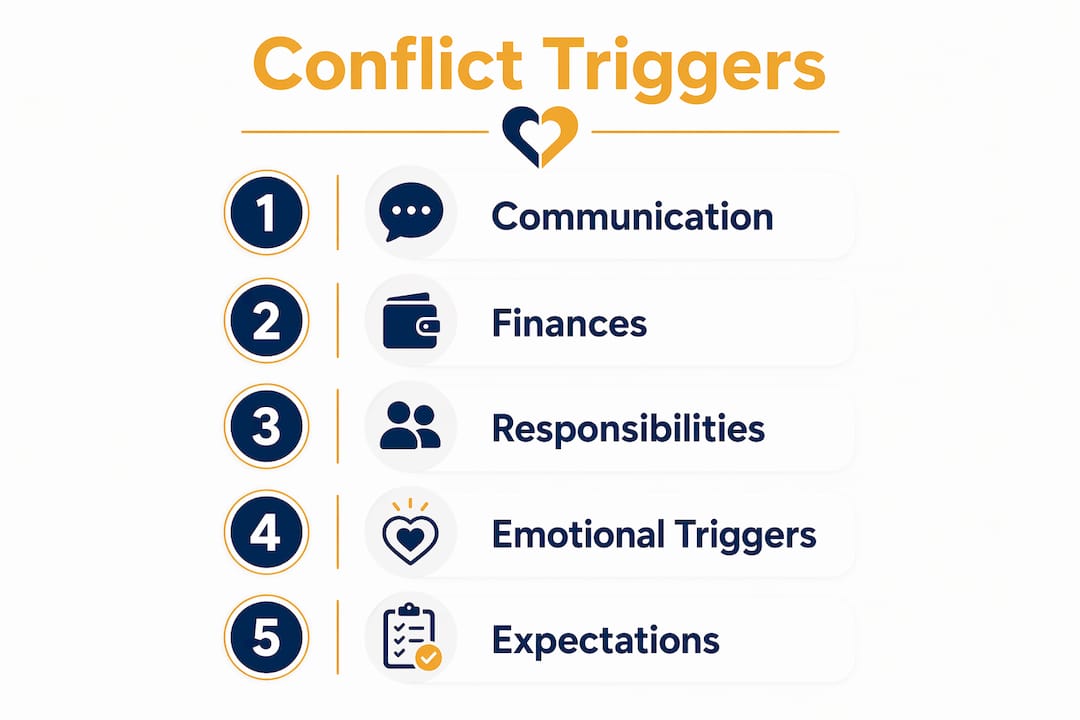
What are the most common newlywed conflict triggers?
Newlywed conflicts most often center on finances, communication breakdowns, emotional triggers, and role expectation mismatches. These are not signs of incompatibility. They are signs that two distinct people are doing the hard work of becoming one household.
The most frequently reported triggers include:
- Financial stress. Debt, different spending philosophies, and disagreements about financial priorities rank as the top source of early marital conflict across most relationship research.
- Communication failures. Misreading tone, assuming intent, and defaulting to criticism instead of curiosity create cycles of misunderstanding that escalate quickly.
- Emotional triggers. Past trauma, family-of-origin wounds, and unresolved personal insecurities do not disappear after the wedding. They show up in arguments about seemingly unrelated topics.
- Unspoken resentments. Small grievances that go unaddressed compound over time. What starts as mild irritation about a habit becomes a symbol of deeper disrespect.
- Power struggles. Decisions about whose career takes priority, whose social circle gets more time, and whose preferences shape the home reflect deeper questions about identity and value within the marriage.
Difficulty in early marriage becomes a real problem only when conflicts are recurring and consistently unresolved. A single argument about money is normal. A pattern of shutting down every financial conversation without resolution is a signal to get support.
How can newlyweds handle conflict constructively?
The most effective shift in conflict resolution for couples is reframing the fight itself. Conflict strengthens marriage when couples treat it as a shared problem to solve rather than a personal attack to defend against. The mental move from “me vs. you” to “us against this issue” changes everything about how a conversation unfolds.
Here is a direct comparison of two approaches to the same conflict:
| Approach | What It Sounds Like | Outcome |
|---|---|---|
| Blame-focused | “You never listen to me.” | Partner becomes defensive, conversation escalates. |
| Problem-focused | “I feel unheard. Can we figure out why?” | Partner stays open, conversation moves toward repair. |
| Withdrawal | Silence, stonewalling, leaving the room | Issue goes unresolved, resentment compounds. |
| Repair attempt | “I don’t want to fight. Can we start over?” | Cycle breaks, emotional safety is restored. |
Couples who practice mindful communication and avoid “win mode” experience greater intimacy and more effective repair after disagreements. Repair does not mean pretending the fight did not happen. It means acknowledging the rupture and actively choosing reconnection.
Couples therapy specialized for early marriage focuses on exposing unspoken expectations, improving communication, and preventing small conflicts from becoming entrenched patterns. You do not need to be in crisis to benefit from professional support. Many couples use tools like the Couples Therapy Workbook from Couplesfightschool to work through these dynamics on their own terms, at their own pace.
Pro Tip: After a conflict, use a simple repair phrase before the conversation ends: “I love you and I want us to figure this out together.” It signals safety and keeps the relationship bigger than the argument.
Couplesfightschool also offers practical conflict resolution techniques that couples can apply immediately, without waiting for a therapy appointment. The goal is not to eliminate conflict. The goal is to fight in ways that bring you closer rather than push you apart.
Key takeaways
Early marriage conflict is a biological and relational inevitability, not a sign of failure, and how couples handle it in the first year shapes the long-term health of the marriage.
| Point | Details |
|---|---|
| Conflict is neurologically driven | Brain chemistry shifts after year one, triggering realistic and sometimes critical perception of your partner. |
| First-year patterns stick | Default habits formed in the first three months of marriage become the hardest to change later. |
| Common triggers are predictable | Finances, communication styles, emotional triggers, and role expectations are the top sources of newlywed friction. |
| Reframing wins arguments | Shifting from blame to shared problem-solving reduces defensiveness and builds intimacy. |
| Early support prevents damage | Addressing recurring conflicts early, through tools or therapy, stops resentment from compounding. |
What i’ve learned after years of working with newlyweds
I have sat across from hundreds of newlywed couples who walked into a session convinced their marriage was already broken. They had been together for six months. They were fighting about laundry and in-laws and who forgot to pay a bill. And they were terrified.
What I tell every one of them is this: the fighting is not the problem. The meaning you assign to the fighting is the problem.
Most couples enter marriage carrying a silent belief that love means harmony. When conflict shows up, they interpret it as evidence that something went wrong. That belief is the real threat to the marriage, not the argument about the dishes.
The couples I have seen build the strongest marriages are not the ones who fought the least. They are the ones who learned to fight well. They stopped trying to win and started trying to understand. They learned to say “I’m feeling triggered right now” instead of launching a counterattack. They repaired quickly and without score-keeping.
The power struggle phase is painful. I will not pretend otherwise. But it is also the phase where you stop performing for each other and start actually knowing each other. That is not a crisis. That is intimacy beginning.
If your conflicts feel overwhelming or you keep hitting the same wall, please do not wait. Seeking help early is not an admission of failure. It is one of the most loving things you can do for your marriage. Resources like premarital and early marriage counseling exist precisely for this moment.
— Carlos
How Couplesfightschool can help you navigate early marriage
Conflict in the first year of marriage is normal. Staying stuck in it is not.
Couplesfightschool was built by licensed mental health professionals Carlos Todd and Natasha Pemberton-Todd specifically to help couples like you move from recurring arguments to real understanding. Whether you want to work through conflict on your own schedule or get personalized guidance, the resources are designed for where you are right now. Start with the conflict de-escalation program to learn practical skills you can use in your next disagreement. Or explore online coaching for couples if you want direct, personalized support. You do not have to figure this out alone.
FAQ
Is fighting in the first year of marriage normal?
Yes. Newlywed fighting is a normal transition reflecting the challenge of blending two lives. It becomes a concern only when conflicts are recurring and consistently left unresolved.
What are the most common reasons newlyweds argue?
Finances, communication breakdowns, emotional triggers, and mismatched role expectations are the top conflict triggers for newlywed couples. These arise naturally from the process of building a shared life.
When does the honeymoon phase end?
Neurochemical research shows that dopamine and oxytocin levels typically decline after the first year, which is when many couples notice a shift in how they perceive and interact with each other.
How do you fight fairly as a newlywed?
Reframe the conflict as a shared problem rather than a personal attack. Avoiding “win mode” and focusing on mutual understanding reduces escalation and builds emotional safety.
Should newlyweds go to couples therapy?
Couples therapy in early marriage is a proactive investment, not a last resort. It helps expose unspoken expectations and builds communication skills before small conflicts become entrenched patterns.
Recommended