
How to Overcome Communication Gridlock in Marriage

Communication gridlock in marriage is defined as a recurring conflict cycle where both partners feel unheard, misunderstood, and emotionally stuck. Unlike ordinary disagreements, gridlock does not resolve with time. It repeats, deepens, and slowly erodes emotional intimacy. The good news is that couples can break this cycle with structured techniques, emotional awareness, and consistent practice. This guide covers the core causes of gridlock, practical tools to resolve marriage communication issues, and how to build the emotional safety that makes lasting change possible.
What causes communication gridlock in marriage?
Gridlock rarely starts with the surface argument. It starts with unmet core needs. Gridlocked conflicts often arise from core unmet needs such as safety, connection, freedom, and respect. When those needs feel threatened, partners stop listening and start defending.
Emotional triggers are the accelerant. One partner says something that lands wrong, and the other reacts from fear or hurt rather than reason. That reaction triggers a counter-reaction. Within minutes, the conversation has nothing to do with the original topic and everything to do with each partner’s emotional survival. Understanding your emotional triggers is the first step to interrupting this cycle.
Three specific patterns keep couples locked in gridlock:
- Threatened core needs. When safety, respect, or freedom feel at risk, the brain shifts into protection mode. Productive conversation becomes nearly impossible.
- Defensive reactions. Withdrawal, stonewalling, and counterattacks are all forms of self-protection. They feel necessary in the moment but block genuine connection.
- “Napalm” language. Statements like “you always” and “you never” escalate defensiveness and conflict immediately. They signal contempt, which is one of the most corrosive forces in a marriage.
Communication driven by unmet core needs feels exhausting and repetitive until those needs are named and addressed directly. Recognizing which need is actually at stake in a conflict is the first real move toward resolution. Couplesfightschool teaches couples to identify these needs before the conversation begins, not in the middle of a fight.
What practical communication tools help break gridlock?
Breaking communication barriers in a relationship requires more than good intentions. It requires structure. Without structure, conversations under emotional pressure default to old, destructive patterns.

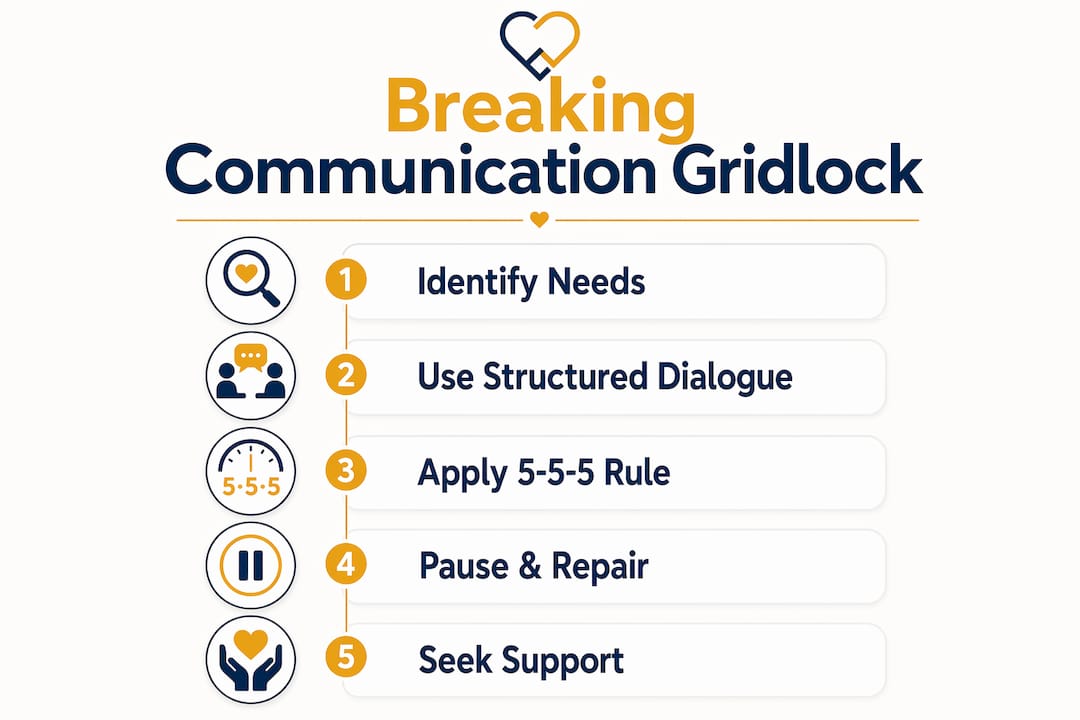
The most practical starting point is the 5-5-5 rule. The 5-5-5 rule structures equal time for speaking and shared dialogue: 5 minutes for one partner to speak without interruption, 5 minutes for the other to respond, and 5 minutes for shared dialogue. This format prevents the common trap of one partner dominating while the other shuts down. Couplesfightschool incorporates this tool directly into its courses because it works even when emotions are running high.
Here are four communication tools couples can apply immediately:
- Use the 5-5-5 rule. Set a timer. Stick to the format. The structure itself reduces anxiety because both partners know they will get a turn.
- Practice active listening. Active listening involves full attention, respect, and validating emotions without necessarily agreeing. Saying “I hear that you felt dismissed” costs nothing and changes everything.
- Lead with “I” statements. Replace “You never support me” with “I feel alone when I don’t hear from you.” The first triggers defense. The second opens a door.
- Name the pattern, not the person. Naming the conflict loop allows couples to depersonalize conflict and find shared solutions. When you say “We’re doing that thing again where we both stop listening,” you make the pattern the problem, not each other.
Pro Tip: Before your next difficult conversation, agree on a code word that either partner can use to pause the discussion. This is not avoidance. It is a deliberate reset that prevents escalation and keeps the conversation productive.
Couplesfightschool’s conflict resolution course walks couples through each of these tools with guided practice, so the skills become automatic rather than theoretical.
How do you create emotional safety in marriage?
Healthy communication is less about perfect words and more about creating emotional safety where both partners feel heard and valued. Without that safety, even the best communication techniques fall flat.
Emotional safety is built through consistent, small actions, not grand gestures. Consider these daily habits:
- Slow down before responding. Pausing for even three seconds before replying reduces the chance of a reactive, hurtful response.
- Speak from vulnerability, not accusation. Expressing vulnerability instead of blame reduces conflict intensity and signals trust.
- Repair quickly after escalation. A simple “I’m sorry I raised my voice” within hours of a conflict prevents resentment from calcifying.
- Build a daily connection habit. Routine check-ins and expressing appreciation daily build a positive emotional reserve that supports difficult conversations later.
The repair attempt is one of the most underrated tools in marriage communication. Most couples wait days or weeks to address a blow-up. The longer the gap, the more the hurt hardens. Couplesfightschool teaches couples to repair within 24 hours, even if the full resolution takes longer.
Research on family therapy effectiveness confirms that structured therapeutic communication methods consistently improve relational safety and reduce conflict frequency. The same principles apply in marriage: structure and consistency matter more than intensity.
What to do when communication gridlock persists?
Some couples apply every tool correctly and still feel stuck. That is not failure. It is a signal that the cycle runs deeper than surface-level habits.
Avoidance, blame, and passive-aggressive behaviors increase the likelihood of prolonged gridlock. Recognizing and interrupting these habits is the critical next step. The table below maps the most common gridlock behaviors to their practical antidotes.
| Behavior | What it looks like | Practical antidote |
|---|---|---|
| Withdrawal | Shutting down, leaving the room, going silent | Agree on a structured timeout with a return time |
| Escalation | Raising voices, bringing up old grievances | Use the 5-5-5 rule to slow the pace |
| Avoidance | Changing the subject, deflecting with humor | Name the pattern and commit to one topic at a time |
| Blame language | “You always,” “you never,” “it’s your fault” | Replace with “I” statements and specific observations |
When these patterns repeat despite genuine effort, temporary compromises can help couples make peace with perpetual conflicts. The goal is not to solve every conflict permanently. The goal is to remove the sting and keep dialogue open. Some differences between partners are perpetual. Accepting that fact reduces the pressure to “win” and creates space for genuine understanding.
Pro Tip: If a conversation has escalated three times in a row on the same topic, stop trying to resolve it in the moment. Instead, schedule a dedicated time to discuss it when both partners are calm, rested, and not hungry. Timing matters more than most couples realize.
Couples therapy or coaching becomes the right move when gridlock has lasted more than six months, when one or both partners feel contempt rather than frustration, or when physical or emotional safety is at risk. Couplesfightschool’s online coaching for couples offers a structured path forward without requiring in-person therapy. Knowing when to bring in outside support is a sign of strength, not defeat.
Key Takeaways
Couples who overcome communication gridlock do so by naming their unmet needs, applying structured dialogue tools, and building emotional safety through consistent daily habits.
| Point | Details |
|---|---|
| Gridlock starts with unmet needs | Identify the core need at stake before the conversation begins. |
| Structure beats willpower | The 5-5-5 rule creates balance when emotions make fair dialogue difficult. |
| Emotional safety is built daily | Small repairs and appreciation habits create the reserve needed for hard conversations. |
| Name the pattern, not the person | Depersonalizing conflict shifts both partners from opponents to teammates. |
| Seek support when stuck | Coaching or therapy is the right move when gridlock persists beyond six months. |
What I’ve learned from couples who finally broke through
After working with hundreds of couples, the pattern I see most often is this: couples wait too long to address gridlock because they believe the problem is the other person. That belief is the actual gridlock. The conflict is not the enemy. The pattern is.
The couples who make real progress are the ones who get curious instead of defensive. They start asking “What does my partner actually need right now?” instead of “How do I prove my point?” That shift sounds simple. It is not. It takes practice, humility, and a willingness to be wrong about your own story.
One of the most transformational moments I witness is when a couple first names their loop out loud together. They look at each other and say, “We keep doing this thing.” Suddenly, they are on the same side. The conflict escalation patterns that felt personal become something they can face together.
Gridlock is not a sign that your marriage is broken. It is a sign that both of you care deeply and have not yet found the right language for what you need. That language exists. Learning it is the work.
— Carlos
How Couplesfightschool helps couples move past gridlock
Couplesfightschool was built specifically for couples who are tired of having the same fight and ready to learn a different way.
The platform’s courses and coaching programs teach the 5-5-5 rule, active listening, emotional safety practices, and the F.I.G.H.T. Plan® framework in a structured, step-by-step format. Every tool is grounded in psychology and designed for real couples under real pressure. The relationship skills resource covers the core communication skills every married couple needs, including the exact techniques covered in this article. Couplesfightschool also offers online coaching for couples who want personalized guidance from licensed professionals. The work is hard. The tools make it possible.
FAQ
What is communication gridlock in marriage?
Communication gridlock is a recurring conflict pattern where both partners feel unheard and emotionally stuck, and the same arguments repeat without resolution. It typically stems from unmet core needs such as safety, respect, or connection.
How does the 5-5-5 rule help resolve marriage communication issues?
The 5-5-5 rule gives each partner five minutes to speak without interruption, five minutes to respond, and five minutes for shared dialogue. This structure prevents one partner from dominating and creates space for genuine listening.
When should couples seek therapy or coaching for communication problems?
Couples should consider professional support when gridlock has persisted for six months or more, when contempt replaces frustration, or when repeated efforts to fix communication patterns have not produced change.
What is the fastest way to break communication barriers in a relationship?
Naming the conflict pattern out loud together is one of the fastest ways to shift the dynamic. When both partners identify the loop they are stuck in, they move from opposing each other to solving a shared problem.
Can couples overcome gridlock without professional help?
Many couples make significant progress using structured tools like the 5-5-5 rule, “I” statements, and daily repair habits. Professional coaching accelerates the process and is especially useful when patterns are deeply entrenched.
Recommended