
What Does Emotional Safety Mean for Your Relationships

Emotional safety is the visceral feeling of being accepted for exactly who you are, able to be vulnerable without fearing judgment, rejection, or abandonment. It is not the absence of conflict or discomfort. It is the steady internal and relational state that lets you show up honestly, even when things get hard. Your nervous system’s social engagement system drives this: a process called neuroception constantly scans your environment for cues of safety or threat, below the level of conscious thought. When it reads “safe,” you open up. When it reads “threat,” you shut down.
Core components of emotional safety include:
- Acceptance of your full self, not a curated version
- Freedom to be vulnerable without fear of attack or ridicule
- Non-judgment from yourself and others
- Permission to express true feelings, including the messy ones
- Trust that the relationship can hold difficulty without breaking
Why emotional safety matters more than you might think
Emotional safety is the foundation of healthy relationships, the ground from which trust, authentic connection, and psychological health grow. Without it, even technically functional relationships stay shallow. People perform rather than connect.
The most common misunderstanding is that emotional safety means never feeling uncomfortable. It does not. Emotional safety is about cultivating trust within discomfort, relying on consistency, clear boundaries, and genuine empathy. You can disagree sharply with someone and still feel emotionally safe with them, as long as you trust they will not weaponize your vulnerability.
Key reasons emotional safety matters:
- It allows authentic self-expression without self-censorship
- It supports mental health by reducing chronic stress and hypervigilance
- It builds the trust that makes repair after conflict possible
- It creates the conditions for real intimacy, not just proximity
- It enables personal growth, since people take risks when they feel held
One subtler point: safety often feels quieter than anxiety, and people who grew up in chaotic or unpredictable environments can mistake calm for boredom. That confusion is worth naming, because it leads people to unconsciously recreate intensity and call it connection.
The evolutionary and psychological roots of feeling safe
Your nervous system did not evolve for modern relationships. It evolved to keep you alive. Polyvagal Theory, developed by Dr. Stephen Porges, explains that the autonomic nervous system continuously scans for safety or threat through neuroception, a process that operates faster than thought. When the system detects safety, the social engagement system activates: you make eye contact, your voice softens, you listen. When it detects threat, fight, flight, or freeze takes over, and genuine connection becomes physiologically impossible.
Key mechanisms at work:
- Neuroception reads tone of voice, facial expression, and body language before your conscious mind does
- Attachment styles formed in childhood shape your baseline threshold for feeling safe with others
- Nervous system regulation must come before cognitive or emotional openness can occur
- Evolutionary bonding depended on accurate threat detection, which is why false alarms (perceiving threat where none exists) are so costly in relationships
Attachment theory, developed by John Bowlby and later expanded by Mary Ainsworth, shows that early caregiving relationships wire the nervous system’s default settings for safety. Secure attachment produces a lower threat threshold. Anxious or avoidant attachment raises it, making emotional safety harder to access and easier to lose.
What actually changes when you feel emotionally safe
The shift is both psychological and behavioral. Emotional safety quiets anxiety and reduces defensive behaviors, freeing up mental and emotional energy that was previously spent on threat monitoring.
What you notice when you feel safe:
- Less need to “read the room” or manage how you come across
- Increased willingness to be vulnerable and share honestly
- Better emotional regulation, you recover from upsets faster
- Authentic self-expression rather than a performance of acceptability
- Reduced anxiety about how your words or feelings will land
People who feel emotionally safe in a relationship also tend to stay more connected to their own internal experience. They are not constantly tracking the other person’s reactions or bracing for criticism. That freed-up attention goes toward genuine presence, which is what makes emotional safety in relationships feel qualitatively different from simply tolerating each other.
What happens when emotional safety is missing

The costs of emotional unsafety accumulate quietly. Lack of emotional safety leads to chronic stress, hypervigilance, self-censorship, impaired trust, and elevated risk for anxiety and depression. People do not always recognize the source. They just know they feel exhausted, guarded, or disconnected.
Specific consequences include:
- Self-censorship: editing thoughts and feelings before sharing them
- Over-explaining: justifying emotions to preempt criticism
- Emotional withdrawal: pulling back to avoid vulnerability
- Hypervigilance: constantly scanning for signs of disapproval or rejection
- Erosion of intimacy: authentic closeness becomes impossible when you cannot be honest
The damage compounds over time. Communication breakdowns that start as small guardedness can calcify into patterns where neither person feels known by the other. Addressing the underlying safety deficit, not just the surface conflict, is what actually changes the dynamic.
How to build emotional safety in yourself and your relationships
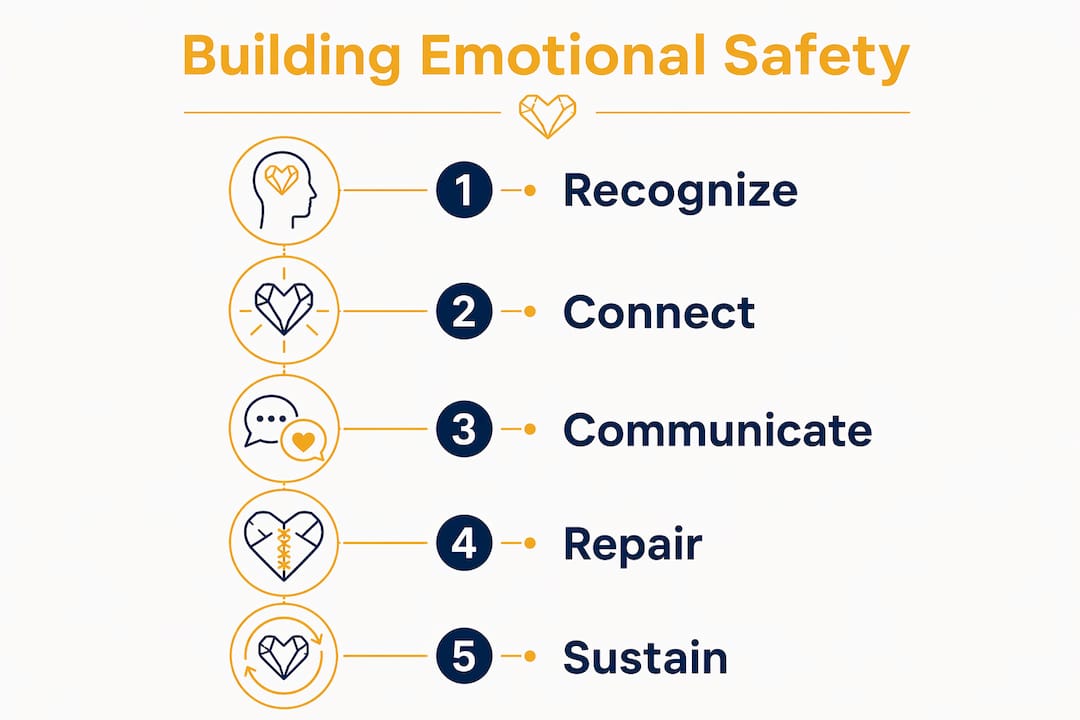
The SWEET Institute identifies five pillars of emotional safety: Non-Judgment, Predictability, Validation, Emotional Regulation, and Repair. These pillars work through repeated, consistent moments rather than grand gestures. Safety is built in the small daily choices, not the occasional dramatic declaration.
Practical steps for building emotional safety:
- Practice non-judgment: respond to disclosures with curiosity, not evaluation
- Be predictable: consistent behavior over time is what the nervous system trusts
- Validate feelings: acknowledge what someone feels before problem-solving
- Regulate yourself first: you cannot offer safety to someone else from a dysregulated state
- Repair quickly: saying “I got that wrong” fast prevents small ruptures from becoming lasting distrust
- Set and respect boundaries: clear limits create the predictability that safety requires
- Practice emotional attunement: notice shifts in the other person’s state and respond with empathy
The inside-out paradigm matters here. Emotional safety grows both from within through self-regulation and externally through consistent, responsive interactions. If you lack internal safety, you will misread neutral cues as threats, which poisons even genuinely safe relationships. Individual work and relational work both belong in the picture.
Expert perspectives and the Couplesfightschool framework
Experts consistently frame emotional safety as a practice, not a destination. It requires the courage to stay present through discomfort rather than avoiding it, with trust and empathy as the operating principles, not perfection.
Carlos Todd and Natasha Pemberton-Todd, the licensed mental health professionals behind Couplesfightschool, built the F.I.G.H.T. Plan® around exactly this insight. The framework addresses emotional regulation, communication, and repair as an integrated system, because safety cannot be separated from how couples handle conflict. The goal is not conflict-free relationships. It is relationships where conflict does not destroy the sense of being on the same team.
Key principles from this expert perspective:
- Nervous system regulation precedes connection; you cannot think your way to safety when your body feels threatened
- Repair is not optional; it is the mechanism that keeps safety intact after inevitable ruptures
- Emotional attunement, noticing and responding to subtle shifts in your partner’s state, builds nervous system trust over time
- Self-awareness about your own triggers prevents you from projecting threat onto safe situations
- Humility in repair, owning your part without defensiveness, is what makes the repair land
Pro Tip: When you notice your partner go quiet or pull back slightly, resist the urge to push for explanation. Instead, name what you observe gently: “You seem a little distant right now. I’m here when you’re ready.” That small move signals safety without pressure.
What emotional safety looks like across different relationships
Emotional safety shows up differently depending on the relationship type, but the core is consistent: you can be honest without bracing for punishment.

In romantic partnerships, emotional safety means you can raise a concern without it becoming a fight, admit a fear without it being used against you later, and disagree without either person threatening to leave. The emotional withdrawal cycle that many couples fall into is almost always a symptom of eroded safety.
In friendships, it looks like being able to say “I’m struggling” without the friendship suddenly feeling transactional, or being able to disappoint someone and still trust the relationship holds.
In the workplace, emotional safety means you can flag a mistake, disagree with a manager, or ask a question without fearing retaliation or ridicule. Psychological safety, the workplace-specific term popularized by Harvard researcher Amy Edmondson, is essentially emotional safety applied to professional teams.
Signs that emotional safety is present
You feel it in your body before you can name it. Tension drops. Breathing slows. You stop monitoring your words so carefully.
Specific signs of emotional safety in yourself and others:
- You leave interactions feeling lighter, understood, and energized rather than drained
- You can share something vulnerable and feel met rather than managed
- Disagreements happen without either person becoming cruel or contemptuous
- Mistakes get acknowledged and repaired rather than denied or weaponized
- You feel free to say “no” or “I need something different” without anxiety about the fallout
- The other person’s emotional state does not feel like a threat you need to manage
What gets in the way of emotional safety
The barriers are often invisible until you name them.
Past relational trauma is the most common one. If your early relationships taught you that vulnerability leads to punishment, your nervous system will treat safety as suspicious. That is not a character flaw. It is a learned protection that outlived its usefulness.
Other common barriers include:
- Unresolved emotional triggers that cause disproportionate reactions to neutral events
- Avoidant or anxious attachment patterns that make closeness feel threatening
- Poor emotional regulation skills, leading to escalation during conflict
- Lack of repair practices, so ruptures accumulate without resolution
- Cultural or family norms that frame vulnerability as weakness
- Inconsistent behavior from a partner or friend, making predictability impossible
Recognizing the barrier is the first step. The second is deciding whether to address it individually, relationally, or both. Couplesfightschool’s conflict resolution techniques are built specifically for couples working through these patterns together.
If you and your partner are ready to move from guarded to genuinely connected, Couplesfightschool offers courses, coaching, and practical frameworks grounded in the same psychology covered here. The relationship skills program is a strong starting point for couples who want to build the kind of safety that holds through real conflict.

Key Takeaways
Emotional safety is built through consistent, small acts of non-judgment, repair, and attunement, not through the absence of conflict.
| Point | Details |
|---|---|
| Core definition | Emotional safety means feeling accepted and able to be vulnerable without fear of judgment or abandonment. |
| Nervous system first | Neuroception scans for safety before conscious thought; regulation must come before genuine connection. |
| Five building pillars | Non-Judgment, Predictability, Validation, Emotional Regulation, and Repair build safety through repeated moments. |
| Safety vs. boredom | Safety feels quieter than anxiety and can be mistaken for boredom by those conditioned to intensity. |
| Repair is the mechanism | Acknowledging mistakes quickly prevents small ruptures from becoming lasting distrust. |
Recommended