
What Emotional Maturity Looks Like: 10 Signs and Examples

Emotional maturity looks like staying connected to your feelings while choosing responses that protect both yourself and the people you care about. It is not about being calm all the time or never getting angry. It is about what you do with the emotion once it shows up.
The most visible signs at a glance:
- Takes responsibility for feelings and actions without deflecting
- Pauses before reacting, especially under pressure
- Sets and holds boundaries without guilt or aggression
- Receives feedback as information, not as a personal attack
- Initiates repair after conflict instead of waiting for the other person to move first
These behaviors matter most in relationships, parenting, and the workplace, where emotional safety in relationships determines whether people feel safe enough to be honest with each other. The American Psychological Association defines emotional maturity as “a high and appropriate level of emotional control and expression” — which is a clinical way of saying: you feel it, and you choose what to do with it.
Table of Contents
- What does emotional maturity look like? A 10-sign checklist
- How emotional maturity shows up in daily life
- How to tell if you or someone else is emotionally mature
- What emotional maturity is — and isn’t
- Practical steps to grow your emotional maturity
- Key Takeaways
- Why behavior-based markers matter more than feelings-based ones
- Useful sources and further reading
What does emotional maturity look like? A 10-sign checklist
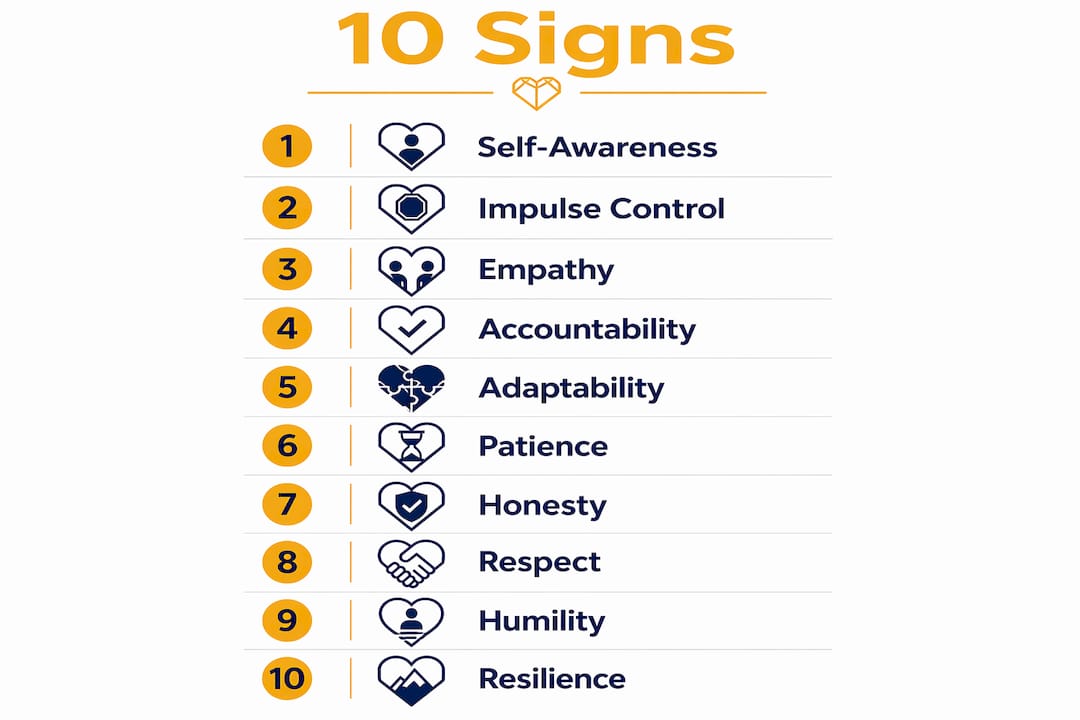
Each sign below is observable. You can see it in behavior, hear it in language, and notice its absence just as clearly.
-
Takes responsibility for feelings and actions. After snapping at a partner, they say “I was overwhelmed and I took it out on you — that was wrong” rather than “You made me react that way.” Taking responsibility without deflecting is one of the most reliable markers.
-
Pauses before reacting. When a colleague sends a frustrating email, they close the laptop for two minutes before responding. The pause is not weakness — it is the gap between stimulus and chosen response.
-
Shows consistent empathy. They can set aside their own viewpoint long enough to genuinely ask what the other person is experiencing. A friend venting about a hard week gets listened to, not immediately problem-solved.
-
Receives feedback without defensiveness. A manager points out a missed deadline. The mature response: “You’re right, I underestimated the timeline. Here’s how I’ll handle it differently.” No counter-attack, no sulking. Emotionally mature people treat feedback as information rather than as a verdict on their worth.
-
Sets and keeps boundaries. They can say “I’m not available for calls after 8 PM” and hold that line without apologizing for it. Boundaries are stated clearly, not hinted at passive-aggressively.
-
Expresses anger without causing harm. They can say “I’m really angry about what happened” without yelling, name-calling, or stonewalling. Anger gets named; it does not get weaponized.
-
Apologizes without qualifying. “I’m sorry I said that” lands differently than “I’m sorry you felt hurt.” The first owns the action. The second quietly shifts blame back to the other person.
-
Tolerates discomfort without avoidance. Difficult conversations do not get indefinitely postponed. They sit with the awkwardness and show up anyway. Conflict avoidance is one of the clearest signs of emotional immaturity in relationships.
-
Separates feelings from identity. They can feel jealous without deciding they are “a jealous person.” The emotion is an experience, not a permanent label. This distinction makes regulation far easier.
-
Keeps perspective on outcomes. When a plan falls apart, they are disappointed but not devastated. They can hold the setback without catastrophizing or collapsing.
Pro Tip: Watch for the difference between someone who is calm because they are regulated and someone who is calm because they have shut down. Regulated calm includes eye contact, engaged listening, and willingness to stay in the conversation. Shutdown calm looks flat, avoidant, and often ends with “I don’t want to talk about this.”
How emotional maturity shows up in daily life
The checklist above describes traits. These scenarios show what those traits actually sound like in practice.
Romantic partner. After a heated argument about finances, one partner says: “I got defensive earlier because I felt criticized, not because your concern wasn’t valid. Can we try again?” That sentence does three things at once: names the emotion, takes responsibility for the reaction, and opens a door to repair. Compare that to the immature alternative — going silent for two days and waiting for the other person to apologize first.

Manager or colleague. A team member misses a project milestone. An emotionally mature manager does not send a passive-aggressive email or make an example of the person in a meeting. Instead: “I noticed the deadline slipped. Walk me through what happened — I want to understand before we figure out next steps.” That framing signals psychological safety and models the conflict resolution skills that high-functioning teams run on.
Parent and child. A parent loses patience and raises their voice. Later, they come back and say: “I yelled earlier and that wasn’t okay. I was frustrated, but that’s not how I want to handle it. I’m sorry.” Children who witness that repair learn that adults make mistakes and fix them — which is a more useful lesson than pretending the outburst never happened.
Friend. A friend cancels plans at the last minute, again. An emotionally mature response: “I care about our friendship, and I need to be honest — when plans get canceled repeatedly, I feel like I’m not a priority. I’d rather talk about it than let it build up.” That is honest, boundaried, and non-blaming. Passive aggression would look like agreeing to reschedule while quietly withdrawing.

How to tell if you or someone else is emotionally mature
A quick self-check is useful, but disciplined reflection over time and honest input from people who know you well are far more reliable than any single quiz. With that caveat in mind, these questions give you a starting point.
Self-assessment questions (answer yes, sometimes, or rarely):
- When I make a mistake, do I acknowledge it without being prompted?
- Can I stay in a difficult conversation without shutting down or escalating?
- Do I know what triggers my strongest emotional reactions?
- When someone criticizes me, can I consider whether they have a point before defending myself?
- Do I set limits in relationships and hold them consistently?
- After a conflict, do I initiate repair — or do I wait for the other person to come to me?
- Can I feel a strong emotion without acting on it immediately?
- Do I take care of my own emotional needs without expecting others to manage them for me?
Mostly “yes” answers suggest solid emotional regulation. A pattern of “rarely” in questions 1, 4, and 6 specifically points to areas worth working on.
Red flags that reliably signal immaturity or relational risk:
- Persistent blaming: nothing is ever their fault
- Gaslighting: denying or distorting the other person’s experience
- Chronic avoidance: refusing to engage with any conflict or hard topic
- Explosive rage: anger that becomes threatening, destructive, or abusive
- Refusal to apologize: ever, under any circumstances
- Emotional withdrawal used as punishment
If you recognize several of these in someone you are close to, the issue goes beyond personal growth work. Knowing when to seek couples therapy is itself a sign of maturity — it means you value the relationship enough to get real help.
What emotional maturity is — and isn’t
People often confuse emotional maturity with emotional intelligence, age, or personality type. They are related but not the same thing.
| Concept | What it actually means | Common confusion |
|---|---|---|
| Emotional maturity | Consistent, applied behavior: choosing regulated responses over time | Mistaken for being calm, stoic, or conflict-averse |
| Emotional intelligence (EI) | A set of skills: recognizing, understanding, and using emotions | Mistaken for maturity — you can score high on EI and still behave immaturely under stress |
| Age | Chronological time alive | Assumed to produce maturity automatically — it does not |
| Introversion | A preference for less social stimulation | Mistaken for emotional regulation — quiet is not the same as regulated |
True emotional maturity allows strong emotions without loss of connection to self or others. It is not suppression. A person who never expresses anger is not necessarily mature — they may simply be avoiding. The difference shows up under real pressure: the regulated person can feel intensely and still choose a response that does not damage the relationship. The suppressor eventually erupts, withdraws, or develops resentment.
Emotional intelligence gives you the map. Maturity is actually driving the route, consistently, when the road gets rough.
Practical steps to grow your emotional maturity
These are not abstract suggestions. Each one is a specific practice you can start this week.
-
Name the emotion before you act on it. When you feel a strong reaction, pause and say (internally or aloud): “I’m feeling [angry/scared/embarrassed].” Naming the emotion activates the prefrontal cortex and reduces the intensity of the reaction. This is the foundation of mindfulness-based emotional regulation.
-
Keep a brief daily journal. Three sentences at the end of each day: what triggered you, how you responded, and what you would do differently. Over weeks, patterns emerge. Journaling builds the self-awareness that makes real-time regulation possible.
-
Practice the pause-and-name in low-stakes moments first. Do not wait for a major fight to try emotional regulation. Practice it when you are mildly annoyed in traffic or frustrated with a slow internet connection. The skill transfers.
-
Use a repair script after conflict. A simple structure: “I felt [emotion] when [specific event]. What I need going forward is [specific request].” This is the kind of language the F.I.G.H.T. Plan® at Couplesfightschool builds on — moving from blame to need-based communication.
-
Rehearse receiving feedback. Ask a trusted person for one piece of honest feedback this week. Practice listening without interrupting or defending. Then say: “Thank you — I’ll think about that.” Nothing more. Notice the discomfort and stay with it.
-
Set one boundary this week and hold it. Start small. Decline one request you would normally say yes to out of guilt. Notice what happens internally and how the other person responds.
-
Seek sustained support when the patterns are deep. Healing practices that last require more than good intentions — they require structure, repetition, and often a skilled guide. Therapy, coaching, or a structured couples program accelerates what solo reflection alone cannot reach.
Pro Tip: The most honest feedback you will ever get comes from people who have seen you under stress. Ask a close friend or partner: “What’s one thing I do when I’m upset that makes things harder?” Then listen without defending. That single question, asked genuinely, is worth months of self-reflection.
Key Takeaways
Emotional maturity is a practiced set of behaviors, not a personality trait you either have or don’t, and the most reliable signs are visible in how someone handles conflict, feedback, and repair.
| Point | Details |
|---|---|
| Core definition | Emotional maturity means feeling strongly while choosing responses that protect self and relationships. |
| Most visible signs | Taking responsibility, pausing before reacting, setting boundaries, and initiating repair are the clearest observable markers. |
| Maturity vs. suppression | Regulated calm stays engaged; suppressed calm avoids and eventually erupts or withdraws. |
| Development is daily | Pause-and-name, journaling, and repair scripts practiced consistently build maturity over weeks, not overnight. |
| When to get help | Persistent blaming, gaslighting, or explosive rage signal patterns that benefit from professional support. |
Why behavior-based markers matter more than feelings-based ones
Most articles on emotional maturity focus on how people feel. At Couplesfightschool, the focus is on what people do — because behavior is what partners, children, and colleagues actually experience.
The checklist in this guide reflects that orientation. Emotional maturity strengthens relationships not because mature people feel the right things, but because they act in ways that sustain trust over time. Chemistry fades. Behavior is what remains.
The F.I.G.H.T. Plan® framework that Couplesfightschool is built around maps directly onto the development steps above: it gives couples a structured language for naming emotions, expressing needs, and repairing after conflict without resorting to blame or withdrawal. The repair script in step four of the development section is a simplified version of that same structure.
If you recognize yourself in the red flags section, that is not a reason for shame. It is information. The couples who make the most progress are rarely the ones who had no problems — they are the ones who decided to take the patterns seriously and get skilled help. Couplesfightschool’s online coaching for couples and the Stop the Fighting course are built for exactly that starting point.
Useful sources and further reading
Research and clinical resources:
- Verywell Mind: 8 Signs of Emotional Maturity — Practical overview with expert quotes from licensed clinicians; good starting point for observable signs.
- Healthline: What Is Emotional Maturity? 16 Key Traits and Tips — Broad trait list with actionable tips; useful for self-assessment.
- Psych Central: How to Know Someone Is Emotionally Mature — Focuses on observable behaviors and communication patterns.
- PositivePsychology.com: Developing Emotional Maturity — Evidence-based development methods including mindfulness and journaling worksheets.
- Blue Gardens Counseling: What Emotional Maturity Actually Looks Like — Clinical perspective on regulation vs. suppression; strong on the nuance.
- Psychology Today: What Emotional Maturity Looks Like — Covers humility, feedback, and relational behavior.
- Greater Good Science Center: Emotional Intelligence Quiz — Research-backed EI self-assessment from UC Berkeley; useful for distinguishing EI from maturity.
- Center for Nonviolent Communication: Feelings and Needs Inventory — Practical toolkit for naming emotions and needs precisely; directly supports the repair script practice.
Couplesfightschool resources:
- Emotional Safety in Relationships — Explains the emotional foundation that maturity builds; includes course links.
- Relationship Conflict Resolution Techniques — Practical exercises couples can use immediately.
- Why Conflict Avoidance Damages Relationships Over Time — Explains why avoidance is a red flag, not a coping strategy.
Recommended