
Communication in Marriage: Practical Habits That Actually Work

You can improve communication in your marriage starting tonight. The simplest route is three small, consistent habits: a soft startup when tension rises, a 10-minute daily connection conversation, and one repair attempt after any conflict. That’s it. No worksheets required on day one.
Three things to try tonight:
- Soft startup: When you need to raise something difficult, begin with “I feel…” instead of “You always…” One sentence change reduces the chance your partner goes defensive before you finish your thought.
- 10-minute connection: Sit together, no phones, and ask one question that has nothing to do with logistics. “What’s something you’re looking forward to this week?” counts.
- Repair attempt: If you argued today, try one brief acknowledgment before bed. “I don’t want to go to sleep still feeling distant” is enough to open the door.
Before-bed loop check:
- Did we connect today, even briefly?
- Did I say something that landed wrong? Can I acknowledge it now?
- Is there anything unresolved that will feel bigger tomorrow?
Research consistently shows that repair attempts reduce escalation when they are both offered and received. The couples who recover from conflict fastest aren’t the ones who fight less. They’re the ones who repair faster.
Table of Contents
- The four types of conversation every couple actually needs
- How harmful patterns derail your conversations before they start
- Practical tools and scripts that actually change conversations
- A 30/90-day plan to rebuild how you communicate
- When to seek professional help and what it looks like in the U.S.
- How Couplesfightschool’s F.I.G.H.T. Plan® fits this work
- How to set communication boundaries that actually hold
- Key Takeaways
- What most couples get wrong about fixing communication
- Couplesfightschool has the tools to take this further
- Useful sources and further reading
The four types of conversation every couple actually needs
Most couples talk plenty. The problem is they talk about the same things repeatedly: schedules, logistics, what went wrong. Dr. Greg Smalley’s four-type framework gives couples a practical way to check whether their conversations are balanced or stuck in one lane.
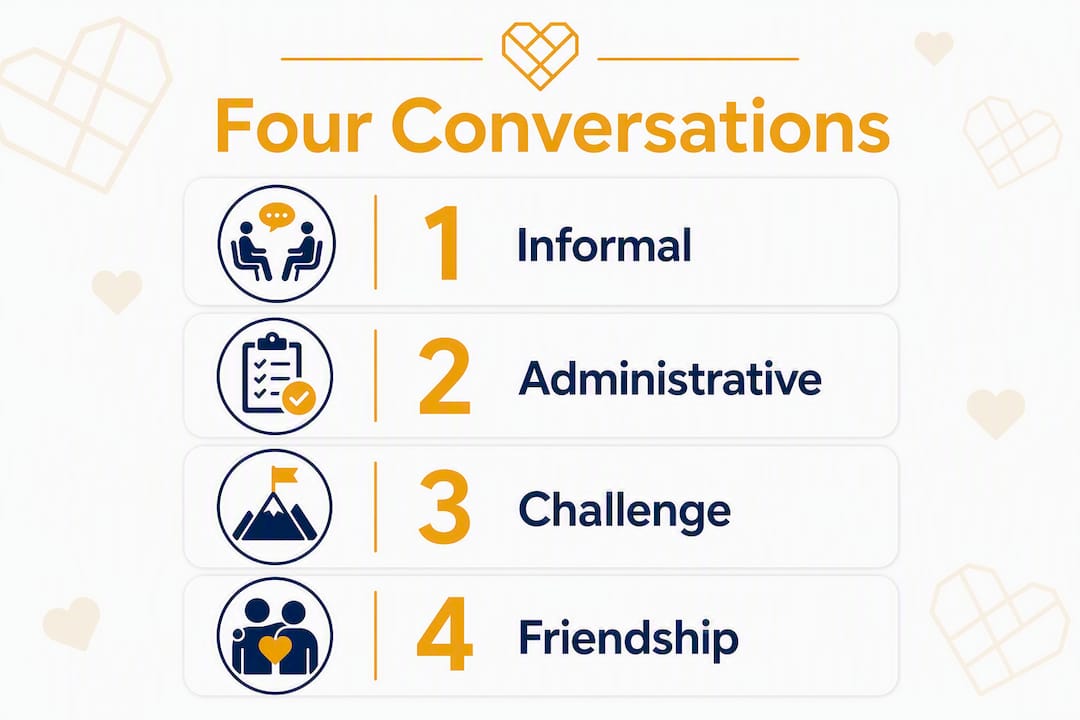
Informal conversation is the small talk, the jokes, the “how was your day” exchange. It sounds trivial, but it keeps the emotional temperature warm. Without it, every conversation starts to feel like a meeting or a negotiation.

Administrative conversation covers logistics: finances, schedules, parenting decisions, household tasks. This type is necessary but tends to crowd out everything else when couples don’t manage it deliberately. Scheduling a weekly 30-minute administrative meeting (same time, same day) keeps logistics from bleeding into dinner, bedtime, and every other moment you could be connecting.
Pro Tip: Set a standing weekly meeting for logistics only. Treat it like a work calendar block. When your partner starts a logistics topic outside that window, you can say, “Can we put that on Thursday’s agenda?” without it feeling like a dismissal.
Challenge conversations are the hard ones: conflict, disagreements, recurring friction. These need structure and skill. Without a framework, they tend to escalate or get avoided entirely, which is worse.
Life-giving conversation is the type most couples underinvest in. These are the conversations that build shared meaning: dreams, memories, what you appreciate about each other, what you’re excited about. A 10-minute daily connection focused on life-giving topics is a practical benchmark. It doesn’t need to be deep every time. Asking “What made you smile today?” qualifies.
Starter prompts by type:
- Informal: “Tell me something weird you saw today.”
- Administrative: “What’s on our plate this week that we need to coordinate?”
- Challenge: “I’ve been sitting with something that’s been bothering me. Is now a good time?”
- Life-giving: “What’s a memory from early in our relationship you still think about?”
Strengthening your marital friendship depends heavily on protecting time for that last category.
How harmful patterns derail your conversations before they start
The most damaging thing about patterns like demand–withdraw and the Four Horsemen isn’t that they’re hard to break. It’s that most couples don’t recognize them while they’re happening.
The demand–withdraw cycle looks like this: one partner pushes for connection or resolution, the other pulls back. The more one pursues, the more the other retreats. Both feel frustrated and misunderstood. Neither is wrong, exactly. They’re just stuck in a loop that predicts relationship distress when it goes unaddressed. If you notice this pattern in your relationship, the resource on breaking the emotional withdrawal cycle walks through specific tools for re-engaging.
The Four Horsemen, a framework from Gottman’s research, describes four interaction styles that reliably erode connection:
- Criticism: Attacking character rather than behavior. “You’re so selfish” vs. “I felt hurt when you didn’t check in.”
- Contempt: Eye-rolling, sarcasm, mockery. The single strongest predictor of relationship breakdown.
- Defensiveness: Responding to a complaint with a counter-complaint or denial. It signals “your concern doesn’t matter.”
- Stonewalling: Shutting down, going silent, leaving the room emotionally or physically. Often a sign of physiological flooding.
Negative-sentiment override is what happens when the pattern has run long enough that even neutral comments land as hostile. Your partner says “Did you move my keys?” and you hear criticism. That’s the override at work.
Signs to watch for in the next 24–72 hours:
- Repeated “you always” or “you never” statements
- One partner going quiet mid-conversation
- Heart rate rising, jaw tightening, a sense of “here we go again”
- Sarcasm or eye-rolling, even mild
- Conversations that end without resolution and restart identically the next day
The good news: repair attempts interrupt these patterns. A well-timed “I need a five-minute break” or “I’m sorry, I said that badly” can stop an escalation before it becomes a full argument. The key is that both partners need to be able to offer and receive repairs. A repair rejected is a repair wasted.
Practical tools and scripts that actually change conversations
Knowing what to do in theory is different from knowing what to say in the moment. Here are four tools with specific scripts.
Closed-loop communication
Closed-loop communication is a three-step method: one partner speaks, the other affirms and clarifies, the first confirms accuracy. It sounds simple because it is. Most misunderstandings happen because one person assumed the other understood.
Script:
Partner A: “I need us to leave by 6:30 on Saturday.”
Partner B: “So you want us both ready to walk out the door at 6:30, not just starting to get ready?”
Partner A: “Exactly, yes.”
That 10-second exchange prevents a Saturday argument.
Active listening and mirroring
Mirroring content and emotion before responding reduces defensiveness. The goal isn’t to agree. It’s to show you heard.
Script:
Then wait. Don’t explain yourself yet. Let them confirm or correct.
I-statements and soft startup
An I-statement keeps the focus on your experience rather than your partner’s behavior. “I felt anxious when dinner plans changed last-minute” lands differently than “You always change plans on me.”
A soft startup pairs an I-statement with a specific request: “I felt disconnected this week. Can we spend 20 minutes tonight just talking?”
Timing and self-soothing
When physiological flooding hits (racing heart, tunnel vision, the urge to either attack or shut down), no communication skill works well. The right move is a time-out: agree to pause for 20–30 minutes, self-soothe (walk, breathe, don’t rehearse arguments), and return.

Pro Tip: Gentle, consensual physical touch, like a hand on the arm or a brief hug, can interrupt physiological arousal before it peaks. If your partner is open to it, a moment of physical connection mid-tension often resets the emotional temperature faster than words.
| Skill | Best for | One-line script | Common mistake |
|---|---|---|---|
| Closed-loop | Logistics, plans, instructions | “So what you need is X — did I get that right?” | Skipping the confirm step |
| Active listening | Emotional conversations | “It sounds like you felt X. Is that right?” | Jumping to solutions too fast |
| I-statements | Raising a concern | “I feel Y when Z happens.” | Adding “but you always…” after |
| Soft startup | Opening a hard topic | “I’ve been feeling X. Can we talk?” | Starting with a complaint instead |
| Time-out | High-arousal moments | “I need 20 minutes. I’ll come back.” | Leaving without a return commitment |
Understanding why communication styles clash helps you pick the right tool for the right moment, rather than defaulting to the same approach every time.
A 30/90-day plan to rebuild how you communicate
Progress in communication is cumulative. Small consistent actions compound. Here’s a realistic program.
Days 1–7: Establish the baseline habits
- Start a 10-minute daily connection conversation (no logistics, no complaints).
- Practice one closed-loop exchange per day on something low-stakes.
- Notice one harmful pattern without reacting to it. Just name it internally.
Days 8–14: Add structure
- Hold your first weekly administrative meeting. Keep it to 30 minutes.
- Practice one I-statement per day, even in writing if speaking feels hard.
- Try one repair attempt after any friction, however small.
Days 15–30: Build the repair habit
- After any argument, do a brief debrief within 24 hours: “What happened, and what could we each do differently?”
- Add daily appreciation. One specific thing you noticed about your partner, said aloud.
- Set one communication agreement together: a rule you both commit to (no phones during the 10-minute connection, no raising issues after 10 PM).
Days 31–60: Expand the rhythm
- Add a monthly “state of the relationship” check-in: 30 minutes to review what’s working and what needs attention.
- Practice repair rehearsals: talk through a past argument calmly and identify where you could have repaired earlier.
Days 61–90: Consolidate and assess
- Review your communication agreements. Update anything that isn’t working.
- Assess progress signals: Are arguments shorter? Are repairs happening faster? Is flooding less frequent?
Signs you’re making progress: Conversations end without either partner feeling dismissed. Repairs land more often than they’re rejected. You notice a pattern starting and can name it before it escalates. Two or three small wins per week is a realistic benchmark at 30 days.
If patterns persist at 30 days: That’s not failure. It’s information. Some patterns are too entrenched for self-guided work alone. A weekly feedback meeting with a therapist or structured workshop can accelerate what self-study stalls.
When to seek professional help and what it looks like in the U.S.
Self-guided work has real limits. Some situations call for professional support from the start.
Seek help when you notice:
- The Four Horsemen appearing in most conversations, not just heated ones
- Chronic stonewalling that doesn’t respond to repair attempts
- Any safety concern (emotional, physical, or psychological)
- Repeated failed repair attempts over 30 or more days
- One or both partners feeling hopeless about change
Evidence-based approaches worth knowing:
Emotionally Focused Therapy (EFT) targets the attachment needs underneath conflict. Trials report recovery rates around 70–73% for couples who complete treatment. It’s one of the most rigorously studied approaches in couples therapy.
Gottman Method focuses on building friendship, managing conflict, and creating shared meaning. It maps closely to the four-type framework and the repair research.
Workshops and coaching models can accelerate skill acquisition. Research shows that workshops speed learning of repair techniques compared with self-study alone, particularly when they include structured practice with feedback.
Premarital and preventive counseling is worth mentioning here: earlier intervention produces better outcomes than waiting for a crisis. If you’re engaged or newly married, this is the highest-leverage moment to invest.
Cost and access in the U.S.: Weekly couples therapy typically costs a range of fees per session without insurance, though many therapists offer sliding-scale fees. Some insurance plans cover couples therapy under mental health benefits. Workshops and online courses are often significantly less expensive per hour of skill instruction. Verify current rates with your provider.
Pro Tip: Before booking a therapist or workshop, ask two questions: “What model do you use with couples?” and “What does a typical 8-session arc look like?” A therapist who can answer both clearly is more likely to offer structured, goal-oriented work rather than open-ended conversation.
This article is general information, not professional advice. For your specific situation, consult a licensed couples therapist or mental health professional.
How Couplesfightschool’s F.I.G.H.T. Plan® fits this work
Couplesfightschool was built specifically for what this article describes: couples who want practical, skill-based tools rather than vague advice.
The F.I.G.H.T. Plan® is a structured framework covering communication, emotional regulation, healing, and relationship transformation. It maps directly to the skills covered here: recognizing harmful patterns, using repair attempts, building life-giving conversation habits, and managing physiological flooding. It’s not a philosophy. It’s a sequence of learnable steps.
What Couplesfightschool offers:
- Therapist-designed online courses with specific scripts and exercises
- Private coaching sessions for couples who need personalized guidance
- Workshops and seminars for structured, facilitated skill practice
- Digital workbooks and guides for self-paced learning
- Resources for premarital, Christian, blended family, and high-conflict couples
Couplesfightschool was founded by Carlos Todd and Natasha Pemberton-Todd, both licensed mental health professionals. The program’s frameworks are grounded in the same research base this article draws from: Gottman’s repair research, attachment theory, and evidence-based communication models.
Couples who engage with a structured course or coaching typically report shorter arguments, faster repairs, and a greater sense of being heard within the first few weeks of consistent practice. The format is flexible: self-paced courses work for couples with limited schedules, while coaching suits those who want real-time feedback on their specific patterns.
For couples ready to go beyond self-study, the relationship skills program is a practical starting point.
How to set communication boundaries that actually hold
Boundaries in conversation aren’t about shutting your partner out. They’re agreements about how you talk, not whether you talk.
The most effective communication boundaries are specific and mutual. “Don’t raise your voice at me” is a boundary. “We don’t discuss finances after 9 PM when we’re both tired” is a boundary. Vague rules like “be more respectful” don’t hold because neither partner knows exactly what they’re agreeing to.
Three boundaries worth setting explicitly:
- Topic timing: Agree on when certain conversations are off-limits (late at night, right after work, during meals with kids).
- Escalation exits: Agree that either partner can call a time-out without it being seen as avoidance, as long as they name a return time.
- Device-free windows: Daily tech boundaries, like no phones during the 10-minute connection, reduce divided attention and signal that the conversation matters.
Respecting personal space within a conversation means allowing pauses. Silence isn’t always withdrawal. Sometimes it’s processing. Agreeing that a 30-second pause is okay before responding removes the pressure to fill every gap with words, which often leads to saying something you’ll need to repair later.
Boundaries also protect the repair process. If one partner needs 20 minutes to self-soothe before returning to a hard topic, that need should be named and honored, not interpreted as stonewalling. The difference is the return commitment. “I need 20 minutes and then I’ll come back” is a boundary. Walking out and going silent for three hours is stonewalling.
Key Takeaways
Consistent small habits, not grand gestures, are what shift communication in marriage over time.
| Point | Details |
|---|---|
| Start with repair attempts | Offer and receive repairs after conflict; rejected repairs predict continued escalation. |
| Use the four-type framework | Balance informal, administrative, challenge, and life-giving conversations each week. |
| Name harmful patterns early | Spot demand–withdraw and the Four Horsemen before they escalate; a time-out beats flooding. |
| Follow the 30-day plan | Daily 10-minute connection, weekly administrative meeting, and one repair attempt per day. |
| Couplesfightschool’s F.I.G.H.T. Plan® | A therapist-designed, structured program that teaches repair skills, scripts, and emotional regulation. |
What most couples get wrong about fixing communication
The conventional wisdom says communication problems come down to not talking enough. Spend more time together, open up more, say how you feel. That advice isn’t wrong, exactly. It’s just incomplete in a way that leaves a lot of couples stuck.
The couples I see struggle most aren’t the ones who don’t talk. They’re the ones who talk constantly and still feel unheard. The issue isn’t volume. It’s pattern. Specifically, it’s the gap between what someone intends to communicate and what their partner actually receives, filtered through years of accumulated hurt, misread signals, and unrepaired moments.
What changes things isn’t more conversation. It’s better repair. A couple that fights hard but repairs quickly is in better shape than a couple that avoids conflict entirely and lets resentment build in the silence. Gottman’s research on this is unambiguous: the presence of repair attempts, and the ability to receive them, matters more than the absence of conflict.
The other thing most guides understate: the partner who chooses de-escalation first determines whether an argument resolves or escalates. That’s not about being the “bigger person.” It’s about understanding that one calm response can interrupt a cycle that would otherwise run for another hour. That’s a skill, and it’s learnable.
If you’ve tried the self-guided approach and the same arguments keep cycling back, that’s not a character flaw. It’s a signal that the pattern is deeper than a tip list can reach. That’s exactly when structured, therapist-backed work earns its cost.
Couplesfightschool has the tools to take this further
Reading about communication skills and actually practicing them under pressure are two different things. Couplesfightschool’s courses and coaching are built for the gap between knowing and doing: therapist-designed, skill-focused, and structured so couples practice the exact scripts and repair techniques covered in this article.

The Stop the Fighting course walks couples through the F.I.G.H.T. Plan® step by step, with guided exercises, conversation scripts, and repair rehearsals built into every module. For couples who want real-time feedback on their specific patterns, private coaching is available in flexible formats. Both options are grounded in the same evidence base this article draws from, and both are designed to produce measurable results within weeks, not months. Start with the course or book a coaching session today.
Useful sources and further reading
-
Couples Communication Breakdown: Why It Happens and How to Repair It — Simply Psychology’s research summary covering the demand–withdraw cycle, the Four Horsemen, and the evidence base for repair attempts. Useful for clinicians and couples who want the research behind the patterns.
-
Healthy Communication in Marriage: Practical Tools to Build Connection and Trust — Encompass Connection Center’s practitioner guide on active listening, daily appreciation, and tech boundaries as high-leverage daily habits.
-
Four Types of Communication to Strengthen Your Marriage — Focus on the Family’s overview of Dr. Greg Smalley’s four-type framework, including the 10-minute daily connection benchmark.
-
Your Guide to Communication in Marriage — Psych Central’s practical guide covering closed-loop communication and the weekly feedback meeting model.
-
Is Premarital Counseling Worth the Time? — Psychology Today’s evidence review on preventive counseling and why earlier intervention produces better long-term outcomes.
-
Benefits of Couples Communication Workshops — Couplesfightschool’s guide to how structured workshops accelerate skill acquisition compared with self-study, including format options and what to expect.
Recommended