
30–45 Minute Sessions: Premarital Conflict Questions for Busy Couples

Use a topic-based set of premarital conflict questions plus simple ground rules to surface patterns and reduce relationship tension before you marry. Addressing both loud, overt arguments and the quieter resentment that builds underneath matters just as much. Below, we organize questions by the topics couples most often skip: communication, money, roles, intimacy, family, and values, so you catch gaps before the wedding, not after it.
TL;DR:
- Addressing communication patterns early is crucial, as couples with weak communication skills face a significantly higher risk of divorce.
- Clarifying financial responsibilities and goals helps prevent recurring disputes over debt, budgets, and savings expectations.
- Discussing household roles and mental load beforehand ensures fair division of chores and reduces exhaustion or resentment.
- Talking openly about intimacy preferences, boundaries, and desire levels can prevent frustration and build mutual understanding.
- Recognizing and addressing red flags like contempt or control is essential, and professional counseling may be necessary before marriage.
Table of Contents
- 1. Communication and conflict style questions
- 2. Money and financial partnership questions
- 3. Roles, chores, and mental load questions
- 4. Intimacy, sex, and affection questions
- 5. Family, children, and in-law expectations
- 6. Values, beliefs, religion, and long-term vision questions
- 7. Red flags and when to seek structured help
- 8. How to use these questions: ground rules and a practical script
- 9. Therapist-backed framework and evidence: why these conflict questions matter
- Why most engaged couples skip the right questions
- Where to get structured support for these conversations
- FAQ
- Sources
1. Communication and conflict style questions
How you fight matters more than whether you fight. The goal here is to name your patterns before they calcify: who raises their voice, who goes quiet, who keeps score.
Ask each other directly:
- What does your first instinct look like when you feel criticized: defend, explain, or shut down?
- Can you recall the last disagreement we had and describe what each of us did during it?
- What did arguing look like in your parents’ marriage, and do you catch yourself repeating it?
- When you need space mid-argument, what helps you come back to the conversation instead of avoiding it?
A newlywed study that tracked communication patterns and divorce risk found that couples in the weakest communication group had a significantly higher risk of divorce over several years compared to the strongest communicators. That gap starts showing up before the wedding, which is exactly why these questions matter now.
Practice naming feelings without assigning blame: “I felt dismissed when the plans changed without a heads-up” lands differently than “You never tell me anything.” For moments that start climbing, try a short pause-and-return script: “I want to keep talking about this, but I need twenty minutes first. Can we come back to it at 8?”
Pro Tip: Write down one sentence each of you can say verbatim when a conversation starts escalating. Rehearsed language works better than improvised language under stress.
2. Money and financial partnership questions
Financial habits are rarely about the dollar amount. They are about control, security, and what money meant growing up.
Work through these before the wedding:
- What debt are you bringing into the marriage, and what is your plan to pay it down?
- Do you want to combine finances completely, keep some separate, or split by category?
- What does “saving enough” look like to you: a number, a feeling, or a specific goal?
- How did your family talk about money, and did that create anxiety, avoidance, or confidence?
- Who will handle which bills, and what is our rule for purchases above a set amount?
That last question deserves a real answer, not a shrug. Decide now whether one person pays the mortgage while the other covers groceries, or whether everything flows through one joint account with agreed check-ins. Vague plans tend to turn into recurring arguments once rent, insurance, and a shared budget actually hit the table.
3. Roles, chores, and mental load questions
Household labor splits unevenly far more often when couples never discussed it out loud. Mental load, the ongoing work of noticing what needs doing, scheduling it, and tracking it, rarely gets named until one partner feels exhausted and the other feels blindsided.
- Who is responsible for which recurring chores, and who notices when something needs doing before it becomes urgent?
- What happens to the division of labor when one of us is sick, traveling, or overwhelmed at work?
- How will we decide things like moving, changing jobs, or big purchases: together, by whoever cares more, or by whoever’s name is on it?
- What does fair feel like to each of us, even if it is not a 50-50 split on paper?
Once you have answers, test them. Run a 30-day chore agreement exactly as discussed, then revisit what worked and what quietly slipped back to old habits.
4. Intimacy, sex, and affection questions
These conversations go easier when you separate logistics from emotion. Talk about frequency and preferences as practical planning first, then make space for the feelings underneath.
- What frequency of sex feels right to you, and how do you want to handle it if our desire levels differ?
- What forms of affection make you feel loved outside of sex: touch, words, time, acts of service?
- Are there boundaries, past experiences, or health concerns you want me to know before we’re married?
- How do you want to bring up a mismatch in desire or satisfaction without it turning into a fight?
Use plain, nonjudgmental language: “I’d like us to check in about this every few months” works better than waiting for resentment to surface. If either of you is dealing with persistent low desire, pain, or a sexual health concern, that conversation belongs with a doctor or a licensed therapist, not just between the two of you.
5. Family, children, and in-law expectations
Few topics cause more friction after the wedding than assumptions about children and extended family that were never actually said aloud.
- Do you want children, and if so, when, and have you discussed fertility timelines or concerns?
- What parenting values matter most to you: discipline style, screen time, religious upbringing?
- How involved do you want each set of parents to be in day-to-day decisions and major ones?
- What are the boundaries around holidays: whose family, which years, and how we split time?
Get specific about logistics now. Decide who hosts which holiday, how often in-laws visit unannounced, and what happens when your two families’ traditions genuinely conflict.
6. Values, beliefs, religion, and long-term vision questions
Daily friction often traces back to a mismatch in bigger priorities that never got named directly.
- How central is faith or spiritual practice to your daily life, and what do you expect from me?
- Where do you want to live long-term, and are you open to relocating for work or family?
- What does work-life balance look like to you: career ambition, time off, retirement age?
- Are there political or moral positions that would actually change how you want to raise a family?
When answers differ, the goal is not agreement on everything. It is deciding which differences you can live alongside and which ones need a real negotiated compromise before the wedding, not after.
7. Red flags and when to seek structured help
Some patterns are not just rough edges to smooth out with practice. They are signals to pause and bring in a professional.
- Contempt: mocking, eye-rolling, or name-calling during disagreements.
- Stonewalling: regularly shutting down and refusing to engage for hours or days.
- Controlling behavior: monitoring, isolating, or punishing you for disagreeing.
- Threats, intimidation, or any physical aggression, which call for a safety plan, not a conversation guide.
- Addiction that one partner minimizes or denies when it is raised directly.
If you recognize two or more of these as recurring, not occasional, structured premarital counseling or individual therapy is worth pursuing before the wedding, not after. Premarital counseling topics checklist can help you map which areas need the most work, and a licensed counselor like those listed through Building Block Resolutions can assess whether skills coaching or deeper therapy fits your situation.
8. How to use these questions: ground rules and a practical script
Questions this direct can backfire without a few agreed rules. Set these before you start.
- Timebox each conversation to 30 to 45 minutes; stop even mid-topic when time is up and schedule a return.
- Pick a neutral location, not the bed or the kitchen where daily arguments usually happen.
- Agree on a pause-and-return phrase both of you will honor without guilt: “I need twenty minutes, then I’m back.”
- No interrupting while the other person answers; take notes instead of responding mid-sentence.
- Write down agreements after each session so neither of you misremembers later.
A simple “I” statement example: “I feel anxious when big purchases happen without a heads-up, and I’d like us to agree on a dollar threshold.” For a longer list of habits that hold up under pressure, see habits that actually work for de-escalation.
Pro Tip: Spread these topics across several shorter sessions instead of one marathon conversation. Fatigue makes every disagreement feel bigger than it is.
9. Therapist-backed framework and evidence: why these conflict questions matter
These categories are not arbitrary. Research on marital tension and well-being found that persistent irritation and resentment, distinct from overt fights, predicts lower marital well-being on its own, and the effect grows stronger when both partners report high tension. That is why these lists probe quiet frustration alongside loud disagreements.
- Programs that teach direct communication and conflict management show measurable drops in negative interaction, according to a federally funded premarital education case study.
- Gottman-style research behind that program flags criticism, defensiveness, contempt, and stonewalling as the patterns most worth catching early.
- Structured, skills-based frameworks like the F.I.G.H.T. Plan® map closely onto these same categories: communication, emotional regulation, and repair.
Couples Fight School® built its approach, including Carlos Todd’s F.I.G.H.T. Plan® work, around that same distinction between overt conflict and underlying tension.
Why most engaged couples skip the right questions
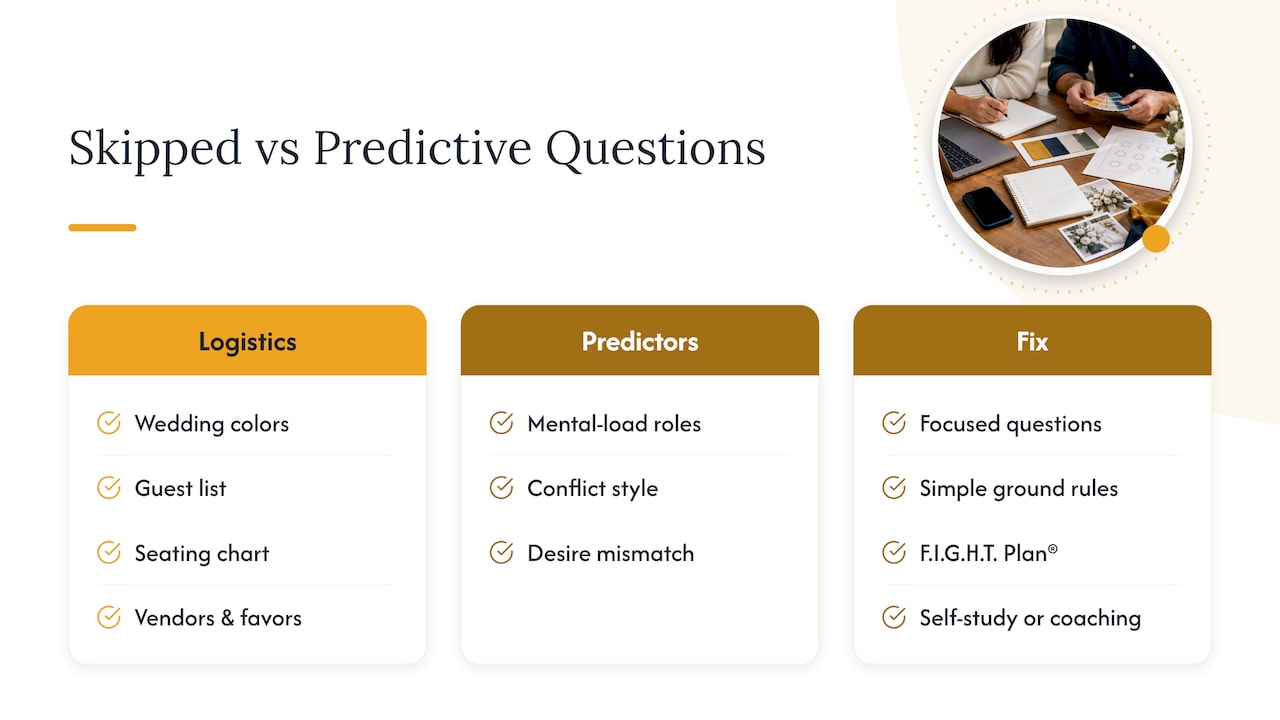
The most common gap I see is not a lack of love or commitment. It is that couples answer the easy questions (wedding colors, guest lists) and skip the ones that actually predict friction: who manages the mental load, how we fight, what happens when desire doesn’t match.
Focused questions paired with simple ground rules close that gap faster than vague conversations ever do. The F.I.G.H.T. Plan® framework exists because skills, not willpower, are what change how couples handle hard topics. Some couples get there through self-study; others move faster with coaching. Both are reasonable starting points.
— Carlos
Where to get structured support for these conversations
If working through these questions on your own feels productive but incomplete, structured tools can carry you further. Our Fight Less Love Again Video Course and F.O.R.E.V.E.R. Workbook give engaged couples a guided, self-paced way to work through conflict skills and premarital topics step by step, priced for couples who want to start without booking a session.

For couples who want more direct support, our VIP Private Coaching Session pairs you with guided practice over four sessions, and our 6 Hours Couples Intensive offers a focused, time-limited option for couples who want faster traction before the wedding. Browse the full shop to find the format that fits how you learn best.
FAQ
What are some premarital questions?
Strong premarital questions cover communication style, money management, household roles, intimacy, family expectations, and long-term values, not just wedding logistics. The goal is surfacing patterns in how you argue, spend, and divide labor before marriage, not just confirming you agree on the big picture.
What are the common causes of conflict in marriage?
Common causes include money disagreements, uneven division of chores and mental load, mismatched expectations about children or in-laws, and unresolved communication patterns like criticism or stonewalling. Marital tension research also points to quiet, ongoing resentment as a separate driver of dissatisfaction, distinct from overt arguments.
What are 24 guidelines for resolving conflicts in a marriage?
Definitions of a specific guidelines list vary by source and are not tied to one standard framework. A more reliable approach is to follow core conflict-resolution principles: timeboxed conversations, pause-and-return language, no interrupting, and writing down agreements, paired with the topic categories covered above.
What are the three most common marriage problems?
Money, communication breakdowns, and unequal division of household and emotional labor are consistently cited as leading sources of marital strain. Addressing these directly through premarital conversations, rather than assuming they will resolve themselves, reduces the chance they become recurring fights.
Sources
- Development of communication in newlywed couples and links to outcomes (PMC)
- Marital tension and marital well-being (Journal of Family Psychology)
- Before You Tie the Knot: Impacts, Outcomes, and Lessons Learned from a Federally-Funded Premarital Education Case Study
Recommended
- Christian Premarital Questions Every Engaged Couple Needs
- Manage Conflict Before Marriage Habits That Actually Work
- Premarital Counseling Topics Checklist for Couples
- Why Engaged Couples Need Conflict Skills Before Marriage