
Lonely in Marriage: Why It Happens and How to Reconnect

Feeling lonely in your marriage usually means the emotional connection has thinned, not that the marriage is over. You can share a house, a bed and a calendar and still feel unseen. The good news is that this kind of loneliness tends to come from patterns, and patterns can be changed with specific, learnable skills.
This guide explains what marital loneliness is, what research says drives it, how to tell which pattern you are in, and what to do this week. It is written for the spouse who feels alone, and just as much for the spouse who suspects their partner does.
TL;DR
- Marital loneliness is a gap in felt connection, not a head count. Living with someone does not cure it.
- Research links high-strain, low-support marriages and persistent anger rumination to higher loneliness, and one partner’s loneliness affects the other’s.
- Small, repeated acts of connection (bids, honest self-disclosure, owning your part in conflict) move couples further than one big gesture.
- Name the feeling to your partner without blame, pick one daily ritual, and get help if you see contempt, shutdown, betrayal or hopelessness.
- If loneliness comes with persistent low mood or thoughts of self-harm, see a doctor or licensed therapist, or reach a crisis line, right away.
Table of Contents
- What loneliness in a marriage actually is
- Why marriages become lonely
- Which kind of lonely are you?
- What to do when you are married but lonely
- What if your spouse is the lonely one?
- Our perspective
- When to get more help
- Tools that fit where you are
- A simple 14-day plan
- FAQ
- Sources
What loneliness in a marriage actually is
It is the feeling that you are not connected to your spouse, whatever the circumstances look like from outside. As Verywell Mind explains, living with another person is not a cure for loneliness. What protects you is feeling connected to your spouse.
That is why the experience is so confusing and, for many people, shameful. Feelingalone.org describes how you can sit at a family dinner and feel invisible. Nothing is visibly wrong. No one is shouting. There is just no one home emotionally.
Common signs include:
- Conversations stay on logistics: kids, bills, who is picking up what.
- You stop sharing small things, like a funny moment at work, because it feels like too much effort or you expect a flat response.
- You feel more understood by a friend, a coworker or your phone than by your spouse.
- You stop asking for things, which is a quiet way of protecting yourself from being let down.
- Physical affection fades, or continues without any emotional warmth.
- You feel relief when your spouse is out of the house.
If you recognize three or four of these, you are in good company, and you are not being dramatic. Loneliness works like a signal, similar to hunger. It tells you that something you need is missing.
Why marriages become lonely
Most lonely marriages did not start that way. Closeness erodes through accumulation: a tense year, a new baby, a job change, an argument that never got repaired. Here is what the research adds.
High strain and low support
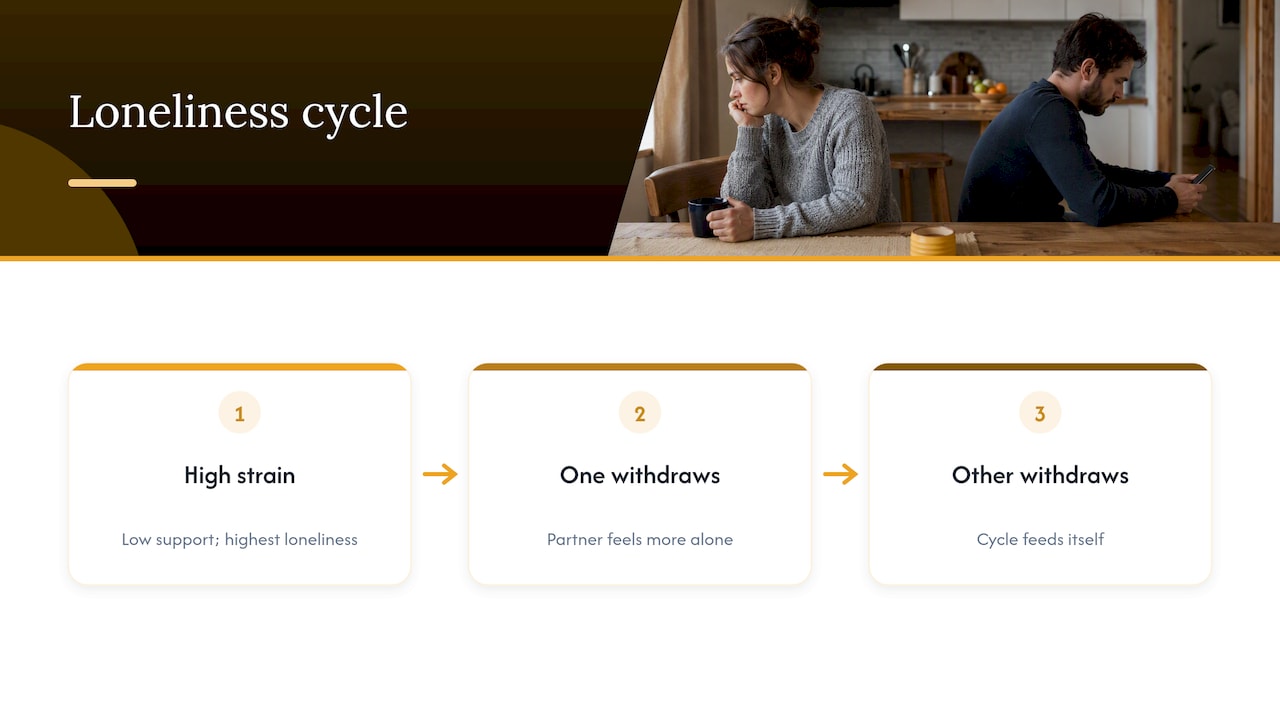
A study of 953 older-adult couples, summarized in a paper on loneliness in the older adult marriage, found that people in marriages marked by high strain and low support reported the highest loneliness. The same research points to a partner effect: one spouse’s marital quality and loneliness shape the other’s. When one partner pulls away, the other often feels more alone, and then pulls away too. The cycle feeds itself.
The same paper notes that women appear especially sensitive to the lack of a reliable confidant in a spouse. If you are a wife who feels this acutely, it is not a character flaw. It reflects how much weight a confiding relationship carries.
Anger that never gets resolved
A dyadic study of 313 heterosexual couples found that anger rumination, meaning staying stuck on angry thoughts, predicted more loneliness in both partners, and that loneliness in turn lowered psychological well-being. Replaying the same grievance in your head does not just sour the mood. It builds a wall.
Criticism and defensiveness
When one person criticizes and the other defends, both walk away without what they wanted. As one therapist’s handout on Gottman’s Four Horsemen puts it, criticism often comes from wanting connection while feeling too scared or angry to ask for it directly. Defensiveness protects you but costs connection. Over months, both partners learn that bringing anything up is risky, so they stop.
We see this pattern constantly, and we cover how it plays out in why couples stop communicating effectively.
Avoidance and withdrawal
Some couples never fight at all. One partner shuts down to keep the peace, and the other reads that silence as indifference. If that sounds familiar, our pieces on the conflict avoidant partner and the emotional withdrawal cycle go deeper.
Life transitions and substances
New parenthood, relocation, illness, job loss and caregiving all shift the ground. Couples who do not talk through those changes drift. Sometimes alcohol becomes part of the distance, and the trust problems that follow need their own plan. For that situation, a guide on rebuilding trust after alcohol lays out a longer timeline for couples.
Which kind of lonely are you?
The fix depends on the pattern. Use this table as a rough guide, not a diagnosis.
| Pattern | What it looks like | What usually helps first |
|---|---|---|
| Roommate drift | Polite, calm, logistical, no fights, no closeness | Daily bids, new shared experiences, honest check-ins |
| Pursue and withdraw | One person pushes for talk, the other goes quiet | Time-outs with a return time, softer starts, slower pacing |
| Chronic conflict | Same fights, rising resentment, anger replays | De-escalation skills, communication agreements, repair attempts |
| After a rupture | Affair, secrets, broken promises, guarded silence | Structured trust rebuilding, usually with a licensed professional |
| Different worlds | Careers, kids or caregiving consume all energy | Scheduled connection, shared goals, dividing the load fairly |
Most couples are a mix. If you are unsure, start with the first row. Everyone benefits from more connection.
What to do when you are married but lonely
1. Treat the loneliness as information
Before you decide what it means about your spouse or your future, treat it as a signal. Something you need, such as attention, being known, or feeling like a team, is not arriving. Write one or two sentences about what you miss. Be specific: “I miss hearing about your day” is more useful than “you never talk to me.”
2. Tell your spouse, without an indictment
Pick a calm moment, not mid-argument and not at 11 p.m. Try a script like this:
“I’ve been feeling lonely lately, and I miss us. I’m not blaming you. I’d like to figure out how we get closer again. Can we talk about it this weekend?”
Notice what this does. It describes your experience, signals goodwill, and asks for a time. A criticism like “you’ve checked out of this marriage” invites a defense. A request invites a response.
If your last attempt ended in a fight, our time-out scripts for couples show how to pause when it gets heated and return to the conversation rather than abandoning it.
3. Make and answer small bids
A bid is a small attempt to connect: a comment, a glance, a question, a touch. Psychologist John Gottman’s research on newlyweds, as reported by Psychology Today, found that after six years, couples still together had turned toward 86 percent of bids, while divorced couples had turned toward only 33 percent.
The lesson is not that every missed bid dooms you. It is that connection is built in tiny moments. Practical ways to start:
- Make one bid a day that is not about logistics: “Look at this,” “How did that meeting go?”, a hand on the shoulder.
- When your spouse makes a bid, stop what you are doing for ten seconds and respond with real attention.
- If you are the one who has stopped bidding, restart on purpose, even if it feels awkward at first.
A research summary on communication skill-building points to bid-making and what researchers call transition processing communication, which means talking aloud about changes in your life together, as teachable skills that can ease loneliness.
4. Replace small talk with self-disclosure
You do not become close by sharing more facts. You become close by sharing more of yourself: worries, hopes, embarrassment, what you are proud of. A 2014 study of couples referred to counseling clinics found that six sessions of self-disclosure training, each lasting 90 minutes, significantly improved constructive communication and reduced avoidance and demand/withdraw patterns. The sample was small and from Iran, so treat it as encouraging rather than definitive, but it matches what we see in practice: disclosure is a skill and it improves with structure.
Try this tonight: each of you answers three questions, taking turns, with no advice allowed.
- What was the hardest moment of your day?
- What is something you have been worried about but haven’t said?
- What is one thing I did this week that made you feel cared for?
If you want more ideas, we collected six therapist-backed communication exercises that take less than an hour.
5. Own your part
This is the hardest step and the most powerful. Verywell Mind’s guidance points to owning your part in conflicts, along with real conversation in place of small talk, as the path from roommates to intimate partners. That does not mean accepting blame for everything. It means finding the one piece that is yours, such as sarcasm, stonewalling, scorekeeping or going quiet, and saying so. “I’ve been shutting down when we disagree, and I know that leaves you alone with it” can change the temperature of a whole evening.
6. Build safety before you ask for vulnerability
People do not open up where they expect to be mocked, corrected or punished. If your spouse is guarded, the work is making the room safer first: no eye-rolling, no weaponizing what they confided, no bringing up old fights as ammunition. Our 90 day psychological safety plan for married couples and emotional safety behaviors to practice tonight walk through concrete habits.
7. Add rituals and new shared experiences
Pick one anchor that happens most days: a 15-minute walk, coffee before the kids wake up, a phone-free dinner twice a week. Then add novelty monthly. Doing new things together gives you something to talk about besides the household. For ideas that go beyond “date night,” see our guide to intimacy building activities.

Also keep in mind that emotional and physical intimacy feed each other. Pressure for sex when emotional closeness is missing often deepens loneliness. Emotional warmth with no physical touch can leave one partner feeling like a friend. Most couples need both, and they usually need to restore the emotional side first.
What if your spouse is the lonely one?
People often search for why a husband or wife feels lonely, and the honest answer is that they likely are not getting enough of what you stopped noticing you were not giving: attention, curiosity, being a confidant. Because of the partner effect described above, your own disconnection matters too, even when you feel fine.
If your spouse says they are lonely:
- Do not defend your intentions first. Try “Thank you for telling me. Tell me more.”
- Ask what a good week would look like to them, and pick one thing to try.
- Resist the urge to fix everything in a night. Consistency beats intensity.
Our perspective
As licensed mental health professionals who have worked with thousands of couples, we have noticed that loneliness is rarely what couples bring up first. They come in to talk about the dishes, money, the in-laws or the same argument for the tenth time. Underneath it, one or both people feel alone.
We built the F.I.G.H.T. Plan® around that observation. Fighting and loneliness are two ends of the same problem: partners who do not know how to be vulnerable and safe at once. Criticism and defensiveness push people apart. Silence does it more quietly. The skills that fix one usually fix the other: regulating yourself in the moment, speaking about your needs without attacking, listening so your partner feels heard, and repairing after a miss.
We also hear the belief that you need a crisis or a long course of traditional therapy before anything can change. In our experience, practical, structured skills practiced in small doses move couples a long way, and they do not need to be in crisis to start. Some situations, such as an affair, abuse or serious mental health concerns, call for a licensed therapist working with you directly. If you are not sure which group you are in, that uncertainty is a good reason to ask for guidance.
One last thing. If you are the person reading this alone at night, you are not failing at marriage. You noticed what you need, and that is the first useful step.
— Carlos
When to get more help
Self-help tools are a good start, but some situations need a professional.
- Contempt, name-calling or threats. If conversations regularly turn cruel, see a licensed couples therapist.
- Betrayal. After an affair, secrets or financial deception, structured trust repair is hard to do alone.
- Fear. If you are afraid of your partner or feel controlled, contact a domestic violence advocate or a therapist who works with safety planning, and do not rely on couples exercises.
- Persistent low mood. If loneliness comes with hopelessness, sleep or appetite changes, or you cannot enjoy things, talk to your doctor or a licensed mental health professional. If you ever think about harming yourself, contact a crisis line or emergency services right away.
- One partner unwilling. You can still change your own part of the pattern. Individual therapy can help you do that.
If you are worried your spouse will not do anything with you, we wrote about how to convince a spouse to take a marriage course with you.
Tools that fit where you are
If you want structure rather than guesswork, our resources are built for couples who want to improve without waiting for a crisis. Stop the Fighting: The Couples Communication & Conflict Resolution Course is $149.00 and teaches the communication and de-escalation skills that make connection safe. Our therapist-created workbooks, from $9.99 to $25.00 depending on the title, include The F.I.G.H.T. Plan workbook and a Christian edition, and you can browse them in our shop. If you would like personal guidance, online couples coaching is available, and the VIP Private Coaching package of four sessions is $997.00.
We would also point you to our overview of online marriage course costs if you are comparing your options.
A simple 14-day plan
| Days | Focus | Practice |
|---|---|---|
| 1 to 2 | Awareness | Write what you miss. Notice your own bids and your spouse’s. |
| 3 to 4 | Opening | Share the “I feel lonely and I miss us” script at a calm time. |
| 5 to 7 | Bids | One non-logistical bid daily. Respond to every bid you notice. |
| 8 to 10 | Disclosure | Do the three-question exercise twice, no advice. |
| 11 to 12 | Ownership | Each names one habit that creates distance and one small change. |
| 13 to 14 | Ritual | Choose one daily and one weekly connection ritual, and review how it felt. |
Expect awkwardness. A stiff first week does not mean it is not working. It means you are practicing something new. Reassess after two weeks: if you feel even slightly closer, keep going. If nothing shifts, or the conversations get worse, that is the point to bring in a coach or licensed therapist.
FAQ
What should I do if I am married but lonely?
Start by naming the feeling to your spouse without blame, then build daily habits: small bids for connection, one honest conversation about something that matters, and a regular ritual together. If you try this for a few weeks and the distance persists, or if there is betrayal, contempt or fear, bring in a licensed couples therapist.
Is feeling lonely in marriage a sign of divorce?
Not by itself. Loneliness is a signal that connection has weakened, and it often reflects a pattern that developed over time and can change. It becomes more serious when it comes with contempt, long stretches of avoidance, or one partner having already mentally left. In those cases, getting professional help sooner is wise.
Why do I feel more alone when my spouse is in the room?
Because being around someone and feeling connected to them are different things. If conversations are mostly logistics, or you expect to be criticized or ignored, being together can highlight the gap. Rebuilding safety and honest sharing usually closes it.
Can I fix this if my spouse will not participate?
You can change your side of the pattern: how you bring up needs, how you respond to bids, and how you repair. Because partners affect each other, that often shifts the dynamic. If your spouse stays closed off for a long time, individual counseling can help you decide what you need next.
Sources
- What to Do If You’re Married and Lonely, Verywell Mind
- Feeling Lonely in a Marriage, Family or Crowd, Feelingalone.org
- Loneliness in the older adult marriage, PMC
- Anger Rumination, Loneliness and Psychological Well-Being in Romantic Relationships, PubMed
- Gottman’s Four Horsemen handout, Lindsay Braman
- Improvising Long-Lasting Relationships, Psychology Today
- The effect of self-disclosure skill training on communication patterns, PMC
Recommended
- Sexless Marriage Communication: Scripts to Use Tonight for Couples
- 9 Ways to Strengthen Marital Friendship That Last