
Empathy in Marriage: What It Is and How to Practice It
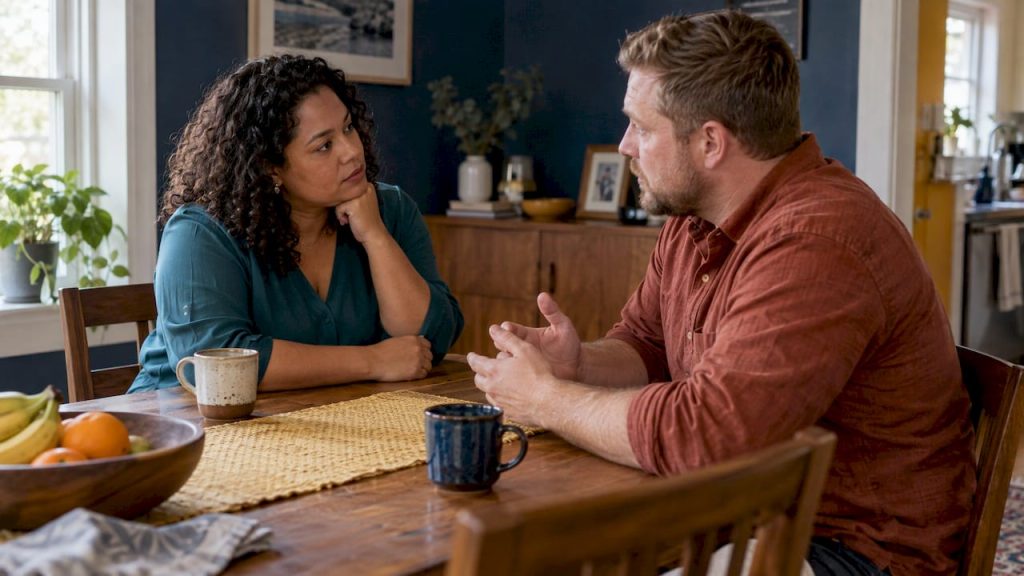
Empathy in marriage is the habit of understanding what your spouse feels and why, and showing them you understand before you try to fix, defend or explain. It is a skill, not a personality trait, and spouses can learn it. This guide explains what empathy involves, what the research says about why it protects a marriage, what it sounds like in a real disagreement, and which exercises you can do together this week.
TL;DR
- Empathy has three parts: seeing your spouse’s point of view, feeling with them, and acting in a way that fits what you understood.
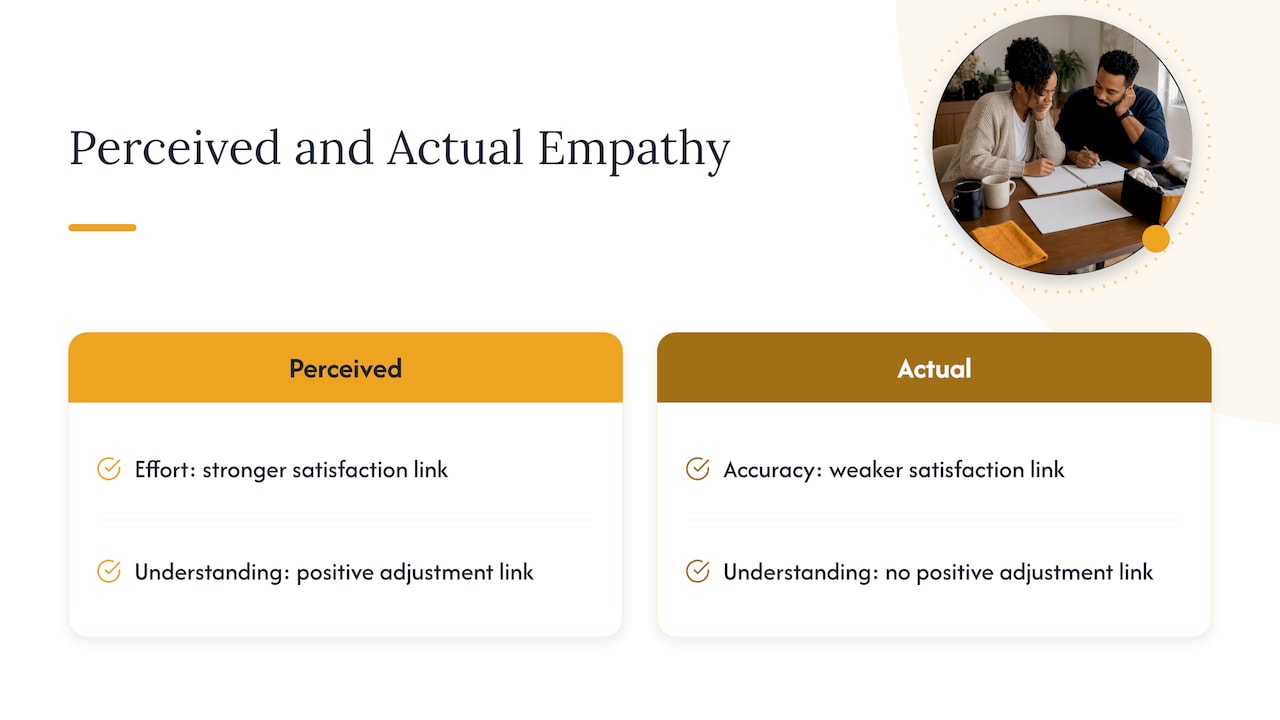
- In research on couples, a partner’s visible effort to understand is linked with satisfaction, even when the guess about their feelings is not perfect.
- During conflict, paraphrase first, ask a clarifying question, validate the feeling, and hold your advice until both of you feel heard.
- Short, repeatable exercises work better than one big talk: speaker-listener turns, a third-person view of an argument, and regular check-ins.
- Empathy works best when both spouses practice it, so start it as a shared project rather than a demand.
Table of Contents
- What empathy means in a marriage
- Why empathy matters for the health of the marriage
- What empathy sounds like during a disagreement
- Five empathy exercises for couples
- Making empathy a routine instead of a rescue
- What gets in the way
- Perspective
- Put these skills into practice with your spouse
- FAQ
- Sources
What empathy means in a marriage
Utah State University Extension describes empathy in marriage as putting yourself in your spouse’s shoes: understanding their emotions and actions, showing care, validating their experience and listening to understand. Partners tend to be more content when they know their spouse grasps what they feel and expresses that.
It helps to separate empathy from two things it is often confused with.
- Agreement. You can understand why your spouse is hurt about a missed dinner without agreeing that you were wrong to work late. Empathy says, “I see how that landed.” It does not say, “You are right and I am wrong.”
- Sympathy or problem-solving. Feeling sorry for your spouse, or jumping to a solution, keeps you outside their experience. Empathy stays in it for a moment.
The three parts of empathy
Greater Good, from UC Berkeley, explains that empathy has a perspective-taking part, an emotional part and a behavioral part. You understand your partner’s viewpoint, you feel something with them, and you do something consistent with that understanding.
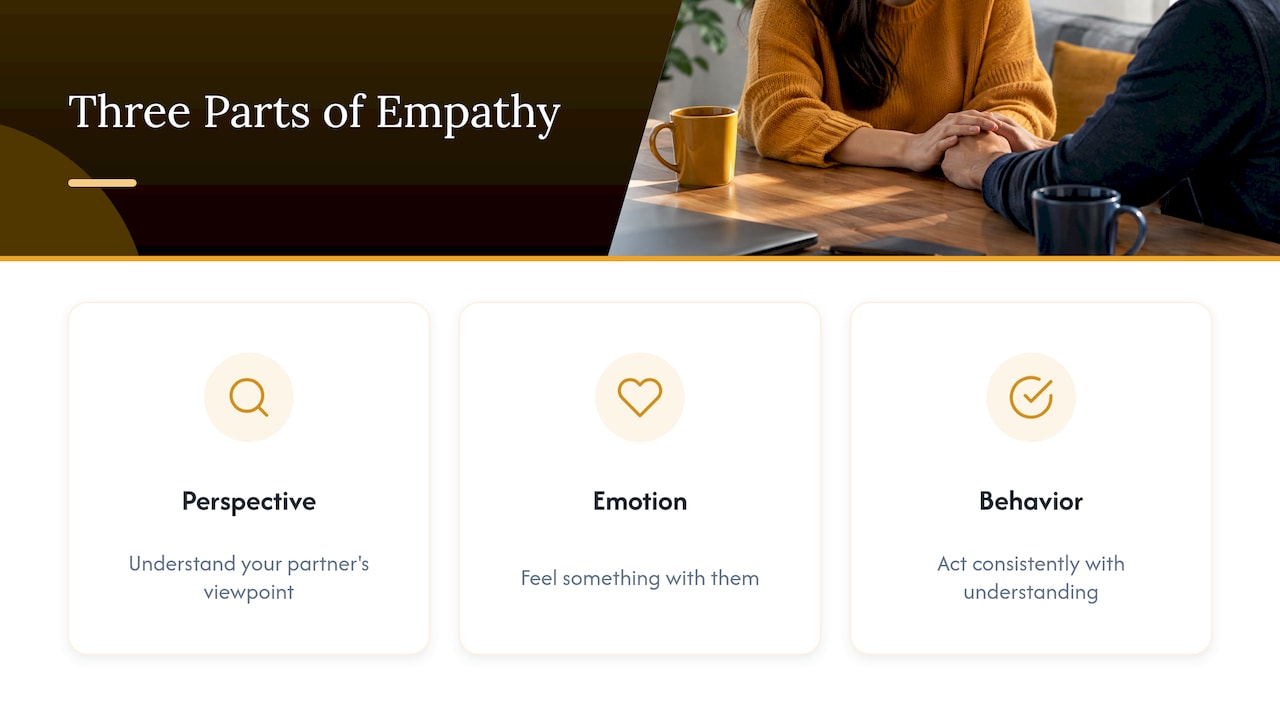
Most couples stall on the third part. A husband may understand that his wife felt dismissed in a meeting with his family, and even feel bad about it, but never say so or change anything. From her side, the empathy never happened.
Why empathy matters for the health of the marriage
The research is consistent on one point: feeling understood matters a great deal, and it is not only about accuracy.
Effort counts, not just accuracy
A study of 156 couples found that perceived empathic effort, meaning the belief that a partner was trying to understand, was more strongly linked with relationship satisfaction than empathic accuracy. A separate study of 152 couples found that perceived understanding, but not actual understanding, was positively associated with dyadic adjustment.
The practical takeaway is kind to anyone who fears getting it wrong. You do not need to read your spouse’s mind. You need to visibly try, and to let them correct you. “Let me check if I have this right” is one of the most useful sentences in a marriage.
Accuracy still helps in hard moments
Greater Good reports that people who read a partner’s thoughts and feelings more accurately during disagreements are generally more satisfied with their relationship. The same source stresses that couples benefit most when both partners experience empathy. One spouse carrying all of it tends to wear thin.
It is a two-way process
A Journal of Marital and Family Therapy study of 178 young adult couples found that each partner’s communicated perspective-taking during conflict was positively associated with both partners’ positive relational experience, and with relationship satisfaction through that experience. In plain terms, when you show you are taking your spouse’s view, it improves the conversation for them and for you.
What empathy sounds like during a disagreement
Most of us know empathy is good. The difficulty is doing it at 9:40 p.m. when you are both tired and one of you just said “you never listen.” Here is how the steps from Greater Good’s active listening practice translate into everyday marriage.
- Choose a quiet moment. Find a place without distractions. Phones go face down. If the topic is heated, agree to a short pause and a time to return to it.
- Let your spouse finish. Do not interrupt, and do not use their pauses to build your rebuttal.
- Paraphrase. Try, “What I hear you saying is that you felt alone with the bills this month.” Then ask, “Did I get that right?”
- Ask a clarifying question. “What was the hardest part of that for you?” invites more than “Why are you upset?”
- Validate the feeling. “That makes sense. I would feel hurt too if I thought I was carrying it alone.” You can validate a feeling without accepting every detail of the story.
- Hold your advice. Wait until both of you feel understood. Then take turns sharing your own view using clear “I” statements.
The same source recommends engaged body language: face your spouse, keep your arms open, and look at them rather than at the screen.
Go one layer under the anger
Greater Good notes that spouses can make difficult discussions less adversarial by asking where a partner’s feelings come from, instead of attacking or defending, and by exploring softer feelings such as sadness and fear beneath anger or resentment.
Here is a quick example.
- Defensive version: “I was at work. I can’t be home for every dinner.”
- Empathic version: “You’ve been eating alone a lot lately, and it sounds like it makes you feel like an afterthought. Is that close?”
The second version does not promise to change the schedule. It simply lets the other person know their feeling was received. Often that alone lowers the temperature enough to problem-solve.
Set the tone in the first few minutes
Psychology Today’s summary of a 2015 study by Gottman, Driver and Tabares reports that setting a positive tone in the first three minutes of conflict was more effective than waiting until later to repair the interaction. Effective early repairs included warmth, empathy, humor, responsibility and self-disclosure. So if you can only practice one moment, practice the opening line of a hard conversation.
We also cover this in how to defuse conflict with your partner, with scripts for the first minute.
Five empathy exercises for couples
These take 10 to 45 minutes and need no special materials. Pick one and repeat it for a few weeks before adding another.
1. Speaker-listener with a shared object
Psych Central describes a speaker-listener exercise using a shared object. Whoever holds the object speaks about a challenging experience. The listener reflects and acknowledges what they heard without offering insight, opinion or solutions. Then you swap.
A few ground rules make it work:
- Pick a topic that is a 3 or 4 out of 10 in intensity, not your biggest wound.
- The speaker uses short chunks so the listener can paraphrase.
- The listener ends with, “Is there more?” before anything else.
For more variations, see our guide to active listening exercises.
2. Gaining perspective on an argument
This Greater Good practice asks each partner to revisit a recent disagreement from the view of a neutral third party who wants the best for both people. You then identify what gets in the way of holding that view, and plan to use it in future disagreements.
The shift is from proving who is right to observing both viewpoints and looking for an outcome that works for both of you. Do it separately first, writing a few lines each, then share what you wrote.
3. Thirty-six questions for closeness
Greater Good’s 36 Questions exercise asks couples to reserve 20 to 45 minutes and take turns answering increasingly probing questions in three sets. The prompts touch on gratitude, upbringing, life stories, dreams, accomplishments, treasured and painful memories, friendship, love and affection.
It is empathy practice in disguise. You learn how your spouse experiences the world, which is what makes it easier to guess their feelings later.
4. A weekly Love Maps check-in
Greater Good reports that John Gottman’s Love Maps are regular conversations about each partner’s goals, dreams, worries and changing needs, and that they help spouses understand and support each other when problems arise.
Try a 15-minute check-in once a week with three questions:
- What is weighing on you this week?
- What are you looking forward to?
- What is one thing I could do that would make this week easier?
5. The repair after a fight
Once things have cooled, each of you answers two questions: “What do I think you felt during that argument?” and “What do I wish I had done differently in the first three minutes?” Share your answers and let your spouse correct your guesses. This turns a fight into practice without anyone having to be the villain.
Our healing and repair quiz can help you see where reconnection tends to break down for you.
Making empathy a routine instead of a rescue
Empathy that only appears in a crisis is hard to summon. Two research threads suggest how to build it into ordinary life.
Time together matters. A 2025 Contemporary Family Therapy study of 314 married couples in a southeastern U.S. state found that higher-quality time was associated with more positive and less negative conflict resolution, with perceived perspective-taking partly explaining those links. Protected, phone-free time may therefore help your fights go better.
Skills and empathy both help. A 2014 randomized study of early married couples compared communication and conflict-resolution training with forgiveness-and-reconciliation training that emphasized empathy. Both produced lasting positive self-reported changes, and both reduced cortisol reactivity one month after treatment. Learning practical communication skills and building empathy are complementary paths, not rivals.
A simple rhythm to start with:
| Frequency | Practice | Time |
|---|---|---|
| Daily | One real question about your spouse’s day, with a paraphrase of the answer | 5 minutes |
| Weekly | Love Maps check-in | 15 minutes |
| Monthly | Speaker-listener on a harder topic, or the 36 Questions | 30 to 45 minutes |
| After a fight | Repair conversation | 10 to 15 minutes |
What gets in the way
Rushing to advice
When your spouse is upset, you probably want to help, and help usually arrives as advice. The listening steps above say to hold it until both of you feel understood. Ask, “Do you want me to listen, or do you want ideas?” It is a small question that prevents many arguments.
Defensiveness
Defensiveness is often a signal that something in you has been touched. Naming your own trigger helps you stay present with your spouse. If you want to explore why certain comments hit so hard, this piece on shadow work in relationships looks at how our own reactions shape the way we respond to a partner.
Waiting for the other person to go first
Because empathy lands best when it is mutual, it is tempting to hold back until your spouse starts. The 178-couple research suggests one partner’s effort can improve the conversation for both. Going first is not losing. It is the fastest way to change the pattern.
Stress and faith differences
Empathy gets harder with a newborn, a job loss, or a blended household. If faith is central to your marriage, we explain how counseling grounded in shared beliefs can support these skills in our piece on faith-based marriage counseling. Engaged couples can start earlier with conflict skills before marriage.
Perspective
We have worked with many couples, and the pattern is rarely a lack of love. It is a lack of a method. Two people who care about each other get stuck in criticism and defensiveness because nobody ever showed them what to do in the first minute of a hard conversation.
That is why we built the F.I.G.H.T. Plan® as a structured, step-by-step system. Empathy is not a mood you wait for. It is a set of behaviors you can learn: slow down, listen for the feeling, say it back, and only then talk about solutions. When couples practice those behaviors together, conversations that used to blow up start to feel safer.
Our approach is designed to be practical, to fit the faith, family and history of the couple in front of us, and to give you tools you can use tonight, not only in a session. If you take one thing from this article, let it be this: try the paraphrase and the check-in for two weeks before you judge whether your marriage can change.
Carlos
Put these skills into practice with your spouse
Reading about empathy is a start. Doing it with a script in front of you is easier. Couples Fight School offers therapist-created tools built around the F.I.G.H.T. Plan®, so you do not have to invent the words in the middle of a fight.
If you want something affordable to begin with, our couples therapy workbook and the F.I.G.H.T. Plan workbooks in the shop run from $14.99 to $25.00, and the F.I.G.H.T. Plan Couples Conflict Toolkit is $27.00. For a full guided path through communication and conflict, Stop the Fighting is a $149.00 course. If you would like personal guidance, see our online couples coaching: the VIP Private Coaching package of four sessions is $997.00.
FAQ
Can empathy be learned if my spouse and I are not naturally empathic?
Yes. Empathy has a perspective-taking part, an emotional part and a behavioral part, and the behaviors are the easiest to practice. Paraphrasing, asking clarifying questions and validating feelings are skills, and they get more natural with repetition.
What if my spouse does not show empathy back?
Start with your own effort, since research on communicated perspective-taking suggests one partner’s effort can improve the conflict experience for both. Ask for what you need in a specific, gentle way, such as “Could you tell me what you heard me say?” If the pattern is painful or does not shift, a licensed couples therapist can help.
Is validating my spouse the same as admitting I was wrong?
No. Validation means acknowledging that your spouse’s feelings make sense given how they experienced the moment. You can validate the hurt and still share your own side afterward, once both of you feel heard.
How often should we do empathy exercises?
Short and regular beats long and rare. A few minutes daily, a 15-minute weekly check-in and a longer exercise monthly is a realistic rhythm for most couples. Add a brief repair talk after any significant argument.
What is an easy empathy exercise to start tonight?
Try the speaker-listener exercise for 10 minutes on a low-stakes topic. One of you speaks while the other paraphrases and asks, “Is there more?” with no advice. Then switch.
Sources
- Building a Better Marriage, Utah State University Extension
- Eye of the Beholder: The individual and dyadic contributions of empathic accuracy and perceived empathic effort, Bryn Mawr College repository
- Feeling Like Partners, Greater Good Magazine
- It Takes Two to Tango, Journal of Marital and Family Therapy
- “I think you understand me.” Studying the role of perceived understanding, Ghent University
- Active Listening, Greater Good in Action
- Gaining Perspective on an Argument, Greater Good in Action
- 36 Questions for Increasing Closeness, Greater Good in Action
- How to Fight Better, Psychology Today
- 5 Tips to Be More Empathetic in Your Relationship, Psych Central
- Forgiveness-reconciliation and communication-conflict-resolution interventions, PubMed
- Strengthening Relationships: The Role of Quality Time, Contemporary Family Therapy
- Shadow Work for Relationships: A Practical Guide
Recommended
- Emotional Neglect in Marriage: Signs and How to Heal
- Lonely in Marriage: Why It Happens and How to Reconnect
- Emotional Flooding in Marriage: What to Do When You’re Flooded
- Sexless Marriage Communication: Scripts to Use Tonight for Couples