
Partner Trauma Triggers: Why They Happen and What to Do
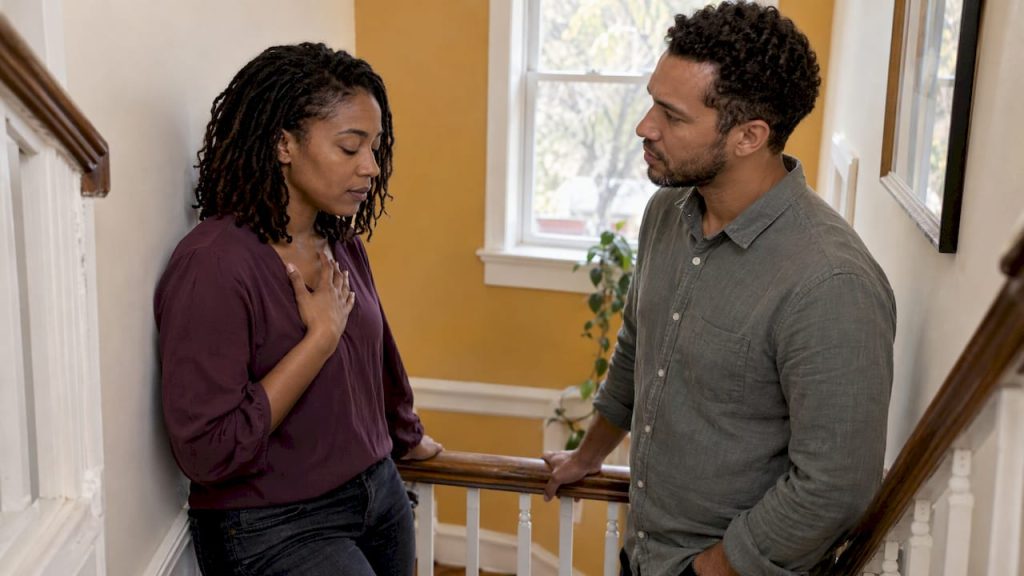
A partner trauma trigger is a reminder of past pain that shows up inside your current relationship: a raised voice, a sudden silence, a touch you did not see coming. The body reacts as if the old danger is happening now, so the reaction can feel far bigger than the moment. You can learn to spot these moments, calm your body, and talk about them without blame. Here is how.
TL;DR
- A trigger is a reminder, not a choice. The brain treats it as a present threat, which is why the reaction can feel out of proportion.
- Common relationship triggers include raised voices, criticism, a partner going quiet or leaving the room, and unexpected touch.
- Ask yourself “Is this familiar?” to separate the old pain from the current disagreement.
- Pause, soften your start-up, and make repair attempts. Calm bodies talk better than alarmed ones.
- Ongoing, intense reactions deserve a licensed trauma-informed professional, alone or together.
Table of Contents
- What a trauma trigger is
- Why the closest person sets it off
- Common triggers between partners
- What a triggered reaction looks like
- How to tell old pain from today’s argument
- What to do in the moment
- Co-regulation: calming each other
- Talking about triggers without blame
- Strengths couples with trauma histories share
- When to get professional help
- Our perspective
- Tools to practice together
- FAQ
- Sources
What a trauma trigger is
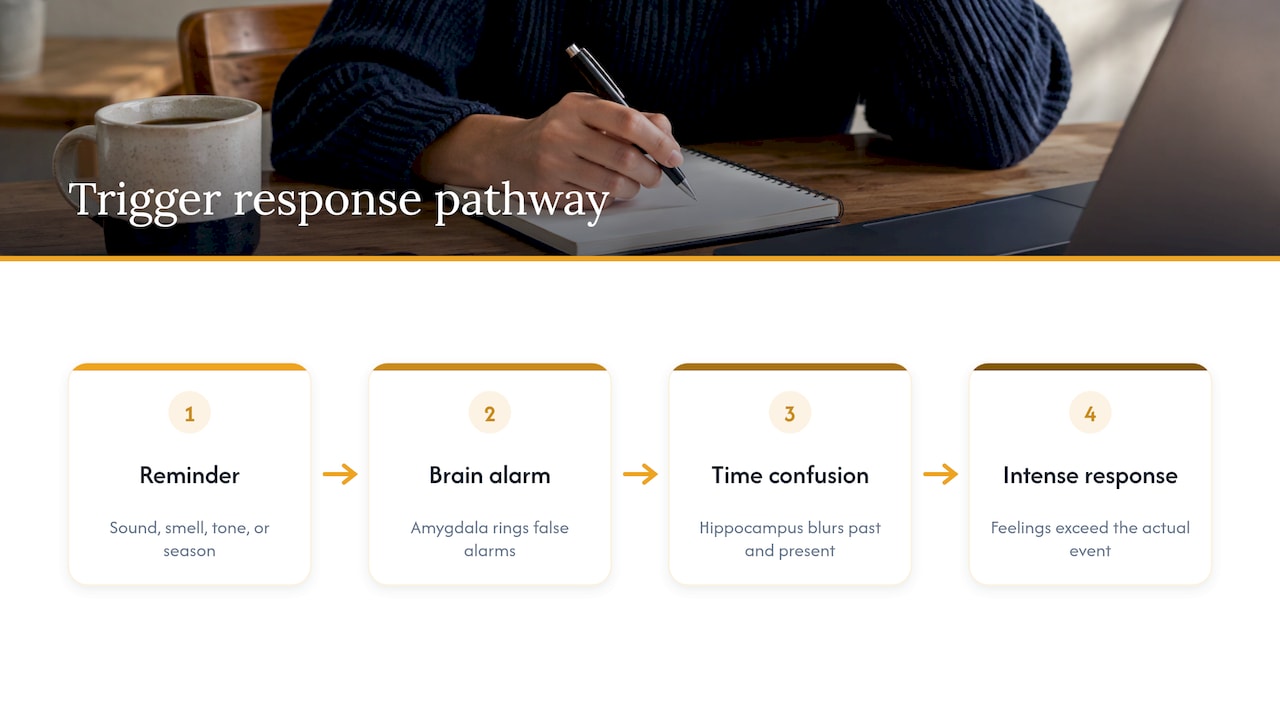
A trigger is a sensory or contextual reminder that activates a trauma response. It can be obvious, like a sound tied to the event, or subtle, like a smell, a tone of voice or a time of year. Triggers are not chosen and are hard to control through willpower, because the brain responds to the reminder as though the threat is happening now.
Two brain areas explain much of this. According to Cleveland Clinic, the amygdala can become overly aroused and hypervigilant, ringing false alarms, while the hippocampus can struggle to tell past from present. A memory then starts to feel like it is happening in the moment.
Emotional triggers also tend to produce thoughts and feelings out of proportion to the actual event. Cleveland Clinic’s example: a partner raising their voice in an argument may set off the same intense anger a person felt as a child when their parents yelled.
If you want a deeper look at this pattern in couples, see our guide to emotional triggers in relationships.
Why the closest person sets it off
It can seem unfair that the person who makes you feel safest is the one who sets you off most. There is a reason. Attachment research suggests the nervous system uses the same circuitry for bonding and for threat detection. When trauma happened inside relationships, closeness itself can become the cue. Intimacy requires vulnerability, and vulnerability is exactly what trauma taught the body to fear.
This does not mean the relationship is harmful. It means your partner is standing in the place where old hurt lives. Seeing that gives both of you a different question to ask. Instead of “What is wrong with you?” it becomes “What just happened in your body?”
Common triggers between partners
Trauma-focused clinicians report a familiar set of relationship triggers. According to Compassion Behavioral Health, these include:
- Conflict or raised voices that mirror a past abusive environment
- Physical affection that arrives without warning or clear consent
- Criticism or dismissiveness that echoes earlier emotional abuse
- A partner leaving the room or going quiet during a disagreement
- Unpredictable emotional reactions that feel unsafe
Note how ordinary these are. Most couples have all of them on a bad night. For a person with a trauma history, each one can carry a second meaning.
Trauma can also affect what makes closeness easy: emotional presence, trust, relaxing a constant watch for danger, and clear communication. A sound, smell, phrase or type of touch can bring up a strong reaction even in a safe relationship.
What a triggered reaction looks like
The U.S. Department of Veterans Affairs notes that after trauma, people may feel jumpy, stay on guard all the time, become irritable or have angry outbursts, find it hard to trust others, or feel detached and not want intimacy.
These often fall into four instinctive patterns, described as fight, flight, freeze and fawn:
| Response | What it can look like in a relationship |
|---|---|
| Fight | Anger, irritability, need for control, defensiveness |
| Flight | Anxiety, restlessness, overworking, avoiding conflict |
| Freeze | Feeling stuck, emotional numbness, trouble making decisions |
| Fawn | People-pleasing, difficulty saying no, putting others first |
Notice that three of the four can look like “not caring” or “not fighting fair” from the outside. A partner who goes numb is not necessarily indifferent. A partner who agrees to everything is not necessarily at peace. Learning to read these as protection, not rejection, changes how you respond. Our article on breaking the emotional withdrawal cycle covers what to do when one of you goes quiet.
How to tell old pain from today’s argument
You do not need to be a therapist to run a simple check. Cleveland Clinic suggests asking yourself, “Is this familiar?”, and comparing what you feel now with past experiences. Journaling about your triggers over time can reveal the patterns and situations behind them.
Signs the reaction may be about more than tonight’s disagreement:
- The intensity is much bigger than the topic.
- Your body reacts first: racing heart, tight chest, shaking, going blank.
- The feeling is old. You have felt it with other people, at other times.
- You cannot think your way out of it in the moment.
The goal, per the same source, is to bring yourself from the past into the present so you know you are not reliving the same thing and that this situation is different. Say it quietly if you need to: “This is my partner. This is today.”
What to do in the moment
When a trigger hits, the thinking brain goes offline. Researchers John Gottman and Nan Silver call it flooding: feeling overwhelmed both emotionally and physically during conflict. Nothing productive happens while you are flooded. Our piece on emotional flooding in marriage goes deeper.
Try this sequence:
- Name it. Say “I think I’m triggered” or “I’m getting flooded.” Naming it is not an accusation.
- Pause on purpose. Agree on a break and a time to return. Our time-out scripts show how to do it without it feeling like abandonment.
- Ground yourself. Feel your feet, look around the room, say today’s date. This reminds the body it is here, not there.
- Come back. Return when you said you would. A break that never ends becomes the very silence that triggers some partners.
If your partner is the one triggered
Stay calm and steady, listen without judging, and do not argue about whether the reaction is “reasonable.” A soft voice, a pause and a question do more than a counterargument. Do not touch without asking. Unexpected touch is itself a common trigger.
Co-regulation: calming each other
Co-regulation means your steady presence helps your partner’s nervous system settle, and theirs helps yours. It is not fixing or lecturing. It is being a safe, predictable person in the room.
Gottman and Silver describe repair attempts as any statement or action that keeps negativity from escalating, such as a soft voice, a smile, fitting humor, non-defensive listening, a hug or an apology. For a triggered partner, choose the repair that feels safe to them, not the one that feels natural to you. Ask in a calm moment: “When I see you getting overwhelmed, what helps most? Space, a hand on your shoulder, a slower voice?”
Two habits make co-regulation work:
- Slow down together. Lower your volume and pace before you ask your partner to lower theirs.
- Agree on signals. A word or hand gesture that means “I’m flooding” removes the need to explain in the heat of the moment.
If repairs keep failing, you are not alone. We explain why in why couples struggle to repair after fights.
Talking about triggers without blame
Choose a calm time, not mid-argument. Use what Gottman and Silver call a soft startup: raising an issue in a way that is sensitive to your partner’s perspective and free from criticism, blame and contempt. That makes the other person less defensive and a productive talk more likely.
A simple script:
- “When the room goes quiet, my body panics. It isn’t about you. Can we figure out what helps?”
- “I want to hear what sets you off. You decide how much to share and when.”
Respect boundaries on both sides. A partner does not owe you their whole history in one night, and you do not owe them endless access to your reactions. If conversations keep stalling, why couples stop communicating effectively may help you see the pattern.
Strengths couples with trauma histories share
It is easy to focus on the pain. Research cited by the American Counseling Association points to strengths in couples where both partners have trauma histories, including shared goals, psychological flexibility, mutual understanding and supportive communication. Many couples build resilience precisely because they have had to learn each other’s signals. For more on coping together, see this resource on relationship problems and mental health.
When to get professional help
Self-help tools are a start, not a cure for serious trauma. See a licensed mental health professional with trauma training if you notice flashbacks, panic, constant hypervigilance, numbness that does not lift, or reactions that damage daily life. If you have lived with abuse or fear your partner, speak with a trauma-informed therapist alone first, because joint sessions are not always safe in those situations. In the U.S., the National Domestic Violence Hotline can help at any hour.
Research also shows the effect runs both ways. Studies cited by the ACA found that secondary traumatic stress in the non-trauma-surviving partner has a moderate to large effect on relationship functioning, and that trauma transmission between partners is bidirectional. If you are the supporting partner, your own care matters too.
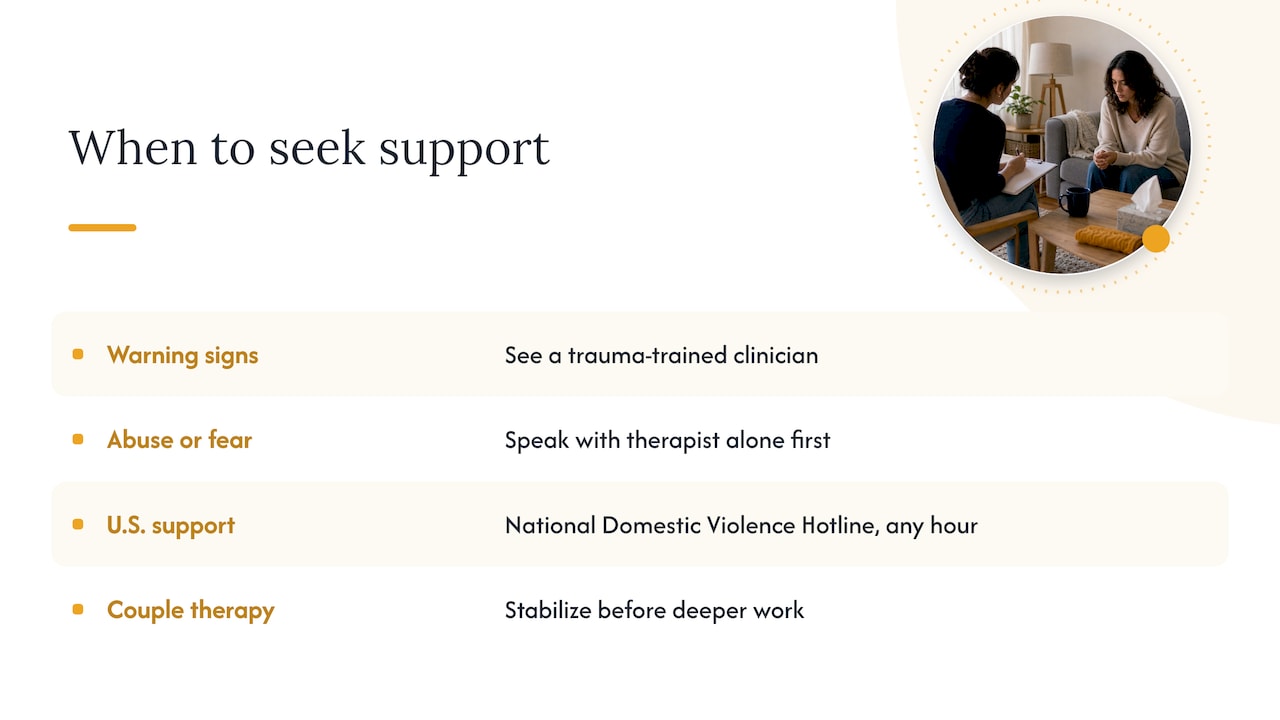
The VA describes emotionally focused couple therapy as processing emotions tied to trauma and attachment behaviors, starting with stabilizing the couple. That order matters: safety first, deeper work after.
Our perspective
Most couples who come to us are not fighting about the dishes or the budget. They are fighting about what the dishes or the budget mean. Underneath is often an old wound that one partner’s tone, silence or distance presses on.
We built the F.I.G.H.T. Plan® because couples need a structure, not just insight. Understanding where a trigger comes from is the first step. The second is having words, a pause routine and a repair habit ready before the next argument arrives. Skills like these are learnable, and thousands of couples have shown us that.
Our approach is designed to help you move from criticism and defensiveness toward understanding and emotional safety, at your own pace and in your own home. Your partner is not your enemy, and your reactions are not a character flaw. They are information.
Carlos
Tools to practice together
If you want a guided path, our LOVE & TRAUMA COURSE is $47.00, and The F.I.G.H.T. Plan Couples Conflict Toolkit is $27.00. For a full communication and conflict program, see Stop the Fighting, $149.00. Couples who want personal guidance can explore online couples coaching.
If a betrayal is the source of your triggers, our page on marriage counseling after infidelity is a good next step.
FAQ
Can a partner’s behavior really trigger trauma even if they mean no harm?
Yes. A trigger is a reminder, not a judgment of your partner’s intent. A tone, a silence or a touch can resemble something from the past, and the brain responds before the thinking mind weighs in. Naming this without blame helps both of you.
How do I know if I’m triggered or just upset?
Ask yourself whether the feeling is familiar and whether the intensity matches the event. A fast body reaction, a feeling that is old, and trouble thinking clearly are common signs of a trigger. Journaling over several weeks can show the pattern.
What should I say when my partner is triggered?
Keep your voice low and your words few: “I’m here. Do you want space or company?” Avoid explaining, defending or touching without asking. Revisit the topic later, when you are both calm.
Can we work on this without therapy?
Many couples build real skills with workbooks, courses and coaching, especially for everyday conflict patterns. If reactions are severe, involve flashbacks or fear of your partner, work with a licensed trauma-informed therapist.
Sources
- Supporting a Partner with PTSD: A Relationship Guide, Simply Psychology
- Types of Trauma and How To Heal, Cleveland Clinic
- Identifying and Managing Emotional Triggers, Cleveland Clinic
- Managing Trauma Triggers in Relationships, NeuroLaunch
- PTSD Triggers in Relationships, Compassion Behavioral Health
- Trauma and Intimacy: Trust, Touch, and Sex
- Common Reactions After Trauma, National Center for PTSD
- Trauma Responses: 7 Hidden Patterns, Psychiatry Magazine
- Manage, University of Georgia Family and Consumer Sciences
- Counseling Couples With A Trauma History, American Counseling Association
- Couple/Family Interventions for PTSD, U.S. Department of Veterans Affairs
Recommended
- 30 Day Stabilization for Survivors: Betrayal Trauma Symptoms and Steps
- Couples: Identify Fight Triggers in 3–5 Logged Arguments
- Window of Tolerance: How to Spot It and Widen Yours
- Break the Pursuer-Distancer Cycle With Scripts You Can Use Tonight