
Sarcasm in Marriage: What It Does and How to Stop
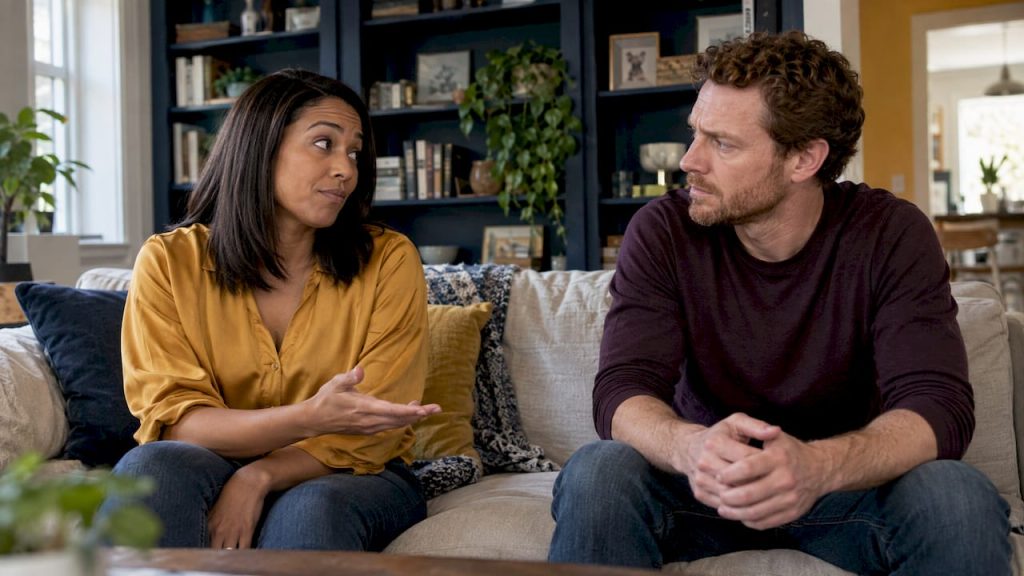
Sarcasm in marriage is a way of saying one thing and meaning the opposite, and when it carries an edge, it tells your spouse you are annoyed, hurt or disappointed without ever saying so. Playful, affectionate teasing can be fine. But sarcasm that mocks, belittles or scores points is a form of contempt, and contempt wears down the safety a marriage depends on. The fix is not to become humorless. It is to say the real thing underneath the joke, plainly and kindly, and to build a few habits that make that easier. If you want a structured way to do it together, our communication and conflict courses were built by licensed mental health professionals for exactly this.
TL;DR
- Sarcasm works by saying the opposite of what you mean, so your spouse has to decode your tone, and the hurt often lands before the humor does.
- Researchers who study conflict describe mean-spirited sarcasm, mockery and eye-rolling as contempt, one of the ‘four horsemen’ of relationship breakdown.
- Underneath a sarcastic remark there is usually an unspoken need: to be noticed, appreciated, reassured or helped.
- Replace the jab with a short, specific ‘I’ statement, and set clear boundaries for how you both talk during arguments.
- If your spouse is the sarcastic one, name the effect, make one clear request, and agree on a repair after a cutting remark.
Table of Contents
- What sarcasm in marriage looks and sounds like
- Why spouses use sarcasm: the need under the joke
- When sarcasm becomes contempt
- How sarcasm affects trust and closeness
- How to stop being sarcastic, step by step
- When your spouse is the sarcastic one
- Keeping humor without the sting
- Tools for couples ready to change the pattern
- FAQ
- Sources
What sarcasm in marriage looks and sounds like
A sarcastic statement uses words that are the opposite of what the speaker means. According to the University of Pennsylvania’s Center for the Study of Communication, the speaker signals this with vocal emphasis and facial gestures such as a smirk, a head shake or an eye roll. The listener is supposed to read the signals and understand the real message.
In a marriage, that decoding job is where things go wrong. You are tired, your spouse is tired, and the signals are easy to miss or to read as an attack. The same page concludes that sarcasm becomes inefficient when the listener ends up with ill will or misreads the intent. Direct comments, even ones that hurt feelings, leave far less guesswork about what the speaker means.
Here is what it often sounds like at home:
- You come home and the dishes are in the sink. “Wow, you really outdid yourself today.”
- Your spouse mentions a promotion at work. “Well, aren’t you special.”
- You are late again. “Right on time, as always.”
- A disagreement about money. “Sure, because you’re the expert on everything.”
The University of Florida’s SMART Couples program gives a very similar example, “Oh, sure, because you’re such a genius,” and tells couples to watch for it because sarcasm and contempt have both been shown to harm relationships.
Playful or hurtful: a quick test
Not every dry joke is a problem. Shared humor is one of the good things in a marriage. A few questions help you tell the difference:
- Who is the target? Teasing aimed at a situation you both find funny (the traffic, the burnt toast) is different from a joke aimed at your spouse’s character, body, family or competence.
- Does your spouse laugh, or go quiet? A pause, a flat “fine,” or a changed subject is information.
- Does it show up during tension? Sarcasm in the middle of an argument is rarely a joke. It is a message about the argument.
- Could you say the plain version out loud? If the honest sentence is “I feel ignored,” and the sarcastic one is a way to avoid saying it, the sarcasm is doing a job that words should be doing.
- Would you say it the same way in front of people you want to impress? If not, ask why it is acceptable at home.
If you or your spouse answers badly to two or more of those, treat it as a pattern worth changing, not a personality quirk.
Why spouses use sarcasm: the need under the joke
People rarely use sarcasm because they enjoy hurting the person they love. More often, they are protecting themselves. Sarcasm lets you say something painful while keeping a way out: “I was only joking.”
Research points in the same direction. A 2026 summary in the British Psychological Society’s Research Digest covers seven studies by Levi Baker of the University of North Carolina, published in the Journal of Personality and Social Psychology. They found that people use indirect opposition, including sarcastic and passive-aggressive comments, mainly to gauge a partner’s commitment when they feel uncertain about it. They were not mostly trying to change the partner’s behavior. The strategy often backfires: it annoys the partner and pushes them further away.
That is worth sitting with. The sarcastic spouse is often asking an unspoken question: Do you still care? Do you see what I do? Am I a priority? The answer they get is a defensive, irritated partner, which makes the original worry worse.
Common needs hiding behind sarcasm include:
- Feeling unappreciated. “Thanks so much for helping” really means “I did everything and nobody noticed.”
- Feeling unheard. After asking three times, the sharp comment is what is left. If this sounds familiar, our piece on why couples feel unheard during arguments goes deeper.
- Fear of being vulnerable. Saying “I miss you” is riskier than saying “Oh, you finally remembered I exist.”
- Old habits from home. Many people grew up in families where sarcasm was how everyone talked, and they never learned another way to express frustration.
- Different communication styles. One spouse is blunt, another hints. The hinting spouse can drift into sarcasm without noticing. See why communication styles clash.
None of this excuses the remark. It does tell you where to aim the repair.
When sarcasm becomes contempt
The line between a sharp joke and something more damaging is contempt. UC Berkeley’s Greater Good in Action describes contempt as a more destructive form of criticism that involves disrespect, disgust, condescension or ridicule. It may include mean-spirited sarcasm, mockery, eye-rolling, sneering or name-calling. It also notes that contempt can grow over time as a person focuses on, and builds up, the qualities they dislike in their partner.
A peer-reviewed 2019 observational study of couples uses the same definition, listing sarcastic mocking, name-calling and eye-rolling as contempt. It describes the four horsemen (criticism, contempt, defensiveness and stonewalling) as the behaviors most destructive to relationships, especially as indicated by later divorce.
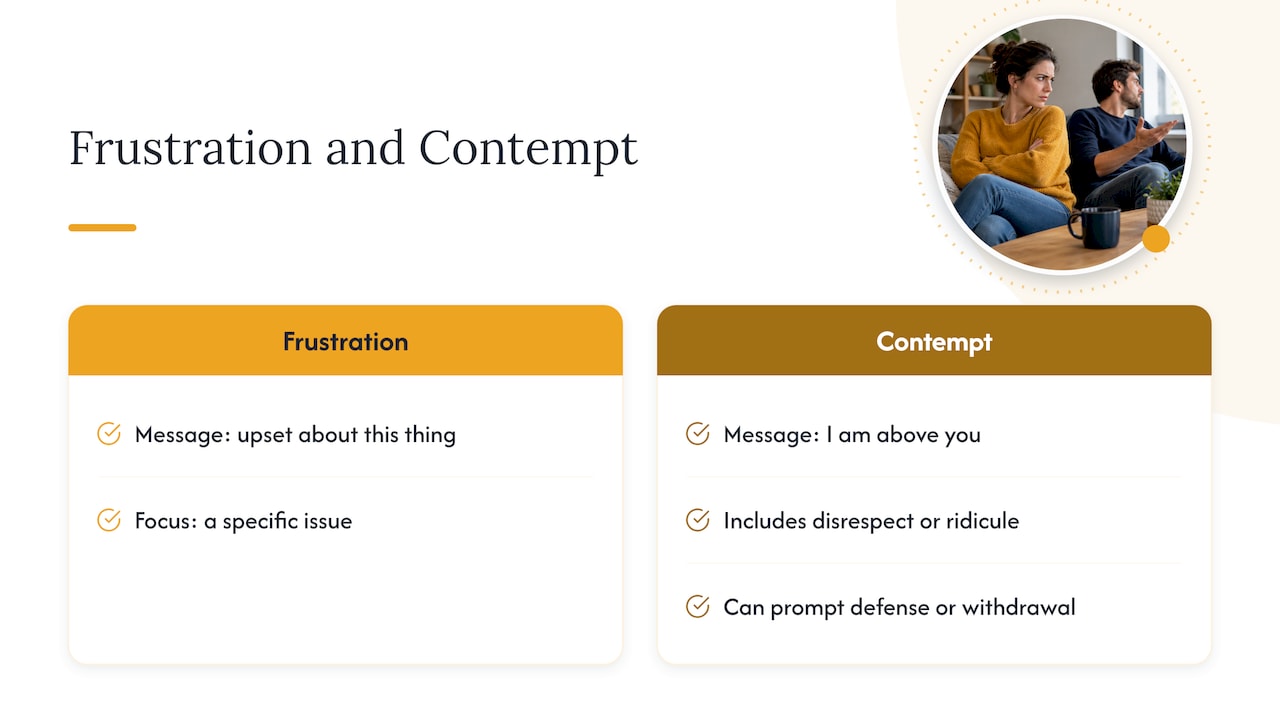
What separates ordinary sarcasm from contempt is the stance behind it. Frustration says, “I am upset about this thing.” Contempt says, “I am above you.” When your spouse can feel the second message, they stop feeling safe, and a person who does not feel safe tends to defend, withdraw or hit back.
If contempt is the pattern in your home, our guide Stop Contempt in Marriage: A Therapist’s Plan for the Next Fight walks through what to do in the moment.
Signs sarcasm has become a pattern
- You or your spouse rolls your eyes or sighs audibly during ordinary conversations.
- Compliments come wrapped in digs.
- Serious topics get answered with jokes, and the topic never gets resolved.
- One person has stopped sharing good news because of how it will be received.
- Apologies sound like “Sorry you can’t take a joke.”
- You keep a private list of your spouse’s flaws and feel a flash of disgust when they make a mistake.
If sarcasm in your home includes threats, humiliation in front of others, or you feel afraid of your spouse, that is more than a communication habit. Contact the National Domestic Violence Hotline at 1-800-799-7233 or a licensed therapist who can assess your safety.
How sarcasm affects trust and closeness
The damage rarely comes from one comment. It comes from repetition. A spouse who is regularly mocked learns to scan for the next jab. They stop offering honest opinions, stop sharing small, tender things, and start keeping their guard up around the person who is supposed to be their safest place.
What that looks like over months:
- Less honesty. If a sincere statement might get turned into a punchline, people say less.
- More defensiveness. The receiving spouse answers the tone instead of the content, so the original issue never gets addressed.
- Emotional distance. Warmth needs safety. Constant edge makes it hard to be warm back.
- Bigger arguments over small things. A comment about the laundry becomes a fight about respect.
There is a physical side too. A study summarized by the University of Florida’s SMART Couples program found that married people who used a more thinking, rational style during disagreements, with words like “realize” and “understand,” released fewer stress-related cytokine proteins afterward. The page notes these proteins can increase inflammation. How you talk in a disagreement is not only about the relationship. It affects your body as well.
How to stop being sarcastic, step by step
If you are the one who reaches for sarcasm, here is a practical routine. It works best when you do it without shame. You are replacing a habit, not confessing a crime.
1. Notice the moment before the comment
Sarcasm has a physical cue: a tightening in your chest, a flash of irritation, the sentence already forming. Learn to catch that beat. Many people find it easiest to start by noticing sarcasm after the fact (“I just did it again”) and gradually move the catch earlier.
2. Ask what you actually feel
Name the feeling and the need in one line. “I’m hurt, and I want to feel like my effort matters.” “I’m overwhelmed, and I need help tonight.” If you cannot name it, say that: “I’m irritated and I’m not sure why yet. Give me a minute.”
3. Say it directly with an ‘I’ statement
The SMART Couples page suggests swapping “you” accusations for “I” statements, with the example “I’m frustrated because I feel overwhelmed by the housework.” Compare the sarcastic version, “Nice of you to finally notice the kitchen,” with the direct one, “I’m tired and I need help with the kitchen tonight.” The second is shorter, harder to misread and much easier to say yes to. We have a full set of scripts in our I-statement examples.
4. Repair quickly when you slip
You will slip. A good repair is short and specific: “That was a sarcastic dig. What I meant was, I felt ignored. Can I try again?” Avoid “I’m sorry if you were offended.” Own the remark, not their reaction.
5. Stop keeping score
Berkeley’s suggested alternative to contempt is to stop tallying your partner’s flaws and consider their positive qualities instead. It recommends writing a list of qualities you appreciate and returning to it when you need a reminder. Do this on a calm day, not in the middle of a fight, and add to it.
6. Review after conflict
The same Berkeley page advises couples to note after a conflict whether either person used four-horsemen behaviors and what to improve next time. Five calm minutes the next day, with each of you naming one thing you did well and one thing to change, builds the habit faster than good intentions.
Where this routine gets hard is the heat of an argument, when the body is flooded and the old habit is faster than the new one. That is why we teach it as a structured system, the F.I.G.H.T. Plan®, so a couple has agreed steps to follow when emotions are high instead of improvising.
When your spouse is the sarcastic one
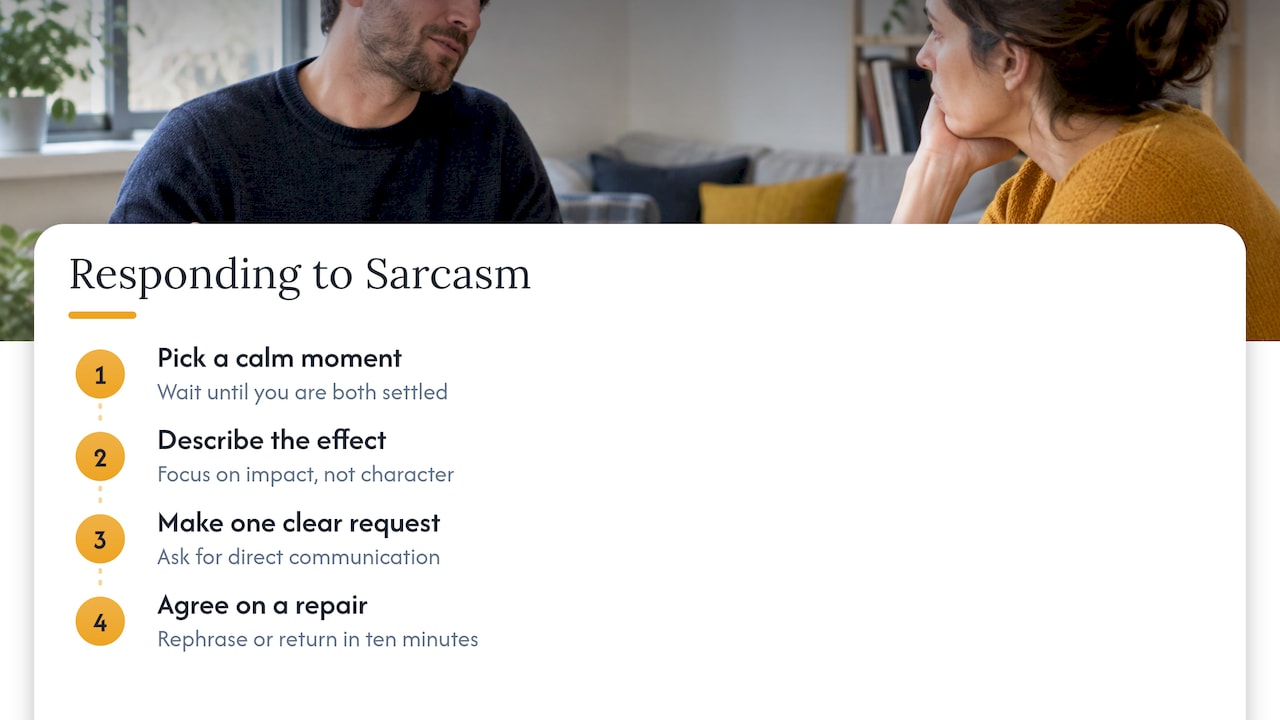
Being on the receiving end is exhausting, and it is easy to respond in kind. A calmer path has four parts.
Pick a calm moment. Do not raise it right after a jab. Wait until you are both settled.
Describe the effect, not the character. “When I hear comments like ‘great job’ after I make a mistake, I feel small and I stop wanting to talk to you” lands better than “You’re a sarcastic jerk.”
Make one clear request. “When you are frustrated with me, I’d like you to tell me directly, even if it’s blunt.” A single concrete request is easier to honor than a demand to change who they are.
Agree on a repair. Decide together what happens after a cutting remark: a quick “Let me rephrase,” or a pause and a return to the topic in ten minutes.
You can also ask what is underneath it. “It sounds like you’re upset about something. What is it?” If your spouse is using sarcasm to test whether you care, a warm, direct answer may be what the comment was reaching for.
Boundaries work best when both of you have agreed on them before a fight. Our guide to argument boundaries in marriage offers six steps to practice in advance, and communication agreements shows how to write them down together. If the two of you keep landing in the same standoff, learning to agree to disagree respectfully takes some of the pressure off.
Keeping humor without the sting
You do not need to give up laughing together. The goal is humor that draws you closer rather than pushing your spouse away. A few guidelines:
- Aim jokes at situations, not at your spouse’s worth, family or body.
- Keep sharp humor out of arguments and sensitive topics like money, parenting, intimacy and in-laws.
- If your spouse says a joke hurt, the conversation is no longer about whether it was funny.
- Build a stock of warm inside jokes, the kind only the two of you understand.
- Notice the ratio. If most of what you say to each other is edged, even in jest, add more plain appreciation.
Perspective
We have sat with a lot of couples whose arguments sound like they are about the dishes, the phone or the in-laws. Underneath, the argument is almost always about whether one of them feels respected and valued. Sarcasm is a fast way to signal “I don’t feel respected” while pretending you did not.
What we teach is that conflict is not the enemy. The way a couple fights is. The F.I.G.H.T. Plan® is a step-by-step approach we created as licensed mental health professionals, so that when emotions run high you have something to do besides scoring a point: slow down, say what is true, listen for what is under your spouse’s words, and repair.
Most couples are not short on love. They are short on tools. When couples learn to say the plain thing kindly, the sarcasm usually has nothing left to do.
Carlos
Tools for couples ready to change the pattern
Reading about sarcasm helps you see it. Changing it takes practice, ideally with a plan you can follow together. Couples Fight School was founded by licensed mental health professionals Carlos Todd and Natasha Pemberton-Todd, and our resources are designed to give couples practical communication tools, conversation scripts and guided exercises.
A few places to start:
- Stop the Fighting: The Couples Communication & Conflict Resolution Course, $149, a full course for couples who want a complete system.
- The F.I.G.H.T. Plan workbook, $14.99 to $25, and The F.I.G.H.T. Plan Conflict Toolkit, $27, for working through conflict step by step. The Christian F.I.G.H.T. Plan Workbook, $9.99 to $20, offers a faith-centered version.
- Online couples coaching, including a VIP private package of 4 sessions at $997, for couples who want guidance on their own situation.

You can see everything in the Couples Fight School shop.
FAQ
Is sarcasm always bad in a marriage?
No. Gentle, shared humor that targets situations rather than your spouse can be part of a warm marriage. It becomes a problem when it carries mockery, when it shows up during conflict, or when your spouse goes quiet or hurt afterward. Berkeley’s description of contempt specifically names mean-spirited sarcasm, not humor in general.
Why does my husband or wife use sarcasm instead of saying what is wrong?
Often it protects them from feeling vulnerable. Research summarized by the British Psychological Society found that people use sarcastic and passive-aggressive comments mainly to gauge a partner’s commitment when they feel unsure of it. The underlying message is frequently a need for attention, appreciation or reassurance.
Is sarcasm a sign of contempt?
When it is mocking or condescending, yes. Contempt is one of the four horsemen that studies of couples link to the most damage, and sarcastic mocking is part of how researchers define it. Occasional dry humor is different, but if you notice disgust or superiority behind the remark, treat it as contempt.
How do I tell my spouse their sarcasm hurts?
Choose a calm time, describe how the comments affect you, and make one clear request, such as asking them to say frustration directly. Avoid labeling them as a sarcastic person. If you feel unsafe, or the comments are part of humiliation or control, speak with a licensed therapist or contact the National Domestic Violence Hotline at 1-800-799-7233.
What can I say instead of a sarcastic comment?
Say the feeling and the need in one sentence: “I’m frustrated, and I need help with this.” The University of Florida’s SMART Couples program recommends ‘I’ statements in place of accusing ‘you’ statements. Short, specific and calm beats clever every time.
Sources
- Sarcasm in Relationships, University of Pennsylvania Center for the Study of Communication
- Why do we give people the silent treatment? BPS Research Digest
- Avoiding the “Four Horsemen” in Relationships, UC Berkeley Greater Good in Action
- The Emotional Bank Account and the Four Horsemen, PMC
- Fight Fair and Keep Your Relationship Healthy, University of Florida SMART Couples
- National Domestic Violence Hotline
Recommended
- Stop Gaslighting in Marriage: What to Do and Say
- Silent Treatment in Marriage: What It Does and How to End It
- Stop Contempt in Marriage: A Therapist’s Plan for the Next Fight
- ADHD and Marriage Conflict: Why You Fight and How to Stop