
Measure Progress, Not Dates: Affair Recovery Timeline & 30–90 Plan

Most couples who stay together after infidelity see measurable progress within 6 to 24 months, though complex or repeated betrayals often take longer. Recovery isn’t judged by a date on the calendar. It’s judged by whether contact with the affair partner has stopped, whether transparency is voluntary, and whether triggers are shrinking. Right now, the priorities are simpler: end the outside contact, create physical and emotional safety, and get support in place before anything else.
TL;DR:
- Fully ending contact with the affair partner within the first 72 hours is essential to move out of crisis mode and prevent prolonged instability.
- Consistent, voluntary accountability and the absence of new affair details over several weeks signal genuine recovery progress.
- Traumatic symptoms like intrusive thoughts require trauma-focused treatment before deeper intimacy rebuilding begins.
- The recovery process can extend beyond 24 months if multiple betrayals, trauma symptoms, or unengaged partners persist, but outcomes remain hopeful.
- Structured support, including planned transparency steps and specialized therapy, significantly improves chances of lasting healing.
Table of Contents
- The Affair Recovery Timeline: Three Phases, Not One Deadline
- What Determines How Long Recovery Takes
- Signs Recovery Is Actually Working
- A Practical Month-by-Month Plan for the First 18 Months
- What the Research Says About Treatment That Works
- A Clinician’s Note on Realistic Expectations
- Where Couples Fight School Fits Into Your Recovery
- Sources
- FAQ
The Affair Recovery Timeline: Three Phases, Not One Deadline
There’s no single, scientifically fixed clock for healing after betrayal. Clinical models describe a sequence of stages rather than a universal timeline, and the phase you’re in matters more than the number of weeks that have passed. Still, most couples move through a recognizable arc, and knowing the shape of it helps you stop panicking about normal setbacks.
Phase 1: Crisis and stabilization (first days to 3 months). This is triage. The affair partner contact needs to end, full stop, and both of you need enough safety to think straight. Couples in this window typically set up short-term transparency routines: shared location access, phone visibility, agreed check-ins. It’s not about permanent surveillance. It’s about giving the injured partner enough footing to stop feeling like the ground is moving.
Phase 2: Processing and repair (roughly 3 to 9 or 12 months). This is where disclosure happens, usually more than once, and where the real work of meaning-making starts. Why did this happen? What was missing? What does the involved partner need to understand about the damage? Injured partners in qualitative research on infidelity recovery consistently point to apology paired with visible behavior change, ongoing social support, and structured boundary negotiation as the things that actually moved them forward, not promises alone. Therapy, if it hasn’t started already, usually kicks in here.
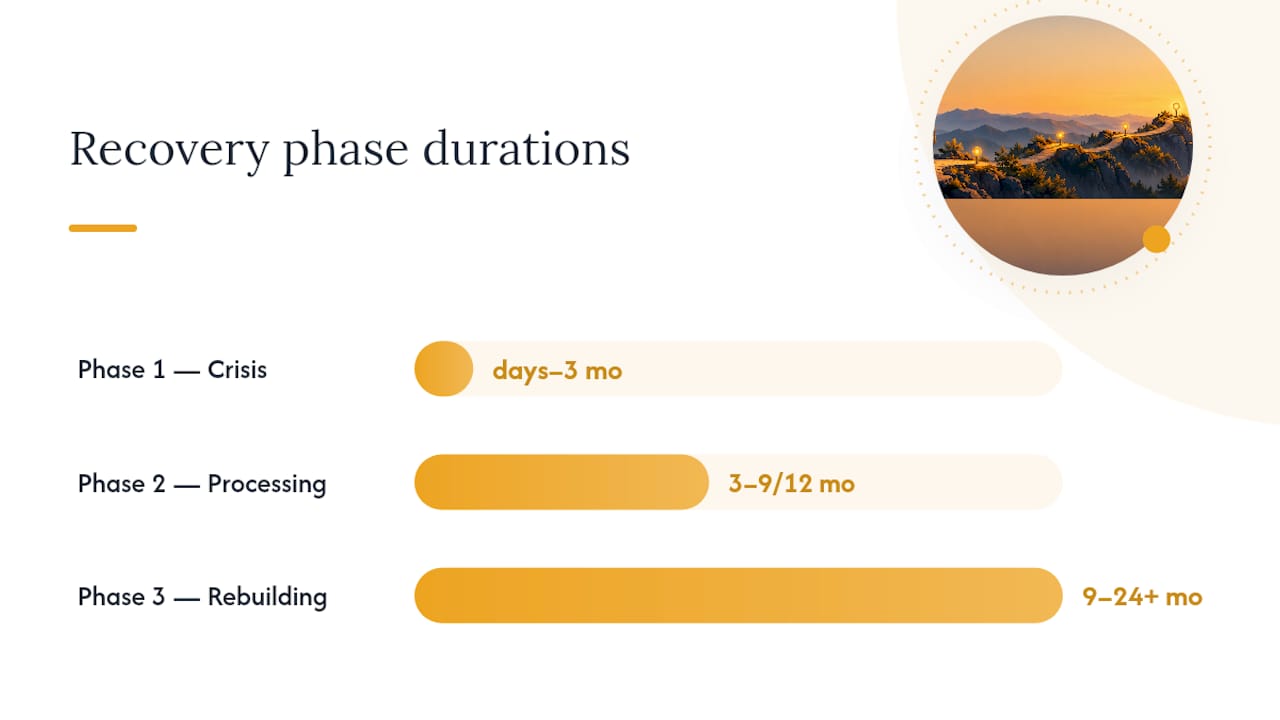
Phase 3: Rebuilding and integration (9 to 24+ months). Consistency becomes the whole game. This is when couples start testing whether the rebuilt trust holds under normal life stress, not just during scheduled therapy sessions. Intimacy work resumes, often cautiously. Somewhere in this window, most couples reach an informed, non-coerced decision about the long-term future of the relationship, rather than staying together by default or leaving in a moment of crisis.
A few things push recovery past the 24-month mark:
- Repeated affairs or a long-term secret relationship rather than a single lapse
- Trauma-like symptoms in the injured partner that need dedicated treatment before deeper repair can start
- New disclosures surfacing months after the couple thought they had the full picture
- One partner who isn’t fully engaged in the process, which stalls everything downstream
None of that means the relationship is doomed. It means the phases run longer, and that’s a difference in duration, not in outcome.
What Determines How Long Recovery Takes
Five variables do most of the work in stretching or shortening the stages of healing after infidelity.
- Severity and closeness of the affair. A brief physical lapse with a stranger tends to be processed differently than a long emotional affair with someone in the couple’s daily life. Proximity and duration both raise the degree of difficulty.
- Whether contact and disclosure are fully closed. If the affair partner is still reachable, or if new details keep surfacing months later, the injured partner never gets to exit crisis mode. Structured, therapist-facilitated disclosure tends to prevent this drip-feed effect better than an improvised conversation does.
- Trauma-like symptoms. Some injured partners develop intrusive thoughts, hypervigilance, or panic responses that mirror post-traumatic stress. When that happens, trauma-focused treatment usually needs to come before deeper intimacy work, not alongside it.
- Both partners’ readiness for honest work. Recovery runs on two tracks at once: the injured partner’s healing and the involved partner’s accountability. Skipping either one slows the whole process.
- External stressors and social reactions. Family pressure, financial strain, or a social circle that keeps relitigating the affair all add friction to an already hard process.
Pro Tip: If you notice the same argument resurfacing every few weeks with no new information, that’s usually a sign the couple has moved past the facts of the affair and into unresolved grief. That calls for a different kind of conversation, not another round of interrogation.
Signs Recovery Is Actually Working
Calendar time tells you almost nothing on its own. These five markers tell you a lot more.
- Outside contact has genuinely ended, and no new details about the affair have surfaced in recent weeks.
- Accountability has become voluntary. The involved partner shares information without being asked, rather than only answering direct questions.
- Triggers are less frequent and less intense. A song, a text notification, or a location doesn’t derail the whole evening the way it once did.
- Crisis days are becoming rare. Weeks pass with ordinary friction instead of full emotional shutdowns.
- Boundaries hold over time. Agreed-upon transparency steps get kept for weeks and months, not just in the first raw stretch after discovery.
Short-term reassurance, like sharing a location or checking in constantly, is a useful safety tool early on. It’s not a long-term substitute for consistent behavior, which is the real signal trust is rebuilding.
A Practical Month-by-Month Plan for the First 18 Months
First 48 to 72 hours. End contact with the affair partner immediately, not eventually. Limit who knows the details for now, since a wide audience can complicate later decisions. Set two or three basic transparency rules you can both actually follow, and prioritize sleep, food, and physical safety over any big conversation.
Weeks 2 through 12. Start therapy, whether that’s individual support, couple’s work, or both. Many couples build a 30 to 90 day behavior-first transparency plan here, with concrete, checkable actions instead of vague promises. Schedule short structured check-ins rather than letting conversations happen only when emotions spike, and handle any new disclosures in a planned setting instead of an ambush.
Months 3 through 9. This is deeper meaning-making: understanding what led to the affair, processing grief over the relationship you thought you had, and practicing emotion-regulation skills so hard conversations don’t spiral. Couples usually start rebuilding small daily rituals, like the check-in call or the Sunday walk, and start sketching a relapse-prevention plan for the specific vulnerabilities that led here.
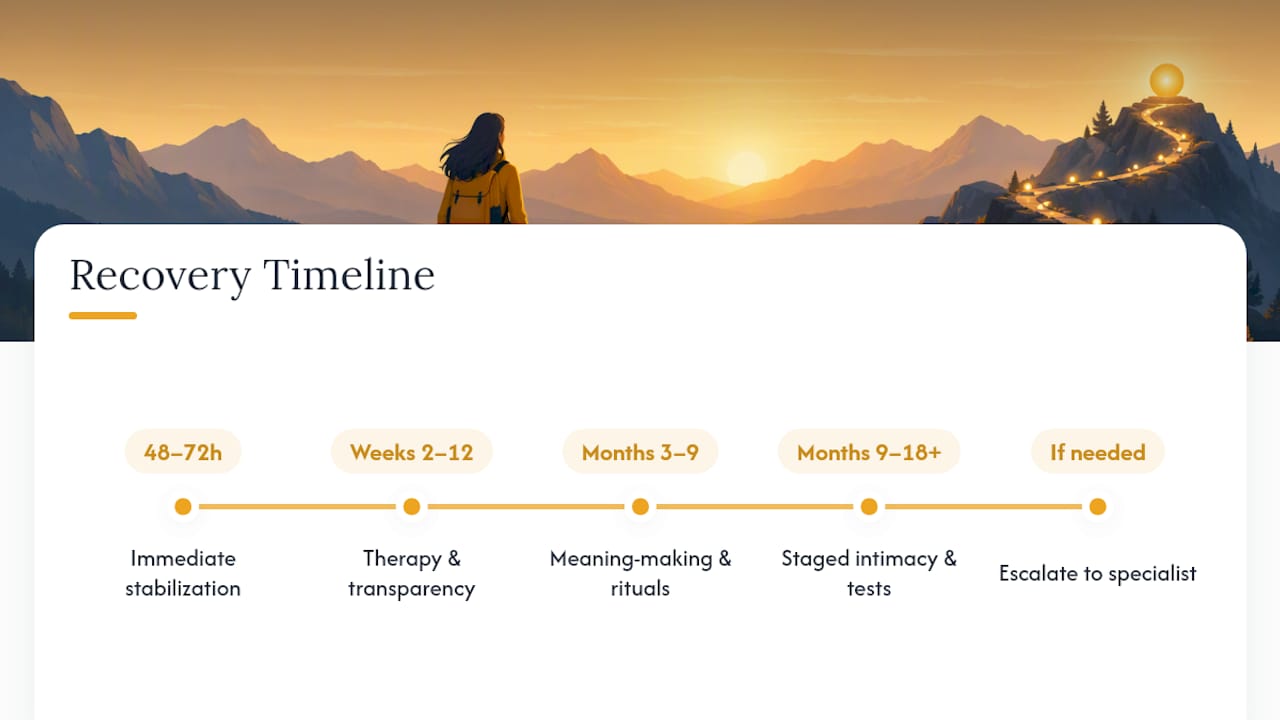
Months 9 through 18 and beyond. Intimacy work resumes in stages rather than all at once. Long-term agreements around transparency, finances, or friendships get renegotiated based on what’s actually worked, not what felt necessary in month one. Couples test stability by reintroducing normal independence, like solo travel or nights out, and use how that goes as real data. Eventually, most reach a clear-eyed decision about staying together.
When to escalate care. If trauma symptoms persist, if secrecy keeps resurfacing, or if accountability never becomes voluntary after months of work, it’s time for a licensed therapist specializing in betrayal rather than continuing to self-manage.
Pro Tip: Write your transparency plan down and put a review date on it. Plans that stay informal tend to drift, and drift is what reopens old wounds.
What the Research Says About Treatment That Works
Psychologists commonly frame affair treatment as atone, attune, and attach: responsibility first, then addressing the relationship problems that contributed to the breakdown, then rebuilding genuine connection. Trying to skip to reconnection before accountability and safety are established is one of the most common reasons couples stall out.
Structured couple interventions built on Gottman-method work have shown measurable improvements in interaction and relationship functioning across multi-month follow-ups, which supports treating recovery as a multi-month process rather than something resolved in a handful of sessions.
- Trauma-focused treatment first, if PTSD-like symptoms are present
- A 30 to 90 day behavior-first transparency plan for early stabilization
- Emotion-regulation exercises for both partners
- Specialist referral or intensive coaching when standard weekly sessions aren’t gaining traction
A Clinician’s Note on Realistic Expectations
Couples put enormous pressure on themselves to “get over it” faster than the healing process allows. Stabilization and measurable behavior change matter more than forced forgiveness on someone else’s timeline. A 30 to 90 day plan works because it gives early structure without demanding emotional resolution before the couple is ready for it. If trauma symptoms or repeated secrecy show up, get a qualified therapist involved. That’s not a failure. It’s the plan working as intended.
— Carlos
Where Couples Fight School Fits Into Your Recovery
Different stages call for different tools, and guessing your way through each one wastes time you don’t have to lose. For early stabilization, the 30 to 90 day behavior-first transparency plan gives you concrete steps instead of vague reassurance. For the processing phase, the R.E.S.T.O.R.E Workbook: Healing After an Affair walks both partners through meaning-making and boundary work at your own pace, and it’s available now in the Couples Fight School shop for $9.99 to $20.00.

If you need more than a workbook can offer, Online Couples Coaching connects you directly with structured, therapist-informed guidance, and the VIP Private Coaching Session – 4 Sessions runs $997.00 for couples who want focused, guided sessions rather than open-ended weekly therapy. Couples who want to compress months of processing into a shorter window often choose the 6 Hours Couples Intensive at $1,995.00, built for concentrated repair work rather than a long-term weekly commitment. Start where your stage actually calls for, not where you wish you already were. Book a coaching session or pick up the R.E.S.T.O.R.E Workbook today to put structure around what comes next.
Sources
- How psychologists help patients heal from infidelity (APA Monitor)
- An integrative intervention for promoting recovery from extramarital affairs (Gordon, Baucom, Snyder)
- Staying together after infidelity: injured partner perspectives (PMC qualitative study)
- Validating the effectiveness of a Gottman-method couples therapy intervention (Trust Revival Method trial)
FAQ
What are the stages of affair recovery?
Most clinical models describe three broad stages: crisis and stabilization, processing and meaning-making, and rebuilding and integration. Psychologists often frame the therapeutic sequence within these stages as atone, attune, and attach, moving from accountability to relationship repair to renewed connection.
How long does it typically take to recover from an affair?
Meaningful progress usually shows up within 6 to 24 months, though this varies widely based on the affair’s severity, whether contact and disclosures have fully stopped, and both partners’ engagement in the process. Recovery is better measured by consistent behavior change than by a fixed date, since clinical stage models treat the timeline as a framework, not a deadline.
What is a realistic timeline for a couple to end contact with an affair partner?
Ending contact should happen immediately, within the first 48 to 72 hours after discovery, not gradually over weeks. Delayed or partial no-contact is one of the most common reasons couples stay stuck in the crisis phase far longer than necessary.
What does progress actually look like after an affair?
Real progress means contact with the affair partner has ended, accountability has become voluntary rather than forced, and emotional triggers are becoming less frequent and less intense. It also means the couple can discuss agreements and boundaries without one partner feeling coerced, and that those agreements hold over weeks and months.
Can Couples Fight School help with early-stage affair recovery?
Yes. The 30 to 90 day behavior-first transparency plan is designed specifically for the crisis and stabilization phase, giving couples concrete steps instead of vague reassurance. Pricing for courses and workbooks, including the R.E.S.T.O.R.E Workbook, is listed on the Couples Fight School shop.
Recommended
- Therapy Backed Behavior First Steps to Repair an Emotional Affair
- Boundaries After Betrayal: Therapist Tools and a 30–90 Day Plan
- 30 Day Stabilization for Survivors: Betrayal Trauma Symptoms and Steps