
Criticism vs Complaint: 4 Rewrite Scripts Couples Can Use Tonight

Criticism attacks who your partner is; a complaint describes what they did. Criticism sounds like “you’re so lazy,” while a complaint sounds like “I felt frustrated when the dishes sat there all night.” The fix starts with a pause: name what you feel, describe the specific behavior, and ask for what you want instead of aiming at your partner’s character.
TL;DR:
- Criticism projects global labels about a partner’s character, often using absolutes, while complaints focus on specific behaviors with a clear incident.
- Rephrasing criticism into a complaint involves expressing feelings, describing behavior, and making a concrete request to foster constructive dialogue.
- Repeated criticism can damage self-esteem over time and predict relationship instability, whereas complaints with actionable behavior rarely cause long-term harm.
- Timing and tone significantly influence how a message is received; addressing issues promptly and softly enhances understanding and reduces defensiveness.
- Practicing structured rewrites and seeking external coaching can help couples shift from criticism to complaint, improving relationship satisfaction.
Table of Contents
- The real difference between criticism and complaint
- Why criticism quietly damages a relationship
- Paired examples: criticism versus the complaint that works better
- How to turn a criticism into a workable complaint
- Small exercises to practice this week
- How Couples Fight School approaches this skill
- What chronic criticism does to a person over time
- Cultural differences in how criticism and complaint get expressed
- How to receive criticism and complaints without shutting down
- Why timing changes how criticism and complaints are heard
- Misconceptions that keep couples stuck in criticism
- Progress here is not a straight line
- Faster ways to learn this with Couples Fight School
- Sources
- FAQ
The real difference between criticism and complaint
Criticism is person focused. It labels who someone is, usually with a global judgment that leaves no room to fix anything. A complaint is behavior focused. It names a specific action, at a specific time, and leaves space for change.
The words themselves give it away. Criticism tends to lean on absolutes: “always,” “never,” “you always do this.” It often drags in a history of past grievances rather than sticking to one moment. A complaint stays narrow. It names one incident, uses “I” statements, and closes with a request rather than a verdict.
Purdue Extension’s guidance on complaining draws this line clearly: criticism attacks character, complaints address behavior, and the second version is far more likely to get heard.
- Criticism uses global labels: “you’re irresponsible,” “you never think about me.”
- Complaints name a specific moment: “you forgot to call last night.”
- Criticism recycles old grievances; complaints stay contained to one issue.
- Complaints end with a concrete request; criticism usually just ends with blame.
Why criticism quietly damages a relationship
Criticism is not a personality quirk. John Gottman named it one of the Four Horsemen precisely because it predicts relationship unhappiness and instability over time. Left unchecked, it tends to trigger defensiveness in the listener, and that pattern can escalate toward contempt and eventual stonewalling, the later horsemen that are harder to walk back.
A meta-analysis of 64 studies covering 5,071 couples found that hostility carries a medium-strength, robust association with lower relationship satisfaction. (source) That is not a minor correlation buried in noise. It shows up consistently across the body of relationship research the analysis reviewed.
There is also a physical piece to this. When someone feels attacked at the level of character, the body can shift into a stress response, sometimes called flooding, where it becomes hard to think clearly or listen at all. In that state, problem-solving basically shuts down, which is one reason arguments that start as criticism rarely end in resolution.
Paired examples: criticism versus the complaint that works better
Seeing the two side by side makes the pattern easy to spot in your own conversations. Each pair below shows the criticism first, then a workable complaint rewrite.
- Chores: “You never clean up after yourself” becomes “I felt overwhelmed seeing the counter still messy after dinner. Can we split cleanup tonight?”
- Parenting: “You’re too soft on the kids, you never back me up” becomes “When Max ignored bedtime and you didn’t step in, I felt alone handling it. Can we agree on a signal for backup?”
- Time together: “You always choose your phone over me” becomes “I missed talking tonight since we were both on our phones. Can we set aside twenty minutes screen free?”
- Money: “You’re so careless with money” becomes “I felt anxious when I saw the credit card charge without a heads up. Can we check in before purchases over a set amount?”
The rewrites share a shape: a feeling, a specific behavior, and a request. That structure is what separates a complaint that gets heard from a criticism that gets a defensive wall.
How to turn a criticism into a workable complaint
Rephrasing on the spot takes practice, but the sequence is short enough to remember mid-argument.
- Pause before speaking, especially if you notice your voice sharpening or your jaw tightening.
- Name the feeling first: frustrated, hurt, worried, tired.
- State the behavior in specific, observable terms tied to a moment, not a pattern.
- Make a request instead of a demand or an accusation.
- Confirm understanding by asking your partner to reflect back what they heard.
A few scripts to borrow directly. For chores: “I felt tired seeing the laundry still on the floor. Could we do a quick evening reset together?” For forgotten plans: “I felt disappointed when the reservation slipped. Can we set a shared reminder next time?” For parenting friction: “I felt unsupported during bedtime tonight. Can we talk about backing each other up in the moment?”
Keep tone level, pick a calm moment rather than mid-chore or right before bed, and avoid opening with “you” as the very first word, since that framing tends to sound like an attack before the sentence even finishes.
Pro Tip: Write your complaint down before saying it out loud once this week. Seeing “I felt… when… could we…” on paper makes the pattern stick faster than trying to remember it live.
For a deeper walk through de-escalation in the heat of the moment, these tactics for diffusing conflict cover what to do once flooding has already started.
Small exercises to practice this week
Skills fade without repetition, so build the rewrite into something small and repeatable rather than a one-time lesson.
- Daily rewrite drill: each evening, take one critical line you thought or said that day and rewrite it as a complaint using the feeling, behavior, request structure.
- Timed complaint conversation: each partner gets five uninterrupted minutes to raise a single complaint while the other only listens, then switches.
- Weekly reflection prompt: journal one sentence on where criticism crept back in and what triggered it, tracking the pattern over a few weeks.
These map closely to the therapist-backed exercises couples can try tonight, which walk through similar structured practice in more detail.
How Couples Fight School approaches this skill
Couples Fight School built its F.I.G.H.T. Plan® around exactly this shift, moving couples from criticism and defensiveness toward specific, actionable communication. Within it, the Six Step Method gives couples a repeatable sequence for raising an issue without it turning into an attack, including how to validate a partner’s feelings without agreeing to everything they say.
Couples who want a self-paced way to absorb this typically start with a workbook or video course, working through scripts at their own speed. Couples who want faster traction, or who keep sliding back into old patterns despite trying scripts on their own, tend to benefit more from live coaching, where a session can catch the specific moment a complaint tips into criticism. Either path aims at the same outcome: less defensiveness, clearer requests, and arguments that actually resolve something.
What chronic criticism does to a person over time
An occasional complaint, handled well, tends to resolve and fade. Chronic criticism does not work that way. Because it targets identity rather than a single action, repeated exposure can wear down a person’s sense of being valued or capable, especially when the same character label gets repeated across months or years.
This is part of why Gottman’s research treats criticism as a structural risk factor rather than a passing annoyance: it is linked to instability in the relationship itself, not just to a bad night. A single complaint about a forgotten errand rarely leaves a mark. A running narrative of “you’re always careless” or “you never think about anyone but yourself” can shape how someone sees themselves, independent of whether the relationship survives it.
The contrast matters practically, not just theoretically. A complaint, even a pointed one, leaves the listener’s sense of self intact because it is about an action they can change. Chronic criticism removes that option, since there is no specific behavior to fix when the message is about who you fundamentally are. That is often why people on the receiving end of long-term criticism describe feeling stuck rather than motivated. The well-being cost is not the disagreement itself. It is the accumulation of feeling defined by your worst moments instead of your actions.
Cultural differences in how criticism and complaint get expressed
What counts as a blunt complaint in one household can land as sharp criticism in another, and the difference is not always about wording. Some families and cultural backgrounds treat direct, plainly stated feedback as normal and even respectful, a sign that an issue is being taken seriously rather than avoided. Others treat the same directness as harsh, favoring indirect hints, third-party mediation, or long buildup before naming a problem outright.
Neither approach is inherently healthier on its own. The risk shows up when partners come from different communication norms and each reads the other through their own lens: the direct partner reads the indirect partner as evasive, and the indirect partner reads the direct partner as needlessly harsh. What one person intends as a plain complaint can be received as an attack simply because the delivery style is unfamiliar.
The practical fix is not to force one style onto the relationship. It is to name the norm explicitly. A couple can agree, for instance, that direct language about a specific behavior is welcome even if it feels blunt, or that a partner who needs more softening at the start of a hard conversation is not being fragile, just wired differently. That conversation about communication style, held outside the heat of an actual disagreement, does more to prevent misread criticism than any script alone.

How to receive criticism and complaints without shutting down
The way a message lands depends as much on the listener as the speaker. When a partner raises a complaint, even an imperfectly worded one, the first move is to resist the urge to correct their delivery before hearing the content. Listening for the underlying need, rather than grading the grammar of the complaint, keeps the conversation from turning into an argument about how the argument was phrased.
A useful habit is to reflect back what was heard before responding: “so you’re saying the plan change last minute left you scrambling.” That single step slows the exchange enough to prevent an immediate defensive reaction, and it also confirms whether the message was actually understood correctly.
When something genuinely lands as criticism rather than a complaint, it helps to name that gently rather than escalate: “I want to hear this, but it would help if we focused on this one thing rather than the pattern.” That keeps the door open instead of shutting the conversation down. Responding well does not mean absorbing every accusation without pushback. It means separating the valid concern buried inside a poorly worded complaint from the sting of how it was delivered, and addressing the concern first.
Why timing changes how criticism and complaints are heard
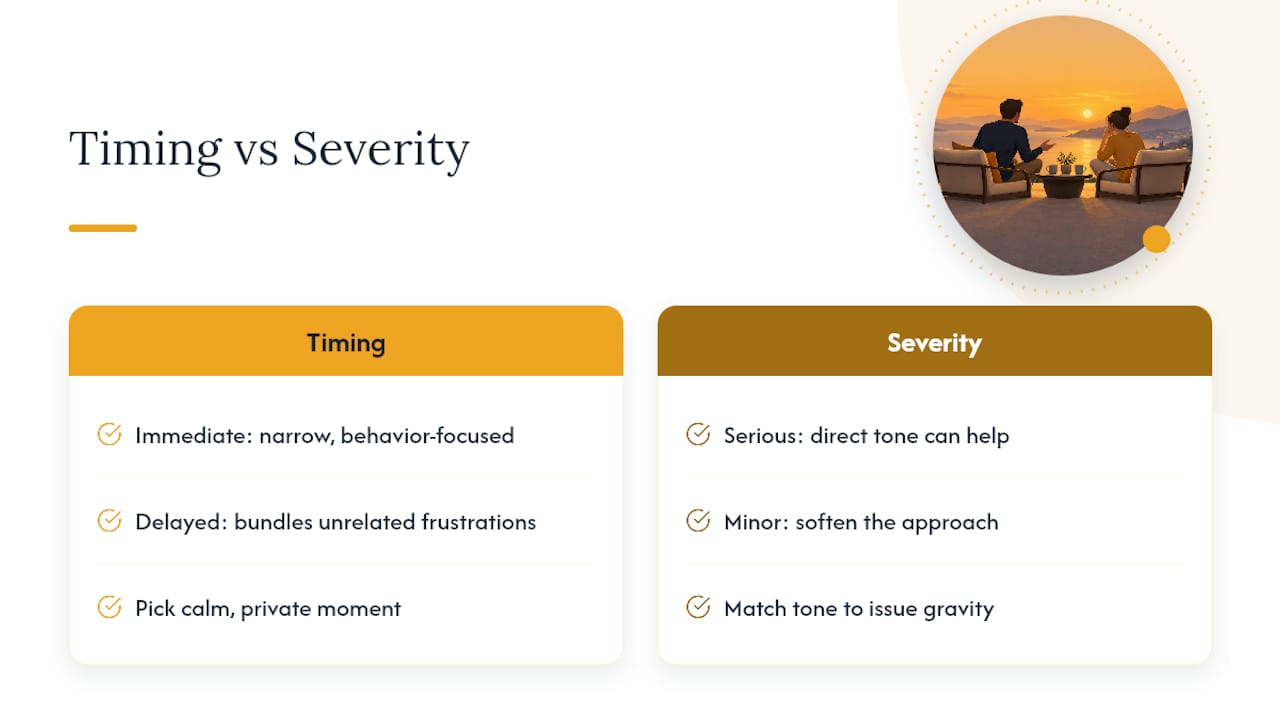
The same words land differently depending on when they are said. A complaint raised the moment someone walks in from a long day, mid-chore, or right before falling asleep is far more likely to be heard as an attack, regardless of how carefully it was worded. Context primes people to be defensive before the content even registers.
Timing works both ways. Bringing up a specific complaint quickly after the moment it happened, while the details are fresh, tends to keep the conversation narrow and behavior focused. Waiting weeks to mention it often means the complaint arrives bundled with unrelated frustrations, which starts to resemble the global pattern language of criticism even if that was never the intent.
Severity also shapes how directness should be handled. Longitudinal research on newlywed couples found that direct, even blunt, problem-solving communication can help when the underlying issue is serious, but the same directness tends to hurt satisfaction when the issue is minor. In other words, save the plain, no-frills complaint for things that matter, and use a softer approach for smaller irritations, since indirect negative communication about small things still predicted lower satisfaction in that research. Picking a calm, private moment, and matching the tone to how serious the issue actually is, does more work than the wording of the complaint itself.
Misconceptions that keep couples stuck in criticism
A few beliefs quietly keep people repeating criticism instead of learning the complaint version. The first is that skipping complaints entirely is safer than raising them; in practice, unspoken frustration tends to resurface later as criticism, since it has had time to generalize into a pattern rather than stay tied to one moment.
The second misconception is that softening a complaint means giving up honesty. A well-built complaint, feeling plus specific behavior plus request, is not a watered-down version of the truth. It is often more precise than criticism, since it names exactly what happened instead of a vague character flaw.
A third misconception treats complaining itself as the problem, when the research distinction is about how a concern is framed, not whether one is raised at all. Avoiding complaints does not protect a relationship. Letting them curdle into global criticism does the damage.
Finally, many people assume a partner who criticizes is simply attacking on purpose. Often what looks like an attack is a poorly phrased version of a real, vulnerable need: fear of being unimportant, or feeling overwhelmed and unheard. Recognizing that underneath the sharp words does not excuse the delivery, but it does explain why “I felt” almost always works better than “you always.”
Progress here is not a straight line
Most couples relapse into old criticism patterns under stress, fatigue, or after a bad week, not because the skill did not stick but because tired brains default to shortcuts. That is normal, not failure. Small, repeated wins matter more than a perfect track record, and a pattern that keeps returning despite real effort is a reasonable signal to bring in outside support rather than push harder alone. One couple who practiced the daily rewrite drill for a few weeks reported catching themselves mid-sentence far more often, swapping “you never” for “I felt,” even on hard nights.
— Carlos
Faster ways to learn this with Couples Fight School
Scripts on a page can only take a couple so far when old patterns are deeply grooved. Couples Fight School built its materials specifically around this shift from criticism to complaint, so the practice comes with structure instead of guesswork.

- The Stop the Fighting: The Couples Communication & Conflict Resolution Course suits couples who want a guided, self-paced walkthrough of exactly these rewrite skills.
- The F.I.G.H.T. Plan workbooks fit couples who prefer working through prompts on paper at their own pace before a conversation.
- A VIP Private Coaching Session or the 6 Hours Couples Intensive fits couples who have tried scripts on their own and keep sliding back into criticism under stress.
Many people notice a shift, catching a criticism before it lands, within a few weeks of consistent practice. Browse the full course and workbook lineup or book a coaching session to start with guided support instead of trial and error.
Sources
- Meta-analytic evidence and relationship science (Gottman-related summary)
- The Art of Complaining: Getting Your Concerns Across Without Criticizing (Purdue Extension CFS-746-W)
- A two-dimensional approach to relationship conflict: Meta-analytic findings.
FAQ
What are the four types of criticism?
Definitions vary across sources, but Gottman’s framework identifies criticism as one of four broader negative patterns, alongside defensiveness, contempt, and stonewalling, known together as the Four Horsemen. Within criticism itself, common forms include global character attacks, “always/never” statements, blame framed as identity, and recycled past grievances.
What is the Gottman difference between criticism and complaint?
Gottman’s research treats criticism as an attack on a partner’s character, while a complaint addresses a specific behavior or event. The Four Horsemen research frames criticism, not complaint, as the pattern that predicts relationship instability.
What are the four types of complaints?
There is no single standardized four-part model for complaints across the sources here. In practical terms, complaints commonly show up around behavior, unmet needs, timing or reliability, and communication style, each addressed by naming a specific incident rather than a character trait.
Is complaining a form of criticism?
No. Purdue Extension’s guidance treats them as distinct: complaints target specific behavior and stay open to change, while criticism targets character and tends to shut conversation down. A complaint only starts to resemble criticism when it broadens into global labels or drags in unrelated past grievances.
Recommended
- Six Therapist Backed Communication Exercises Couples Can Do Tonight
- Four Part Conflict Conversation Starters for Couples That Stop Fights
- Memorized Scripts for Four Horsemen Antidotes That Stop Fights Tonight
- Stop Arguing With Your Husband in 10 Minutes Using Therapist Scripts