
Argument Boundaries in Marriage: 6 Steps to Practice Before a Fight

Agree on one boundary rule before your next disagreement, then practice it out loud together this week. That single step, a mutual rule paired with real enforcement, is the foundation researchers and clinicians point to for calmer arguments, and it is the starting point we teach through the F.I.G.H.T. Plan.
TL;DR:
- Boundaries should define your own response, such as stepping away when voices rise, rather than dictate your partner’s feelings or behavior.
- Agree on a pause signal while calm, rehearse it aloud, then take about 20 minutes for quiet breathing when either person becomes overwhelmed.
- Use brief impact statements instead of accusations, keep one concern to each conversation, and reconnect by naming when you will return to the discussion.
- A weekly check in lasting five minutes can reveal whether a rule needs adjustment; state consequences calmly and follow through whenever someone crosses it.
- Physical threats, phone monitoring, isolation, weapons during arguments, or sexual coercion call for safety planning with trained advocates, not negotiation over ordinary argument rules.
Table of Contents
- What healthy argument boundaries look like
- Step-by-step: agree, practice, and use boundaries before, during, and after arguments
- Scripts and phrases that reduce defensiveness during arguments
- When a boundary issue is actually a safety issue
- How the F.I.G.H.T. Plan supports boundary practice
- Balancing your own limits with staying emotionally connected
- Techniques for stating a limit without raising the temperature
- When past hurt shapes how you set boundaries today
- A clinician’s note on committing to boundaries
- Practical next step: courses and coaching to help you practice argument boundaries
- FAQ
- Sources
What healthy argument boundaries look like
A boundary is a limit on your own behavior and response, not a leash you put on your partner. It protects safety and closeness at the same time, which is the opposite of control or stonewalling. When you say “I need us to lower our voices,” you are describing what you will do (stay calm, step away if needed), not dictating what your partner must feel.
Healthy couples draw boundaries in a few recurring categories:
- Conversational boundaries: no interrupting, no name-calling, one topic at a time.
- Emotional safety boundaries: no threats, no silent treatment used as punishment, no bringing up past mistakes as weapons.
- Physical boundaries: no blocking doorways, no throwing objects, physical space when someone asks for it.
- Time and space boundaries: agreed hours for hard conversations, a cooling-off window when things heat up.
- Topic limits: certain subjects (in-laws, finances, an ex) get a scheduled conversation instead of an ambush.
You likely need to set or revisit boundaries if the same fight resurfaces weekly, if arguments escalate faster than they used to, if one of you withdraws and goes quiet for days, or if stress from work or parenting keeps spilling into unrelated disagreements. Healthy boundaries act as a buffer that actually makes vulnerability safer, not a wall that keeps your partner out.
Step-by-step: agree, practice, and use boundaries before, during, and after arguments
Boundaries only work when they are rehearsed before you need them, not invented mid-fight. Here is a simple sequence to build into your relationship.
- Negotiate one or two rules while calm. Pick something specific, like “we take a break if either person raises their voice,” and agree on a shared signal word or hand gesture that means “pause.”
- Practice the pause out loud. Say the signal to each other once or twice when nothing is wrong, so it feels familiar instead of alarming the first time you need it.
- Use the signal the moment arousal spikes. A real time-out means stepping away for roughly 20 minutes of calm breathing with no phone scrolling, long enough for your body to physically reset rather than just leaving the room for show.
- Speak in impact language, not accusation. Replace “you always do this” with a statement about what happened and what you need.
- Debrief briefly after things settle. A five-minute check-in, not a replay of the whole argument, confirms what worked and what still needs adjusting.
- Reaffirm the boundary and any agreed consequence. If the rule was crossed, name it plainly and recommit, rather than letting it quietly slide.
Weekly check-ins, even five minutes over coffee, keep these rules from going stale. Role-playing a hard conversation once a month, the way you would rehearse a presentation, makes the real thing far less shaky. For more detail on performing a time-out that actually lowers tension, our guide to time-outs for couples walks through the full sequence.
Pro Tip: Practice your pause signal during a calm moment this week, not during your next fight, so your body already recognizes it as safe.
Scripts and phrases that reduce defensiveness during arguments
The words you reach for in the heat of an argument matter more than most couples realize. The findings of a meta-analysis of multiple studies covering thousands of couples found that hostility is strongly linked to lower relationship satisfaction, while neutral, impact-focused language reduces defensiveness in the moment.
A few templates worth memorizing:
- “When you raise your voice, I feel unsafe to keep talking. I need us to pause for a few minutes.”
- “When this topic comes up at night, I feel ambushed. I need us to schedule it for tomorrow.”
- “When your mom’s comments come up again, I feel caught in the middle. I need us to agree on a response together before it happens again.”
- “When texts come in after 10 p.m. about this, I feel like there’s no real end to the day. I need our phones off after that time.”
For calling a pause, a soft version sounds like “Can we take five? I want to come back to this clearheaded.” A firmer version, for when things are escalating fast, is “I’m stopping this conversation now. I’ll come back in twenty minutes.” Practicing the tone and pace of these lines out loud, slowly, matters as much as the wording itself. Our relationship boundary scripts page has thirty more examples you can adapt to your own situations, and for the specific case of late-night texting, Pingher’s guide to texting boundaries covers how to set limits that protect connection instead of creating pressure.
When a boundary issue is actually a safety issue
Some conflict patterns go beyond boundary-setting and need a different response entirely. Watch for physical threats or violence, controlling behavior like monitoring your phone or isolating you from friends, the presence of weapons during arguments, or any form of sexual coercion. These are signs to shift from negotiating rules to safety planning.
Research summarized in a scholarly overview on domestic violence found that most survivors use one or more safety strategies before seeking outside help, which means acting early matters.
If any of this applies to you:
- Document incidents with dates and details when it is safe to do so.
- Identify one or two trusted people you can contact quickly.
- Save hotline and shelter numbers somewhere your partner cannot access.
- Build a specific exit plan rather than a general intention to leave “someday.”
Safety planning is personal and context-dependent, so lean on trained advocates and hotlines rather than general relationship advice for this part.
How the F.I.G.H.T. Plan supports boundary practice
A structured plan gives structure to exactly the sequence above. Earlier steps in such frameworks focus on naming triggers and agreeing on ground rules before conflict starts, the middle steps map to in-the-moment regulation (the pause, the impact language), and the later steps cover repair and recommitment after a disagreement ends.
- Pre-argument agreements correspond to the plan’s early naming and ground-rules work.
- The pause and “I” statements map to the plan’s regulation steps.
- Debrief and reaffirming boundaries align with its healing and repair stage.
Couples who struggle with one recurring fight, the same argument about chores or in-laws resurfacing every few weeks, often find that writing the rule down and rehearsing it breaks the cycle faster than discussing it again from scratch. Our step-by-step guide to diffusing conflict and de-escalation scripts walk through these exercises in more depth.
Balancing your own limits with staying emotionally connected
A boundary that shuts your partner out entirely stops being protective and starts becoming distance. The goal is holding a limit while staying reachable, which is a harder balance than it sounds.
In practice, that means pairing your boundary statement with a bridge back to connection. “I need us to pause” works better paired with “and I do want to finish this conversation once we’re both calmer,” because it signals the break is about regulation, not rejection. Empathy during conflict does not mean abandoning your own limit. It means acknowledging your partner’s experience even while holding your ground: “I hear that this feels sudden to you, and I still need five minutes.”
Couples who treat boundaries and empathy as opposites tend to swing between two extremes, either enforcing rigid rules that feel punishing or dropping every limit to avoid seeming cold. Strategic flexibility, adjusting your approach based on the specific situation rather than forcing one fixed style, tends to serve couples better than either extreme. Some arguments call for a firm, immediate pause. Others just need a softer tone and a few extra minutes of patience before a limit is necessary at all. The skill is reading which one you are in, which gets easier with practice rather than instinct alone.
Techniques for stating a limit without raising the temperature
How you deliver a boundary often determines whether it lands as protective or provocative. A few adjustments make a real difference.
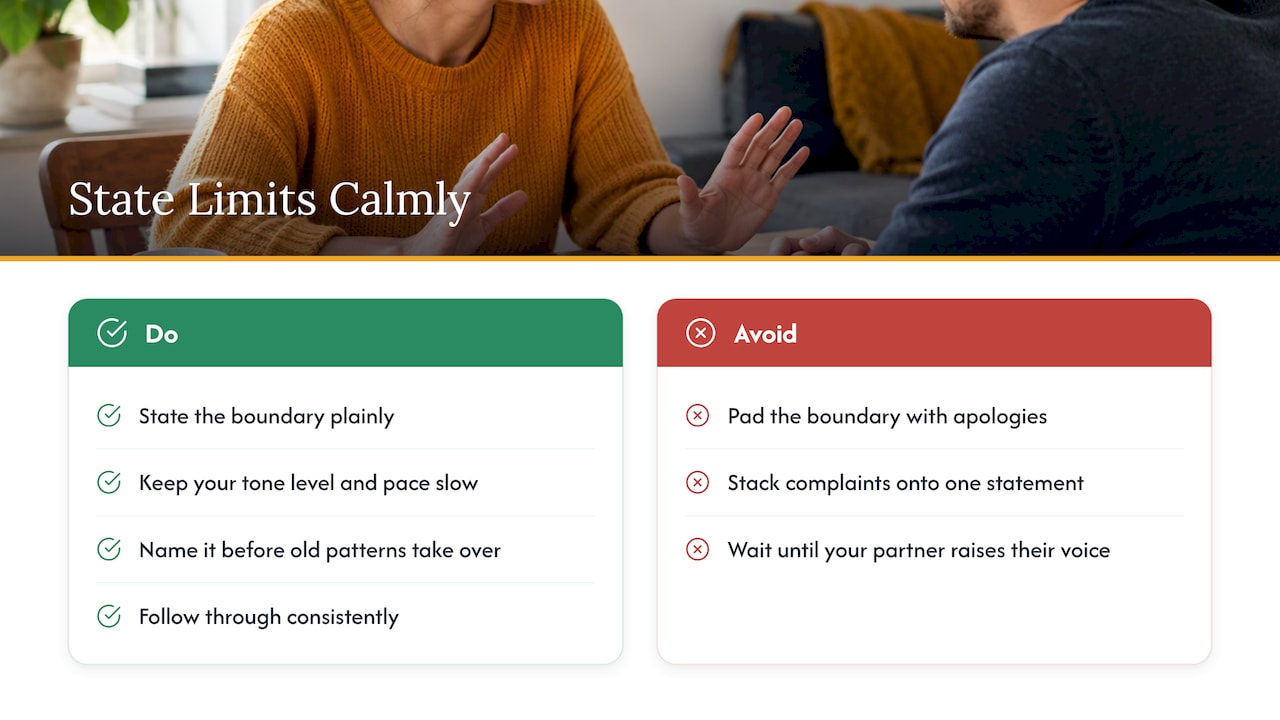
State the boundary once, plainly, without padding it in apologies or burying it in a long explanation. “I need us to stop raising our voices” is clearer and less likely to invite argument than a five-sentence justification for why you feel that way. Keep your tone level and your pace slow. A boundary delivered at the same volume as the fight itself reads as another jab rather than a limit.
Timing matters too. Naming a boundary the instant your partner raises their voice can feel like a counterattack. Naming it a beat earlier, as soon as you notice the conversation sliding toward old patterns, gives it room to land as protective rather than retaliatory.
Avoid stacking multiple complaints onto one boundary statement. “I need us to pause, and also you never listen, and also this happens every time” turns a clear limit into a fresh argument. State the boundary, hold it, and save other concerns for a separate, calmer conversation. Finally, follow through matters more than wording. A boundary you state but never enforce teaches your partner to ignore it next time, while one you consistently honor, even imperfectly, builds trust that your word means something.
When past hurt shapes how you set boundaries today
Some boundary struggles have less to do with the current argument and more to do with what either of you learned growing up or in past relationships. If raised voices in your childhood home meant real danger, a partner’s mildly frustrated tone today might trigger a response that feels disproportionate to the moment.
Recognizing this pattern is often the first useful step. Instead of asking “why is my partner overreacting,” ask “what is this response protecting against.” That shift alone softens a lot of arguments, because it reframes an intense reaction as old pain surfacing rather than present-day hostility.
Couples healing from past betrayal, an affair, or earlier high-conflict relationships often need boundaries that explicitly address rebuilding trust, not just managing disagreements. A boundary like “I need to know where you are during long work trips” is not control when it follows a breach of trust. It is a repair tool, and it can loosen over time as trust rebuilds. If a specific trigger keeps resurfacing across unrelated arguments, that is often a sign it deserves its own conversation, outside of conflict, rather than being managed reactively every time it appears.
A clinician’s note on committing to boundaries
Boundaries are an act of care, not a punishment, even when they feel uncomfortable to state out loud. You will mess up the timing, forget the signal, or raise your voice before remembering to pause, and that is normal progress, not failure. Pick one rule tonight and say it to each other before you need it.
— Carlos
Practical next step: courses and coaching to help you practice argument boundaries
Reading about boundaries is different from rehearsing them with real scripts, which is why we built resources around practice rather than theory alone. The F.I.G.H.T. Plan Couples Conflict Toolkit gives you the ground-rules exercises from this article in a structured format, while Stop the Fighting: The Couples Communication & Conflict Resolution Course walks through the full pre, during, and post sequence step by step.

If your recurring fight needs more hands-on guidance, our online coaching sessions and 6-hour couples intensive pair you directly with a clinician to practice these exact scripts. Visit our shop to find the format that fits where you are right now.
FAQ
What happens when boundaries aren’t respected?
A boundary that gets repeatedly ignored usually needs a clearer consequence stated in advance, not just a repeated reminder. Reaffirm the rule calmly, name what will happen next time it is crossed, and follow through, since enforcement is what makes a boundary real rather than a suggestion.
How do you set boundaries with an angry partner?
Wait for a calm moment rather than trying to introduce a new rule mid-argument, since boundaries negotiated under stress rarely stick. State the limit briefly, in impact language (“when voices get loud, I need us to pause”), and use a pre-agreed signal so it does not sound like a fresh accusation.
How can you protect yourself emotionally in a relationship?
Protecting yourself emotionally starts with naming what you need plainly, using “I” statements focused on impact rather than blame, which research on couple communication links to lower defensiveness. Pairing a clear limit with continued warmth, rather than withdrawal, keeps protection from turning into distance.
How do you set boundaries with a difficult person in your marriage?
Keep the boundary about your own behavior rather than trying to change theirs: “I will leave the room if voices get loud” instead of “you need to stop yelling.” Consistency matters more than firmness here, since a limit enforced sometimes and ignored other times teaches a difficult partner that it is negotiable.
When does a marital disagreement signal a safety concern instead of a boundary issue?
Warning signs include physical threats, controlling behavior, access to weapons during arguments, or sexual coercion, and any of these call for safety planning rather than conflict scripts. A scholarly review on domestic violence notes that most survivors use safety strategies well before seeking outside help, so acting on these signs early matters.
Sources
- Boundaries in relationships (Verywell Mind)
- Practical resources on domestic violence (NCBI / scholarly overview)
- Conflict management styles: pitfalls and best practices (PON)
- Good boundaries, great relationships (Psychology Today)
Recommended
- 7 Steps to Christian Marriage Boundaries: Therapist Backed, Biblical
- Manage Conflict Before Marriage Habits That Actually Work
- Couples: Identify Fight Triggers in 3–5 Logged Arguments
- Why Engaged Couples Need Conflict Skills Before Marriage