
Taking Space After an Argument: 20 Minutes and Scripts to Reconnect

Taking space after an argument helps when it is a negotiated, time-limited time-out with a clear return plan, not a disappearing act. A short pause of seconds can stop escalation in the moment, while a longer break of 20 minutes to several hours allows your body and mind to settle, as long as you commit to reconnecting, ideally within 24 hours. Space should never replace safety planning when coercion or violence is present.
TL;DR:
- Agree on a specific return time and contact rules before separating, and aim to reconnect within 24 hours to limit uncertainty and resentment.
- Use the break to calm your body with breathing or a walk, name what you feel and need, and avoid rehearsing rebuttals.
- The caller should ask whether their partner is ready, then keep the reconnection focused on one solvable issue for 20 to 30 minutes.
- Do not use a pause as a substitute for safety planning when coercion, intimidation, or violence is present; seek specialist domestic violence support.
Table of Contents
- What a negotiated time-out is and why it works
- How long should you take space? Practical timing guidance
- How to ask for space: ready-to-use scripts and templates
- What to do during the break: regulating and preparing to reconnect
- How to reconnect after the break: who reaches out and what to say
- When not to use space: safety, abuse, and misuse of time-outs
- Why rehearsed scripts make negotiated time-outs reliable
- Learn the skills: structured support from Couples Fight School
- FAQ
- Sources
What a negotiated time-out is and why it works
A negotiated time-out is an intentional interruption of an argument paired with a commitment to come back and finish the conversation. It is not walking away and hoping the issue fades. The agreement itself, knowing when and how you will reconnect, is what separates a time-out from avoidance.
The mechanism is physiological as much as psychological. When emotions run hot, the body shifts into a state that makes calm, rational exchange nearly impossible. Negotiated time-outs work by giving both partners room to calm down before returning to problem-solving, according to relationship extension guidance from Utah State University.
There are two distinct uses worth separating. One is immediate de-escalation, stopping a conversation before it spirals in the next few seconds. The other is a longer cooling period meant for reflection, where you process what happened and think through what you actually want to say. Clinical guidance on time-outs frames the technique as something couples train for: recognizing escalation cues, building a specific plan, and returning with new skills rather than just calmer nerves. Confusing the two uses is a common reason time-outs fail. A five-second pause will not resolve a complicated disagreement about finances, and a three-hour break is overkill for a comment that just needs a beat to land differently.
How long should you take space? Practical timing guidance
The right length depends on what you are trying to accomplish. For a comment that is about to detonate, a pause of just five to fifteen seconds can interrupt the reflex to snap back, according to a University of St Andrews lab study that found brief forced breaks reduced aggression in an escalating conflict game involving 81 couples.
For arguments that have already gotten heated, you need more than a few seconds. A break of 20 to 30 minutes gives your nervous system time to come down from a state of high arousal. Some disagreements call for longer: several hours, or occasionally a full day. Negotiated time-out guidance generally recommends a minimum cooling period and suggests returning within 24 hours whenever possible, since longer gaps tend to let resentment harden instead of ease.
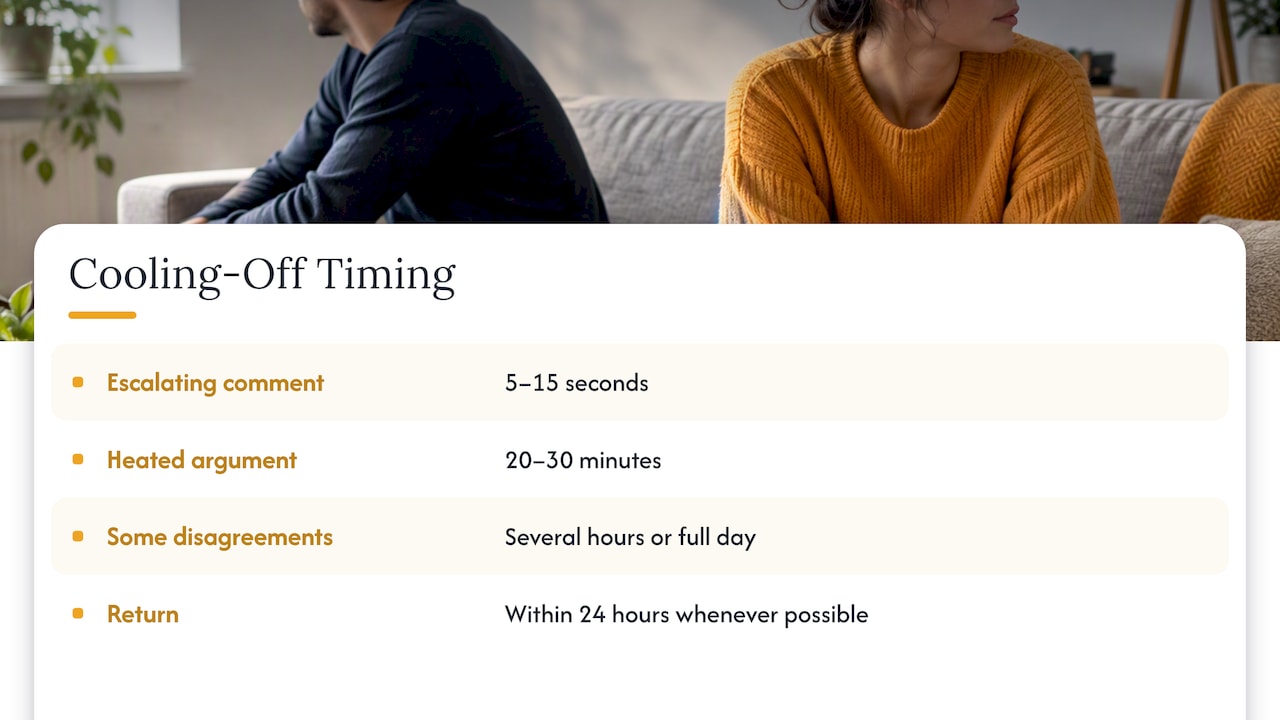
A few factors change what length makes sense: how physically wound up you feel, whether anxious attachment makes long silences feel like abandonment, how complicated the actual problem is, and what you and your partner have agreed to before. Whatever length you choose, name a specific check-in time before you separate. An open-ended “I need space” invites worry and can escalate the very conflict you are trying to defuse.
How to ask for space: ready-to-use scripts and templates
The clearest way to ask for a break follows a simple formula: reassurance, reason, return time. Psychology Today’s guidance on couple time-outs recommends this structure specifically because it prevents a pause from feeling like rejection.
A few adaptable scripts:
- “I care about us, and I’m getting too heated to be helpful right now. Can we pick this back up at 7:30?”
- “I notice my heart is racing. I want to talk this through, just give me 20 minutes and I’ll come find you.”
- “This matters to me and I don’t want to say something I regret in front of everyone. Let’s finish this when we get home.”
- “I felt myself shutting down just now. I need about an hour, and I’ll text you when I’m ready.”
Pre-negotiating a nonverbal signal, a raised hand, a specific word, a hand on the chest, lets either partner call a pause without a speech in the middle of a tense moment. Our therapist-created time-out scripts walk through exactly how to build and rehearse these signals before you need them.
Agree in advance on what contact is allowed during the break: a text to confirm you are okay, or complete silence until the check-in time. Either works, as long as you both know which one it is. What undermines a time-out is vague or punitive language: disappearing without a word, using silence as a weapon, or issuing an ultimatum like “we’re done talking about this” instead of naming a return time.
What to do during the break: regulating and preparing to reconnect
The point of the break is to actually calm down, not to rehearse your argument in your head. A few steps make that more likely:
- Use a physical reset: box breathing, a brisk walk, or progressive muscle relaxation all shift your body out of high alert.
- Write down, in a sentence or two, the primary emotion you are feeling and what you actually need right now.
- Prepare one validation statement, something true you can say that acknowledges your partner’s experience.
- Identify one specific behavior you are willing to try differently when you reconnect.
- Set an alarm for your agreed return time instead of watching the clock.
Our emotional regulation practices for couples offer more structured exercises for this exact window.
Notice when you have shifted from calming down to building a case. Rehearsing rebuttals keeps your body in the same aroused state the break was meant to interrupt, and it defeats the purpose entirely.
Pro Tip: Practice box breathing or a short walk on an ordinary day, not just during conflict, so the habit is already familiar when you actually need it.

How to reconnect after the break: who reaches out and what to say
The person who called the time-out typically takes the lead on restarting the conversation. Guidance from Psychology Today notes this keeps the return from feeling like something that just happens to the other partner.
Start by asking permission rather than launching back in: “Is now still a good time?” A reconnection opener that leads with curiosity lands better than one that leads with blame. Try something like “I’ve been thinking about what you said, can you walk me through it again?” or “I want to understand what set this off for you.”
Keep the first reconnection focused and short, somewhere around 20 to 30 minutes, and pick one solvable piece of the disagreement rather than trying to resolve everything at once. If you land on even a small shift, point it out. Progress that goes unnoticed rarely feels like progress.
If the conversation stalls or the issue is bigger than one sitting can handle, name a specific next step: “Let’s park this and talk more after dinner tomorrow” works better than letting the topic quietly disappear. Our guide on why couples struggle to repair after fights covers what tends to break down at this stage.
When not to use space: safety, abuse, and misuse of time-outs
Time-outs are built for couples working through ordinary conflict, not as a substitute for safety planning when violence or coercive control is present; for deeper insight, see the role of forgiveness in church. Reporting on the St Andrews study notes that clinical guidance frames time-outs as a tool for interrupting escalation, not as a fix for abusive dynamics.
Watch for signs the tool is being misused: one partner repeatedly disappearing with no return plan, using space as a way to dodge accountability, or silence that functions as punishment rather than regulation. None of that is a negotiated time-out.
If you recognize coercion, intimidation, or violence in your relationship, a time-out is not the right tool. Reach out to a specialist domestic-violence resource or a licensed professional for support.
Why rehearsed scripts make negotiated time-outs reliable
A negotiated time-out sounds simple on paper and falls apart under real pressure if you have never practiced it. That gap between knowing the concept and actually using it under stress is where most couples lose the plot, not in understanding the idea.
Scripts matter because they take the guesswork out of a moment when your judgment is already compromised. Our F.I.G.H.T. Plan framework builds time-out language, return signals, and reconnection steps into a repeatable system rather than leaving couples to improvise from memory mid-argument.
Treat a time-out the way you would treat any other skill: something you get better at with repetition, not something that works perfectly the first time you try it under duress.
— Carlos
Learn the skills: structured support from Couples Fight School

Reading about negotiated time-outs is useful, but most couples make faster progress with a script in hand and a plan they have actually rehearsed together. We built our resources around exactly that gap.
- The F.I.G.H.T. Plan – Couples Conflict Toolkit ($27.00) gives you a compact, ready-to-use time-out and communication system.
- Stop the Fighting: The Couples Communication & Conflict Resolution Course ($149.00) walks you through de-escalation and repair step by step.
- VIP Private Coaching Session, 4 Sessions ($997.00) pairs you directly with guided practice for calling and returning from time-outs.
- The 6 Hours Couples Intensive ($1,995.00) is built for couples who want concentrated, hands-on work in a single sitting.
These resources fit couples who want therapist-created language they can lean on instead of improvising mid-conflict. If you would rather build the skill with support than figure it out alone, visit our shop or book a coaching session to get started.
FAQ
What should couples do after a fight?
Couples benefit from a brief cooling-off period followed by a focused reconnection conversation, rather than either an immediate confrontation or indefinite silence. Using a negotiated time-out with a set return time, then addressing one specific issue when you reconnect, tends to work better than trying to resolve everything at once.
Will a girl come back if you give her space?
Giving a partner space works best when it is an agreed, time-limited break with a specific return time rather than open-ended silence. Clinical guidance frames a planned return as the part that actually rebuilds trust, not the absence itself.
Who should reach out first after a fight?
The partner who called the time-out generally takes the lead on restarting the conversation, since they set the pause and are expected to follow through on the return. Psychology Today’s guidance on couple time-outs notes this keeps the reconnection from feeling one-sided.
How to make up after a big argument?
Start by asking if it is a good time to talk, then open with curiosity rather than blame, something like asking your partner to walk you through their perspective again. Keep the conversation to around 20 to 30 minutes, focus on one solvable piece of the issue, and acknowledge any progress, even partial.
How soon should you reconnect after taking space?
Reconnecting within 24 hours is generally recommended whenever possible, since longer gaps tend to let resentment build instead of ease. Negotiated time-out guidance treats the committed return time as essential to the technique working at all.
Sources
- Managing conflict with negotiated time-outs | USU Extension
- Time-outs for couples | Psychology Today
- Study suggests five-second break can defuse an argument between coupled partners | University of St Andrews news
- APA PsycNET record on time-out technique in clinical work
Recommended
- Stop Escalation in 20–45 Min: Therapist Scripts for Couples’ Time Outs
- Stop Arguing With Your Husband in 10 Minutes Using Therapist Scripts
- 5 Therapist Backed Couples Conversation Scripts to Use Tonight
- 6 Research Backed Conflict De-escalation Techniques with Ready Scripts