
Why Couples Stop Communicating Effectively

Couples stop communicating effectively when emotional safety erodes, not when love fades. The real term for this breakdown is relational communication shutdown, and it happens when partners shift from genuine connection to self-protection. You may still talk every day about schedules, chores, and the kids. But the deeper conversations, the ones where you share fear, longing, or hurt, quietly disappear. Understanding why that shift happens is the first step toward reversing it.
Why couples stop communicating effectively: the emotional safety factor
Emotional safety in relationships is the foundation that makes honest conversation possible. When it exists, you can say “I feel invisible to you” without bracing for ridicule or dismissal. When it breaks down, you protect yourself by staying on the surface.

Couples struggle not because they don’t care, but because they communicate surface content while avoiding the vulnerable emotions underneath. That avoidance is not laziness or indifference. It is a rational response to a perceived threat. If every time you opened up, your partner got defensive or shut down, you learned to stop opening up.
Vulnerability requires consistent evidence that it will be met with empathy. Safety involves knowing your tender feelings will not be weaponized or ignored. Without that track record, most people default to logistics. The conversation stays at “Did you pay the electric bill?” because that question carries no emotional risk.
Common signs that emotional safety has broken down include:
- Avoiding eye contact during difficult topics
- Giving short, clipped answers to deflect deeper questions
- Changing the subject when emotions surface
- Feeling like you have to “manage” your partner’s reaction before speaking
- Saying “I’m fine” when you are clearly not
Pro Tip: Schedule a low-stakes check-in conversation once a week, not to solve problems, but simply to share one feeling each. This rebuilds the habit of emotional honesty before the stakes get high.
What destructive communication patterns actually do to a relationship
The common misconception is that communication problems arise from skill deficits. The real obstacle is emotional reactivity and threat responses that override whatever skills you have. You can know every technique in the book and still shut down completely when you feel attacked.
Destructive patterns are the behaviors that take over when emotional flooding kicks in. Emotional flooding is the state where your nervous system is so activated that rational thought becomes nearly impossible. At that point, you are not choosing to be cruel or dismissive. Your brain has shifted into survival mode.
The most damaging patterns include:
- Criticism: Attacking your partner’s character instead of addressing a specific behavior (“You never think about anyone but yourself”)
- Contempt: Expressing disgust or superiority through eye-rolling, sarcasm, or mockery
- Defensiveness: Responding to a complaint with a counter-complaint, blocking any real resolution
- Stonewalling: Shutting down completely and refusing to engage, often as a response to feeling overwhelmed
- Mind-reading: Assuming you know what your partner means or intends without asking
These five patterns, identified extensively in couples therapy research, are not random. They are self-protective responses triggered by emotional overwhelm. Each one signals that the person using it feels threatened. The problem is that each one also makes the other partner feel threatened, which escalates the cycle.
How does the pursue-withdraw cycle block real connection?
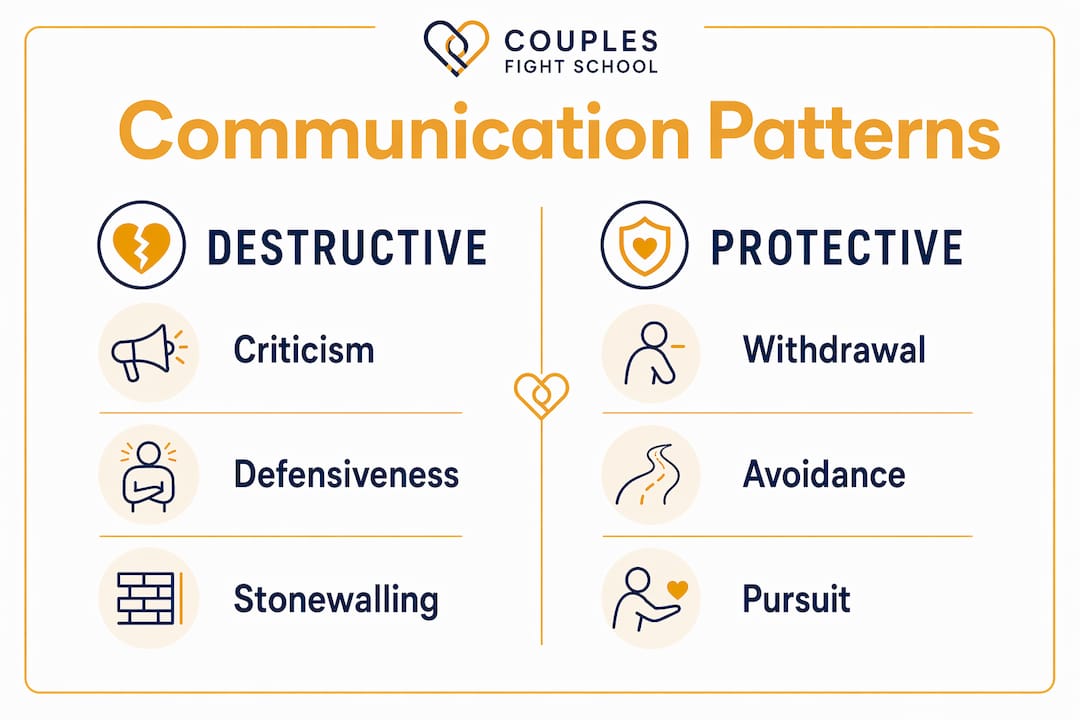
The pursue-withdraw cycle is one of the most common and least understood conflict escalation patterns in relationships. One partner pushes for resolution, closeness, or acknowledgment. The other pulls back. The more one pursues, the more the other withdraws. The more the other withdraws, the more urgently the first pursues.
Both partners are overwhelmed. The pursuer feels abandoned and desperate for connection. The withdrawer feels flooded and needs space to regulate. Neither is wrong about their own experience. But the cycle itself becomes the enemy of communication.
“The pursue-withdraw dynamic often blocks connection: one partner pursues resolution while the other withdraws, escalating frustration on both sides. This cycle is a self-protective pattern triggered by emotional overwhelm, not a lack of caring.” — TherapyExplained
What makes this cycle so destructive is that every attempt to reconnect reinforces the disconnection. The pursuer’s urgency reads as pressure to the withdrawer. The withdrawer’s silence reads as rejection to the pursuer. Over time, both partners stop trying. The pursuer gives up. The withdrawer never re-engages. That is when the relationship goes quiet in the most dangerous way.
Why fixing surface issues does not restore real connection
Couples often argue about dishes, money, or parenting. Those topics feel like the problem. They are rarely the actual problem. Shame, fear of exposure, and lack of emotional safety cause couples to default to surface-level dialogue, locking them in communication gaps that logistics alone cannot close.
The table below shows how surface complaints typically mask deeper emotional needs:
| Surface complaint | Underlying emotion |
|---|---|
| “You never help around the house.” | “I feel unseen and taken for granted.” |
| “You’re always on your phone.” | “I feel like I’m not a priority to you.” |
| “You spend too much money.” | “I feel anxious and out of control.” |
| “You never want to be intimate.” | “I feel rejected and unwanted.” |
Therapists shift focus from blame to patterns, helping couples recognize the cycles and underlying emotions beneath surface complaints. Expressing feelings rather than attacking behavior improves empathy and connection. When you say “I feel lonely when we don’t talk at dinner,” your partner can respond to your pain. When you say “You ignore me at dinner,” your partner responds to the accusation.
Avoiding vulnerability perpetuates the breakdown. The surface argument continues because neither partner ever hears what the other actually needs.
Practical strategies to rebuild communication and emotional connection
Rebuilding communication requires restoring emotional safety first. Technique alone will not work inside an unsafe environment. Emotional safety cannot typically be rebuilt mid-argument. Preparatory conversations outside conflict make it safer to share hard emotions later.
Follow these steps to start rebuilding:
- Choose the right moment. Never start a difficult conversation when either of you is hungry, tired, or already activated. Pick a calm, neutral time with no distractions.
- Use “I” statements. Replace “You always do this” with “I feel hurt when this happens.” Using “I” statements and focusing on present feelings helps down-regulate conflict.
- Listen to understand, not to respond. Reflect back what your partner said before offering your own view. “What I’m hearing is that you feel overlooked. Is that right?”
- Take a break when flooded. Agree in advance that either partner can call a time-out. Returning to the conversation after a break is far better than abandoning it entirely.
- Recognize your pattern. Name the cycle out loud together. “We’re doing the thing where I push and you pull back. Can we slow down?” Naming the pattern interrupts it.
- Seek professional support. A trained counselor helps both partners recognize cycles and underlying emotions that are invisible from inside the relationship.
Pro Tip: Try a “soft start-up” when raising a concern. Begin with something positive about your partner before naming the issue. It lowers defensiveness before the conversation even begins.
Communication improvement is relational. Both partners need to change their timing, reactivity, and responsiveness. One person bearing the entire effort is not a repair. It is a delay.
Key takeaways
Couples stop communicating effectively because emotional safety erodes first, and no communication skill can substitute for the trust that makes vulnerability feel safe.
| Point | Details |
|---|---|
| Safety before skill | Rebuild emotional safety before trying new communication techniques. |
| Patterns override knowledge | Emotional flooding triggers destructive patterns even in couples who know better. |
| Pursue-withdraw is mutual | Both partners are overwhelmed in this cycle, not just the one who withdraws. |
| Surface fights mask deeper needs | Address the underlying emotion, not just the presenting complaint. |
| Repair is a shared responsibility | Both partners must adjust timing, reactivity, and responsiveness for real change. |
What I’ve learned after years of working with couples in conflict
Most couples who come to Couplesfightschool believe their problem is that they don’t know how to communicate. They want scripts, frameworks, and techniques. And yes, those tools matter. But almost every time, the real issue is not a skill gap. It is a safety gap.
I have sat with couples who could articulate every principle of healthy communication and still tear each other apart the moment a real nerve was hit. The techniques vanished the second emotional flooding took over. What they needed first was not a better script. They needed a reason to believe that being honest would not cost them something.
The part most articles miss is this: you cannot have a productive conversation about a hard topic with someone you do not yet feel safe with. You can try. You will fail. Then you will blame the technique instead of the missing foundation.
The other thing I have seen consistently is that one partner cannot carry the repair alone. I have worked with people who read every book, attended every workshop, and changed everything about how they communicated. Their partner changed nothing. The relationship did not improve. Communication is not a solo sport. Both people have to show up differently, at the same time, with the same commitment.
If you are in that place right now, the most useful thing you can do is not find a better communication tip. It is to have an honest conversation about whether both of you are willing to do the work. That conversation, as uncomfortable as it is, is the real starting point.
— Carlos
How Couplesfightschool can help you rebuild from here
Knowing why communication breaks down is only half the work. The other half is having a structured path to rebuild it.

Couplesfightschool offers online coaching for couples built around the F.I.G.H.T. Plan® framework, a psychology-backed system developed by licensed mental health professionals Carlos Todd and Natasha Pemberton-Todd. The coaching addresses emotional safety, conflict patterns, and communication skills together, not in isolation. For couples who prefer a self-paced option, the Fight Less, Love More course walks you through the same principles with practical tools you can apply immediately. Both options are designed for couples who are serious about change, not just looking for a quick fix.
FAQ
Why do couples stop talking about real feelings?
Couples stop sharing real feelings when emotional safety breaks down. Without consistent evidence that vulnerability will be met with empathy, partners default to surface-level conversation to protect themselves.
Can couples fix communication without therapy?
Yes, but it requires both partners to actively change their patterns, timing, and reactivity. Professional support accelerates the process by helping couples identify cycles they cannot see from inside the relationship.
What is the pursue-withdraw cycle?
The pursue-withdraw cycle is a pattern where one partner pushes for connection and the other pulls back. Both responses are driven by emotional overwhelm, not indifference, and the cycle escalates the longer it continues.
Why do communication skills fail during arguments?
Communication skills fail during arguments because emotional flooding activates the brain’s threat response, overriding rational thought. Skills require a regulated nervous system to work, which is why timing and de-escalation matter more than technique in the moment.
How does emotional safety affect communication in relationships?
Emotional safety is the condition that makes honest conversation possible. When partners trust that vulnerability will be met with empathy rather than contempt or dismissal, they are far more likely to share the deeper feelings that real connection requires.