
Couples Coaching Insurance: What’s Covered and What to Expect

Health insurance typically does not pay for couples coaching, because plans reimburse treatment of diagnosed conditions and coaching is skill-building for a relationship. That is the plain answer. The useful part is what you do with it: knowing which kind of help your plan can cover, what to ask before you book, and how to get a structured, therapist-created plan for your marriage at a price you can see up front. At Couples Fight School, our F.I.G.H.T. Plan® workbooks start at $9.99 and our private coaching has a published price, so you know the cost before the first session.
TL;DR
- Coaching is generally treated as non-medical personal development, so insurers typically do not reimburse it. Therapy for a diagnosed condition is the type of care plans are built to cover.
- When couples counseling is covered, it is usually because one partner has a diagnosis and the care is medically necessary, not because the relationship is struggling.
- Before booking anything, call the number on your insurance card and ask four questions: coverage, cost share, session limits and referral rules.
- Coaching, courses and workbooks are paid directly, with prices published: workbooks from $9.99, courses from $47, four private sessions for $997.
- Free and sliding-scale counseling exists in many communities if cost is the main barrier.
Table of Contents
- Why insurance and couples coaching rarely meet
- When couples counseling can be covered
- The four questions to ask your insurer
- Coaching, therapy, courses: what each is for
- What direct pay looks like, in real numbers
- If cost is the barrier
- Making direct pay work harder
- Our perspective
- Where to start
- FAQ
- Sources
Why insurance and couples coaching rarely meet
Insurance pays for medical care. A plan reimburses a provider when a licensed clinician treats a diagnosed condition, such as depression, anxiety or PTSD, and documents that the treatment is medically necessary. Coaching sits on the other side of that line.
The National Council of Private Psychotherapists explains that most therapy services are eligible for insurance reimbursement under federal parity law, while coaching is typically not covered because it is viewed as a non-medical service aimed at personal development rather than treatment of a mental health condition. The same source describes coaching as building capabilities and effectiveness toward goals, and therapy as addressing specific mental health conditions.
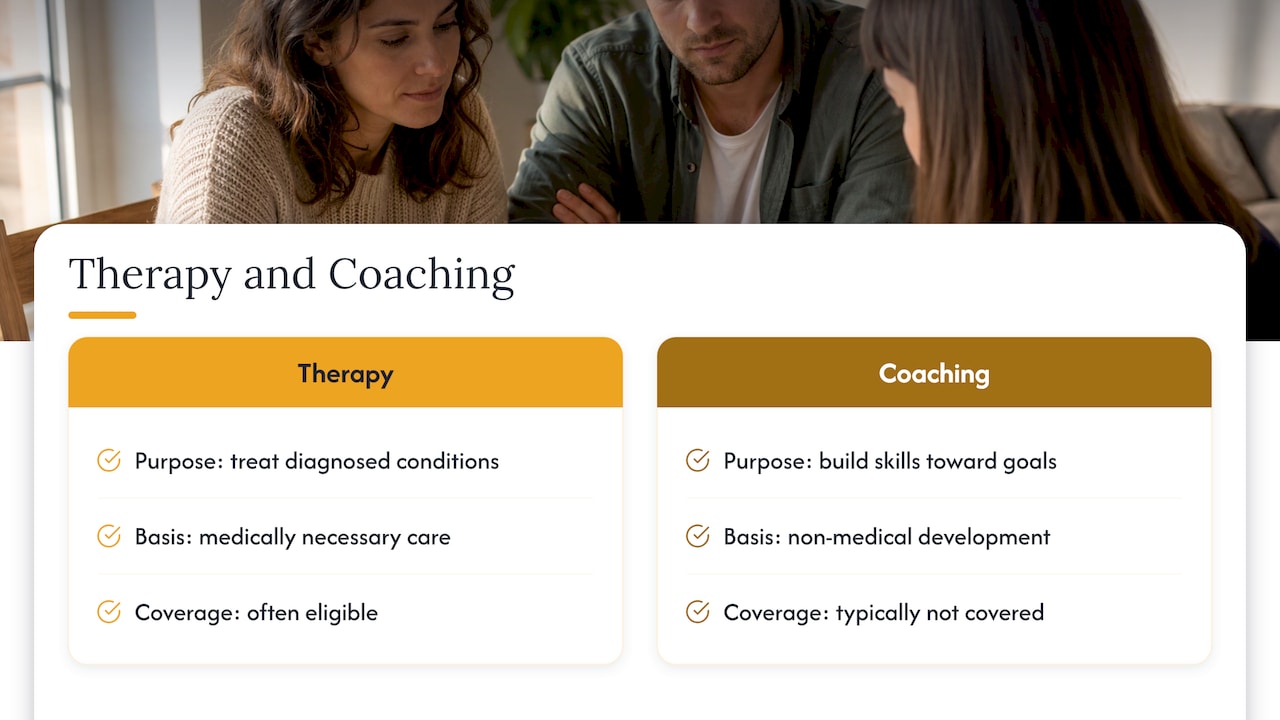
That distinction is about billing, not about value. A couple that wants to stop repeating the same argument, talk without criticism and rebuild closeness is asking for skills. Skills are what coaching, courses and workbooks teach. Insurance simply has no category for them.
There is one more wrinkle readers often ask about. In 2020 the American Medical Association approved three temporary billing codes for health and wellness coaching. A peer-reviewed 2024 review in PMC reports those codes were renewed for 2025 to 2029, yet they are generally not reimbursed by public and private payers. Having a code does not mean your plan pays.
When couples counseling can be covered
Coverage for couples counseling is a different question from coverage for coaching, and it is narrower than most people hope. One health plan’s member guidance says that couples therapy coverage varies by plan and typically does not extend to general relationship challenges or communication issues. In some cases a plan may cover it if one or both partners has a diagnosed mental health disorder and the therapy is deemed medically necessary.
In practice, that means:
- A diagnosis comes first. The insurer is paying to treat a person, not to repair a relationship.
- The treatment plan must target the diagnosis. Medicare is the clearest example. A professional guide quoting Medicare rules says family psychotherapy is covered only when its primary purpose is treating the patient’s condition, and that strictly relationship-focused counseling with no diagnosis is not covered.
- Plans differ. Network rules, referral requirements and session limits vary from one employer plan to the next.
If you or your spouse is living with a diagnosed condition such as depression or anxiety, and you want a licensed clinician to treat it, ask a licensed therapist in your plan’s network whether couples sessions fit the treatment plan. That is the route where insurance may help. If what you want is a communication system, a way through recurring arguments, or help recovering after an affair, you are looking for education and coaching, which are paid directly.
The four questions to ask your insurer
Do not guess from a website. One phone call settles it. The federal Substance Abuse and Mental Health Services Administration advises you to call the number on the back of your insurance card and ask about coverage for the type of treatment you want, your copay or coinsurance, how many appointments are covered per year, and which providers are in your area. It also notes that some plans have case managers, such as a nurse or social worker, who can help at no charge.
So you do not have to improvise, here is a script:
- “Does my plan cover couples or marital counseling, and under what conditions?” Listen for whether a diagnosis is required.
- “What is my deductible, copay or coinsurance for outpatient mental health visits?” Your deductible is what you pay before the plan starts sharing costs.
- “Is there a limit on sessions per year, and do I need a referral from my primary care doctor?” Northwestern University’s counseling center notes that session limits are often around 20 per calendar year and that you should ask about referral requirements.
- “What happens if I see an out-of-network provider?” The same guide explains that out-of-network care typically means paying in full and then submitting paid invoices for reimbursement.
Write down the date, the name of the representative and what they said. If the answer is that relationship-focused sessions are not covered, you have your answer and can plan a budget around direct pay.
Coaching, therapy, courses: what each is for
The fastest way to spend money well is to match the kind of help to the problem. Here is how we see the three main options.
| Couples therapy | Couples coaching | Course or workbook | |
|---|---|---|---|
| Main purpose | Treating a diagnosed mental health condition | Building communication, conflict and intimacy skills | Learning a structured system at your own pace |
| Insurance | May cover, if medically necessary | Typically not covered | Not covered |
| Best when | One or both partners has a clinical condition | You want guidance applying skills to your own relationship | You want to start now, together, on a set budget |
If you are unsure which side of the line you are on, our guide on when to seek couples therapy walks through the signs. For a plain-English look at the coaching side, read what relationship coaching is. And if you want to understand which therapy methods have research behind them, see our guide to evidence-based couples therapy.
NCPS also raises a point worth taking seriously: some people choose coaching when therapy would be more appropriate. If you are dealing with a serious condition, trauma symptoms, substance use or thoughts of harming yourself, see a licensed clinician or call 988, the Suicide and Crisis Lifeline. If your safety is at risk in the relationship, contact the National Domestic Violence Hotline at 1-800-799-7233. Coaching and workbooks are built for couples who are safe and ready to work on the relationship.
What direct pay looks like, in real numbers
Because nothing here goes through an insurer, you see the price before you commit. These are the prices published on our site:
| Option | Published price | Good fit |
|---|---|---|
| F.I.G.H.T. Plan workbook | $14.99 to $25.00 | Couples who argue in loops and want a structured system |
| F.O.R.E.V.E.R. Workbook (premarital) | $9.99 to $20.00 | Engaged couples building a marriage that lasts |
| R.E.S.T.O.R.E Workbook (healing after an affair) | $9.99 to $20.00 | Couples rebuilding trust after betrayal |
| The Christian F.I.G.H.T. Plan Workbook | $9.99 to $20.00 | Faith-centered couples |
| The F.I.G.H.T. Plan Couples Conflict Toolkit | $27.00 | A quick, practical toolkit for conflict |
| Fight Less Love Again Video Course | $47.00 | Couples who prefer to learn by video |
| LOVE & TRAUMA COURSE | $47.00 | Couples working through how past pain shows up in the relationship |
| Stop the Fighting: The Couples Communication & Conflict Resolution Course | $149.00 | A full course for communication and conflict |
| VIP Private Coaching Session, 4 sessions | $997.00 | Couples who want personal guidance |
| 6 Hours Couples Intensive | $1995 | Couples who want concentrated time together |
Compare that with what you may pay through insurance for a relationship issue that is not diagnosed: usually the full session rate, with no reimbursement. Our breakdown of online marriage course costs for U.S. couples explains the price tiers and what each includes.
One practical point: if you want to explore whether a health savings account or flexible spending account can be used, the 2024 PMC review notes that HSA and FSA use is a potential route only when a physician prescribes coaching as medically necessary treatment. Ask your plan administrator before assuming anything.
If cost is the barrier
Some couples searching this keyword are not choosing between coaching and therapy. They are choosing between help and nothing, because money is tight. There are real options.
Start with a low-cost system. A workbook that costs $9.99 to $25.00 can be worked through together on a weekly date, and it gives you a shared language for conflict. Our guide to free online marriage counseling and what to try first lays out where to begin if you want to start today.
Check your community. Many places offer low or no-cost counseling. The City of Bloomington, Minnesota, for example, provides couples and marriage therapy at no cost to residents, in-home, onsite or by telehealth. In South Dakota, a state resource page lists a community counseling clinic in Sioux Falls open to individuals, families and couples with limited funds, where supervised graduate students provide therapy and fees start at $25 based on ability to pay. Search your own city or county health department site, and ask local university training clinics.
Ask your employer. Some employers offer an employee assistance program with a small number of free counseling sessions. Call your HR benefits line and ask what it includes for couples.
Making direct pay work harder
When you pay out of pocket, you want every dollar to turn into a changed conversation at home. A few habits make that happen, whichever resource you use:
- Pick one pattern to change first. Criticism, defensiveness, shutting down: choose the one that shows up most and work on it for two weeks.
- Schedule it. One 45-minute weekly slot beats good intentions. Put it in both calendars.
- Practice outside the hard moments. Skills like pausing, naming a feeling and asking a clarifying question are easiest to learn when you are calm.
- Do the exercises together. Reading alone helps one person. Working side by side changes the system.
This is where a structured plan helps. The F.I.G.H.T. Plan® is a step-by-step framework for communication, emotional regulation, healing and relationship transformation, created by licensed mental health professionals. You are not left to invent your own method.
Our perspective
Couples tell us the same thing when they ask about insurance: they assumed that if the relationship hurts, someone else should be paying for the fix. We understand it. But insurance is built to treat diagnoses, and most of the couples we meet are not sick. They are stuck in patterns nobody ever taught them to change.
That is why we built Couples Fight School around skills. Carlos and Natasha are licensed mental health professionals, and the F.I.G.H.T. Plan® puts what they know into a structure you can follow: communication, emotional regulation, healing and rebuilding intimacy. It was designed so couples can make real progress without escalation and without waiting for a diagnosis or an approval letter.
There is a practical benefit to direct pay too. You see the price first, you choose your pace, and nobody outside your marriage decides what you are allowed to work on. Start with a workbook, step up to a course, or book private coaching when you want us in the room with you. Our materials also serve engaged couples, blended families, Christian couples and couples recovering from betrayal, so you can start with the one that matches your situation.
Carlos
Where to start
If you want a structured plan you can begin tonight, the F.I.G.H.T. Plan workbooks and courses in our shop start at $9.99, with the Stop the Fighting course at $149.00 for couples who want the complete system. If you want us alongside you, online couples coaching includes a VIP package of four private sessions for $997.00.
Faith-centered couples can start with the Christian F.I.G.H.T. Plan Workbook, and our article on the benefits of faith-based marriage counseling explains how that approach works. If you prefer learning alongside others, see the benefits of couples communication workshops.
FAQ
Does insurance cover couples coaching?
Typically no. Coaching is viewed as non-medical personal development, and insurers reimburse treatment of diagnosed conditions. Even the temporary billing codes approved for health and wellness coaching are generally not reimbursed by payers. Couples coaching is normally paid directly.
Will insurance cover a life coach?
The same rule applies. Life coaching is generally treated as a non-medical service, so plans do not usually pay for it. Call the number on your insurance card to confirm what your own plan does.
Does insurance ever pay for couples counseling?
Sometimes. A plan may cover it when one or both partners has a diagnosed mental health condition and the therapy is medically necessary. Coverage for general communication or relationship problems is typically not included, and plans vary, so ask your insurer directly.
Can couples get free marriage counseling?
In some communities, yes. Certain cities and counties fund no-cost or sliding-scale counseling, and university training clinics often offer reduced fees. You can also begin with low-cost workbooks while you look for a local program.
What should I ask my insurance company?
Ask whether couples or marital counseling is covered and under what conditions, what your deductible and copay are, how many sessions are allowed per year, and whether a referral or in-network provider is required.
Sources
- Coaching and Psychotherapy: Not Quite the Same, NCPS
- Health & Wellness Coaching Services: Making the Case for Reimbursement, PMC
- Mental health care coverage: what your plan covers, Priority Health
- Will Medicare Cover Couples and Family Therapy?
- Mental Health Treatment: What Does Health Insurance Cover?, SAMHSA
- Using Your Health Insurance for Mental Health Care, Northwestern University
- Virtual Care Options, City of Bloomington MN
- Community Counseling Clinic, Sioux Falls Psychological Services
Recommended
- What Is Relationship Coaching? A Plain-English Guide for Couples
- $200–$10,000: What U.S. Couples Workshop Costs Actually Buy
- Online Marriage Course Costs for U.S. Couples: 4 Tiers, What You Get
- Evidence-Based Couples Therapy: What Works and How to Choose