
Opposite-Sex Friendships in Marriage: Where the Line Is
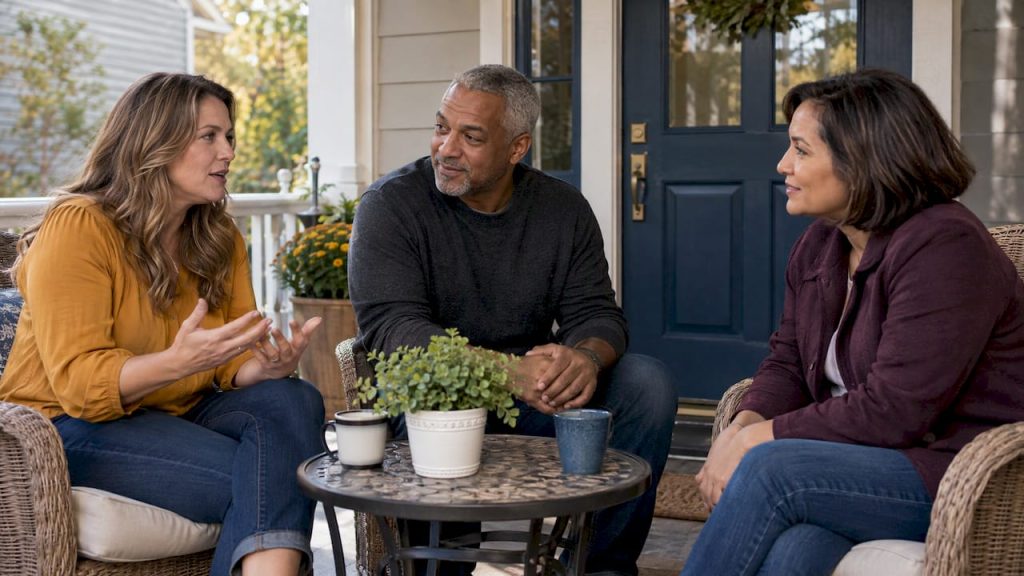
Yes, married people can have friends of the opposite sex. What decides whether the friendship helps or hurts is not the friend’s gender. It is whether you and your spouse have agreed on what the friendship looks like, and whether the closeness your marriage needs is still going to your marriage. If that agreement is missing, or one of you is uncomfortable and can’t say so without a fight, a friendship can become a wedge. That conversation is a skill you can learn, and it is exactly what we teach couples at Couples Fight School.
TL;DR
- Researchers who study this don’t set a universal rule. Utah State University Extension says the answer depends on the boundaries partners agree on and how the friendship works.
- Close or intimate friendships carry more risk, because familiarity and affection can deepen emotional bonds.
- The warning sign is redirected intimacy: confiding in the friend, not your spouse, about the things that matter most.
- Agree on boundaries together, and bring up discomfort early, calmly and with specifics.
- If a friendship has already hurt your spouse, change the pattern promptly and be honest about what the friendship was giving you.
Table of Contents
- Why this question is harder than it sounds
- How a friendship becomes an emotional affair
- Warning signs to notice in yourself
- Boundaries that protect both the friendship and the marriage
- Why it creates tension even when nothing is “wrong”
- How to talk about it when one of you is uncomfortable
- If a friendship has already hurt your spouse
- Our perspective
- Tools to work on this together
- FAQ
- Sources
Why this question is harder than it sounds
Most advice online falls into two camps. One says opposite-sex friendships after marriage are inherently dangerous. The other says suspicion of them is controlling. Neither helps a couple who actually have a coworker, a college friend or a neighbor in the picture and a real feeling in the pit of the stomach.
The research is more measured. Biola University’s Center for Marriage and Relationships wrote in 2018 that these friendships can be normal and healthy, while close or intimate ones carry greater risk. Utah State University Extension takes a similar line: outcomes turn on how the couple discusses and aligns expectations, not on the category of friendship.
So the useful question is not “are they allowed?” It is “what does this friendship do to the closeness between us?”
How a friendship becomes an emotional affair
An emotional affair is not a friendship with a label stuck on it. A federal fatherhood resource, the Emotional Cheating fact sheet, describes it as a friendship that develops into emotional closeness and deeper communication usually reserved for a spouse. It treats this as a progression from an ordinary friendship, not as proof that every opposite-sex friend is an affair partner.
That gives you a practical way to tell the two apart. Compare what each looks like:
| Friendship | Emotional affair | |
|---|---|---|
| Who gets the confidences | Shared with your spouse too, or ordinary in content | Increasingly intimate, turned to instead of your spouse |
| Where you take marital problems | To your spouse | To the friend, who becomes the sounding board |
| Openness | Your spouse knows the friend and the contact | Contact is minimized, hidden or explained away |
| Emotional needs | Met mostly within the marriage | Increasingly met by the friend |
| Effect on the marriage | Neutral or positive | Less effort put into the marriage |
The same fact sheet notes that when someone’s emotional needs are being met outside the relationship, they may be less likely to work on it. That is the quiet harm. Nothing dramatic has to happen. The energy simply drains out of the marriage.
If you want to understand how the damage plays out once it has occurred, our guide to repairing an emotional affair walks through the first steps, and betrayal isn’t just an affair explains why hurt can be real even without anything physical.
Warning signs to notice in yourself
The fact sheet names the main signals: increasingly intimate confidences, and turning to the friend for emotional support instead of your spouse. Such relationships, it says, can develop into romantic ones. In practice, ask yourself honestly:
- Do I tell this friend things about my day, my fears or my marriage before I tell my spouse?
- Do I look forward to talking to them more than to my spouse?
- Would I change how I text or talk if my spouse were reading over my shoulder?
- Am I complaining about my spouse to this person?
- Have I started explaining the friendship defensively, even when no one asked?
BYU’s Forever Families project frames affair prevention around recognizing risky situations and avoiding rationalizations that justify crossing a line. Rationalizing is the tell. “It’s just talking” and “he’s like a brother” are the sentences people use right before the pattern deepens.
If you are the spouse who is worried, notice that the same signs apply in reverse. You are looking for a shift in where the intimacy goes, not for proof of anything. A feeling of unease is a reason to start a conversation, not a verdict.
Boundaries that protect both the friendship and the marriage
The boundaries that show up across the research are consistent. Here they are, in plain terms.
Agree on them together
The fact sheet advises setting rules and expectations for platonic friendships that your spouse is comfortable with. Utah State University Extension says boundaries need to be clear and mutually respected, and that spouses should get to know each other’s friends and discuss concerns openly. A boundary you set alone and announce is a rule. A boundary you build together is an agreement, and agreements get kept.
Keep the marriage private
Avoid intimate conversations about the marriage and complaining about your partner to the friend. This is the single most protective habit. When you vent about your spouse to someone attractive and sympathetic, you hand over the role of confidant, and the friend becomes the person who “gets you.”
Watch time, topics and one-on-one settings
Utah State University Extension recommends considering the time spent together and the topics discussed, avoiding being alone together or discussing intimate matters, and involving the spouse where appropriate. A friendship that mostly happens in groups, or with your spouse around, has a different risk profile than weekly private lunches.
Be strict online and at work
The fact sheet specifically calls for strict boundaries in online and workplace relationships. These are where daily contact and shared stress make closeness build fastest, often without either person deciding anything.
Make your spouse the priority and disclose early
Biola’s Center for Marriage and Relationships says the spouse should be the priority, that developing intimate feelings should be disclosed, and that a past lover, or a friend the couple already disagrees about, warrants particular care. Telling your spouse about a flicker of attraction early, before it has grown, is far easier than explaining it after months of secrecy.
For couples who want their boundaries grounded in faith, our seven steps to Christian marriage boundaries lays out the process with a therapist’s eye.
Why it creates tension even when nothing is “wrong”
One study from the University of Oklahoma, by Kristin Kathryn Froemling, looked at how married partners communicate about a cross-sex friendship. It was small, with ten married couples, four of whom completed all three research methods, so treat it as a window and not a statistic. What it found is recognizable: couples wrestled with four tensions.
- Prioritizing yourself versus your spouse.
- Time with your spouse versus time with the friend.
- Disclosing details versus diverting the topic.
- Confronting the friendship versus avoiding the discussion.
Notice that none of these is about whether the friend is a good person. They are about priorities and communication. That is why two decent people can end up in a standoff over a friendship that, objectively, is harmless. The problem is usually the silence around it.
How to talk about it when one of you is uncomfortable
This is where most couples stumble. The uncomfortable spouse says “I don’t like her,” the friend’s defender hears “you’re controlling,” and a fight about trust becomes a fight about freedom. Here is a sequence that keeps it about the marriage.
- Pick the moment. Not during an argument, not when the friend just texted, not at bedtime. Choose a calm window and say it will be a conversation, not a confrontation.
- Start with the specific behavior and your feeling. “When you two have lunch every week and I hear about it afterward, I feel left out” lands very differently from “You’re too close to her.”
- Say what you need, not what they must stop. “I’d like to meet her and have us all do something together” is an invitation. “Stop seeing her” is an ultimatum.
- Listen for the need behind the friendship. Your spouse may be getting something from it, such as humor, appreciation or a place to unwind, that they aren’t getting at home. That is information about the marriage, not an excuse.
- Agree on two or three concrete boundaries. Topics, timing, transparency. Write them down if that helps.
- Revisit it. Check in after a few weeks. Boundaries are meant to be adjusted as life changes.
If you are the person with the friend, your job in this conversation is to take the discomfort seriously without turning it into an accusation. You are not on trial. You are protecting the thing you both want.
This is the exact skill our F.I.G.H.T. Plan® is built around: raising a hard subject without criticism or defensiveness, so each partner feels heard. If the conversation always blows up, strengthening the friendship foundation in your marriage is a good place to begin, and nine ways to strengthen marital friendship gives you daily habits that make your spouse your closest friend.
If a friendship has already hurt your spouse
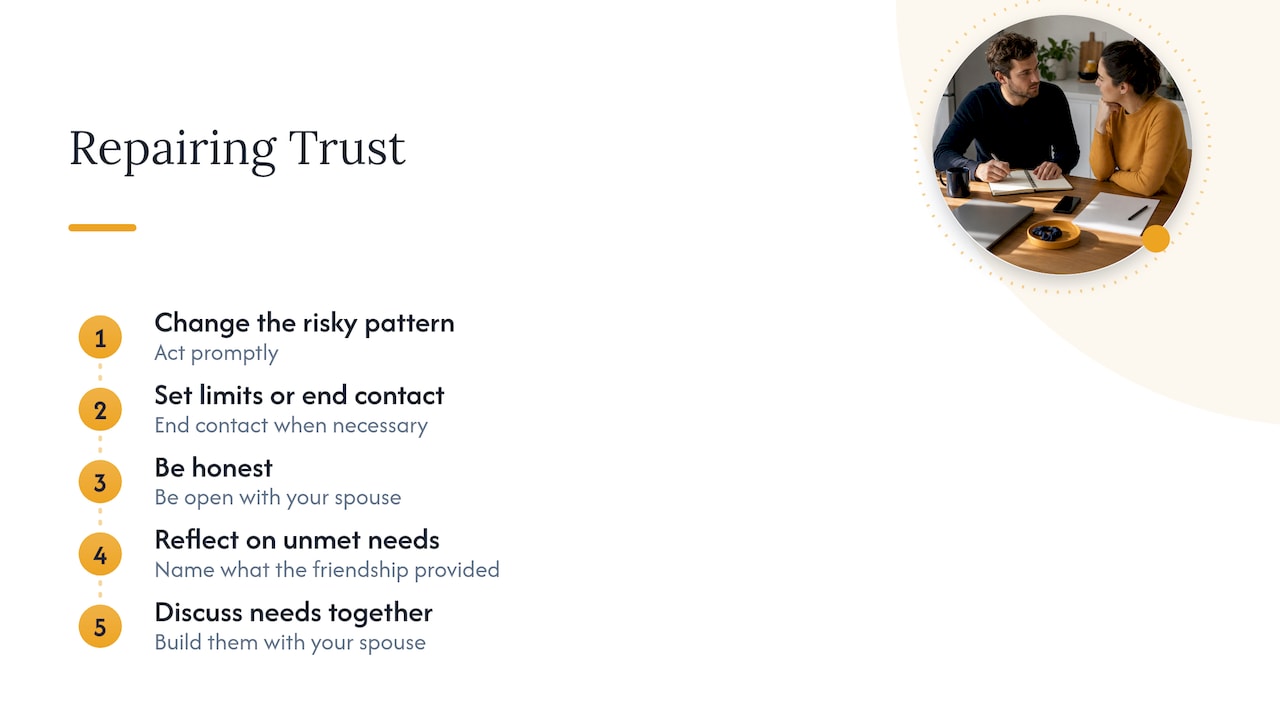
If trust has been shaken, the Emotional Cheating fact sheet gives a clear direction: change the risky pattern promptly, set new limits or end contact when necessary, be honest, reflect on what needs the friendship met, and discuss those needs with your spouse.
That last step is the one people skip. Ending the friendship stops the leak, but it doesn’t answer why you went looking. If you only cut contact, the need goes unmet and returns. Name it: appreciation, adventure, being listened to without a fight. Then bring it to your spouse as something you want to build together.
For the hurt spouse, the work is different: you need honesty, consistency and time. Our resources on forgiveness after infidelity, rebuilding intimacy step by step and what to expect from couples therapy after betrayal take you through it. If the situation has become a legal question about the marriage itself, speak with a licensed family law attorney in your state.
Our perspective
We have worked with many couples whose fights were never really about the friend. They were about feeling second. The friendship was just where the feeling landed.
Our view is that a couple doesn’t need a rule that bans all opposite-sex friends, and it doesn’t need a couple who pretend the risk isn’t real. It needs a way to talk about closeness, openly and without attack. That is a trainable skill, not a personality trait.
That is why the F.I.G.H.T. Plan® is a structured system: it gives you the words, the order and the emotional regulation to raise something like this before it becomes a wound. We built it as therapists, for couples who want practical progress.
Carlos
Tools to work on this together
Couples Fight School was founded by licensed mental health professionals Carlos Todd and Natasha Pemberton-Todd. If you want a structured way to have this conversation, The F.I.G.H.T. Plan workbook is listed at $14.99 to $25.00, and the F.I.G.H.T. Plan Couples Conflict Toolkit is $27.00. Christian couples can use The Christian F.I.G.H.T. Plan Workbook, listed at $9.99 to $20.00. For a full course, Stop the Fighting is $149.00, and Fight Less Love Again is $47.00.
If trust has already been damaged, our R.E.S.T.O.R.E workbook on healing after an affair is $9.99 to $20.00, and private coaching is available for couples who want guidance through the conversation. The VIP Private Coaching Session package of four sessions is $997.00.
FAQ
Is it wrong to have a close opposite-sex friend when you’re married?
Not inherently. Utah State University Extension says whether a friendship should continue depends on the boundaries partners agree on and the dynamics of the friendship. Close friendships need more care, because they carry a higher risk of emotional drift.
What is the difference between an emotional affair and a friendship?
In a friendship your spouse is part of the picture and your deepest confidences still go to them. In an emotional affair, closeness and communication usually reserved for a spouse shift to the friend, often while the contact is downplayed. The shift in where your intimacy goes is the key signal.
What if my spouse refuses to end a friendship I’m uncomfortable with?
Start with the feeling and the specific behavior, not a demand. Ask to know the friend and agree on boundaries together. If every attempt becomes a fight, a couples coach or licensed therapist can help you both be heard.
Should I tell my spouse if I develop feelings for a friend?
Biola’s Center for Marriage and Relationships says developing intimate feelings should be disclosed. Telling early, and adding distance from the friend, protects both the marriage and your integrity.
Sources
- Are Opposite Sex Friendships Okay in Marriage? (Biola CMR, 2018)
- The Risk of Opposite-Sex Friendships in Marriage (Biola CMR, 2017)
- Friendships Outside Committed Relationships (Utah State University Extension)
- Emotional Cheating (fatherhood.gov fact sheet)
- Romantic partners’ communication about their cross-sex friendships (University of Oklahoma, 2000)
- Immunized Against Infidelity (BYU Forever Families)
Recommended
- How to Strengthen the Friendship Foundation in Marriage
- Secrecy in Marriage: When Privacy Becomes a Problem
- 9 Ways to Strengthen Marital Friendship That Last
- Ex Drama in Marriage: How to Set Boundaries and Protect Your Bond