
5 Biblical Therapy Based Steps to Forgiveness in Christian Marriage

Scripture does not leave forgiveness open to negotiation: Ephesians 4:32 and Colossians 3:13 command believers to forgive as Christ forgave them. That command can be obeyed now, as a willful decision, even while trust, safety, and reconciliation are handled as a separate, slower process. There are practical tools available for spouses who want to turn that decision into daily practice.
TL;DR:
- Forgiveness involves a deliberate decision to release the debt, which can be made quickly, but emotional healing and trust rebuilding take longer.
- Reconciliation is a separate process that requires genuine repentance and consistent change, and it may never occur if these conditions are not met.
- Structures like prayer, honest acknowledgment, and support programs can help couples practice forgiveness effectively, especially after severe ruptures.
- Forgiveness does not mean dismissing harm or ignoring safety issues; protective actions are necessary in cases of ongoing violence or abuse.
- Trust rebuilds in phases such as transparency, consistent behavior, and vulnerability, often requiring months or years depending on the severity of the hurt.
Table of Contents
- What the Bible says about forgiving in marriage
- Forgiveness, reconciliation, and boundaries: how they’re different
- A practical, stepwise process for forgiving your spouse
- Common myths and pitfalls about Christian forgiveness
- When forgiveness isn’t safe: protecting yourself and your family
- Rebuilding trust and realistic timelines
- Spiritual practices and prayers that support forgiveness
- How Couples Fight School approaches forgiveness
- A pastoral reflection: mercy that seeks justice
- How Couples Fight School® can help you take the next step
- Sources
- FAQ
What the Bible says about forgiving in marriage
Ephesians 4:32 tells believers to be “kind to one another, tenderhearted, forgiving one another, as God in Christ forgave you.” Colossians 3:13 repeats the same logic: forgive “as the Lord has forgiven you.” Neither verse treats forgiveness as optional or as something that happens only once the offending spouse has earned it. The New Testament language pictures forgiveness as canceling a debt, a deliberate release of what someone rightfully owes, extended because of the grace bent outward that God has already shown the one forgiving.
Matthew 6:14-15 ties a believer’s own forgiveness to a willingness to forgive others, and Luke 17:3-4 pictures forgiveness as something offered again and again, even seven times in a day, when a person repents. Those passages describe a repeated, willful act, not a single emotional resolution. Scripture references collected by sites like Openbible show these same passages surfacing again and again because they form the backbone of biblical teaching on the subject.
At the same time, Scripture never asks the vulnerable to stay silent about harm or to treat every relationship as automatically safe. The Bible commands forgiveness of the heart while leaving room for wisdom about the body, the home, and the children involved.
- Ephesians 4:32 commands kindness and forgiveness modeled on Christ’s forgiveness of the believer.
- Colossians 3:13 frames forgiveness as bearing with one another and forgiving grievances.
- Matthew 6:14-15 links receiving forgiveness to extending it.
- Luke 17:3-4 pictures forgiveness as a repeated response to repentance, not a one-time transaction.
Forgiveness, reconciliation, and boundaries: how they’re different
Forgiveness and reconciliation get treated as the same event, and that confusion causes real harm. Clinical and pastoral voices distinguish decisional forgiveness, the willful choice to release a debt, from emotional forgiveness, the slower fading of resentment and pain, and from reconciliation, which is a separate process that requires repentance, demonstrated change, and rebuilt trust.
A spouse can forgive decisionally within days of an offense while emotional forgiveness takes months, and reconciliation may never happen at all if the offending partner never repents or changes. Ministry teaching sometimes calls the temporary distance couples need a redemptive separation, a season apart aimed at safety and healing rather than divorce, used when ongoing contact would deepen harm rather than support restoration.
- Decisional forgiveness: choosing to release the right to retaliate or hold the offense over the other person.
- Emotional forgiveness: the gradual reduction of resentment, anger, and intrusive thoughts about the offense.
- Reconciliation: restored relationship, contingent on repentance and consistent behavioral change over time.
- Redemptive separation: a temporary, intentional distance used for safety or healing, not a step toward divorce.
Professional or pastoral help becomes necessary when a spouse minimizes real harm, when the same offense repeats without any change in behavior, when one partner feels physically or emotionally unsafe, or when conversations about the hurt consistently end in escalation rather than progress.
A practical, stepwise process for forgiving your spouse
Forgiveness in marriage is rarely linear, but a repeatable process gives couples something to return to when emotions resurface. Pastoral guides describe forgiveness as a process built on prayer, honest acknowledgment of pain, and gradual trust rebuilding rather than a single decision that erases the hurt.
- Decide to forgive. Make a brief, specific prayer commitment: naming the offense to God and choosing, in that moment, to release the right to punish or withhold love over it.
- Name and process the pain. Write down what happened and how it felt, grieve what was lost, and resist the urge to skip straight to “I’m over it” before the pain has actually been felt. This step guards against what researchers call spiritual bypass, using forgiveness language to avoid the harder work of grief.
- Seek and assess repentance. Genuine repentance looks like ownership without excuses, concrete changes in behavior, and willingness to accept accountability structures rather than just apology words.
- Practice letting go of rumination. Short daily exercises, such as naming one thing you are grateful for in the marriage or interrupting a repeated angry thought with a specific counter-fact, reduce the mental replay that keeps old wounds fresh.
- Use structured support when the hurt is severe. A randomized controlled trial found that structured forgiveness interventions produced measurable increases in marital commitment and trust that held at a five-month follow-up, which is why counselors often recommend formal programs for deeper ruptures rather than relying on willpower alone.
Pro Tip: Keep a short “repair script” ready: name the specific harm, state what you need going forward, and ask one direct question about how your spouse plans to change. This site’s guide on forgiveness after infidelity walks through this kind of script in more detail.
Common myths and pitfalls about Christian forgiveness
Forgiveness gets distorted in ways that either stall healing or expose someone to continued harm. Correcting these myths early prevents both outcomes.
- Forgiveness is not the same as condoning what happened; you can forgive an act while still calling it wrong.
- Forgiveness does not produce instant emotional healing; the ache can linger long after the decision is made.
- Forgiveness is never permission for a spouse to keep repeating harmful or abusive behavior.
- Spiritual bypass, quoting Scripture to shut down legitimate grief or anger, tends to undermine real healing rather than speed it up.
- A quick gut check helps: if forgiving feels like pretending nothing happened, or if it is being used to silence you rather than heal you, slow down and get outside input before going further. This site’s piece on unresolved resentment offers more diagnostic questions.
When forgiveness isn’t safe: protecting yourself and your family
Forgiving your spouse’s heart and staying in an unsafe home are two different questions, and Scripture’s call to forgive never requires a person to remain exposed to danger. Certain situations call for immediate protective action before any conversation about reconciliation happens.
- Physical violence or credible threats of violence toward you or your children.
- Coercive control, including financial control or isolation from family and friends.
- Ongoing substance abuse or addiction with no engagement in treatment.
- Repeated infidelity or deception with no willingness to seek accountability.
If any of these apply, contact a local domestic violence hotline, a trusted pastor, or a counselor before making decisions about staying, leaving, or confronting your spouse. A short-term separation plan, sometimes built around a 30 to 90 day boundary-setting window, can create physical and emotional safety while repentance and change are assessed rather than assumed. This site’s boundaries after betrayal guide lays out that kind of plan in practical terms.
Pro Tip: Write down your safety plan and share it with one trusted person outside the marriage. A plan that exists only in your head is easy to abandon under pressure.
Justice and forgiveness are not opposites. A spouse can forgive the debt personally while still reporting a crime, seeking a legal protective order, or requiring formal counseling before any reunion.
Rebuilding trust and realistic timelines
Trust does not return on the same schedule as forgiveness, and expecting it to creates unnecessary frustration for both spouses. Trust rebuilds in observable phases: an early phase of transparency, where the offending spouse volunteers information rather than waiting to be asked; a middle phase of consistency, where promised changes hold up over weeks and months without reminders; and a later phase of renewed intimacy, where the wounded spouse can be vulnerable again without constant vigilance.
- Transparency: sharing passwords, schedules, or financial details voluntarily rather than defensively.
- Consistency: following through on small commitments repeatedly, not just during moments of crisis.
- Accountability: accepting check-ins from a counselor, pastor, or trusted friend without resentment.
- Renewed vulnerability: the hurt spouse gradually re-engaging emotionally as evidence of change accumulates.
The trial cited above found that structured forgiveness work produced measurable gains in marital commitment and trust that persisted five months after the intervention ended, which suggests that trust rebuilt through structured effort tends to hold rather than fade. There is no fixed calendar for full restoration: some couples see real progress in a matter of months, while recovery from deeper betrayals such as infidelity often takes a year or more of consistent, demonstrated change. Progress is best measured by behavior over time, not by how quickly the pain stops being felt.
Spiritual practices and prayers that support forgiveness
Daily spiritual habits keep forgiveness from becoming a one-time event that gets abandoned when old feelings resurface.
- Pray a short confession prayer naming your own resentment or bitterness before asking God to help you release it.
- Write a lament, an honest prayer of grief that names the pain without rushing to resolve it.
- Read Matthew 18:21-35 or Colossians 3:12-13 slowly once a week as a reminder of the standard you are aiming for.
- Keep a short gratitude list focused specifically on your marriage, even during a hard season.
- Ask a pastor or small group leader to check in with you regularly rather than carrying the process alone.
How Couples Fight School approaches forgiveness
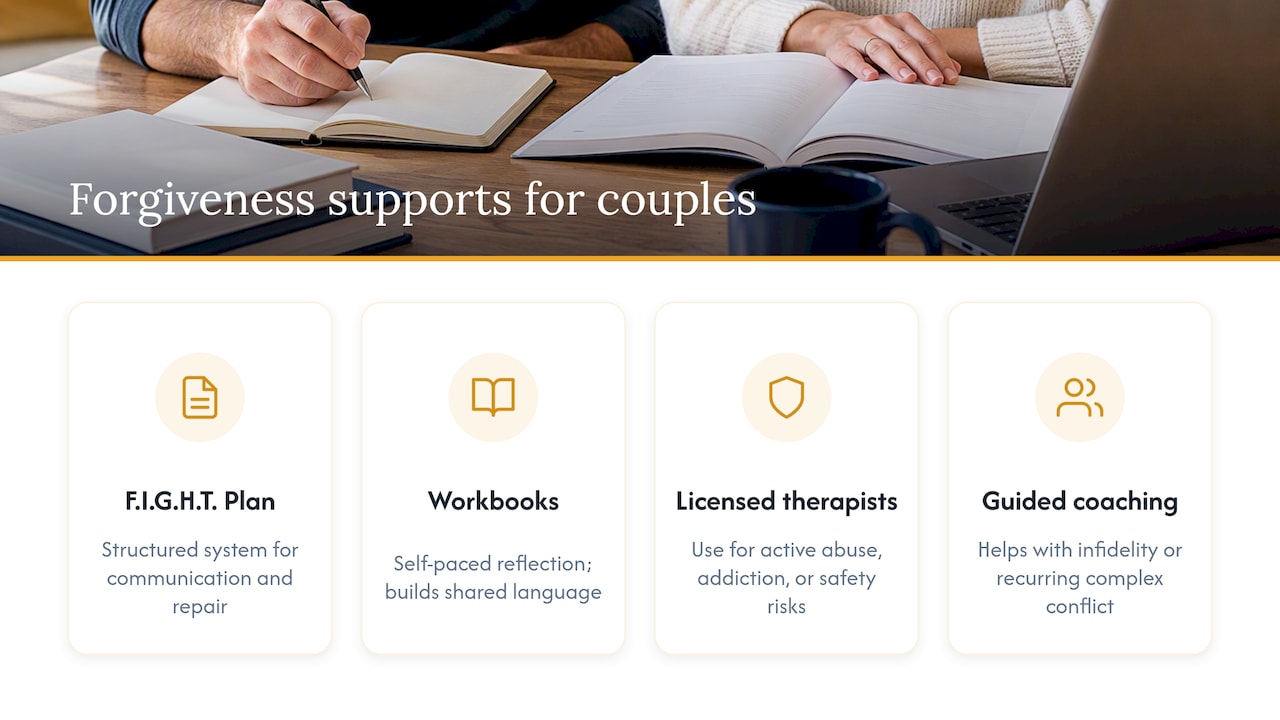
A structured system called the F.I.G.H.T. Plan® provides a framework for communication, emotional regulation, and relationship repair. The approach translates clinical tools, such as brief decisional commitments, repair scripts for hard conversations, and scheduled accountability check-ins, into practices couples can use at home without waiting for a weekly therapy appointment.
Workbooks or self-paced courses can support personal reflection or help couples develop a shared language for conflict. Referrals to licensed therapists may be necessary in cases of active abuse, untreated addiction, or serious safety concerns. Guided coaching can assist with more complex relationship challenges such as infidelity recovery or recurring conflict that resists change.
A pastoral reflection: mercy that seeks justice
Forgiveness without wisdom becomes naive, and wisdom without mercy becomes hard. Christian marriage asks for both at once: a heart that releases the debt and a mind that still asks hard questions about safety, repentance, and change. Reconciliation that skips repentance is not grace, it is denial wearing grace’s clothes.
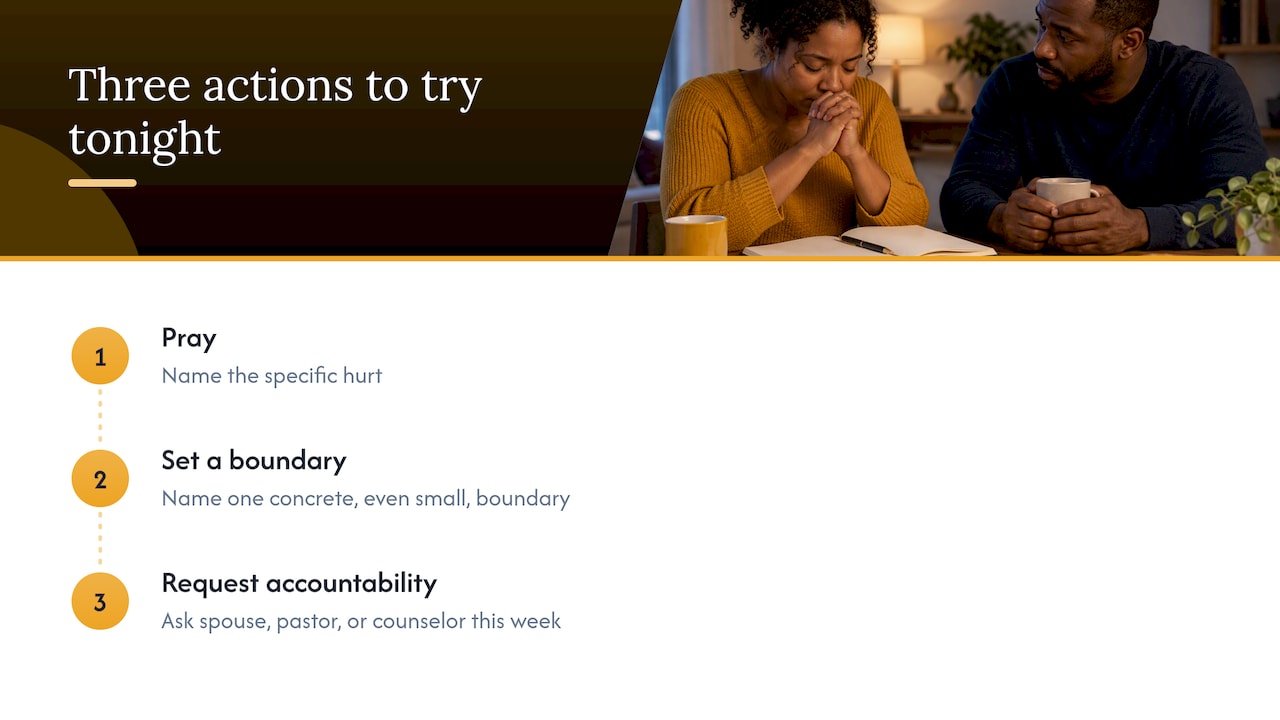
Tonight, try three things: pray a short prayer naming the specific hurt you are carrying. Name one concrete boundary you need right now, even a small one. Ask for one honest accountability conversation, with your spouse, a pastor, or a counselor, before the week ends.
— Carlos
How Couples Fight School® can help you take the next step
Forgiveness gives you a starting point, not a finished process, and having a structured next step makes the difference between good intentions and lasting change. For couples working through infidelity specifically, the R.E.S.T.O.R.E Workbook Healing After an Affair walks through rebuilding trust and love step by step. For couples wanting a shared framework for everyday conflict, Stop the Fighting: The Couples Communication & Conflict Resolution Course and The Christian F.I.G.H.T. Plan Workbook offer a faith-centered version of the same skills.
- Choose a workbook or course for self-paced personal work or lighter conflict patterns.
- Choose coaching or an intensive when the hurt runs deep or past attempts at repair have stalled.
- The VIP Private Coaching Session and 6 Hours Couples Intensive give couples guided, therapist-led time to work through severe ruptures together.
Visit the Couples Fight School shop to find the resource that matches where your marriage is right now.
Sources
- How to forgive your partner even when it’s hard (Greater Good / UC Berkeley)
- Impact of a Forgiveness-Based Intervention on Marital Commitment and Trust Restoration | Applied Family Therapy Journal
- Marriage: Forgiving and Forbearing (Desiring God)
- How to Forgive Your Spouse When It’s Not Easy (Focus on the Family)
FAQ
What are the 4 R’s of forgiveness?
Different ministries and counselors describe the forgiveness process with varying frameworks, so a single canonical “4 R’s” list is not consistent across sources. Commonly discussed elements include recognizing the hurt, releasing the right to retaliate, rebuilding trust over time, and restoring the relationship where repentance and safety allow.
How do I forgive a partner who hurt me?
Start with a decisional choice to release the debt, made in prayer, and then process the pain honestly through journaling or conversation rather than suppressing it. From there, assess whether real repentance and change are present, and use structured support, such as counseling or a forgiveness after infidelity guide, when the hurt is severe.
What does the Bible say about forgiving in marriage?
Ephesians 4:32 and Colossians 3:13 command spouses to forgive one another as God in Christ forgave them, describing forgiveness as canceling a debt rather than waiting for it to be earned. Matthew 6:14-15 ties receiving forgiveness to extending it, and Luke 17:3-4 pictures forgiveness as a repeated response to genuine repentance.
Can a marriage survive without forgiveness?
Unforgiveness tends to entrench resentment and distance, making ongoing conflict harder to resolve and closeness harder to rebuild. A randomized trial found that structured forgiveness work increased marital commitment and trust, suggesting that forgiveness plays a meaningful role in whether a strained marriage stabilizes or continues to deteriorate.
When should forgiveness not lead to reconciliation?
Forgiveness should not lead to reconciliation when there is active abuse, untreated addiction, or a pattern of repentance without follow-through on real change. In these cases, safety and professional support take priority, and reconciliation, if it happens at all, should wait until change is demonstrated consistently over time.
Recommended