
Couples: Safe NVC, Coach Backed 2 Minute Script to Start Tonight

Nonviolent communication helps couples trade blame for clarity when both partners practice it with patience and realistic expectations. It will not fix a relationship overnight, and it is not a substitute for professional help when coercion or violence is present. Tonight, you can start small: spend two minutes naming what you feel and need, then make one specific, doable request of your partner.
TL;DR:
- Nonviolent communication is most effective when both partners practice patience and set realistic expectations, particularly avoiding escalation in high-conflict situations.
- Starting with brief self-empathy, reflective listening, and request rehearsal helps build communication skills without overwhelming emotions or causing defensiveness.
- Validation must come before problem-solving, by acknowledging feelings and needs without immediately offering solutions or dismissing emotions.
- NVC is unsuitable when a relationship involves coercion, violence, or control, requiring professional intervention rather than structured exercises.
- Progress often feels awkward initially, but consistent practice, possibly guided by coaching, leads to clearer understanding and improved connection over time.
Table of Contents
- What nonviolent communication actually means for couples
- Three exercises you can practice tonight
- Why validation has to come before problem-solving
- When NVC is not the right tool
- How structured coaching turns NVC into a daily habit
- What progress with NVC actually looks like
- Courses, coaching, and workbooks that teach these skills
- Sources
- FAQ
What nonviolent communication actually means for couples
Nonviolent communication, often called NVC, was developed by psychologist Marshall Rosenberg and rests on four parts: observation, feeling, need, and request. The Center for Nonviolent Communication describes the method’s core aim as creating connection first, before problem-solving even begins.
The starting point is separating what you saw from what you concluded about it. “You didn’t text me back for six hours” is an observation. “You don’t care about me” is a judgment dressed up as a fact, and it is the kind of line that turns a conversation into a defense trial.
A couples example shows the shift:
- Observation: “You looked at your phone three times while I was talking about my day.”
- Feeling: “I felt hurt and a little invisible.”
- Need: “I need to feel like my day matters to you.”
- Request: “Can we put phones away for the first ten minutes when one of us gets home?”
Naming a need instead of a complaint gives your partner something to respond to besides guilt. That distinction, need versus accusation, is what separates NVC from ordinary venting.
Three exercises you can practice tonight
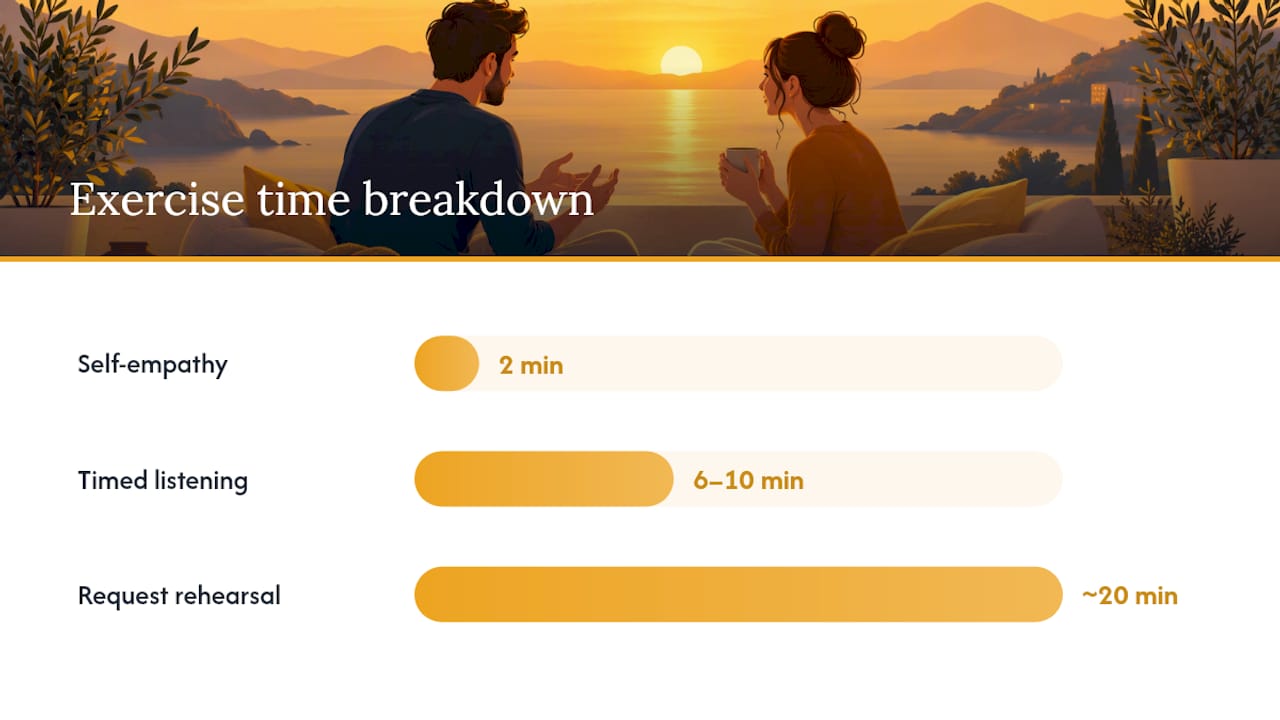
You do not need a therapy background to try this. These three exercises take under thirty minutes combined and work best done in order.
- Two-minute self-empathy. Before you say anything to your partner, sit quietly and name your own feeling and need out loud or on paper. Research on NVC in relationships notes that this brief self-check reduces reactivity and keeps the conversation from opening on the defensive. Then form one request: specific, doable, and stated positively, like “Can we talk after dinner?” instead of “Stop ignoring me.”
- Timed empathic listening. Partner A talks for three to five minutes about a frustration while Partner B only reflects back feelings and needs, no advice, no rebuttal. Then switch roles. A kitchen timer keeps this fair and stops one person from dominating the floor.
- Request rehearsal. Take a recurring complaint and turn it into three different possible requests instead of one fixed demand. This turns a standoff into a menu of options your partner can actually say yes to.
Use a visible timer so both partners trust the boundaries, and agree beforehand on a pause signal, a raised hand or a single word, for when either person needs a break. If a partner reacts defensively, that is normal early on: slow down and return to self-empathy rather than pushing the exercise through.
Pro Tip: Practice these exercises on a mild disagreement first, not your biggest recurring fight, so the skill feels doable before you test it under real pressure.
Why validation has to come before problem-solving
Validation means letting your partner know their feelings make sense, even if you do not agree with their conclusion. It is not the same as saying they are right, and confusing the two is where a lot of couples get stuck. Verywell Mind’s explanation of emotional validation points to reflecting feelings back, keeping open body language, and avoiding interruptions as concrete techniques that work alongside NVC.
Three quick validating moves:
- Reflect what you heard before responding: “So you felt dismissed when I checked my phone.”
- Name the need underneath the complaint instead of arguing the facts.
- Ask a curious question rather than offering a fix: “What would have felt better in that moment?”
A paired example: your partner says, “You never help with dinner.” Validating first sounds like, “You’re feeling stretched thin and want more support in the evenings.” Only after that lands do you move into the observation, feeling, need, request sequence together.
When NVC is not the right tool
NVC assumes both partners are safe enough to be vulnerable and that either person can decline a request without punishment. A primer on intimate relationships makes the point directly: if refusing a request leads to withdrawal, guilt, or retaliation, it was never a request, it was a demand in disguise.
Communication exercises like these are built for situational conflict, arguments about chores, time, or misunderstandings, not for relationships marked by coercive control or violence. Watch for these signs that mean it is time to stop practicing and get specialized support instead:
- One partner consistently controls money, movement, or contact with friends and family.
- Disagreements escalate to threats, intimidation, or physical aggression.
- One partner uses guilt, silence, or punishment to shut down the other’s requests.
If any of these describe your relationship, contact a local domestic violence hotline or a trauma-informed therapist before attempting structured communication exercises at home. Safety planning comes first, skill-building comes after.
How structured coaching turns NVC into a daily habit
Reading about the four components is one thing. Using them mid-argument, with your heart rate up, is another. That gap is where structured programs earn their place. A framework like this adds what solo reading usually lacks: sequencing conflict conversations so partners know what step comes next instead of freezing or escalating.
A framework like this adds what solo reading usually lacks:
- Sequencing, so you are not guessing what to do after naming a feeling.
- Accountability, through coaching or workbook check-ins instead of good intentions alone.
- Repeated practice, built into a course or workbook rather than left to memory.
For couples who find the exercises above clarifying but still get stuck mid-fight, that is usually the signal to move from self-practice into a guided course or a coaching session built for exactly that moment.
What progress with NVC actually looks like
Expect it to feel stiff for a while. Naming feelings and needs out loud is not how most of us were raised to talk, and the research on couples applying NVC notes that this clunky phase is common before it becomes natural. Aim for small, regular practice over perfect scripts.
The goal is not reciting the four steps correctly. It is your partner feeling understood by the end of a hard conversation. When you stall out repeatedly, pairing self-practice with a guided program or a coach is not a failure, it is how most couples actually get unstuck.
— Carlos
Courses, coaching, and workbooks that teach these skills
Learning the four components from an article gets you started. Turning them into a habit under real pressure is a different task, and it is where Couples Fight School’s resources are built to help. The Stop the Fighting: The Couples Communication & Conflict Resolution Course walks couples through structured scripts and sequencing so a hard conversation has a clear shape instead of spiraling.

- Workbooks give you scripts and reflection exercises to practice on your own timeline.
- Video courses walk both partners through the same framework together, so you are not the only one who read the material.
- Coaching and intensives provide live feedback in the moment when self-practice alone is not cutting through a recurring fight.
If you want a faster reset than weekly self-practice allows, the full catalog of courses and workbooks is the place to start.
Sources
- What Is Emotional Validation? (Verywell Mind)
- Why The 7-7-7 Rule Should Be A Conversation Starter, Not A Cure (HuffPost)
- Purpose of NVC (CNVC)
FAQ
What is the 7-7-7 rule for couples?
The 7-7-7 rule is a structured conversation format some couples use as a check-in ritual, and relationship coaches caution it works best as a scaffold, not a strict formula. Used rigidly, it risks turning into a performance of connection rather than genuine curiosity about your partner.
What are the criticisms of nonviolent communication?
A common critique is that NVC can feel scripted or robotic when partners recite the steps without genuine self-empathy first, which comes across as interrogation rather than dialogue. Critics also note that a request only counts as nonviolent if your partner can decline it without facing withdrawal or guilt.
Does NVC work in personal relationships?
NVC can improve how couples handle everyday friction when both partners practice empathic listening and accurately name feelings and needs, which research on NVC applications links to relationship satisfaction. It works best for situational disagreements and is not designed to address coercive control or abuse.
What are the psychological signs of a low-effort husband?
This question points to a broader concern about emotional investment rather than a clinical diagnosis, and no established framework in this article defines it as a fixed checklist. A more useful approach is naming the specific behavior you are noticing, like unreturned effort in conversations, and using an observation-feeling-need-request script to raise it directly.
When should couples get professional help instead of practicing NVC alone?
If practicing these exercises leads to escalation, stonewalling, or one partner consistently shutting down requests, that is a signal to bring in a trauma-informed therapist or couples counselor. Structured coaching or a couples intensive can also help when self-practice repeatedly stalls on the same recurring conflict.
Recommended
- Six Therapist Backed Communication Exercises Couples Can Do Tonight
- 6 Research Backed Conflict De-escalation Techniques with Ready Scripts
- Imago Dialogue Steps: 10–15 Clinician Backed Scripts for Couples