
How to Build Emotional Intimacy Before Marriage

Emotional intimacy is defined as the state of feeling safe, fully known, and deeply connected with your partner at a level that allows genuine vulnerability without fear of judgment. To build emotional intimacy before marriage, you need more than love and good intentions. You need trust, emotional safety, and the daily habits that create a foundation strong enough to hold a marriage together. Research shows that premarital education reduces divorce risk by 31% through communication and conflict skills training. That number tells you something critical: the couples who invest in connection before the wedding are statistically more likely to stay connected after it.
What foundational elements are needed to build emotional intimacy before marriage?
Emotional intimacy, known in clinical psychology as relational closeness, rests on three non-negotiable foundations: trust, emotional safety, and responsive communication. Without all three, vulnerability stays shallow and connection stays surface-level.
Trust is not built through grand romantic gestures. It accumulates through consistent, predictable behavior over time. When your partner says they will call, they call. When they say something is private, it stays private. Trust is the permission slip for vulnerability, and without it, emotional intimacy cannot grow past a certain depth.

Emotional safety means your partner can share a fear, a failure, or a difficult feeling without bracing for criticism, ridicule, or dismissal. Many couples confuse the absence of fighting with emotional safety. They are not the same thing. A relationship can be conflict-free and still be emotionally cold if one or both partners have learned to self-censor.
Communication quality matters far more than communication quantity. More talking alone does not build intimacy. What builds it is the quality of how you respond when your partner reaches toward you. Gottman Institute research describes these small reaching moments as “bids for connection,” and how you respond to them predicts long-term relationship stability more accurately than how you handle big arguments.
- Trust is built through small, consistent actions repeated daily, not occasional grand gestures.
- Emotional safety requires zero-judgment responses, especially to difficult or vulnerable disclosures.
- Communication skills include learning to listen without immediately problem-solving or redirecting.
- Responsiveness to small bids for connection, a smile, a question, a touch, compounds into deep relational trust over months and years.
Pro Tip: Before your next difficult conversation, agree on one rule: no fixing allowed. The listener’s only job is to understand. This single shift changes the emotional temperature of most conversations immediately.
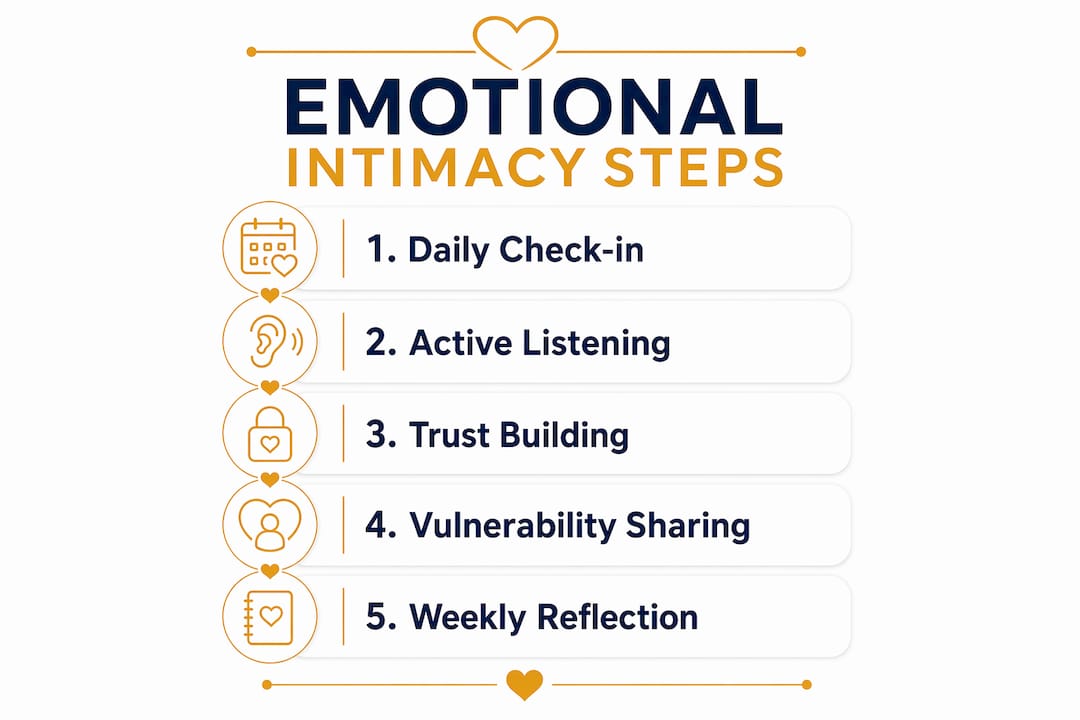
How to cultivate emotional closeness daily: practical habits
The most effective daily habits for developing emotional ties are not complicated. They are small, repeatable, and easy to skip when life gets busy. That is exactly why intentionality matters.
-
Daily emotional check-ins. Set aside 10 to 15 minutes each day to ask your partner one genuine question about their inner world. Not “How was your day?” but “What felt hardest today?” or “What are you most looking forward to this week?” Daily deliberate connection of just 15 minutes produces meaningful growth in intimacy over time. The key is consistency, not duration.
-
Respond to bids for connection quickly. A bid is any small attempt your partner makes to connect: sharing a funny video, mentioning a worry, asking for your opinion on something minor. Responding to bids more often is directly linked to lower divorce rates in Gottman Institute research. Turning toward these moments, rather than away or against them, is one of the highest-return habits you can build before marriage.
-
Practice stress-reducing conversations. Sharing external stressors about work or family three times a week helps maintain emotional closeness by keeping partners inside each other’s world. The rule here is that the listener focuses entirely on empathy, not solutions. This is not a problem-solving session. It is a connection ritual.
-
Use clean vulnerability. Vulnerability is not venting or oversharing. It is the practice of naming a specific feeling and a specific need clearly. “I feel anxious about the wedding budget and I need reassurance that we are a team” is clean vulnerability. “You never listen to me about money” is not. The difference is the difference between connection and conflict.
-
Incorporate non-sexual physical touch intentionally. Non-sexual touch releases oxytocin, the bonding hormone, and changes how partners perceive physical contact over time, making it feel safe and comforting rather than transactional. A hand on the shoulder, a long hug at the end of the day, or sitting close while watching television all count.
Pro Tip: Schedule a weekly 20-minute “State of Us” conversation where each partner shares one thing they appreciated about the other and one thing they need more of. Keep it structured and keep it kind. Couples who do this consistently report feeling more understood within 30 days.
Which premarital counseling approaches actually work?
Premarital counseling is the structured process of working with a licensed professional to surface communication patterns, conflict styles, and relational expectations before marriage. Premarital counseling success is linked specifically to training couples in their own predictable interaction patterns under stress, not generic relationship advice. This distinction matters because what works for one couple may not work for another.
Emotion-Focused Therapy (EFT), developed by Dr. Sue Johnson, is one of the most rigorously studied approaches for building relational intimacy. EFT significantly improves marital intimacy and adjustment with large effect sizes, specifically η² = .662 for intimacy and η² = .89 for adjustment in controlled studies. Those numbers represent real, measurable change in how connected couples feel and how well they function together. EFT works through repeated guided cycles of emotion processing and repair, not through one-time vulnerability exercises.
Here is how four major premarital education models compare:
| Program | Core Focus | Best For |
|---|---|---|
| PREP (Prevention and Relationship Enhancement Program) | Communication and conflict skills | Couples with high conflict patterns |
| Gottman Method | Friendship, conflict management, shared meaning | Couples wanting research-backed structure |
| SYMBIS (Save Your Marriage Before It Starts) | Values, expectations, and personality alignment | Faith-based or values-driven couples |
| Prepare-Enrich | Comprehensive assessment across 20 relationship areas | Couples wanting a diagnostic starting point |
No single program is universally superior. The right choice depends on your specific patterns, values, and what you most need to strengthen. A licensed counselor can help you identify which model fits your relationship best.
- EFT is the strongest evidence-based option for couples dealing with emotional distance or attachment injuries.
- Gottman Method works well for couples who want practical tools grounded in decades of research.
- SYMBIS and Prepare-Enrich are strong choices for couples in faith communities or those who want a structured assessment first.
- Attending 4 to 8 sessions produces statistically significant results, according to the research on premarital session outcomes.
What mistakes destroy emotional intimacy before marriage?
The most common mistake couples make is waiting for the “right moment” to have deep conversations instead of building connection through consistent small moments. Emotional intimacy grows from frequent small positive interactions, not infrequent deep talks. Saving everything for a monthly check-in creates emotional distance, not depth.
The second major mistake is confusing fixing with caring. When your partner shares a problem and you immediately offer solutions, you signal that you are more interested in resolving the discomfort than in understanding their experience. Most people do not want to be fixed. They want to be heard. Learning to sit with your partner’s pain without rushing to eliminate it is one of the most powerful intimacy skills you can develop before marriage.
Avoiding conflict is another intimacy killer. Couples who sidestep difficult conversations in the name of keeping the peace accumulate unspoken resentments that eventually surface as contempt or emotional withdrawal. The goal is not conflict-free. The goal is conflict-capable. You can learn to manage relationship conflict in ways that bring you closer rather than drive you apart.
The four behaviors that most reliably destroy emotional safety are criticism, contempt, defensiveness, and stonewalling. These Four Horsemen patterns create emotionally unsafe environments where vulnerability becomes impossible. Recognizing them in your own behavior, not just your partner’s, is where real change begins.
- Replace criticism with complaints. “You never help” is criticism. “I need more help with dinner prep” is a complaint. One attacks character; the other addresses behavior.
- Counter contempt with specific appreciation. Name what your partner does well, regularly and specifically.
- Replace defensiveness with accountability. “You’re right, I dropped the ball on that” builds more trust than any defense ever will.
- Break stonewalling cycles with agreed-upon time-outs. A 20-minute break with a committed return time is repair, not avoidance.
Pro Tip: Create a repair ritual before you need it. Agree on a signal, a word, a gesture, or a phrase that means “I want to de-escalate and reconnect.” Having it in place before conflict hits means you can use it when emotions are high and logic is low.
Key takeaways
Building emotional intimacy before marriage requires daily responsiveness, emotional safety, and structured skill-building through evidence-based approaches like EFT and premarital counseling.
| Point | Details |
|---|---|
| Trust is built daily | Small, consistent actions create the trust that allows genuine vulnerability to develop. |
| Respond to bids for connection | Turning toward small reaching moments predicts long-term stability more than big conversations. |
| EFT produces measurable results | Emotion-Focused Therapy shows large effect sizes for both intimacy and marital adjustment. |
| Avoid the Four Horsemen | Criticism, contempt, defensiveness, and stonewalling destroy emotional safety faster than any argument. |
| Premarital counseling cuts divorce risk | Couples attending 4 to 8 sessions show statistically lower separation rates. |
What I’ve learned about intimacy that most couples find out too late
After years of working with couples as a licensed mental health professional and co-founder of Couplesfightschool, the pattern I see most often is this: couples wait. They wait for the right time to have the hard conversation. They wait until they are engaged to start working on communication. They wait until after the wedding to address the emotional distance that has been growing for months.
Emotional intimacy does not wait. It either grows or it shrinks, and it does so based on what you do on ordinary Tuesdays, not on anniversaries or milestone conversations.
The couples who come to me with the strongest foundations are not the ones who had the fewest problems before marriage. They are the ones who built the habit of turning toward each other early, consistently, and without waiting for a crisis to make it feel urgent. They learned to diffuse conflict before it escalated into patterns that required months to undo.
One more thing I want to say directly: premarital counseling is not a sign that your relationship is struggling. It is a sign that you are serious about building something that lasts. The couples who invest in skill-building before marriage are not the ones who think their relationship is broken. They are the ones who understand that a strong marriage is built, not found.
Do not wait for a problem to give you permission to invest in your relationship. Start now, with the small habits, the daily check-ins, and the willingness to be known.
— Carlos
Ready to build a deeper connection before you say “I do”?
Couplesfightschool was built specifically for couples who want to do the work before marriage, not after. Founded by licensed mental health professionals Carlos Todd and Natasha Pemberton-Todd, the platform combines psychology-backed tools with real-world communication skills that you can use starting today.
Whether you are looking for structured guidance through online coaching for couples or want to work through the Fight Less Love More course at your own pace, Couplesfightschool gives you the frameworks, the practice, and the professional support to build emotional intimacy that holds. The couples who invest now arrive at marriage with skills, not just hope.
FAQ
What does it mean to build emotional intimacy before marriage?
Building emotional intimacy before marriage means developing the trust, safety, and vulnerability that allow partners to feel fully known and deeply connected. It is a process built through daily habits and responsive communication, not a single conversation or milestone.
How long does it take to build emotional intimacy in a relationship?
There is no fixed timeline, but research shows that consistent daily connection of as little as 15 minutes produces meaningful intimacy growth over time. The key variable is consistency, not intensity.
Is premarital counseling worth it for couples who are already close?
Premarital counseling benefits every couple because it surfaces communication and conflict patterns that only appear under stress. Couples who attend 4 to 8 sessions show statistically lower separation rates regardless of how strong their relationship feels at the start.
What is the biggest barrier to emotional intimacy before marriage?
The most common barrier is avoiding conflict to preserve harmony, which creates emotional distance instead of closeness. Couples who learn to engage conflict constructively, rather than avoid it, build significantly deeper connection over time.
How does Emotion-Focused Therapy help couples build intimacy?
EFT builds intimacy through repeated guided cycles of emotion processing and relational repair, producing large effect sizes for both intimacy and marital adjustment in controlled studies. It is one of the most evidence-based options available for couples seeking to deepen their emotional connection before marriage.
Recommended
- How to Convince Spouse to Take Marriage Course with You
- How to Choose the Right Partner and Fight Less