
Individual Therapy’s Role in Couple Recovery

Individual therapy is defined as a one-on-one therapeutic process that stabilizes your internal emotional state, processes personal trauma, and builds the self-regulation capacity required for successful couple recovery. When a relationship has been damaged by betrayal, chronic conflict, or emotional distance, the instinct is often to jump straight into couples therapy. That instinct, while understandable, skips a critical step. The role of individual therapy in couple recovery is to prepare each person internally so that couples work can actually take hold. Without that foundation, even the best couples therapist is working against a nervous system that is not ready to receive repair.
How does individual therapy support emotional regulation during couple recovery?
Relational trauma, including betrayal, repeated conflict, or emotional neglect, dysregulates the nervous system in measurable ways. Your brain’s threat-detection system stays on high alert, making it nearly impossible to listen, reflect, or repair during a couples session. Individual therapy is recommended first after relational betrayal specifically to stabilize the nervous system before couples repair begins. This sequencing is not a preference. It is a clinical necessity.
When you are flooded, your prefrontal cortex, the part of the brain responsible for empathy and problem-solving, goes offline. Individual therapy gives you a private space to work through that flooding without the added pressure of your partner’s reactions. Modalities like EMDR (Eye Movement Desensitization and Reprocessing), somatic therapy, and mindfulness-based cognitive therapy are specifically designed to regulate the body’s stress response before relational work begins.

The practical result is significant. Couples therapy without individual stabilization can re-traumatize both partners through fight, flight, or freeze responses triggered mid-session. Individual therapy interrupts that cycle by expanding what therapists call the “window of tolerance,” the range of emotional intensity within which you can still think clearly and respond rather than react.
Signs that you may need individual therapy before or alongside couples work include:
- Feeling emotionally flooded or shut down during conversations with your partner
- Intrusive thoughts, hypervigilance, or difficulty sleeping related to the relationship
- Anxiety or depression that existed before the current relationship conflict
- A strong sense that your reactions are disproportionate to the moment
- Difficulty trusting your own perceptions or judgment
Pro Tip: If you notice your heart rate spiking, your chest tightening, or your mind going blank during conversations with your partner, those are signs of nervous system flooding. Tell your individual therapist. That is exactly the material individual therapy is designed to address before you bring it into a couples session.
How does personal trauma affect your relationship dynamics?
Unresolved personal trauma does not stay contained to your past. It travels with you into every relationship and surfaces most intensely in moments of conflict, intimacy, or perceived rejection. Attachment wounds from childhood, previous relationship trauma, or experiences of abandonment all shape how you interpret your partner’s behavior today. Individual therapy creates the space to identify those patterns without your partner present, which matters more than most people realize.
Individual therapy is preferred when the primary distress is internal, such as anxiety, trauma responses, or deep shame, rather than a conflict pattern between two people. This distinction is critical. Bringing unprocessed individual trauma into a couples session often derails the session entirely, because the therapist must now manage one person’s acute distress rather than the relational dynamic.
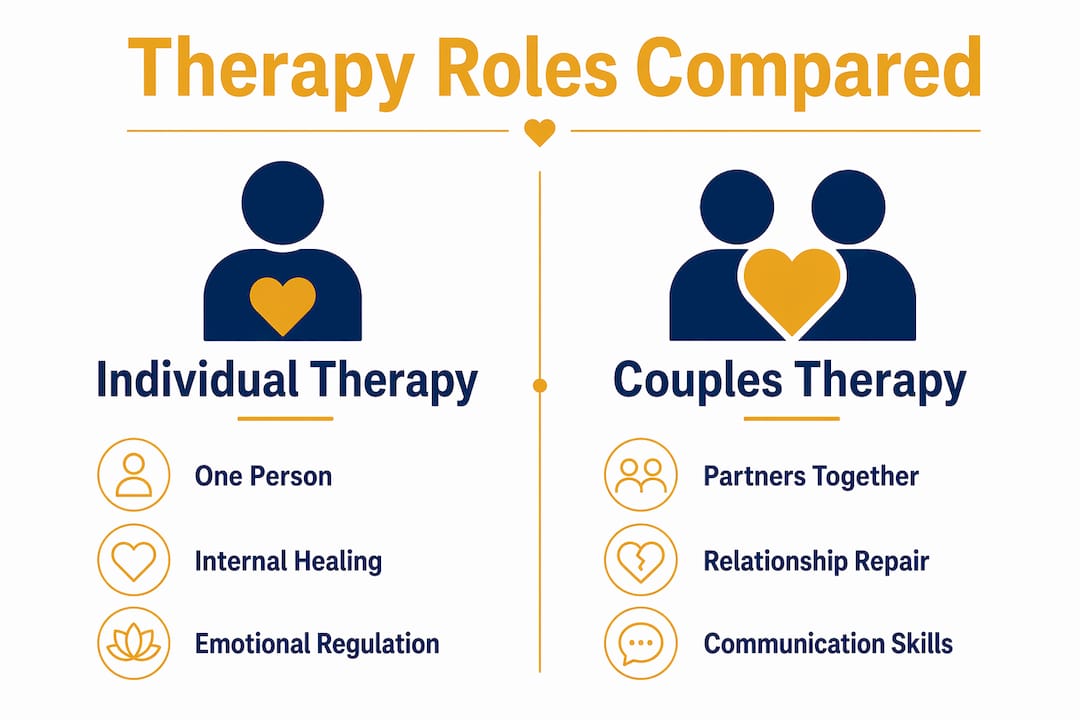
There is also an accountability issue. Couples therapy can shift accountability focus if one partner’s individual pain dominates the session. When the person who caused harm begins processing their own trauma in front of the injured partner, it can inadvertently minimize the injured partner’s experience. Individual therapy keeps those processes separate and clean.
The individual therapy benefits for relationship recovery include:
- Increased self-awareness about personal triggers and their origins
- Reduced projection of past wounds onto a current partner
- Greater capacity for accountability without collapsing into shame
- Clearer communication of needs because you understand them yourself first
- Reduced reactivity during conflict, which directly improves couple interactions
This work is not a detour from couple recovery. It is the most direct path to it. When you understand your own emotional architecture, you stop asking your partner to manage feelings that were never theirs to manage.
How do individual therapy and couples therapy complement each other?
The most effective couple recovery strategies do not treat individual therapy and couples therapy as competing options. They treat them as sequential or parallel tracks that serve different but interlocking purposes. Starting individual trauma therapy before couples therapy transforms the couples experience by increasing self-regulation and presence. You show up to couples sessions with more capacity, less reactivity, and a clearer sense of your own role in the dynamic.
Timing matters significantly. Safety, stability, and accountability must precede couple repair for the process to succeed. Therapists trained in betrayal-informed care typically assess each partner’s window of tolerance before recommending couples work. If either partner is still in acute trauma response, couples sessions are premature regardless of how motivated both people are.
The table below clarifies the distinct but complementary goals of each format.
| Focus area | Individual therapy | Couples therapy |
|---|---|---|
| Primary client | One person | The relationship itself |
| Core goal | Stabilize, process, and build self-awareness | Repair interaction cycles and rebuild trust |
| Best suited for | Internal distress, trauma, anxiety, shame | Relational patterns, communication breakdowns |
| Timing in recovery | Before or alongside couples work | After individual stabilization begins |
| Accountability focus | Personal responsibility and self-regulation | Shared patterns and relational repair |
Parallel individual and couples therapy focuses individual work on triggers, self-trust, and accountability while couples therapy addresses interaction cycles and repair. When both therapists communicate, with your consent, the coordination produces outcomes that neither format achieves alone. Individual therapy also reduces blame cycles and emotionally unsafe storytelling in betrayal recovery, which makes couples sessions more productive from the first appointment.
Pro Tip: Ask both your individual therapist and your couples therapist whether they are open to a brief coordination call. Many therapists welcome this. It prevents you from having to translate between two therapeutic relationships and keeps both tracks aligned toward the same recovery goals.
What practical steps help you integrate individual therapy into couple recovery?
Knowing that individual therapy matters is one thing. Knowing how to use it well is another. The following steps give you a concrete path forward.
-
Assess your internal distress first. If your suffering centers on anxiety, intrusive thoughts, shame, or trauma responses rather than a specific conflict pattern with your partner, individual therapy is your starting point. Individual therapy builds coping mechanisms and resolves emotional difficulties that directly aid recovery.
-
Choose a trauma-informed therapist. Not all individual therapists are trained in relational trauma. Look specifically for clinicians trained in EMDR, Internal Family Systems (IFS), somatic experiencing, or Emotionally Focused Individual Therapy (EFIT). These modalities address the nervous system directly rather than working only at the cognitive level.
-
Be transparent with your partner about your goals. You do not need to share session content, but telling your partner that you are working on your own regulation and self-awareness reduces suspicion and models the kind of personal accountability that couple recovery requires. Resources like the couples therapy workbook from Couplesfightschool can help both of you stay aligned on shared recovery goals even while doing separate work.
-
Set clear goals with your individual therapist. Tell your therapist explicitly that you are in or planning couples therapy. Ask them to help you build emotional regulation skills, identify your personal triggers, and develop language for your internal experience. This focus keeps individual therapy in service of the relationship without making the relationship the only topic.
-
Manage your expectations about timeline. Healing from infidelity typically takes 18 to 24 months with both partners engaged, and recovery is non-linear. Individual therapy is not a shortcut. It is the work that makes the rest of the work possible.
-
Practice self-care as a therapeutic tool. Sleep, physical movement, and time with supportive people outside the relationship are not luxuries during recovery. They are nervous system regulators that extend the work you do in individual sessions. Couplesfightschool’s guide on how to fight less and love more offers practical communication tools that complement individual therapy work between sessions.
Key takeaways
Individual therapy is the prerequisite for effective couple recovery because it stabilizes the nervous system, processes personal trauma, and builds the self-regulation capacity that couples therapy requires to succeed.
| Point | Details |
|---|---|
| Sequence matters | Individual therapy should begin before or alongside couples therapy to prevent retraumatization. |
| Internal distress needs individual focus | Anxiety, trauma, and shame are best addressed one-on-one before bringing them into couples sessions. |
| Parallel tracks produce better outcomes | Individual and couples therapy working together reduce blame cycles and improve relational repair. |
| Trauma-informed modalities are most effective | EMDR, IFS, and somatic therapy directly address nervous system dysregulation in relational trauma. |
| Recovery takes time | Healing is non-linear and typically spans 18 to 24 months with consistent therapeutic support. |
What I’ve learned from watching couples skip this step
I have worked with hundreds of couples over the years, and the pattern I see most consistently is this: couples who struggle most in joint sessions are almost always the ones where one or both partners came in without any individual support. They are trying to repair a relationship while simultaneously managing an unregulated nervous system, unprocessed grief, and a shame response that has nowhere to go. It is like trying to rebuild a house during an active storm.
What surprises people is that individual therapy is not a sign that the relationship is secondary. It is actually the most relationship-focused thing you can do. When you understand your own triggers, when you have processed your own history, and when you can stay present under emotional pressure, you become a fundamentally different partner in the room. The couples work gets traction because you have traction internally.
The other thing I want to say directly: if you are the person who caused harm in the relationship, individual therapy is not optional. Processing your own shame, your own history, and your own accountability in a private space protects your partner from having to witness your healing at the expense of their own. That is not fair to them, and most couples therapists will tell you the same thing. Betrayal recovery, in particular, requires that both people have their own therapeutic container. The forms that betrayal takes in relationships are broader than most people recognize, and individual therapy helps each partner understand their specific experience clearly.
Prioritize your personal healing. Not instead of the relationship, but as the foundation for it.
— Carlos
Ready to take the next step in your recovery?
Couplesfightschool was built by licensed mental health professionals who understand that relationship healing requires both individual and relational work. Whether you are just beginning to process what happened or you are ready to rebuild alongside your partner, professional guidance makes the difference between spinning in pain and actually moving forward.
The online coaching for couples program at Couplesfightschool integrates the kind of individual support and relational skill-building that this article describes, delivered by professionals who specialize in conflict resolution and emotional intimacy. You can also explore resources on emotional safety in relationships to understand what a healthy foundation for recovery actually looks and feels like. Your healing is worth the investment.
FAQ
What is the role of individual therapy in couple recovery?
Individual therapy stabilizes the nervous system, processes personal trauma, and builds emotional regulation skills that make couples therapy more effective. It is the internal foundation that relational repair requires.
Can therapy help couples even when only one partner attends?
One partner doing individual therapy still improves the relationship by reducing reactivity, increasing self-awareness, and breaking personal patterns that fuel conflict. Both partners attending individual therapy produces the strongest outcomes.
Should individual therapy come before couples therapy?
Individual therapy should begin before or alongside couples therapy when either partner is experiencing acute trauma responses, anxiety, or internal distress. Entering couples therapy without individual stabilization risks retraumatization during sessions.
How does individual therapy improve communication in relationships?
Individual therapy helps you identify your triggers, understand your emotional responses, and develop language for your internal experience. That self-knowledge translates directly into clearer, less reactive communication with your partner.
How long does individual therapy take to support couple recovery?
Recovery timelines vary, but healing from significant relational trauma typically spans 18 to 24 months with consistent support from both individual and couples therapy working in parallel.
Recommended
- Best Online Couples Therapy Alternatives for Long-Distance Relationships – Couples Fight School
- StripeM-Inner