
Money Fights in Marriage: 20–30 Minute Values First Fix by Therapists

Money fights are almost never about the dollar amount. They’re proxy fights over values, control, and safety, and treating them as a spreadsheet problem keeps couples stuck. Start with a 20 to 30 minute “money date” this week: name what money means to each of you, agree on a simple “yours/mine/ours” account rule, and put every debt and asset on the table. The research and tools below explain why this works and how to run it.
TL;DR:
- Money fights often stem from control, values, and safety issues rather than the dollar amount, making clear communication and transparency essential.
- Consistent patterns like unfair contributions, secret accounts, and disagreements over big or small expenses perpetuate conflict, especially when trust is broken.
- Implementing a structured “money date” with check-ins, storytelling, values mapping, and small action steps can significantly reduce ongoing disputes.
- Three primary account models—fully joint, fully separate, and hybrid—work well when accompanied by explicit rules and regular reassessment; hybrid models are especially favored by younger couples.
- Couples experiencing repeated, entrenched conflicts, secrecy, or trust breaches should seek professional help from therapists or financial advisors rather than relying solely on routine discussions.
Table of Contents
- Why Do Money Fights Happen in Marriage?
- What Patterns Keep Showing Up in Money Arguments?
- Should Couples Combine, Separate, or Split Their Finances?
- How Should Couples Talk About Money Without Fighting?
- When Does a Money Fight Need Professional Help?
- The F.I.G.H.T. Plan® Approach to Money Conflicts
- A Therapist’s Take on What Actually Changes Money Fights
- Ready-Made Tools for Couples Who Are Done Fighting About Money
- Sources
- FAQ
Why Do Money Fights Happen in Marriage?
Money is the single most common relationship stressor. Money fights escalate faster and cut deeper than most other marital arguments. According to the American Psychological Association, 31% of adults with partners name money as a major source of conflict, and it consistently predicts relationship stress and divorce risk. That number surprises people who assume communication or intimacy problems top the list. Money outranks both, because money is never just money. It’s a stand-in for security, fairness, freedom, and sometimes love itself.
Financial therapists use the term “money scripts” to describe the unconscious beliefs each partner brings into the marriage, usually formed in childhood. Three show up constantly in couples work:
- Scarcity scripts: “There’s never enough,” which drives hoarding, anxiety spending, or refusal to enjoy money even when it’s available.
- Money-equals-love scripts: Gifts and spending become the language of affection, so a partner who says no to a purchase feels like they’re withholding love.
- Money-equals-shame scripts: Debt or a low income becomes tied to self-worth, so any conversation about finances triggers defensiveness instead of problem-solving.
These scripts collide with power. Whoever earns more, or controls the accounts, often controls the decisions, even in marriages that consider themselves equal partners. That imbalance doesn’t have to be malicious to cause damage. A partner who manages all the bills without meaning to exclude the other can still create a dynamic where one person feels like a dependent rather than an equal owner of the household’s finances. Financial transparency in relationships starts with noticing who holds the information and who’s left guessing.
What Patterns Keep Showing Up in Money Arguments?
A thematic analysis of couples’ recalled conflicts and social media posts found the same handful of fight patterns repeating across hundreds of relationships. Researchers organized them along two axes: fairness and responsibility. Couples who land at the extremes of either axis, one partner feeling wildly overburdened or wildly excluded, report significantly worse relationship outcomes, according to the study published on PMC.
- Unfair contributions. One partner feels they’re carrying more of the financial load relative to income, effort, or sacrifice, even if the dollar figures look balanced on paper.
- Who pays for what. Recurring bills become symbolic battles: whoever “always” covers groceries or the mortgage starts keeping score, whether they admit it or not.
- Exceptional expenses. A big-ticket purchase, a vacation, a bailout for a family member, exposes value differences that day-to-day spending never surfaces.
- Mundane expenses. Small, repeated purchases (coffee, subscriptions, takeout) become flashpoints because they reveal priorities more honestly than any one-time decision does.
The classic saver-versus-spender dynamic sits on top of all four. Savers feel like they’re the only responsible adult in the house; spenders feel judged, controlled, or punished for enjoying money they helped earn. Both positions are internally logical, which is exactly why the fight never resolves through logic alone.
Financial infidelity, hiding purchases, secret accounts, or undisclosed debt, does more damage than almost any other money pattern. Research covered by Northeastern University links it to trust erosion that closely resembles the aftermath of an affair. Secrecy about money doesn’t just create a financial problem. It creates a belief that your partner will lie to protect themselves, and that belief outlasts whatever the money was spent on.
Should Couples Combine, Separate, or Split Their Finances?
There’s no single correct account structure, but there are three workable models, and each one needs explicit rules or it collapses into resentment.
- Fully joint. Every dollar goes into shared accounts. Works best when incomes are similar and both partners have equal say in every purchase decision, with an agreed dollar threshold (say, $200) above which either partner checks in before spending.
- Fully separate. Each partner keeps individual accounts and splits shared bills by percentage of income rather than a flat 50/50 split, which avoids punishing the lower earner.
- Hybrid (“yours, mine, ours”). A joint account covers shared bills and goals. Personal accounts stay untouched and unquestioned. Psychology Today reports that partially pooled systems like this often correlate with higher relationship satisfaction than fully pooled ones, because they preserve autonomy while still funding shared priorities.
Unequal incomes make the hybrid model especially useful. Instead of splitting bills evenly, each partner contributes a proportional share to the joint account and keeps the remainder as a personal allowance with no questions asked. Northwestern Mutual’s research notes that younger couples increasingly prefer this partial-pooling approach over either fully joint or fully separate systems.
If you’re not sure which model fits, run a three-month experiment: open one joint account for bills and savings goals, set a personal allowance for each partner, and revisit it at the money date after month three. Adjust before it becomes a grievance.
How Should Couples Talk About Money Without Fighting?
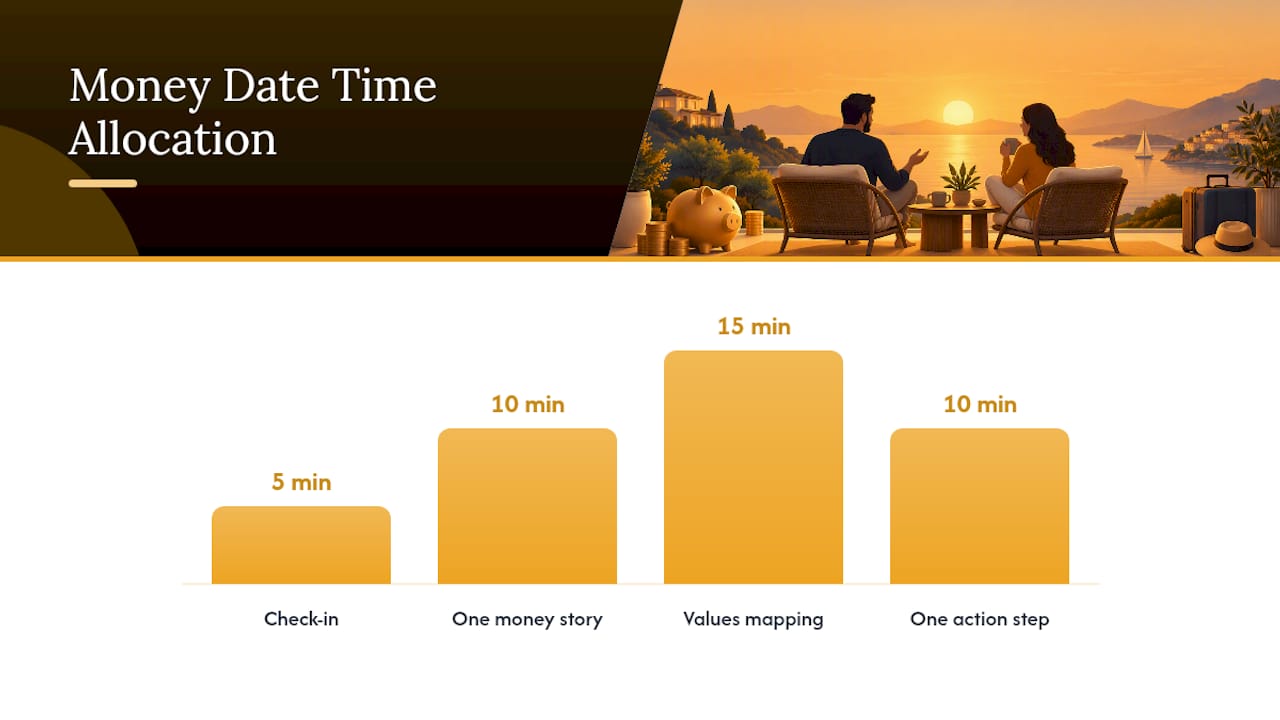
A repeatable routine beats a one-time heart-to-heart every time. Financial therapists recommend a structured “money date,” 30 to 45 minutes, scheduled like any other appointment, with four time-boxed parts:
- Check-in (5 minutes). How is each partner feeling about money right now, stress level only, no numbers yet.
- One money story (10 minutes). Each partner shares a memory that shaped how they see money, tying the conversation back to money scripts instead of current bills.
- Values mapping (15 minutes). What does each of you actually want money to do for your life together, security, experiences, generosity, freedom?
- One action step (10 minutes). Agree on a single, small next move. Not a full financial plan. One decision.
Three scripts make this easier to run without it turning into a debate:
- Opening: “I want to understand how you see this, not convince you I’m right.”
- Reflecting: “What I’m hearing is that this feels unfair because of X. Did I get that right?”
- Agreeing: “Can we try this for one month and revisit it, instead of deciding forever right now?”
Language matters more than most couples expect. Investopedia’s guide to resolving money conflicts recommends replacing the word “budget” with “spending plan,” since budget carries restriction and failure connotations that trigger shame scripts almost instantly. Goals-first framing, “here’s what we’re saving for,” works better than expense-first framing, “here’s what you’re not allowed to buy.” Fidelity’s research on couple communication backs scheduling these conversations regularly rather than waiting for a crisis to force one.
Pro Tip: Never start a money date the same day a bill surprised you. Wait 24 hours so the conversation is about the pattern, not the panic.
For couples who need help interrupting a fight already in motion rather than preventing the next one, a short de-escalation script can stop the spiral before it turns into the same argument you’ve had a dozen times before.
When Does a Money Fight Need Professional Help?
Some patterns are too entrenched, or too dangerous, for a money date to fix. Watch for these red flags:
- One partner discovers secret accounts, hidden debt, or undisclosed purchases more than once.
- Money is used as a threat: withholding funds, controlling access to accounts, or making the other partner ask permission for basic needs.
- The same fight repeats for months with zero movement, even after both partners try new approaches.
- Financial infidelity has already happened and trust hasn’t started rebuilding after a genuine attempt at transparency.
Which professional you need depends on what’s actually broken. A financial therapist specializes in the emotional and behavioral side of money, useful when scripts and shame are driving the conflict more than the numbers. A couples therapist helps when money is one symptom of a broader communication breakdown. A financial advisor helps once the emotional work is done and you need an actual plan, investment strategy, or debt payoff structure. Couples sometimes need two of the three, in sequence, not one instead of the other.
Walk into a first session with a short written summary: total debts, rough income for each partner, and the specific incident that pushed you to seek help. That saves the first session for the real conversation instead of paperwork, and it sets a realistic expectation that repair takes months, not one appointment.
The F.I.G.H.T. Plan® Approach to Money Conflicts
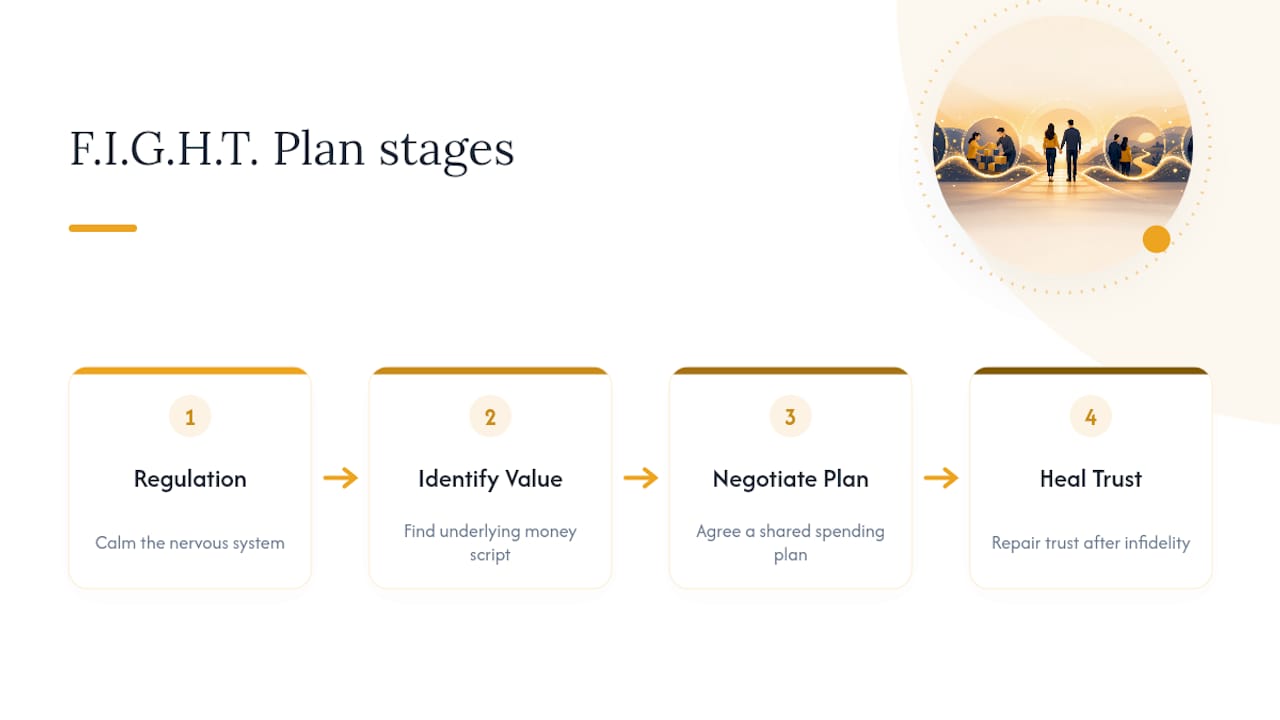
The licensed mental health professionals behind a relationship education platform built the F.I.G.H.T. Plan® specifically because most couples don’t need more financial information. They need a structure for the conversation itself. The framework maps cleanly onto money conflict, since the steps move a couple from regulation (calm the nervous system before discussing anything with dollar signs attached), to identifying the underlying value or money script driving the reaction, to negotiating a spending plan both partners can live with, to healing the trust damage when financial infidelity has already occurred.
Two exercises translate this into something you can try this week. First, a value-mapping worksheet: each partner writes down three things money is supposed to protect or provide (safety, freedom, generosity, status) and compares lists before discussing a single expense. Second, a 10-minute de-escalation script for the moment a money conversation starts heating up, three sentences, said out loud, before either partner tries to solve anything. Couples who use structured frameworks like this consistently report that the fight stops being about who’s right and starts being about what each of you actually needs.
A Therapist’s Take on What Actually Changes Money Fights
The couples who stop fighting about money aren’t the ones who have the best financial plan. They’re the ones who built a routine and stuck with it past the point of feeling awkward. One good conversation after a blowup rarely changes anything long term, because the underlying script that caused the blowup is still sitting there, waiting for the next trigger.
What works is boring: a weekly 20-minute check-in, and a personal allowance neither partner has to justify. That second piece matters more than people expect. Removing the need to explain every small purchase removes most of the daily friction before it ever becomes a fight. And if you’re already past the point where a conversation calms things down, get outside help sooner than feels necessary. Waiting rarely makes the pattern easier to unwind.
— Carlos
Ready-Made Tools for Couples Who Are Done Fighting About Money
Reading about money scripts is useful. Practicing them with your actual partner is what changes the outcome, and that’s where a structured resource earns its place over another late-night conversation that goes nowhere. This platform’s tools are built around the same idea driving this article: fix the value mismatch first, then the money follows.

If a single money date sounds like the right starting point, the Fight Less Love Again Video Course walks you through the same regulation and values-mapping steps at your own pace. Couples dealing with more entrenched patterns, repeated fights, financial infidelity, or a saver-spender standoff that’s lasted years, tend to get more traction from Online Couples Coaching, where a therapist-led session replaces guesswork with direct feedback. For couples who want a guided workbook to run their own money dates without live coaching, The F.I.G.H.T. Plan – Couples Conflict Toolkit gives you the scripts and worksheets in one place at $27. Whichever entry point fits your situation, the next step is the same: pick one resource and schedule your first money date this week.
Sources
- American Psychological Association — Money issues (practice update)
- When couples fight about money, what do they fight about? (PMC)
- Resolve money conflicts: A guide to financial peace in relationships — Investopedia
FAQ
Is money the number one cause of divorce?
Money isn’t always ranked as the single top cause, but it’s consistently one of the strongest predictors of relationship stress and divorce risk. The APA found that 31% of adults with partners identify money as a major conflict source, putting it ahead of many other commonly cited relationship problems.
What percentage of married couples fight about money?
Close to a third of partnered adults report money as a major source of conflict, according to APA data cited earlier in this article. The real number is likely higher, since many couples underreport money disagreements or don’t recognize a values clash as a “money fight” at all.
How do I deal with a financially irresponsible spouse?
Start by identifying whether the behavior is a values mismatch (different priorities) or a trust issue (hidden spending, secret debt). A structured money date and a spending plan built around shared goals resolves the first; the second usually needs financial transparency exercises and, if trust has broken down, a financial therapist or the F.I.G.H.T. Plan – Couples Conflict Toolkit to rebuild it.
What is the number one thing that destroys marriages?
No single factor destroys every marriage, but chronic, unresolved conflict, especially around money, is one of the most reliable predictors of long-term relationship breakdown. The deeper issue is rarely the money itself; it’s the values, power, and safety concerns money conflicts expose and leave unaddressed.
How much does Couples Fight School coaching cost?
Online Couples Coaching pricing is available directly on the coaching page. The VIP Private Coaching Session, which includes four sessions, is listed at $997.
Recommended
- Stop Arguing With Your Husband in 10 Minutes Using Therapist Scripts
- 5–10 Minute Check Ins Therapists Use to Fix Unmet Needs in Marriage
- Married Couples: Share the Mental Load With a 3–5 Chore System
- Stop a Fight Tonight: Clinician Backed Emotional Regulation for Couples