
Stop Arguments Tonight. 6 Reflective Listening Steps and Ready Scripts

Reflective listening is a communication skill where you listen fully, then reflect back what you heard so the speaker feels understood and misunderstandings get caught early. The core sequence is listen, pause, paraphrase, reflect the feeling, clarify if needed, and summarize. Used consistently in personal or work conversations, it makes the speaker feel heard and cuts down on the back-and-forth that comes from guessing at meaning.
TL;DR:
- Fully attentive listening and a brief pause after the speaker’s turn are crucial for accurately capturing content and emotion.
- Paraphrasing should condense the speaker’s point into fewer words starting with “So you’re saying” or “It sounds like,” rather than repeating verbatim.
- Naming feelings with a declarative statement rather than a question fosters trust and reduces defensiveness during conversations.
- Practice drills, such as micro-practices and role-plays, help develop reflective listening skills, especially when incorporating scripts for emotions and content.
- Correcting reflection mistakes with simple, honest feedback and using scripts like “It sounds like” and “You seem” improves the effectiveness of reflective responses.
Table of Contents
- How to work through each reflective listening step
- Why reflective listening actually changes conversations
- The mistakes that make reflective listening feel awkward
- Drills that build the skill through repetition
- Scripts you can borrow today
- What most people underestimate about learning this skill
- Practice reflective listening with guided tools from Couples Fight School
- Where to read more on reflective listening
- Sources
- FAQ
How to work through each reflective listening step
Reflective listening steps only feel natural once you have practiced the small behaviors inside each one. Here is what each step actually looks like in a live conversation.
- Listen attentively. Put the phone away, face the speaker, keep your posture open, and hold eye contact without staring. Resist forming your response while the other person is still talking. Practitioner guides on reflective listening consistently list full attention as the first building block.
- Pause before responding. Let a beat of silence pass after the speaker finishes. This gives them room to keep going if they were not done, and gives you a second to organize what you heard instead of jumping in half-formed.
- Paraphrase the content. Capture the gist in a sentence shorter than what they said. Open with “So you’re saying…” or “It sounds like…” and then compress their point instead of repeating it word for word.
- Reflect the emotion. Name the feeling as a statement, not a question: “You seem frustrated with how the schedule changed” lands better than “Are you frustrated?” Declarative phrasing signals you noticed the feeling rather than fishing for it, a distinction clinician notes on reflective listening treat as central to doing this well.
- Clarify only when something is genuinely unclear. Ask one short, open question, such as “When you say overwhelmed, do you mean with the workload or the deadline?” Skip clarifying questions when your paraphrase already covered the ground.
- Summarize and confirm next steps. Close the loop with a short recap and, if the conversation calls for it, name what happens next: “So the plan is you’ll send the draft Friday and I’ll review it over the weekend.”
Pro Tip: Keep your reflections shorter than the original statement. If you are talking as much as the speaker, you are paraphrasing, not reflecting.
Why reflective listening actually changes conversations
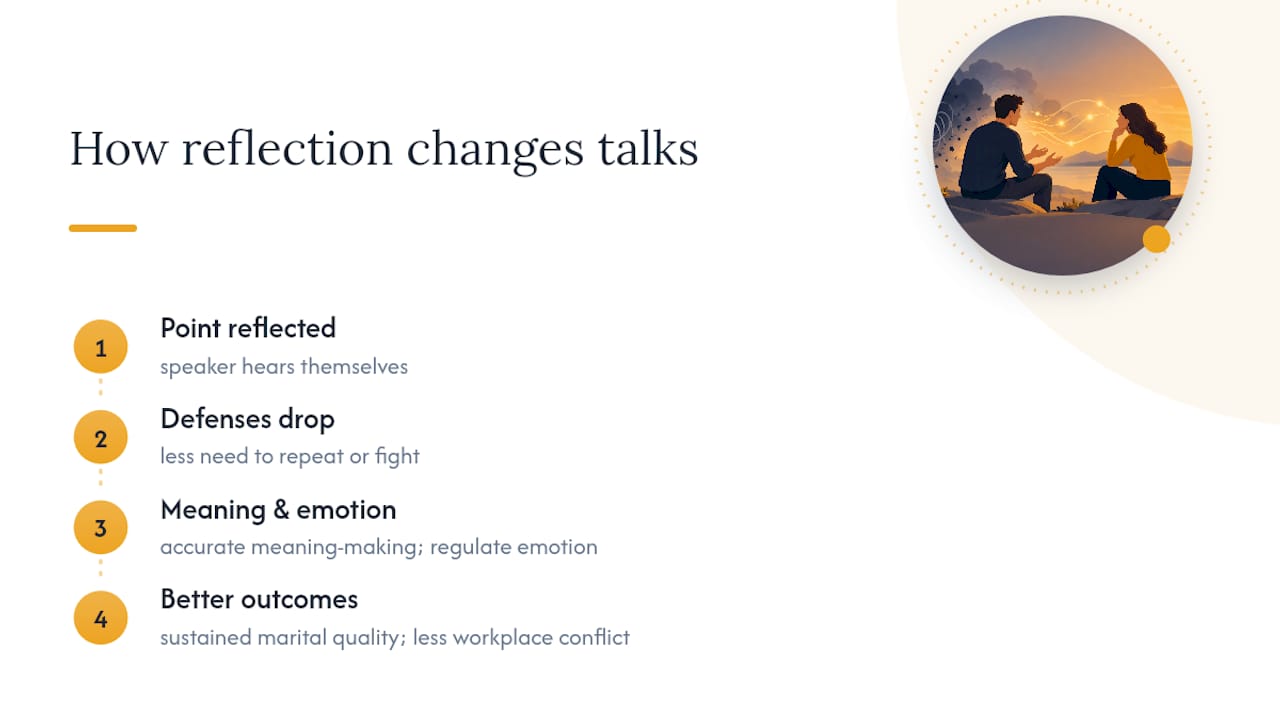
The mechanism is simpler than it sounds: when someone hears their own point reflected back accurately, they relax their defenses because they no longer feel the need to repeat themselves or fight to be understood. That drop in defensiveness leaves room for accurate meaning-making instead of assumption-filling, and it gives the speaker a moment to notice and regulate their own emotion rather than escalate it.
A brief conflict reappraisal intervention was found to eliminate the normative decline in marital quality over the second year of a two-year study of couples, according to research published in Psychological Science. That is a small dose of structured reflection doing outsized work over time.
The same logic holds outside relationships. Industry reporting on workplace listening links reflective and active listening to reduced conflict and stronger collaboration, since employees who feel heard tend to engage more openly with feedback instead of digging in.
The mistakes that make reflective listening feel awkward
Most people fumble the same handful of things when they start.
- Turning reflections into questions. “Are you upset?” sounds like an interrogation. Fix it by stating what you noticed: “You sound upset about this.”
- Parroting instead of paraphrasing. Repeating someone’s sentence back word for word feels robotic. Fix it by compressing their point into fewer words that capture the essence.
- Jumping to solutions too fast. Offering advice before the speaker feels understood shuts them down. Hold the advice until they have confirmed you got it right.
When a reflection misses the mark, say so plainly: “That wasn’t quite right, let me try again,” restate a shorter version, and invite them to correct you. This kind of recovery script, recommended in clinician notes on handling missed reflections, keeps trust intact even when your first guess was off.
Pro Tip: A wrong reflection is not a failure. It often prompts the speaker to explain further, which gets you both to clarity faster than a perfect guess would.
Drills that build the skill through repetition
Reflective listening steps stick when you rehearse them outside of high-stakes moments, not just during them.
- The 3-minute partner drill. One person talks for three minutes about anything real, then the listener spends one minute paraphrasing content and naming the emotion. Score yourself on whether you captured the gist and the feeling, not the exact words.
- Solo micro-practice. Pick a recent conversation and write two different reflections you could have used. This trains you to notice feeling words even when no one is watching.
- Workplace drill. Take a recent miscommunication, such as a missed deadline, and write one reflective line followed by a clarifying question: “It sounds like the timeline caught you off guard. Was the original date ever confirmed in writing?”
Aim for 5 to 10 minutes of daily micro-practice and one longer role-play each week. Short, frequent reps build the habit faster than occasional long sessions.
Scripts you can borrow today
Seeing the shift from raw complaint to reflection makes the technique easier to copy.
- Couples, before: “You never help with anything around here.” After: “You feel like you’re carrying the household on your own.” The speaker often follows with something like, “Yeah, especially with the kids’ schedules this month,” which gives you real specifics to work with.
- Workplace, before: “Nobody told me the deadline moved.” After: “You’re frustrated that the change didn’t reach you in time.” That opens the door to a shared next step, like agreeing on one channel for schedule updates going forward.
- Two lines worth memorizing: “It sounds like…” for content, and “You seem…” for emotion. Both work in almost any conversation without sounding scripted once you have used them a few times.
What most people underestimate about learning this skill
Students almost always nail the paraphrasing step fast and struggle far longer with naming emotions accurately. It is a distinct skill, not an extension of paraphrasing, and it takes deliberate reps to stop mistaking a judgment for a feeling. In teaching reflective listening skills, short, clinician-backed scripts are often used because they lower the mental load for beginners and provide exact phrasing to copy before improvising. The couples who progress fastest are the ones who practice the scripts daily, not just when a fight is already underway.
— Carlos
Practice reflective listening with guided tools from Couples Fight School

Reading the steps is one thing. Rehearsing them with real scripts and feedback is another, and that is where our resources come in. The Stop the Fighting: The Couples Communication & Conflict Resolution Course walks couples through structured exercises built around the same reflective listening sequence covered here, and our communication exercises give you short drills to rehearse tonight instead of waiting for the next argument to test your skills.
- Stop the Fighting course: structured lessons and paired exercises for practicing reflection as a couple.
- Private coaching options providing guided feedback on reflective skills.
| Resource | What it helps with |
|---|---|
| Stop the Fighting: The Couples Communication & Conflict Resolution Course | Structured practice of reflective listening steps |
| Private Coaching Sessions | Personalized feedback on reflective listening |
Browse the full shop for workbooks and courses, or book a coaching session if you want a therapist watching your practice directly.
Where to read more on reflective listening
These sources back the claims in this guide and are worth a closer read.
- Reflective listening: a guide to building better connections for the core step breakdown.
- A brief intervention to promote conflict reappraisal for the research behind the benefits.
- Our active listening exercises for guided practice templates.
Sources
- A Brief Intervention to Promote Conflict Reappraisal Preserves Marital Quality Over Time
- Reflective listening: a guide to building better connections
- Listening and reflective listening guidance (practitioner notes)
- How active listening and effective feedback work together to reduce workplace conflict
FAQ
What are the three stages of reflective listening?
Reflective listening is often broken into attending (giving full attention), reflecting (paraphrasing content and naming emotion), and clarifying or summarizing to confirm understanding. Different guides split these stages slightly differently, but the underlying moves stay the same: hear it, mirror it back, then check it.
What are the five principles of reflective practice?
Definitions vary across fields, but a common version drawn from listening guidance includes empathy, acceptance, congruence, and concreteness as core attitudes, alongside consistent attention to the speaker. Workplace listening resources frame these as the orientation that makes reflections land well rather than sound vague.
What are the five key listening techniques?
Common techniques include full attention, paraphrasing, reflecting emotion, asking open clarifying questions, and summarizing to confirm understanding. These map directly onto the step sequence covered earlier in this guide.
Can you give an example of reflective listening?
If someone says, “I feel like I’m always the one keeping this project on track,” a reflective response would be, “You’re frustrated carrying most of the responsibility alone.” That kind of declarative reflection, recommended in clinician guidance on reflective listening, often invites the speaker to add detail rather than shut the conversation down.
Recommended
- Stop Arguing With Your Husband in 10 Minutes Using Therapist Scripts
- 6 Research Backed Conflict De-escalation Techniques with Ready Scripts
- Six Therapist Backed Communication Exercises Couples Can Do Tonight
- Memorized Scripts for Four Horsemen Antidotes That Stop Fights Tonight