
Using a Couples Workbook: How to Make It Work

A couples workbook works when you treat it like a shared project: a set time each week, one chapter at a time, and a plan for what to do when a prompt stirs up an argument. Opened once and left on the nightstand, it does nothing. A therapist-created workbook gives you the structure so you spend your energy on each other instead of on figuring out what to talk about. Our F.I.G.H.T. Plan workbook is built that way, and the routine below works with it or any well-built workbook.
TL;DR
- Pick a workbook that matches your biggest issue (conflict, premarital planning, rebuilding trust after an affair, or faith-centered guidance) and agree on it together.
- Set a weekly time, set a goal, and schedule a check-in, as university-published relationship education materials advise.
- Work alone first when the material calls for it, then talk together, one chapter at a time.
- Stop and pause when a prompt turns into a fight. That is information, not failure.
- If exercises keep blowing up, add coaching or a structured course for guided support.
Table of Contents
- What a couples workbook actually is
- Choose the right workbook before you start
- Set it up: goals, time and a check-in
- Work through each chapter
- When a prompt turns into a fight
- Workbook, course or coaching: what each gives you
- Make the progress stick
- Your next step
- Our perspective
- FAQ
- Sources
What a couples workbook actually is
A couples workbook is a set of guided exercises, questions and conversation scripts that you complete alone and together. Instead of hoping a good talk happens, it gives you a prompt, a format and a way to practice a skill: listening without interrupting, stating a need without blame, calming down before you respond, repairing after a fight.
The skills it builds depend on the book. Ours are organized around the F.I.G.H.T. Plan®, a structured system for communication, emotional regulation, healing and relationship transformation, created by licensed mental health professionals Carlos Todd and Natasha Pemberton-Todd. Other titles focus on premarital preparation, healing after an affair, or conflict from a Christian perspective.
Choose the right workbook before you start
Most workbooks fail at the choosing stage. One partner buys something that fits their worry, the other feels accused, and it never gets opened. Choose together, and match the book to the situation you are in now.
| Your situation | Workbook that fits | Price range |
|---|---|---|
| Same arguments on repeat, criticism, defensiveness | The F.I.G.H.T. Plan: A Revolutionary Couples’ Communication and Conflict Resolution Workbook | $14.99-$25.00 |
| Engaged or planning marriage | F.O.R.E.V.E.R. Workbook, a premarital guide | $9.99-$20.00 |
| Trust broken by an affair | R.E.S.T.O.R.E Workbook, healing after an affair | $9.99-$20.00 |
| Faith is central to how you want to handle conflict | The Christian F.I.G.H.T. Plan Workbook | $9.99-$20.00 |
| You want a quick set of tools for the heat of the moment | The F.I.G.H.T. Plan Couples Conflict Toolkit | $27.00 |
All are listed on our shop page. The price range reflects the format you choose. If you want a look at how we think about the category first, see our guide to the couples therapy workbook.
Three things to check in any workbook:
- It gives you something to do, not just read. Prompts, scripts and reflection exercises beat chapters of theory.
- It goes in a sequence. Early chapters should build safety and basic communication before they ask for vulnerable topics.
- It fits your relationship. Dating, engaged, married, blended and faith-based couples face different pressures.
Set it up: goals, time and a check-in
University-published relationship education materials give a simple frame. The University of Georgia’s ELEVATE couples workbook, adapted from the National Extension Relationship and Marriage Education Network, asks couples to set specific, realistic goals, list shared needs and wants, come up with several ways to reach a goal, and schedule a regular progress check-in weekly, biweekly or monthly.
Turn that into a routine:
- Pick a fixed slot. Forty-five to sixty minutes, same day each week, phones away. Not right after a fight and not at midnight.
- Write one goal. “Argue about money without raising our voices” is workable. “Be happier” is not.
- Agree on ground rules first. No interrupting, no bringing up old cases, and either of you can call a ten-minute pause. Our ground rules quiz is a quick way to settle these.
- Book the check-in now. Put the first review on the calendar before you finish chapter one.
Work through each chapter
Start alone, then come together
Some designs separate the two steps on purpose. A 2026 Utah State University graduate report describes a paired workbook in which partners complete “Me” chapters separately to understand their own needs, then work through “We” chapters together to share what they learned. Even in a workbook that does not split things up, answering the reflection questions privately first gives each of you a clearer, calmer answer to bring to the table.
Run the conversation
- One person reads the prompt aloud.
- The first partner answers for a set time, say five minutes.
- The listener reflects back what they heard before responding.
- Swap.
- Finish with one thing you appreciated about the other’s answer.
The listener’s job is understanding, not rebuttal. If you want to try this format before committing to a full book, our six communication exercises couples can do tonight use the same approach.
Practice, then use it in real life
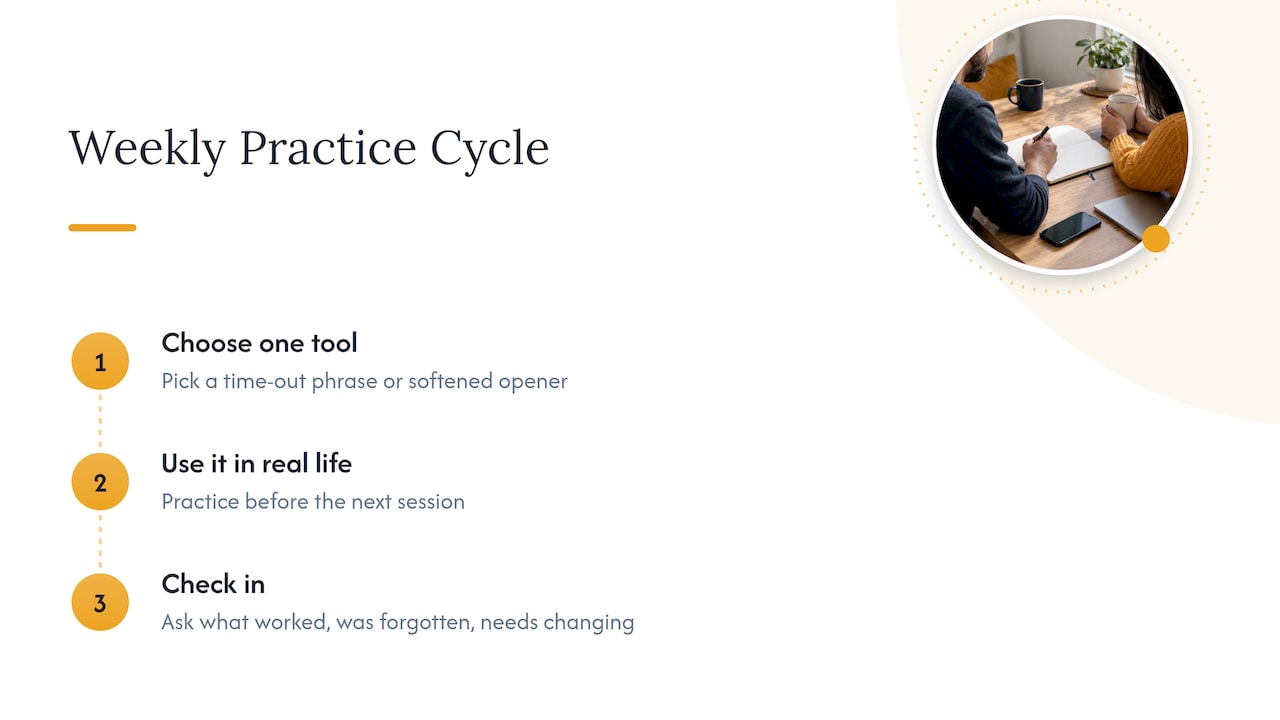
Reading a script is not a skill. Choose one tool a week, such as a time-out phrase or a softened way to open a hard topic, and use it in real situations before the next session. At the check-in, ask: when did it work, when did we forget, what will we change?
When a prompt turns into a fight
It will happen. A question about trust or money touches something raw, and you are suddenly in the pattern the workbook was meant to interrupt.
- Call the pause. Agree on a word beforehand. Take twenty minutes apart, then return.
- Go smaller. Skip to a lower-stakes prompt and come back to the hard one next week.
- Name the pattern, not the person. “We are in our criticism-and-defense loop” is easier to hear than “you always…”
- Keep the date. Skipping the next session after a bad one teaches you that hard topics are unsafe.
Some situations deserve more support than a book alone: heavy conflict, an affair, long emotional distance, or old trauma. In those cases, pair the workbook with guidance. Our Love & Trauma course is $47.00, and our online couples coaching lets you work through the material with a professional. If you or your partner ever feel unsafe, or there is any violence or threat of it, call the National Domestic Violence Hotline at 1-800-799-7233 rather than working through a workbook together.
Workbook, course or coaching: what each gives you
A workbook is the lowest-cost, most flexible way to start. A self-paced course adds teaching and demonstration. Coaching adds a person who responds to your specific patterns.
Research on self-paced programs points to why structure and support both matter. A peer-reviewed review of online relationship education describes a self-paced program in which partners complete most activities independently and then hold structured conversations, with optional coaching calls as a support. The same review notes the design allows flexible completion and deep reflection. That is the same rhythm as a good workbook routine: reflect alone, talk together, add a guide when you want one.
Workbooks also work alongside professional help. A 2014 peer-reviewed review recommends using enrichment interventions as homework between therapy sessions or afterward to maintain gains.
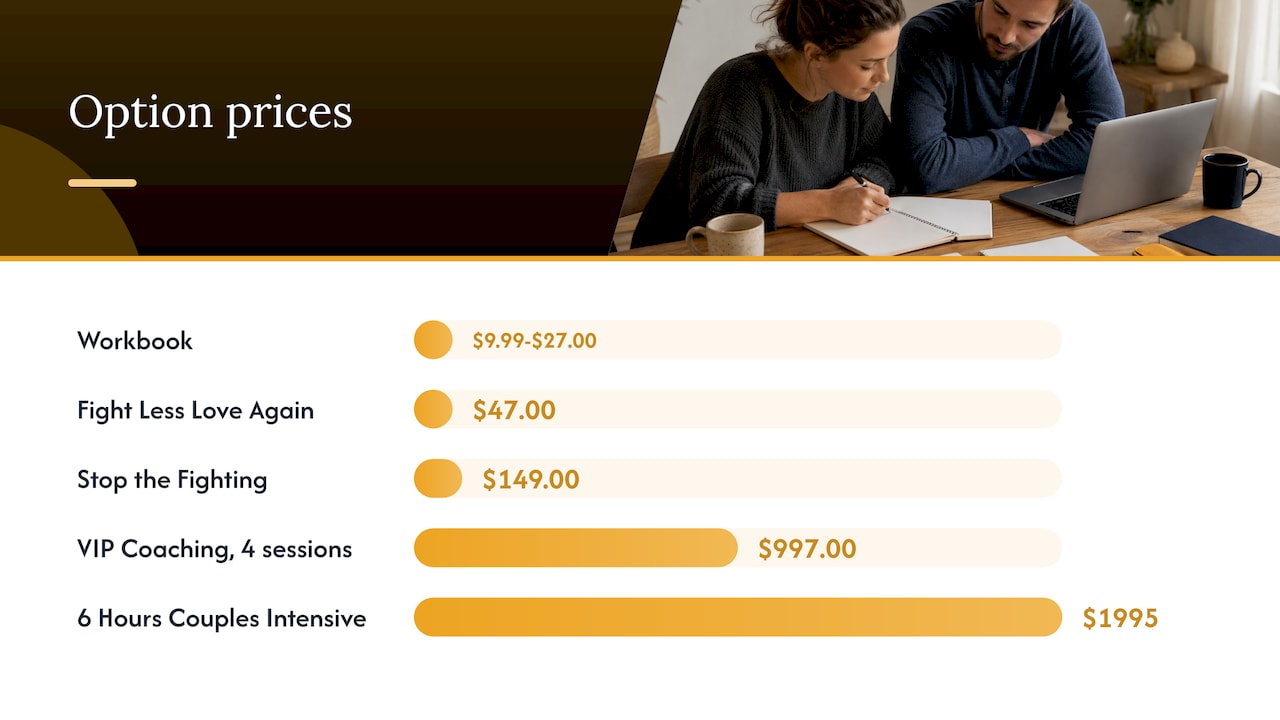
Here is how our options line up:
| Option | Price | Best for |
|---|---|---|
| Workbook | $9.99-$27.00 | Couples ready to practice on their own schedule |
| Fight Less Love Again Video Course | $47.00 | Learning the skills by video, at your pace |
| Stop the Fighting course | $149.00 | A full communication and conflict resolution program |
| VIP Private Coaching, 4 sessions | $997.00 | Personal guidance on your specific patterns |
| 6 Hours Couples Intensive | $1995 | A concentrated, focused block of work |
Our Stop the Fighting course is the next step if you finish a workbook and want a deeper, more structured program.
Make the progress stick
Couples often feel better after two or three sessions and then drop the routine. Build habits that outlast the novelty.
- Review monthly. Reread your original goal. What changed?
- Keep one practice daily. A five-minute check-in on how each of you is doing is enough.
- Celebrate wins. Note the conversation that went well. Specific credit builds safety.
- Plan the next chapter. Finishing a book is a good moment to define a shared vision. Our guide to creating a shared vision for marriage is a natural next step, and the marriage enrichment checklist keeps the habits going.
Your next step
If you want a structure built by licensed mental health professionals, start with the workbook that matches your situation on our shop page. If you want a professional alongside you, book online couples coaching.
Our perspective
We built the F.I.G.H.T. Plan® because most couples do not fight because they do not love each other. They fight because nobody taught them how to disagree safely. A workbook is where that teaching starts.
What we care about most is that the work happens in real life. A good session is not the one where you feel inspired. It is the one where, two days later, one of you uses the pause phrase in the middle of a heated moment and it holds.
That is why our workbooks, courses and coaching share one framework. You can begin with a book, add a course when you want to see the skills modeled, and bring in coaching when you want someone to look at your particular patterns with you. Couples of every kind, from engaged and blended families to Christian couples and those in high conflict, can start where they are.
Show up weekly, be kind to each other when it gets hard, and keep going.
Carlos
FAQ
How often should we work on a couples workbook?
Once a week for 45 to 60 minutes is a good rhythm for most couples. It is frequent enough to keep momentum and spaced enough to practice between sessions. Add a short daily check-in if you can.
What if only one of us wants to do it?
Start small. Offer one short exercise and ask for a trial of two or three weeks, framed as something you do for the relationship rather than a verdict on your partner. Choosing the workbook together helps a lot. Coaching can also help when one partner needs a guided entry point.
Is a workbook enough, or do we need coaching?
Many couples make real progress with a workbook and a consistent routine. If you keep hitting the same wall, or you are dealing with betrayal or trauma, adding coaching or a course gives you more support. See our guide to evidence-based couples therapy for how the options differ.
Can we use a workbook after an affair?
Yes. Our R.E.S.T.O.R.E Workbook is written for healing after an affair and rebuilding trust. Many couples pair it with guided support, such as our online marriage counseling after infidelity page describes.
Sources
- Taking Your Relationship to the Next Level (University of Georgia ELEVATE couples workbook)
- Turning Me Into We: A Workbook to Improve Relational Wellbeing (Utah State University)
- How Effective is Online Couple Relationship Education? (PMC, 2021)
- Incorporating Internet-based Interventions into Couple Therapy (PMC, 2014)
Recommended
- Create a Shared Vision for Marriage: A Practical Guide
- Six Therapist Backed Communication Exercises Couples Can Do Tonight
- How to Convince Spouse to Take Marriage Course with You