
Pastoral Counseling’s Role in Marriage Crisis
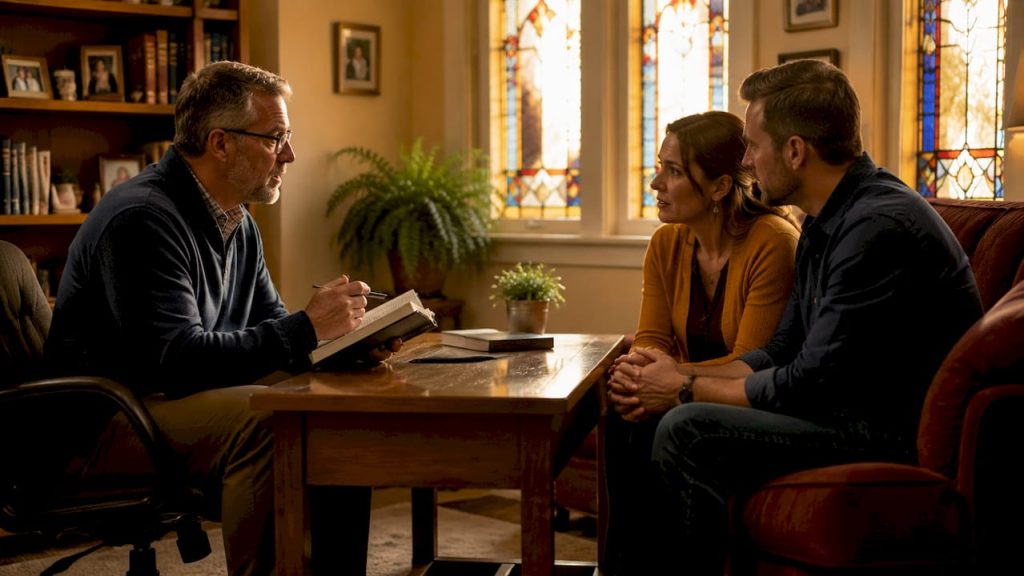
Pastoral counseling in a marriage crisis is the process where a faith leader provides spiritual guidance, emotional support, and scriptural wisdom to couples facing relational breakdown. It is not a replacement for licensed therapy. It is a distinct form of care that addresses the spiritual and theological dimensions of conflict that clinical methods alone do not cover. 72% of couples in crisis seek support from a faith leader first. That number shows how deeply people connect their marriage to their faith when things fall apart. Methods like Emotionally Focused Therapy (EFT) and the Gottman Method address behavioral and attachment patterns, while pastoral counseling addresses covenant, forgiveness, and spiritual identity. The strongest outcomes come when both work together.
How does pastoral counseling support couples during a marriage crisis?
Pastoral counseling gives couples a space where their faith is not a side note. It is the foundation. A pastor or trained pastoral counselor brings theological insight, prayer, and scripture into the conversation alongside emotional support. That combination addresses dimensions of marital pain that a clinical office may not touch.
The specific roles a pastoral counselor plays include:
- Providing prayer and theological grounding. Prayer and scripture create spiritual reconciliation and emotional safety for couples who feel their covenant is broken. This is not symbolic. It gives couples a shared reference point outside themselves.
- Creating a safe space for honest expression. Many couples find it easier to speak truthfully in a faith context where they feel held accountable to something larger than their own feelings.
- Facilitating forgiveness. Forgiveness in a pastoral context is not just emotional release. It is a theological act. Pastoral counselors guide couples through what forgiveness means scripturally and how to practice it practically.
- Addressing communication barriers with biblical principles. Biblical principles and prayer help couples communicate better, rebuild trust, and move past resentment in ways that align with their values.
- Drawing on congregational support. A pastoral counselor can connect couples to marriage ministries, accountability partners, or community groups within their faith community. That network is a resource clinical therapy rarely provides.
Pro Tip: Before your first session with a pastoral counselor, write down three specific conflicts you want to address. Vague requests produce vague help. Specificity gives your counselor something concrete to work with.
Pastoral counseling also supports couples navigating parenting stress, faith differences, and mixed-belief marriages by building mutual respect and honest dialogue. These are real, recurring pressure points that erode marriages slowly. Having a counselor who understands the spiritual stakes makes a measurable difference.

Pastoral counseling vs. clinical therapy: what is the difference?
The distinction between pastoral counseling and clinical marriage therapy is not about which is better. It is about which is appropriate for what. Both serve couples in crisis. They operate from different frameworks and address different layers of the problem.
| Factor | Pastoral Counseling | Clinical Marriage Therapy |
|---|---|---|
| Primary framework | Theological and spiritual | Psychological and evidence-based |
| Core methods | Prayer, scripture, faith community | EFT, Gottman Method, CBT, trauma protocols |
| Scope | Spiritual reconciliation, forgiveness, covenant | Behavioral change, attachment repair, trauma processing |
| Credentials | Pastoral training, seminary education | Licensed therapist (LMFT, LPC, LCSW) |
| Best suited for | Faith conflicts, communication, spiritual disconnection | Infidelity recovery, trauma, addiction, mental illness |
| Integration potential | High, works well alongside clinical therapy | High, benefits from pastoral spiritual context |
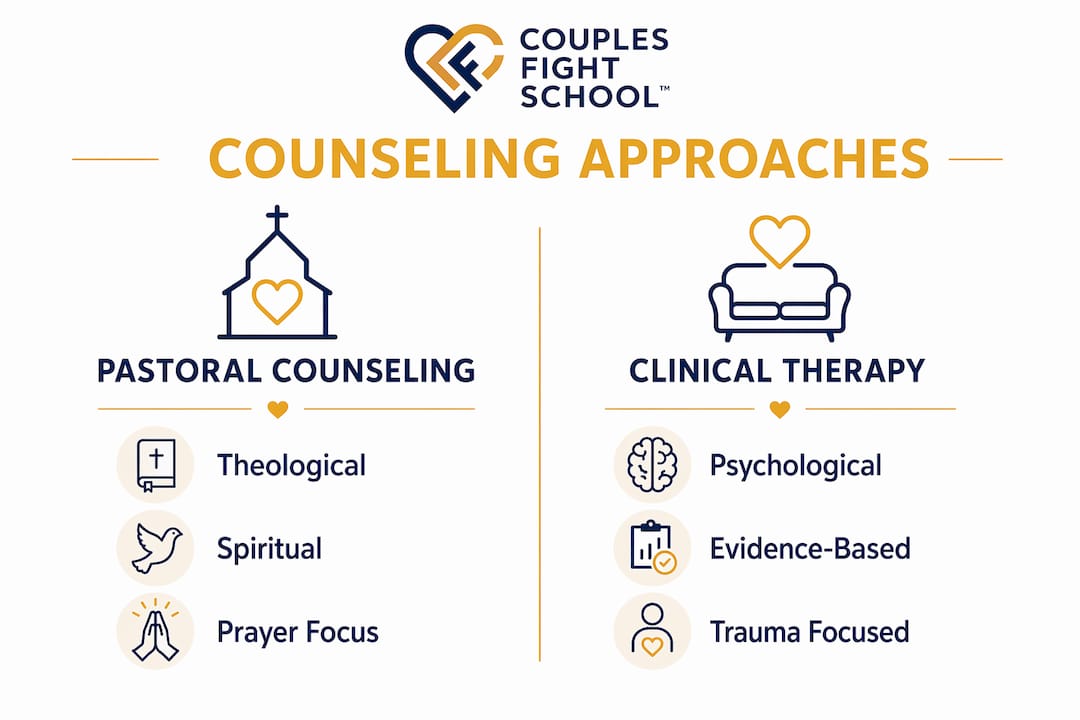
Licensed therapists trained in the Gottman Method and EFT address deep relational trauma and behavioral dysfunction that falls outside pastoral counseling’s scope. That is not a criticism of pastoral counselors. It is a recognition of what each role is designed to do.
Faith-informed clinical therapy treats spirituality as central to the counseling process, not incidental. That distinction matters. A therapist who understands your faith does not ask you to set it aside. They work with it. That is where the two approaches become genuinely complementary rather than competing.
A common misconception is that seeing a therapist means your faith is not enough. That is false. Seeking help is a sign of commitment, not failure. The two forms of care address different layers of the same wound.
Which marriage problems fit pastoral counseling and which need clinical care?
Knowing which type of support fits your situation saves time and prevents harm. Not every marital problem requires the same level of intervention.
Pastoral counseling is well suited for:
- Faith-related conflicts, including disagreements about religious practice, prayer, or spiritual leadership in the home
- Communication breakdowns rooted in pride, defensiveness, or lack of empathy
- Forgiveness struggles after betrayal that does not involve ongoing abuse
- Spiritual disconnection where one or both partners feel distant from God and from each other
- Parenting disagreements shaped by different values or faith backgrounds
- General marital drift where intimacy has faded but no acute crisis exists
Clinical therapy is the right choice when:
- Infidelity has occurred and trauma responses are present. Online marriage counseling after infidelity provides structured support for this specific wound.
- One or both partners have untreated mental illness, addiction, or a history of abuse
- Deep attachment trauma from childhood is driving current conflict patterns
- Physical safety is at risk in any form
Pastoral counseling alone is insufficient for serious issues such as untreated mental illness, addiction, or abuse. That boundary exists to protect couples, not to diminish pastoral care. A good pastoral counselor recognizes these limits and refers couples to licensed professionals when needed.
For complex cases, coordination between a pastoral counselor and a licensed therapist produces the best outcomes. Combining pastoral support with therapy yields the strongest results for faith-identified couples in crisis. The two professionals can work in parallel, each addressing what they are trained for.
How can couples get the most from pastoral counseling during marital distress?
Accessing pastoral counseling effectively requires more than showing up to a session. Preparation and realistic expectations shape how much couples benefit.
- Find a pastoral counselor with relevant training. Not every pastor has formal counseling training. Look for someone with a degree in pastoral counseling, clinical pastoral education (CPE), or certification through organizations like the American Association of Pastoral Counselors (AAPC). Training matters.
- Set specific goals before your first session. Decide together what you want to address. Forgiveness, communication, spiritual reconnection, or a specific recurring conflict. Clear goals keep sessions focused and productive.
- Understand confidentiality boundaries. Pastoral counselors operate under different confidentiality rules than licensed therapists. Ask directly what is shared with church leadership and what stays private. This protects both partners.
- Use prayer and scripture between sessions. Biblical principles applied to marriage conflict reinforce what you work on in sessions. Couples who practice between appointments make faster progress than those who treat sessions as isolated events.
- Engage your faith community intentionally. Marriage ministries, small groups, and accountability partnerships within your congregation extend the support beyond the counselor’s office. Community is a resource, not a threat to privacy.
- Know when to add clinical therapy. If your pastoral counselor identifies issues beyond their scope, treat that referral as a gift, not a rejection. Integrating faith with clinical care produces stronger outcomes than either approach alone.
Pro Tip: Ask your pastoral counselor directly: “What is outside your scope, and who would you refer us to?” A counselor who answers that question clearly is one you can trust.
Seeking counseling is a sign of strong marital commitment, not weakness. Couples who reach out proactively address problems before they compound. That reframe matters because shame keeps too many couples from getting help they genuinely need.
Key takeaways
Pastoral counseling and clinical therapy work best together, each addressing what the other cannot reach.
| Point | Details |
|---|---|
| Pastoral counseling defined | It provides spiritual guidance, prayer, and scriptural wisdom for couples in marital crisis. |
| Clinical therapy fills the gap | EFT and the Gottman Method address trauma and behavioral dysfunction beyond pastoral scope. |
| Know when to refer | Abuse, addiction, and untreated mental illness require licensed clinical intervention, not pastoral care alone. |
| Integration produces best outcomes | Combining pastoral and clinical support gives faith-identified couples the strongest path to healing. |
| Seeking help shows commitment | Couples who pursue counseling demonstrate high marital commitment, not failure or weakness. |
Why I believe the either/or approach fails couples every time
I have worked with hundreds of couples who came to us after spending months in one form of support while ignoring the other. Some had been in pastoral counseling for a year without addressing the trauma driving their conflict. Others had been in clinical therapy that never once acknowledged how central their faith was to their identity. Both groups were stuck.
The either/or approach fails because it treats a whole person as a partial problem. Your marriage does not exist in a spiritual vacuum, and it does not exist outside your psychology either. When a couple sits across from me and one partner says, “My faith is the most important thing in my life,” that is not background information. That is the center of the work.
What I have found is that Christian couples still struggle with conflict even with strong faith because faith alone does not teach communication skills. And clinical therapy alone does not address the covenant dimension of marriage that gives many couples their deepest motivation to stay and fight for each other.
The most effective path I have seen is a collaborative model. A pastoral counselor who handles the spiritual mentorship, the forgiveness work, the scriptural grounding. A licensed therapist who handles the trauma, the attachment patterns, the behavioral cycles. Both professionals aware of each other and working toward the same goal.
The couples who heal fastest are not the ones who found the perfect counselor. They are the ones who stopped waiting for permission to get help and started building a support team around their marriage.
— Carlos
Build a stronger marriage with the right support
If your marriage is under pressure right now, you do not have to figure it out alone. Couplesfightschool was built by licensed mental health professionals Carlos Todd and Natasha Pemberton-Todd specifically to give couples practical, psychology-backed tools for conflict and communication.
Whether you are dealing with recurring arguments, emotional distance, or a full crisis, Couplesfightschool’s online coaching for couples gives you direct access to structured support grounded in both clinical expertise and real-world relationship experience. The Fight Less, Love More course is a practical starting point for couples ready to stop the cycle and build something better. Your marriage is worth the investment.
FAQ
What is pastoral counseling in marriage?
Pastoral counseling in marriage is spiritual and emotional support provided by a trained faith leader using prayer, scripture, and theological guidance to help couples navigate conflict and rebuild their relationship.
Does pastoral counseling help in a marriage crisis?
Yes. Pastoral counseling addresses forgiveness, spiritual disconnection, and communication barriers effectively. For trauma or mental health issues, it works best alongside licensed clinical therapy.
When should a couple see a licensed therapist instead of a pastor?
Couples dealing with infidelity trauma, addiction, abuse, or untreated mental illness need a licensed therapist. Pastoral counseling alone is not equipped to handle these clinical issues safely.
Can pastoral counseling and clinical therapy work together?
Yes. Combining both approaches gives faith-identified couples the strongest support. The pastoral counselor handles spiritual mentorship while the therapist addresses behavioral and trauma-related issues.
Is seeking marriage counseling a sign of a failing marriage?
No. Couples who seek counseling demonstrate strong commitment to their marriage. Reaching out early prevents small conflicts from becoming permanent damage.
Recommended