Why Engaged Couples Need Conflict Skills Before Marriage
Conflict resolution for couples is defined as the set of communication, emotional regulation, and fairness skills that allow partners to disagree without causing lasting damage. Understanding why engaged couples need conflict skills is not optional preparation for marriage. It is the foundation. Research shows that conflict itself does not predict relationship failure. How you argue does. Therapists Linda Engelman and Melissa Madeson both confirm that couples who learn to fight constructively before marriage build stronger emotional safety and avoid the resentment cycles that quietly erode relationships over time.
Why engaged couples need conflict skills before saying “I do”
Conflict resolution skills are the tools that allow two people to disagree without destroying trust. They include active listening, emotional regulation, knowing how to express needs without attacking, and the ability to repair after a rupture. These are not personality traits. They are learned behaviors.
Couples who enter marriage without these skills do not avoid conflict. They just handle it badly. Arguments escalate faster, resentment builds quietly, and small disagreements become recurring fights about the same unresolved issues. Therapist Melissa Madeson identifies process-focused conflict resolution as the key difference between couples who grow through disagreement and those who get stuck in it. The process matters more than the outcome of any single argument.
The importance of conflict skills shows up most clearly in what they protect. Couples with healthy conflict habits experience more connection and emotional safety rather than persistent distance. They build teamwork. They understand each other’s perspectives instead of defending their own positions.
Here is what conflict resolution skills actually do for engaged couples:
- Communicate needs clearly without criticism or blame
- Regulate emotions so conversations stay productive instead of reactive
- Repair quickly after disagreements instead of letting tension linger
- Build mutual empathy by staying curious about your partner’s experience
- Prevent resentment by addressing issues before they compound
Learning these skills before marriage means you are not figuring them out in the middle of your first serious fight as a married couple. You are already practiced.
How does the positive to negative interaction ratio affect your relationship?
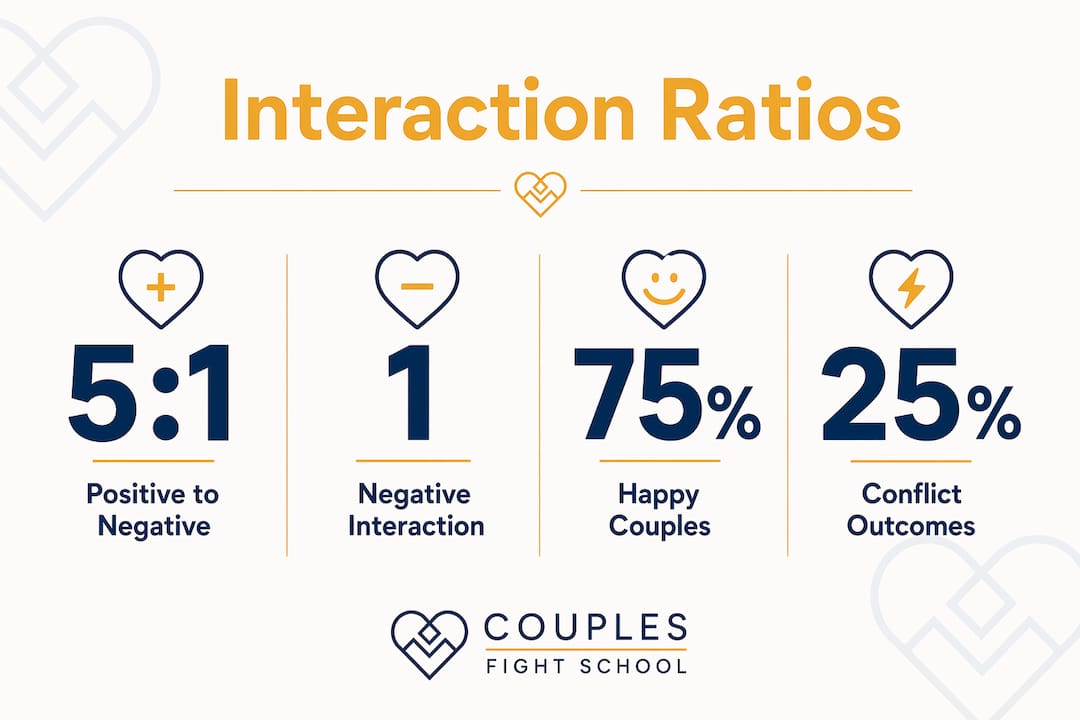
The single most predictive measure of relationship stability is not how often couples fight. It is the ratio of positive to negative interactions during conflict. Stable, happy couples maintain approximately 5 positive interactions for every 1 negative one, even during disagreements. That ratio is the benchmark.
This means that for every criticism, eye roll, or dismissive comment, a couple needs five moments of warmth, humor, validation, or genuine curiosity to stay in balance. Most couples in distress flip that ratio without realizing it. They stack negatives and wonder why every conversation feels like a battle.
| Interaction type | Examples | Effect on relationship |
|---|---|---|
| Positive | Validation, humor, curiosity, affection | Builds safety and trust |
| Negative | Criticism, contempt, defensiveness, stonewalling | Erodes trust and connection |
| Neutral | Factual statements, topic shifts | Neither builds nor damages |
| Repair attempts | Apologies, softening tone, humor | Restores balance after rupture |
The practical implication is clear. You do not need to eliminate negative moments from conflict. You need to flood the conversation with enough positive ones to keep the relationship stable. A well-timed “I hear you” or a moment of genuine laughter mid-argument is not weakness. It is skill.
Pro Tip: When a conversation starts to heat up, try one deliberate positive move before responding to the content of the disagreement. Name something you appreciate about your partner’s perspective, even if you disagree with it. That single shift can change the entire tone.
Research on communication habits in long-term couples confirms that the quality of everyday interactions, not just conflict moments, shapes how couples handle disagreements when they arise.
What communication strategies help engaged couples handle conflict effectively?
The first three minutes of a conflict conversation shape the entire discussion. Starting a conversation softly increases the likelihood of a successful resolution. That is not intuition. That is research. If you open with criticism or contempt, the conversation is already in trouble before either partner has said what they actually need.
A softened start-up is a specific technique. It means raising a concern without attacking the person. Instead of “You never listen to me,” you say “I feel unheard when I bring up our finances and the conversation moves on quickly.” The difference is not just tone. It is structure. You are describing your experience, not indicting your partner’s character.
Here is a practical sequence for constructive conflict communication:
- Choose the right moment. Do not start a serious conversation when either partner is hungry, tired, or already stressed from something unrelated.
- Use a softened start-up. Lead with “I feel” or “I noticed” instead of “You always” or “You never.”
- State one issue at a time. Stacking grievances overloads the conversation and makes resolution impossible.
- Regulate before you respond. If your heart rate is rising, pause. Take a breath. Respond from a calmer place.
- Confirm understanding before rebutting. Repeat back what your partner said before you respond to it. This alone reduces escalation significantly.
Therapist Melissa Madeson emphasizes that respect and emotional regulation during conflict break repetitive argument cycles more effectively than simply trying to “win” the discussion. Clarity about what you need and respect for how you deliver it are the two variables most within your control.
Pro Tip: Practice the softened start-up on low-stakes topics first. Use it when you are mildly frustrated, not when you are furious. Building the habit in calm moments means it will be available to you when the stakes are higher.
The Couples Journal from Meet Me Here offers structured prompts for starting difficult conversations, which is a practical tool for engaged couples building these habits before marriage.
How can engaged couples practice fair fighting skills and transform conflict?
Fair fighting is a term therapists use to describe conflict that follows agreed-upon rules of respect, even when emotions are high. Therapist Linda Engelman describes building fair fighting skills as rewiring reactive response circuits. It feels awkward at first because you are replacing automatic reactions with deliberate choices. That discomfort is not a sign that it is not working. It is a sign that it is.
The most common mistake engaged couples make is avoiding conflict entirely to keep the peace. Holding issues in does not resolve them. It stores them. Suppressed conflict builds resentment that surfaces later with more intensity and less context. The couple then fights about the eruption rather than the original issue.
Scheduling conversations is one of the most underused tools in conflict resolution for couples. Instead of reacting in the heat of the moment, you agree on a time when both partners are emotionally ready to talk. This removes the ambush dynamic, where one partner feels blindsided and immediately goes defensive.
Practical steps for building fair fighting habits before marriage:
- Agree on ground rules together. Decide in advance that you will not name-call, walk out without a return time, or bring up unrelated past issues.
- Schedule difficult conversations. Say “Can we talk about this tonight after dinner?” instead of starting the conversation mid-argument.
- Debrief after conflicts. Once you have both calmed down, spend five minutes discussing what went well and what you would do differently.
- Use a conflict resolution framework as a shared reference point so both partners are working from the same playbook.
- Celebrate repair. When you handle a conflict well, acknowledge it. Positive reinforcement builds the habit faster.
The goal is not to become a couple that never fights. The goal is to become a couple that fights in ways that bring you closer rather than further apart. That shift is entirely learnable.
Key takeaways
Engaged couples who build conflict resolution skills before marriage protect their relationship from the resentment, emotional distance, and recurring arguments that erode connection over time.
| Point | Details |
|---|---|
| Conflict skills are learned | Communication, emotional regulation, and fairness are habits, not personality traits. |
| The 5:1 ratio predicts stability | Maintaining five positive interactions for every negative one keeps relationships healthy during conflict. |
| First three minutes matter most | A softened start-up at the beginning of a conflict conversation significantly improves the outcome. |
| Avoiding conflict builds resentment | Scheduling conversations when both partners are ready prevents ambush arguments and stored tension. |
| Practice transforms the habit | Fair fighting feels awkward initially but becomes natural with consistent, deliberate repetition. |
What I have learned from watching couples build these skills
I have worked with hundreds of couples at different stages of their relationships, and the pattern is consistent. The couples who struggle most in marriage are rarely the ones who fought the most before it. They are the ones who never learned how to fight well.
Engaged couples often come to Couplesfightschool with the assumption that conflict means something is wrong with their relationship. That belief is the first thing we address. Conflict is not a warning sign. It is a normal feature of two people building a shared life. The question is never whether you will disagree. The question is whether you have the skills to come back together after you do.
What I find most encouraging is how quickly couples shift once they have a framework. The F.I.G.H.T. Plan® gives couples a shared language and a structured process. That shared language alone reduces the chaos of conflict because both partners know what they are trying to do. They are not just reacting. They are working.
The couples who invest in conflict resolution techniques before marriage do not just fight less. They trust each other more. They feel safer bringing up hard things. That emotional safety is what makes intimacy possible over the long term. Build the skills now, while the stakes are lower and the motivation is high.
— Carlos
Start building your conflict skills before the wedding
Knowing why engaged couples need conflict skills is the first step. Practicing them is what changes your relationship.
Couplesfightschool offers structured resources built specifically for couples who want to get ahead of conflict before marriage. The Fight Less, Love More course gives you a step-by-step system for replacing reactive patterns with constructive ones. If you want personalized guidance, online coaching for couples connects you with licensed professionals who can work through your specific conflict patterns with you. You can also take the conflict style quiz to identify where you and your partner currently stand and what to work on first.
FAQ
Why do engaged couples need conflict skills before marriage?
Conflict skills allow engaged couples to handle disagreements constructively rather than destructively. Couples who build these skills before marriage avoid the resentment and recurring arguments that develop when conflict is handled poorly over time.
What is the 5:1 ratio in conflict resolution for couples?
The 5:1 ratio means stable, happy couples maintain approximately five positive interactions for every one negative interaction during conflict. This ratio predicts relationship stability more reliably than the absence of conflict itself.
What is a softened start-up in conflict communication?
A softened start-up is a technique where you open a difficult conversation by describing your own feelings and experience rather than criticizing your partner. Starting conflict discussions this way significantly improves the likelihood of a productive resolution.
How do you practice fair fighting as an engaged couple?
Fair fighting is built through consistent practice of agreed-upon rules: no name-calling, scheduling conversations rather than reacting in the moment, and debriefing after conflicts. Therapist Linda Engelman describes the process as rewiring reactive response circuits, which takes repetition before it feels natural.
Does avoiding conflict protect a relationship?
Avoiding conflict does not protect a relationship. Suppressing disagreements builds resentment that surfaces later with more intensity. Scheduling planned conversations when both partners are emotionally ready produces far better outcomes than avoidance.
Recommended