
Break the Pursuer-Distancer Cycle With Scripts You Can Use Tonight

The pursuer distancer cycle is a loop where one partner pushes for contact and the other pulls away, and each move makes the other stronger. To interrupt it, pause the conversation, name what your body is doing, and take a bounded time-out with a set return time. We walk through the research, the signs, and word-for-word scripts below.
TL;DR:
- A diary study of 116 couples found demand and withdrawal in both role directions at equal frequency, and partners could switch roles by topic.
- When either partner needs a pause, they should name the feeling, agree on a specific return time, regulate, and come back as promised.
- An experiment found that suppressing emotion raised arousal and negative feelings, while adopting a positive mindset lowered both for the person and their partner.
- Research on socioeconomic context found withdrawal can sometimes reduce conflict under heavy economic strain, so no single communication rule fits every couple.
Table of Contents
- What is the pursuer-distancer cycle?
- How does the pattern develop?
- What do pursuers and distancers actually do?
- Why does the cycle keep repeating itself?
- What does the cycle cost a relationship?
- How can you break the cycle? A step-by-step plan
- When should you get professional help?
- What does the research say, and where are its limits?
- How do gender and socialization shape these roles?
- How does your upbringing feed the pattern?
- What role does emotional vulnerability play?
- How do you rebuild trust and connection after repeated conflicts?
- Which communication techniques target this cycle?
- A practitioner’s view: the cycle is the problem
- Skills, scripts, and support from Couples Fight School
- FAQ
- Sources
What is the pursuer-distancer cycle?
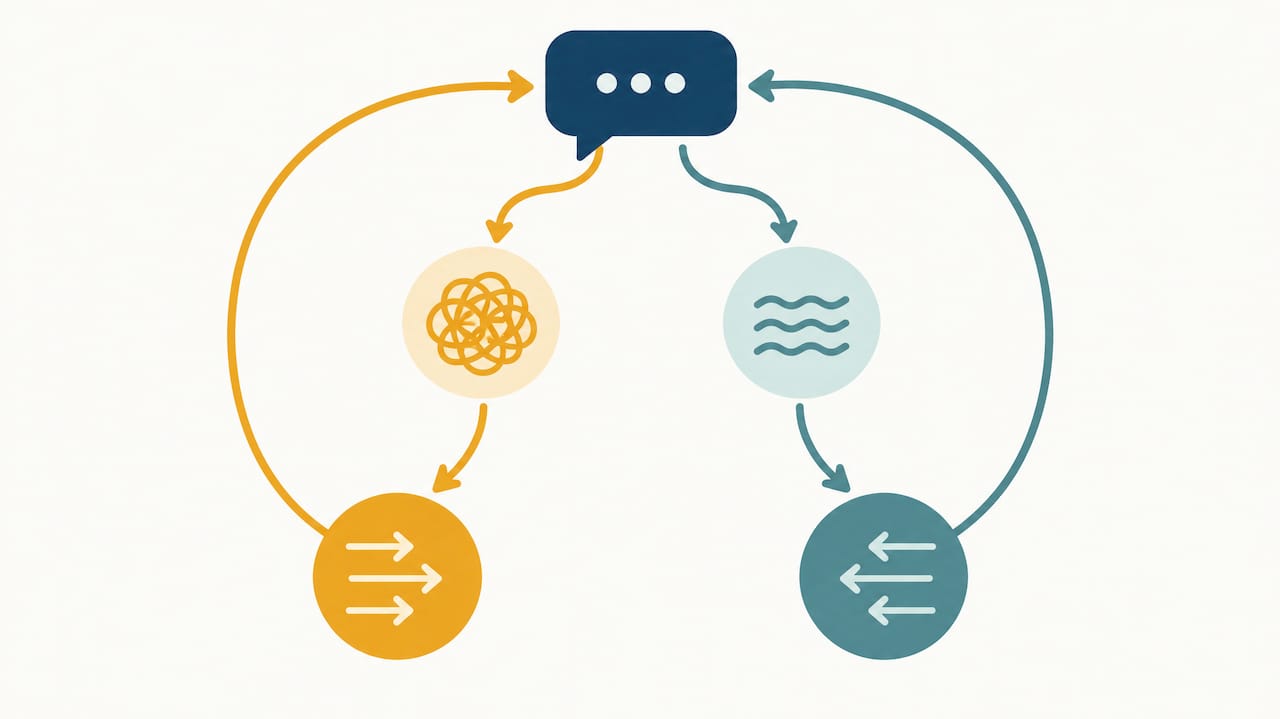
At its simplest, the pursuer distancer cycle is a repeating interaction. One partner raises a concern, asks for closeness, or presses for an answer. The other partner goes quiet, changes the subject, or leaves the room. The first partner pushes harder because the silence feels like rejection, and the second pulls back further because the pressure feels like an attack.
Researchers use several labels for the same pattern, so you may meet them in articles and therapy offices:
- Pursue-withdraw cycle: the term most often used in clinical writing.
- Demand-withdraw pattern: the term used in much of the communication research, where one partner “demands” change or discussion and the other withdraws.
- Anxious-avoidant conflict: the attachment-flavored label, which points at the fears underneath each role.
- Emotional push-pull: the everyday description couples tend to give when they describe it to each other.
The most important point is that this is an interactional pattern, not a personality type. Neither of you is “the needy one” or “the cold one” by nature. The loop belongs to the two of you together, and it needs both moves to keep running. If one move changes, the loop changes.
Roles are also not fixed. A diary study of 116 U.S. couples found that husband-demand/wife-withdraw and wife-demand/husband-withdraw showed up at equal frequency in couples’ homes. A longitudinal study of 29 married couples with videotaped conflict discussions found that role direction varied by topic. You might pursue about money and withdraw about sex, while your partner does the opposite. Timing matters too: the partner who is rested and calm may pursue on Sunday morning and withdraw on Thursday night after a brutal workday.
That flexibility is good news. It means the pattern is not stamped into either of you. It also means that mislabeling motives is the first trap to avoid. A pursuer is rarely trying to control, and a distancer is rarely trying to punish. Most of the time, each person is trying to reduce their own distress in the only way that has ever worked for them.
How does the pattern develop?
Three forces combine to make this cycle feel automatic: attachment needs, emotion regulation, and life context.
Attachment drivers
Attachment styles shape what each partner does when closeness feels threatened. Someone with anxious attachment tends to read distance as danger, so they move toward the partner: more questions, more reassurance seeking, more intensity. Someone with avoidant attachment tends to read pressure as danger, so they move away: more space, fewer words, more self-reliance.
- The anxious move: push for contact to confirm the bond is safe.
- The avoidant move: pull back to avoid feeling overwhelmed, criticized, or exposed.
- The trap: each move is a reasonable fix for one person and an alarm for the other.
Under the anger of the pursuer there is usually fear of being unimportant. Under the quiet of the distancer there is usually fear of failing or of being flooded. Neither fear is visible in the moment, which is why the surface behavior gets blamed.
Emotion regulation
Arousal is the engine. When a conversation heats up, heart rate rises, thinking narrows, and both people lose access to their best listening. Pursuit raises arousal in the distancer. Withdrawal, to the pursuer, signals loss of contact, which raises arousal too. Regulating, or calming, your own body is therefore not a courtesy. It is a leverage point.
An experimental study on regulation during couple conflict showed why. Researchers found that telling one partner to suppress emotion raised cardiovascular arousal and negative feeling, while asking them to take a positive mindset lowered arousal and negative feeling for the person and for the partner. One person’s regulation spreads to the other, which is the idea behind co-regulation.
Context
Stress, workload, and money pressure change whether pulling away helps or hurts. A couple under constant strain has less capacity for hard conversations, so more of them go sideways. We return to the research on context in the evidence section below, because the picture is more nuanced than “withdrawal is always bad.”
Regulation reaches both partners: in the experiment above, a calm mindset in one person lowered arousal and negative affect in both, so calming yourself first is a real contribution to the conversation.
What do pursuers and distancers actually do?
Reading about the cycle is easy. Spotting it in yourself late in the evening is harder. These lists give you observable behaviors to look for. Most people recognize themselves in both, depending on the topic.
Common pursuer behaviors:
- Repeating the same request or question several times in a short span.
- Criticism that is really a bid for connection, such as “You never talk to me” when the wish is “I miss you.”
- Raising the volume, speeding up, or following a partner from room to room.
- Bringing up several grievances at once because the first one was not acknowledged.
- Reading silence as proof of not caring and saying so.
Common distancer behaviors:
- Going quiet, giving one-word answers, or stonewalling.
- Leaving the room, the house, or switching to a phone or television.
- Minimizing: “It’s not a big deal,” “You’re overreacting.”
- Changing the subject to something practical and safe.
- Agreeing quickly just to end the conversation, then not following through.
Here is a micro-example of how a spiral starts.
Pursuer: “We never talk anymore. Can we talk about this tonight?”
Distancer: “I’m tired. Can we talk later?”
Pursuer: “It always waits. You don’t care how I feel.”
Distancer: “I just said I’m tired.” (picks up the phone)
Pursuer: “Wow. Okay. Fine. Ignore me.”
Look at what each person heard. The pursuer heard “you don’t matter.” The distancer heard “you’re failing again.” Both were wrong about the other’s meaning, and both reacted to the meaning rather than the words. The moment to catch is the second line, before the criticism arrives. Our guide to conflict escalation patterns couples repeat shows where this cycle sits among other common spirals.
Why does the cycle keep repeating itself?
The loop lasts because each partner’s coping move is the other partner’s trigger. Pursuit raises the distancer’s sense of threat. Withdrawal lowers that threat for them in the short run, which rewards withdrawal and makes it more likely next time. But for the pursuer, withdrawal removes the very contact they were seeking, which raises their alarm and drives more pursuit. Both people are being reinforced for exactly the behavior that frustrates the other.
The escalation path usually looks like this:
- Trigger: a concern, a disappointment, or a bid for attention.
- Pursuit: the request gets sharper, louder, or more critical.
- Withdrawal: the other partner shuts down or leaves to escape the pressure.
- Alarm: the pursuer feels abandoned and presses harder.
- Shutdown or blow-up: the conversation ends in silence, a fight, or a cold truce with nothing resolved.
Regulation is what changes the outcome. In the experimental study mentioned above, suppressing emotion raised arousal while a positive mindset lowered it for both the person and their partner. Pushing feelings down does not make a conversation safer. Calming your body and engaging honestly does.
Not every pause is avoidance, though. A bounded pause with a stated return time can de-escalate a fight, while open-ended disappearance or punishing silence does damage. The difference is the promise to come back.
- Healthy pause: “I’m too worked up to listen well. I need a short break, and I’ll come back at the time we agree on.”
- Avoidance: walking out without a word and treating the topic as closed.
- Healthy pause: the partner who leaves says what they need and when they will return.
- Avoidance: the partner who stays gets no information and fills the gap with worst-case guesses.
Our page on time-outs for couples gives the structure and scripts for taking one well.
Both partners’ bodies respond to how one partner regulates: when one person suppressed emotion in the study, arousal and negative affect rose, and when one adopted a positive mindset, both partners calmed.
What does the cycle cost a relationship?
Repeated pursue-withdraw loops cost more than the argument itself. In the diary study of 116 couples, both demand-withdraw patterns predicted more negative emotion, more negative tactics, and lower conflict resolution even after accounting for marital satisfaction. In plain terms, the pattern made conflicts go worse regardless of how happy the couple was overall.
Over time, the costs build.
- Short term: hurt feelings, harsher words, and issues left unresolved.
- Medium term: each partner starts expecting the worst, so every conversation begins on the defensive.
- Long term: resentment in the pursuer, loneliness in the distancer, and fading closeness for both.
The long-term picture is not identical for every couple. In the longitudinal study of 29 married couples, wife-demand/husband-withdraw predicted a decline in wives’ satisfaction one year later, but role direction itself varied by topic. This was a small sample, so it should not be turned into a rule about men or women.
What tends to happen emotionally is easy to recognize. The pursuer stops hoping and either escalates or gives up asking. The distancer stops trying because every attempt feels like it will be judged. Both begin to protect themselves, and protection looks like distance. That is how couples who still love each other end up feeling like roommates.
How can you break the cycle? A step-by-step plan
The plan has three layers: what to do in the moment, what to do between fights, and what to agree on in advance. Practice the middle layer first, when you are calm, so the first layer works when you are not.
In the moment: the pause and return script
- Notice your body. Look for a fast heartbeat, tight chest, hot face, or the urge to leave or to push. That is the cue to slow down.
- Name it without blame. Say “I’m getting flooded” or “I’m getting really anxious,” not “You’re attacking me” or “You’re ignoring me.”
- Ask for a bounded pause. “I want to get this right. Can we take a short pause and agree on when to come back?” A time makes the pause safe for the pursuer.
- Regulate during the break. Do not rehearse your argument. Calm your body first.
- Return on time. Show up when you said you would, even if you are not fully calm. Keeping the promise matters more than perfection.
- Restart with one request. “Here’s what I need. Can we try again?”
Our de-escalation techniques page covers tools you can use in seconds, and the research-backed de-escalation scripts add more ready phrasing.
Pro Tip: Write the return time on the fridge or set a phone reminder before you leave the room, so the pursuer can see the pause has an end.
A regulation toolkit
Pick one or two of these and practice them on ordinary days:
- Slow breathing: Breathe slowly and steadily for a short while.
- Positive-mindset rehearsal: before a hard talk, recall one thing you value about your partner. The experimental work above links a positive mindset with lower arousal for both partners.
- Grounding: name five things you can see, four you can feel, three you can hear.
- Movement: a short walk, stretching, or washing your face with cool water.
Communication agreements
Agree on these when you are calm:
- Ask instead of accuse: “Could we talk about the schedule this weekend?” beats “You never help.”
- Set a return time every time: nobody leaves without saying when they will be back.
- Check the impact: after someone speaks, ask “How did that land?” before replying.
- Limit the topic: one issue per conversation, and park the rest.
Our piece on why couples need communication agreements goes deeper on building them.
Between-conflict routines
- Daily check-in: A brief check-in with no problem-solving, where each person shares one high and one low.
- Scheduled problem-solving: a weekly time slot for issues, so pursuers do not have to chase and distancers can prepare.
- Script rehearsal: read your pause script aloud together once, when neither of you is upset.
Practice assignments by role
For pursuers: Before raising a concern, write one sentence that starts with “I feel” and ends with “I would like.” Say that sentence instead of the first thing that comes to mind. Then wait through a few seconds of silence without filling it.
For distancers: Practice one “I’m here” sentence per day, such as “I’m listening, give me a second to think.” Staying visible while you take time is the skill. Silence with no signal reads as absence.
If you want ready-made scripts and exercises, our six communication exercises couples can do tonight is a practical place to start.
When should you get professional help?
Some situations call for more than self-help. Consider a therapist if:
- Safety is in question: intimidation, threats, coercive control, or violence call for safety-focused help, not communication exercises. Research on demand-withdraw sequences in adolescent dating aggression shows that hostility within these patterns is linked to aggression.
- You are stuck: the same fight has repeated for months despite honest effort.
- Distress is severe: either of you feels hopeless, depressed, or unable to function.
- Trust has broken: after an affair or a major betrayal, structured support helps.
Emotionally Focused Therapy, or EFT, is one approach worth asking about. A 2016 review describes it as a brief, evidence-based couples therapy grounded in attachment theory. It focuses on identifying the negative cycle, reaching the fears and needs beneath it, and shaping new responses between partners. Process research in the review links softening and emotionally engaged responses with successful change. Outcomes differ across studies and couples, so treat it as a promising fit rather than a guarantee.
Questions worth asking a clinician:
- Experience: How much of your practice involves repeating conflict cycles?
- Focus: What will our sessions concentrate on, and how will we measure progress?
- Homework: What will we practice between sessions?
- Fit: How do you work when one partner tends to withdraw in session?
What does the research say, and where are its limits?
Here is the evidence in one place, along with the boundaries that keep our guidance honest.
- Both directions occur: the home diary study of 116 couples found demand-withdraw in both role directions at equal frequency, and both predicted more negative emotion and poorer resolution.
- Roles vary by issue: the longitudinal study found that direction changed by topic, so avoid stereotyping either partner.
- EFT targets the cycle: the 2016 EFT review describes an attachment-based method aimed at this very pattern.
- Regulation changes physiology: the experiment showed that regulation instructions altered arousal and negative affect for both partners.
- Context moderates effects: research on socioeconomic context reports that communication that is maladaptive for middle-class couples can be adaptive for socioeconomically disadvantaged couples.
That last finding is a real boundary condition. In couples under heavy economic strain, withdrawal sometimes lowers conflict rather than raising it. The classic pattern of wife-demand/husband-withdraw predicting dropping satisfaction showed up in lower-risk, more resourced couples, while other patterns appeared in higher-risk couples. The takeaway is not that withdrawal is fine. It is that context changes what a behavior means, and that no single script fits every couple.
Context changes outcomes: the same demand-withdraw behavior can predict different results depending on a couple’s socioeconomic circumstances, which is why we describe patterns rather than prescribe one rule.
How do gender and socialization shape these roles?
Many people assume women pursue and men withdraw. Research does not support treating that as a rule. The diary study found both directions at equal frequency in the home, and the longitudinal study found that direction depended on the topic being discussed.
Still, socialization can nudge people toward a role. Many boys are taught to handle upset alone and to treat visible emotion as weakness, which can make withdrawal feel like composure. Many girls are encouraged to keep relationships connected and to talk things through, which can make pursuit feel like caring. Those lessons are not destiny, and plenty of couples reverse them.
Notice also that the person who wants change on an issue tends to become the pursuer, and the person who prefers the status quo tends to withdraw. That is a position, not a gender. A husband who wants more affection may pursue, and a wife who wants to avoid a money conversation may withdraw.
In practice, drop the stereotype and ask a better question: on this topic, who wants what, and what does each of us fear? That question gets you to the real conflict faster than a label does.
How does your upbringing feed the pattern?
You learned your first lessons about conflict long before you met your partner. If anger in your childhood home meant shouting, you may now pursue loudly to be heard, or withdraw fast to stay safe. If conflict was never discussed, you may have learned that raising a problem is dangerous, or that silence is how problems get solved.
Common family-of-origin lessons that feed the loop include:
- “Feelings cause trouble.” This often produces a distancer who goes quiet.
- “If I don’t push, no one listens.” This often produces a pursuer who escalates.
- “Love can disappear after a fight.” This produces both: pursuit to repair quickly, withdrawal to avoid the risk.
These lessons were smart adaptations at the time. They become a problem only when they run on autopilot in an adult relationship that is safer than the one you grew up in.
Try this: each of you finishes the sentence “In my family, when people disagreed, we…” Share the answers without commenting on them. Many couples find that their partner’s reaction suddenly makes sense. It stops being a verdict on you and becomes a history you can both be gentle with.
What role does emotional vulnerability play?
Vulnerability is what ends the cycle, because it replaces the surface move with the feeling beneath it. A pursuer’s criticism, “You never listen,” carries a softer message: “I’m afraid I don’t matter to you.” A distancer’s silence carries one too: “I’m afraid I’ll say the wrong thing and lose you.”
Saying the softer message is risky. It feels safer to stay angry or stay quiet. But the EFT review points to exactly this shift: process research links softening and emotionally engaged responses with successful change.
How to foster it, in both partners:
- For pursuers: lead with the need, not the complaint. “I miss you and I’m scared we’re drifting” lands differently than “You’re always on your phone.”
- For distancers: share one small feeling instead of the whole picture. “I’m overwhelmed and I want to get this right” is enough.
- For the listener: respond to the feeling first. “That makes sense. Thank you for telling me” before any defense or fix.
- For both: keep the setting calm. Vulnerability is hard in the middle of a fight, so practice it during your daily check-in.
Reward the attempt, even if it is clumsy. Each time vulnerability is met kindly, both of you learn that the risk is survivable.
How do you rebuild trust and connection after repeated conflicts?
After months or years of the cycle, both partners are usually tired and guarded. Trust rebuilds through small, repeated, kept promises rather than one big gesture.
Start with the return promise. Every time someone takes a pause and returns on time, that is a deposit. Every time the pursuer lets the pause happen without chasing, that is a deposit too. Over weeks, these make the pause feel safe.

Then add repair. After a rough exchange, whoever feels ready first can say, “I didn’t like how that went. Can we try again?” and name their own part: “I got sharp,” or “I went silent and left you hanging.” Owning your move, without listing your partner’s, is the heart of repair.
Next, rebuild warmth outside of conflict. Short positive moments count: a real greeting at the door, a text during the day, ten undistracted minutes at night. Connection grows in ordinary time, not just in hard talks.
Finally, be patient with setbacks. The cycle will return on stressful days. What counts is how quickly you notice it and how kindly you come back. If hurt runs deep, our couples conflict workbook resources and professional support can give the process structure.
Which communication techniques target this cycle?
Generic advice like “communicate better” misses the mechanics. These techniques each work on a specific link in the pursue-withdraw chain.
- Soft start-up: begin with the feeling and the request, not the accusation. This lowers the distancer’s threat response from the first sentence.
- Bounded pauses: a stated time and a stated return cut the pursuer’s fear of abandonment.
- Reflective listening: repeat back what you heard before replying. Our active listening exercises offer ways to practice it.
- Impact checks: ask “How did that land?” to catch misreadings before they harden.
- One topic at a time: pursuers tend to stack grievances, so agree to finish one before opening another.
- Naming the cycle: say “I think we’re doing the thing again” as a team, against the pattern rather than against each other.
The last one often does the most. When both partners can point at the loop together, it stops being a fight about who is wrong and becomes a shared problem you can solve.
A practitioner’s view: the cycle is the problem
I have sat with many couples who arrived convinced that one of them was broken. Almost always, they were two decent people caught in a loop that neither designed. The pursuer was not too needy. The distancer was not too cold. The pattern was doing the damage, and it could be changed.
That is why I think the most underrated skill in a relationship is the return. We obsess over what to say in a fight, but the bounded pause and the promise to come back do more than any perfect sentence. Disciplined, boring practice beats insight every time. Understanding your attachment history is useful, but it will not interrupt a fight late in the evening. A rehearsed script will.
Try one small thing tonight. Sit down together for a brief check-in and say, one at a time, “One thing I felt today was…” and “One thing I’d like from you this week is…” No fixing, no rebuttals, just thanks. Then agree on a pause phrase you will both use when things heat up.
You are not failing. You are practicing a skill that most of us were never taught.
— Carlos
Skills, scripts, and support from Couples Fight School
We built our programs so couples can learn the skills above with therapist-created structure rather than guesswork. Our self-paced Stop the Fighting course teaches regulation, scripts, and the F.I.G.H.T. Plan® framework; current prices are on our course page.

- Self-paced courses and workbooks: browse our shop for courses and toolkits, including The F.I.G.H.T. Plan Couples Conflict Toolkit.
- Hands-on help: our online couples coaching is for couples who want guided support in changing a recurring cycle; current prices are on our coaching page.
- Intensive option: current prices for the 6 Hours Couples Intensive are on our intensive page.
Pick the format that fits your schedule, open the shop or coaching page, and start with one tool this week.
FAQ
How do you break the pursuer distancer cycle?
Pause the conversation before it escalates, name what your body is feeling, and agree on a specific time to return. Both partners then practice one change: the pursuer leads with a feeling and a request, and the distancer stays visible and communicates while taking time. Practicing these when calm makes them work when you are not.
What is the pursuer-distancer cycle according to Gottman?
The Gottman approach describes a similar pattern in which one partner pushes while the other shuts down, and it emphasizes that physiological flooding makes conversation unproductive. The remedy is to pause, calm down, and return. We do not cite a specific Gottman source here, so see the research above for the studies we rely on.
Is withdrawing during a fight always unhealthy?
No. A bounded pause with a stated return time can de-escalate a conflict, while open-ended silence or leaving without a word tends to damage trust. Research also shows that context matters, since communication that hurts some couples can be adaptive for those under heavy socioeconomic strain.
When should we see a therapist about this pattern?
Seek help if the same fight has repeated for months, distress is severe, trust has broken, or any intimidation, threats, or violence are present. Safety concerns call for professional support rather than communication exercises. Emotionally Focused Therapy is one evidence-based option designed to target negative couple cycles.
Sources
- Demand-Withdraw Patterns in Marital Conflict in the Home
- Pubmed
- Pubmed
- An experimental study of emotion regulation during relationship conflict interactions: The moderating role of attachment orientations.
Recommended
- 5 Therapist Backed Couples Conversation Scripts to Use Tonight
- 6 Research Backed Conflict De-escalation Techniques with Ready Scripts
- Memorized Scripts for Four Horsemen Antidotes That Stop Fights Tonight
- Stop Arguments Tonight. 6 Reflective Listening Steps and Ready Scripts