
Sexless Marriage Communication: Scripts to Use Tonight for Couples

Improving the quality of sexual and emotional communication, not just having more sex, is the most evidence-backed first step for reducing distress in a sexless marriage. A 2022 meta-analysis of nearly 40,000 people found that how well couples talk about sex predicts satisfaction more strongly than how often they have it, with married couples showing an especially strong link. This article gives you scripts, a stepwise plan, and clear signs it’s time to call in a professional, drawing on frameworks used by relationship educators in similar situations.
TL;DR:
- Couples should prioritize improving emotional and sexual communication, as it predicts relationship satisfaction more reliably than increasing sex frequency alone.
- Addressing medical issues and understanding emotional patterns like shame, conflict, or safety concerns is essential before expecting communication alone to restore intimacy.
- Initiating conversations at neutral, safe moments using curiosity and “I” statements helps prevent defensiveness and fosters honest dialogue.
- Rebuilding physical closeness through gradual, nonsexual touch and shared activities strengthens emotional bonds and lays groundwork for desire to return.
- Seeking professional help becomes necessary if interactions involve coercion, hostility, or unresolved trauma, with therapy prioritized over self-guided efforts in complex cases.
Table of Contents
- Understanding Sexless Marriage Communication: What the Term Actually Means
- Why Sexless Marriages Happen: Causes and Emotional Patterns
- How to Start the Conversation Without Blowing It Up
- Rebuilding Intimacy Beyond Conversation
- When Talking Isn’t Enough: Signs You Need Outside Help
- The F.I.G.H.T. Plan® Approach to Sexless Marriage Communication
- Managing the Emotional Wave These Conversations Bring Up
- Naming the Fear Underneath the Silence
- Why Active Listening Changes the Whole Conversation
- Setting Expectations That Won’t Set You Up to Fail
- Keeping the Conversation Alive as Your Relationship Changes
- A Realistic Timeline: What to Expect as You Do This Work
- Getting Guided Support From Couples Fight School®
- Key Research and Resources Cited
- Sources
- FAQ
Understanding Sexless Marriage Communication: What the Term Actually Means
Clinicians generally define a sexless marriage as having very infrequent partnered sex, though the exact number matters far less than how each partner feels about it. A couple having sex twice a month but both wanting it can feel more “sexless” in spirit than a couple having sex eight times a year who feel connected in between. This is why sexless marriage communication has to start with naming the actual experience, not just counting encounters.
There are a few common patterns worth recognizing:
- Zero partnered sex: No sexual contact between partners for six months or longer.
- Rare or ritualized sex: Sex happens, but infrequently and often without much emotional presence.
- Solitary substitution: One or both partners rely on masturbation or pornography instead of partnered intimacy.
- Discrepant desire: Sex happens at a frequency one partner finds fine and the other finds painfully insufficient.
Naming which pattern you’re in matters because it changes the conversation you need to have. A couple with zero physical touch needs a different opening than a couple stuck in low-desire ritual sex. Research on sexual communication discrepancies in married individuals found that when partners can’t agree on or discuss their sexual reality, relational uncertainty grows and satisfaction drops on both sides. The gap between what’s happening and what’s being said out loud is often more damaging than the low sex itself.
Why Sexless Marriages Happen: Causes and Emotional Patterns
Desire discrepancy is the single biggest driver of sexless marriages, but it rarely stands alone. It usually tangles up with medical issues, life stress, and a communication pattern that makes the topic feel unsafe to raise.
Medical and situational contributors show up often enough that a checkup should be step one, not a last resort. Hormonal shifts, medication side effects, chronic pain, depression, and postpartum recovery can all suppress desire in ways no amount of better conversation will fix on its own. The Mayo Clinic notes that low sexual desire has multiple treatable medical causes, and ruling those out first saves couples from misreading a hormone problem as a rejection problem.
Beyond biology, most sexless marriages fall into recognizable emotional loops:
- The pressure-withdrawal cycle: One partner brings up sex, the other feels criticized and pulls back, which triggers more pressure next time.
- Shame avoidance: A partner stops initiating because past attempts were met with rejection, sarcasm, or silence.
- Conflict spillover: Unresolved arguments about money, parenting, or chores quietly kill desire long before anyone connects the dots.
- Safety collapse: Sex starts to feel emotionally risky, so the nervous system treats intimacy itself as a threat to avoid.
That last pattern deserves attention because it explains why simply “talking more” doesn’t always help. When intimacy feels unsafe, more talking without safety just means more exposure to a threat. A study of nearly 400 married individuals found relational uncertainty directly fuels sexual communication discrepancies, which then predict lower satisfaction for both partners. Desire discrepancy, in other words, is frequently a communication problem wearing a libido costume.
How to Start the Conversation Without Blowing It Up
Timing decides more of the outcome than most people realize. Bringing up sex during an argument, right after rejection, or in bed in the dark almost guarantees defensiveness. Pick a neutral moment, ideally when you’re both fed and not exhausted, and ask permission before diving in: “Can we talk about something that’s been on my mind? It’s about us, not a complaint.” That single sentence does more work than most people give it credit for, because it signals intent before content, and intent is what a defensive nervous system checks first.
Here’s a sequence that works better than winging it:
- Ask for a window, not a verdict. “I want to talk about our closeness sometime this week, no pressure tonight. When’s good for you?” This removes the ambush feeling.
- Open with curiosity, not accusation. “I’ve been wondering how you’ve been feeling about us physically lately” beats “We never have sex anymore” every time.
- Use I-statements tied to feelings, not behavior counts. “I’ve been feeling distant and I miss feeling wanted” lands differently than “You never initiate.”
- Invite their version before defending yours. “What’s your take on where we’re at?” Then actually listen before responding.
- Name the goal out loud. “I’m not trying to fix this in one conversation. I just want us talking about it instead of avoiding it.”
- End with a small, concrete next step. Not a resolution. Something like “Can we try fifteen minutes of just talking, no pressure for anything after, this weekend?”
Meta-communication, talking about how you’re talking, is one of the most underused tools in this whole process. When a conversation goes sideways, either partner can call for a “do-over”: pause, name the fear underneath the reaction, and try the sentence again. Saying “That came out harsher than I meant, can I try again? I think I’m scared you’re going to say you’re not attracted to me anymore” does more repair work than pretending the harsh comment never happened. This meta-communication technique keeps one bad sentence from becoming the final word on the whole topic.
The research also backs a specific bias in how you frame solutions once the conversation opens up. A mixed-methods study of desire discrepancy strategies found that partnered strategies, doing things together to rebuild connection, correlated with higher satisfaction than individual coping strategies like one partner privately trying to “fix” their libido. Frame every solution as something you’ll try together, not something one partner owes the other.
Pro Tip: If your partner shuts down or gets defensive mid-conversation, resist the urge to push harder. Say, “I can see this is hard to hear right now. We can pause and come back to it, no timeline.” Pressure is what created the avoidance in the first place. More pressure won’t undo it.
Expect pushback in a few predictable shapes: stonewalling, minimizing (“it’s not that big a deal”), or counter-attacking with a complaint of their own. None of these mean the conversation failed. They mean you found the edge of what feels safe to discuss, which is useful information, not a dead end.
Rebuilding Intimacy Beyond Conversation
Talking rebuilds understanding, but touch and shared experience rebuild desire. Couples who wait for “the talk” to fix everything before touching again often stay stuck, because desire tends to follow physical and emotional closeness, not the reverse.
Start with low-stakes, no-agenda touch that has zero chance of leading anywhere sexual, at least at first. A ten-second hug at the door, holding hands during a walk, or a hand on the shoulder while cooking rebuilds the association between touch and safety instead of touch and expectation.
Try this sequence over several weeks:
- Week one: Reintroduce daily nonsexual affection, a hug, a kiss hello, sitting closer on the couch, with zero expectation attached.
- Week two: Add a weekly ritual that has nothing to do with sex, a walk, cooking together, a shared hobby. The research on partnered strategies found shared activities consistently outperformed solo coping for rebuilding satisfaction.
- Week three: Introduce longer, non-goal-oriented touch, a back rub or extended cuddling, explicitly labeled as “not leading anywhere unless we both want it to.”
- Week four and beyond: Let sensuality reenter gradually, at whatever pace both partners genuinely want, checking in verbally rather than assuming.
This graduated approach, sometimes called soft scheduling, sidesteps the classic trap where “scheduling sex” feels clinical and pressuring. Instead, you’re scheduling connection, and letting sex be a possible outcome rather than the stated goal.
Pro Tip: Try a five-minute nightly check-in: no phones, just sitting facing each other and answering “What was the best part of your day?” and “Is there anything you needed from me today that you didn’t get?” It sounds small. Couples who do it consistently report it’s the exercise that moved the needle most, because it rebuilds the habit of turning toward each other daily.
When Talking Isn’t Enough: Signs You Need Outside Help
Some situations need more than better scripts at home. If either partner is using pressure, guilt, or coercion to get sex, or if conversations consistently spiral into hostility, contempt, or threats, that’s a signal for professional support, not a communication tweak.
Watch for these signs specifically:
- Conversations about sex reliably end in shouting, stonewalling, or one partner leaving the room for days.
- One partner feels obligated or pressured into sex they don’t want.
- The sexlessness is tied to an affair, addiction, or unresolved trauma neither of you can safely discuss alone.
- Physical symptoms (pain during sex, persistent low desire, erectile difficulty) haven’t been medically evaluated.
- You’ve tried talking consistently for months with zero movement in either direction.
Different professionals handle different pieces of this. A physician or gynecologist rules out medical causes first. A certified sex therapist, found through directories like AASECT, works specifically on sexual concerns, desire discrepancy, and body image. A couples therapist focuses more broadly on the relational patterns, trust, and communication style feeding the problem. Before an intake call, it helps to write down when the sexlessness started, what you’ve already tried, and what each partner wants out of therapy, so the first session moves past history-taking and into actual work.
The F.I.G.H.T. Plan® Approach to Sexless Marriage Communication
Couples Fight School® built the F.I.G.H.T. Plan® around a simple premise: couples don’t need more information about their problems, they need a repeatable process for talking about them without escalating. Applied to a sexless marriage, the framework treats emotional safety as the prerequisite for sexual communication, not a nice add-on. You can’t talk honestly about desire while your nervous system is bracing for criticism.
Three exercises from that approach work well as a starting point:
- The permission opener: Before any sexual topic, one partner asks, “Is now an okay time to talk about something vulnerable?” and waits for a real yes.
- The fear-behind-the-frustration reveal: Each partner finishes the sentence “When I feel rejected, what I’m actually afraid of is…” out loud, before assigning blame.
- The do-over request: Either partner can pause a conversation that’s going badly and ask to restate their point without the sharp edge.
Couples wanting a fuller version of this can work through the 90-day psychological safety plan or start with the therapist-backed communication exercises built for exactly this kind of stuck conversation.
Managing the Emotional Wave These Conversations Bring Up
These conversations tend to trigger more than the words themselves would suggest, because sex touches identity, desirability, and fear of abandonment all at once. A partner who hears “I’ve been feeling distant” might actually hear “you’re not enough,” even when that’s nowhere in the sentence.
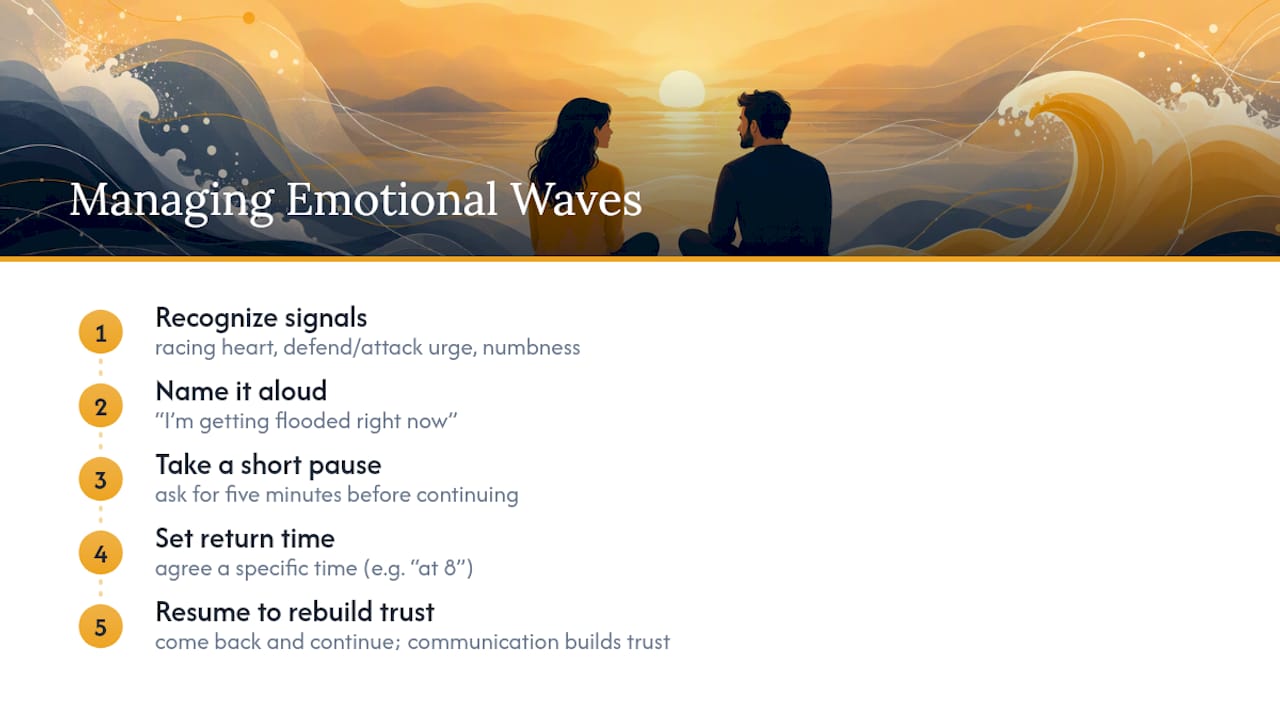
The most useful skill here is recognizing when you’ve crossed from discussing the issue into a stress response. Racing heart, the urge to defend or attack, going numb or blank, these are signs your body has shifted into fight, flight, or freeze. Once that happens, the content of the conversation stops mattering because no one can absorb new information mid-threat response.
When you notice it, say so out loud: “I’m getting flooded right now, I need five minutes before I can keep talking.” This isn’t avoidance if you actually come back. Setting a specific return time, “let’s pick this back up at 8,” prevents the pause from becoming permanent silence. Longitudinal research on couples shows trust and communication reinforce each other over time: partners who trust each other communicate more, and that communication builds more trust. Managing the emotional wave well, rather than avoiding the topic altogether, is what keeps that cycle moving in the right direction instead of the wrong one.
Give each other room to have a bigger reaction than the moment seems to warrant. A comment about frequency might land on top of years of unspoken hurt. That’s not overreacting, that’s old material surfacing through a small crack.
Naming the Fear Underneath the Silence
Most people avoiding sexual conversation aren’t avoiding sex itself. They’re avoiding a specific fear: that they’re inadequate, that their partner secretly finds them unattractive, that admitting low desire will end the marriage, or that raising the issue will just invite more criticism.
These fears rarely get spoken directly, which is exactly why they keep running the show. A partner who fears rejection might stop initiating entirely rather than risk one more “not tonight.” A partner who fears being blamed for the low desire might get defensive at the first mention of the topic, even a gentle one.
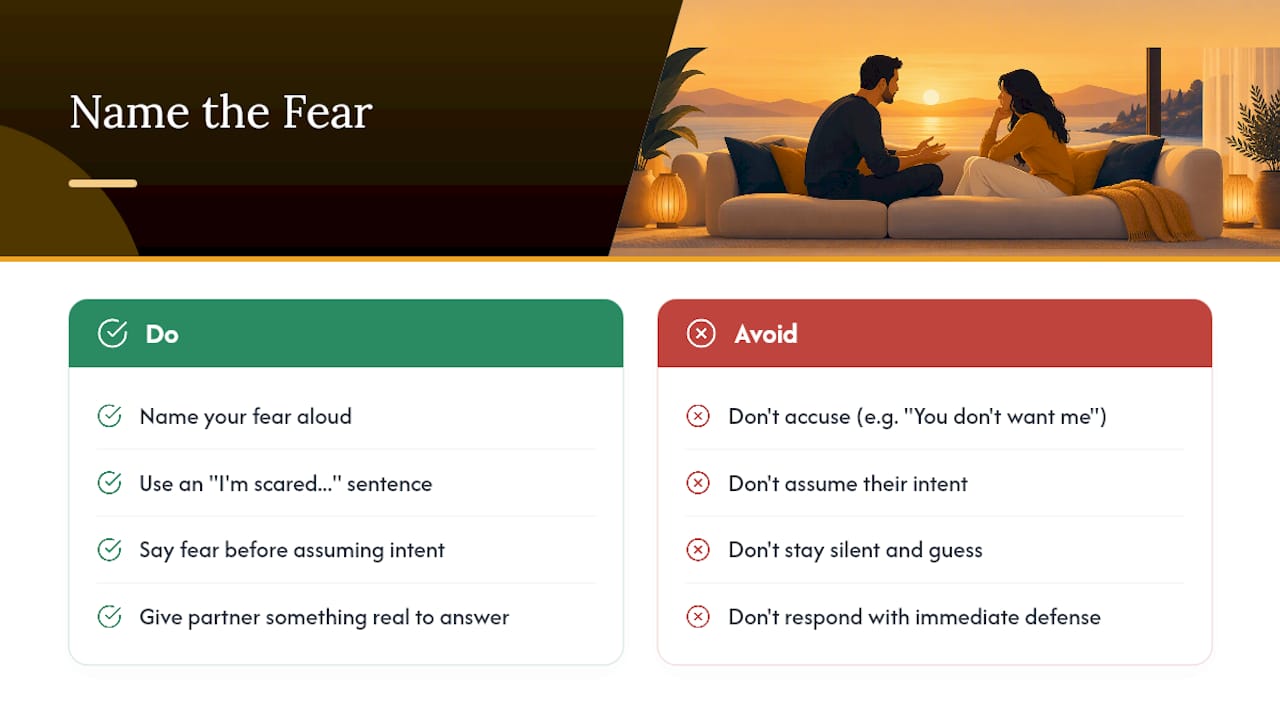
Try naming your own fear before assuming your partner’s intent. Instead of “You obviously don’t want me anymore,” try “I’m scared that bringing this up means you’re going to tell me you’re not attracted to me, and that’s why I’ve been avoiding it.” That sentence does two things at once: it’s honest, and it removes the accusation your partner would otherwise have to defend against.
The same goes the other direction. If you’re the partner with lower desire, naming your own fear, “I’m scared if I tell you the truth about how I’ve been feeling, you’ll think something’s wrong with me” or “I’m scared this will turn into pressure,” gives your partner something real to respond to instead of a wall of silence to interpret. Fear named out loud shrinks. Fear guessed at tends to grow.
Why Active Listening Changes the Whole Conversation
Most people rehearse what they’re going to say next while their partner is still talking. That’s not listening, that’s waiting for your turn, and your partner can usually tell the difference.
Active listening means reflecting back what you heard before responding: “So you’re saying you feel pressure every time I bring this up, and that makes you want to avoid the topic altogether. Is that right?” This single move does something pressure and logic can’t: it proves you actually heard them, which lowers their need to keep repeating themselves louder or angrier to be understood.
Empathy works alongside this by focusing on the feeling under the words rather than agreeing with every claim. You don’t have to agree that you “never” initiate to validate that your partner feels unwanted. Try: “I hear that you’ve been feeling really alone in this, and that sounds painful, even if I see the frequency a little differently than you do.” That sentence validates the feeling without conceding a fact you dispute, which keeps the conversation from turning into a debate about who’s counting correctly.
Setting Expectations That Won’t Set You Up to Fail
Couples who expect one honest conversation to restore years of disconnected sex usually end up more discouraged than when they started. Rebuilding sexual communication in a marriage is closer to physical therapy than to a light switch: consistent, low-intensity effort over weeks produces more durable change than one intense breakthrough session.
A realistic goal for month one isn’t “have sex again.” It’s “have three calm conversations about how we’re both feeling, without either of us shutting down.” A realistic goal for month two might be reintroducing consistent nonsexual touch. Desire and frequency tend to follow safety and connection, not the other way around, so measuring progress by connection quality, not by a return to any specific number, keeps you from mistaking a good week for total repair or a hard week for total failure.
Keeping the Conversation Alive as Your Relationship Changes
Sexless marriage communication isn’t a problem you solve once. Desire shifts with stress, health, hormones, parenting seasons, and just about everything else life throws at a long marriage, which means the conversation needs to be revisited, not closed.
Build in a standing check-in, monthly works for most couples, where you both ask: “How are we doing on this, compared to a month ago?” This normalizes small course corrections instead of letting frustration build silently for another six months before anyone says anything. Couples who treat this as an ongoing practice rather than a one-time fix tend to adapt faster when life throws a new stressor at their intimacy, because the muscle for having the conversation is already built.
A Realistic Timeline: What to Expect as You Do This Work
Progress here rarely looks like a straight line, and expecting one is the fastest way to feel like you’re failing. Some weeks you’ll have a genuinely open conversation and feel closer than you have in years. The next week, an offhand comment during a stressful Tuesday will undo half of it. That’s not regression. That’s how nervous systems actually recalibrate around a topic they’ve spent years treating as dangerous.
Focus on small, trackable wins rather than the big scoreboard question of “are we having sex yet.” Did you both stay calm during a hard conversation this week? Did affection happen without anyone flinching? Those are the real markers of progress, even on weeks when nothing physical happens. Curiosity beats urgency here. The couples who treat this like a shared experiment, “let’s see what happens if we try X this week”, tend to stick with it longer than couples treating it like a deadline. Write down small shifts as they happen. Six months from now, a running list of small wins will tell you more than memory alone ever could.
Getting Guided Support From Couples Fight School®
Self-directed scripts and exercises solve a lot of sexless marriage communication problems, but some couples need structured, guided practice to break years of avoidance. That’s the gap this approach is built to close: a therapist-created system instead of generic advice, with a specific plan instead of vague encouragement to “just communicate more.”

If you want a self-paced starting point, the Stop the Fighting: The Couples Communication & Conflict Resolution Course walks through the exact communication patterns behind stuck, sexless dynamics. Couples who want more hands-on support can book a 6-Hour Couples Intensive, a single concentrated session designed to work through exactly this kind of entrenched pattern in one sitting. For ongoing accountability, Online Couples Coaching pairs you with real guidance session by session instead of leaving you to interpret a workbook alone.
Start with the free communication exercises tonight if you’re not ready to book anything yet. If those conversations keep stalling in the same place, browse the full course library and pick the format that matches how much structure you actually need right now.
Key Research and Resources Cited
The claims in this article draw on peer-reviewed research into sexual communication, desire discrepancy, and relational trust, alongside clinical and professional resources for readers who need next steps.
- Meta-analysis: sexual communication and relationship/sexual satisfaction (2022)
- Sexual satisfaction mediates effects of dyadic sexual communication (2023)
- Strategies for mitigating sexual desire discrepancy (PMC)
- Sexual communication discrepancies in married individuals (PMC)
- Mayo Clinic: low sex drive in women
- AASECT certified therapist finder
Sources
- Meta-analysis: sexual communication and relationship/sexual satisfaction (2022)
- Sexual satisfaction mediates effects of dyadic sexual communication (2023)
- Strategies for mitigating sexual desire discrepancy (PMC)
- Sexual communication discrepancies in married individuals (PMC)
FAQ
Can Separate Bedrooms Help With a Sexless Marriage?
Separate bedrooms can help temporarily if sleep issues (snoring, mismatched schedules, insomnia) are damaging the relationship independent of sexual concerns. But sleeping apart long-term without an explicit, revisited agreement often reduces the casual touch and proximity that rebuild desire, so it works best as a short-term fix paired with intentional connection time elsewhere.
How Long Without Intimacy Is Considered a Sexless Marriage?
Clinicians generally define a sexless marriage as having very infrequent partnered sex, though the exact number matters far less than how each partner feels about it. A couple content with infrequent sex isn’t experiencing the same problem as a couple in constant tension over the same frequency.
What Should I Do When My Partner Stops Being Intimate?
Start by asking with curiosity rather than accusation, something like “I’ve noticed we’ve had less closeness lately, and I wanted to check in on how you’ve been feeling,” rather than leading with a complaint about frequency. Rule out medical or situational causes first, since sudden changes in desire often have a physical or stress-related root that no conversation alone will fix.
How Do I Cope With a Sexless Relationship Emotionally?
Naming the loneliness out loud, to your partner, a therapist, or both, reduces the isolation that usually makes a sexless marriage feel worse than the lack of sex itself. Structured support such as couples coaching or a certified sex therapist through AASECT gives you a process to work through the feelings instead of carrying them alone indefinitely.
Does Better Communication Actually Bring Sex Back Into a Marriage?
Research links higher-quality sexual communication to lower desire discrepancy and higher satisfaction, largely because it increases felt safety and closeness between partners. It’s not a guarantee of any specific outcome, but a 2023 study found the effect operates through increased sexual satisfaction, which is the mechanism most communication-first approaches, including Couples Fight School®’s F.I.G.H.T. Plan®, are built around.
Recommended