AttachedTherapy.com Alternatives for Couples: 2026 Guide

If you’re looking for practical alternatives to AttachedTherapy.com, the three formats worth your time are structured self-guided programs with human check-ins, weekend intensives, and therapist-matching platforms that let you filter by modality. For most couples stuck in repetitive fight cycles, a short skills-based course with accountability check-ins is the fastest starting point. For concentrated change in a short window, a weekend intensive beats months of sporadic sessions. For clinical-level concerns, a matching platform that filters by EFT or Gottman training gets you to the right therapist faster.
Best for at a glance:
- Immediate conflict repair: real-time tools and scripted de-escalation prompts
- Step-by-step skill-building: structured course with coach check-ins (Couplesfightschool’s F.I.G.H.T. Plan® framework is built for this)
- Concentrated progress: weekend intensives or workshops
- Clinical attachment work: therapist-matching platforms filtering by EFT or Gottman techniques
- Budget-conscious start: one-time-payment programs or workbooks
Table of Contents
- How do the main alternative formats compare?
- How to pick the right alternative for your couple
- What do these alternatives actually provide?
- When is a program enough, and when do you need a clinician?
- Key Takeaways
- Why a skills-first approach often moves faster than weekly therapy
- Couplesfightschool: where to start for conflict repair and skill-building
- Where to learn more: authoritative resources and next steps
How do the main alternative formats compare?
| Format | Typical cost | Specialization | Modality filtering | Accountability | Best for | Mobile access |
|---|---|---|---|---|---|---|
| Self-guided program | Varies by program, generally a one-time payment | Varies (Gottman, EFT, general) | Limited | None (on-demand) | Skill-building at your own pace | Yes |
| Coach-led course | — | Communication, conflict | None | Human check-ins | Couples wanting structure + feedback | Yes |
| Weekend intensive | $500–$2,000+ | Concentrated conflict repair | Depends on provider | High (live) | Fast measurable change, motivated couples | No |
| Therapist-matching platform | — | Attachment, EFT, Gottman, CBT | Strong | Weekly sessions | Clinical needs, modality-specific fit | Yes |
| App-based tools | Free–$30/month | General communication | None | Low (self-paced) | In-the-moment de-escalation | Yes |
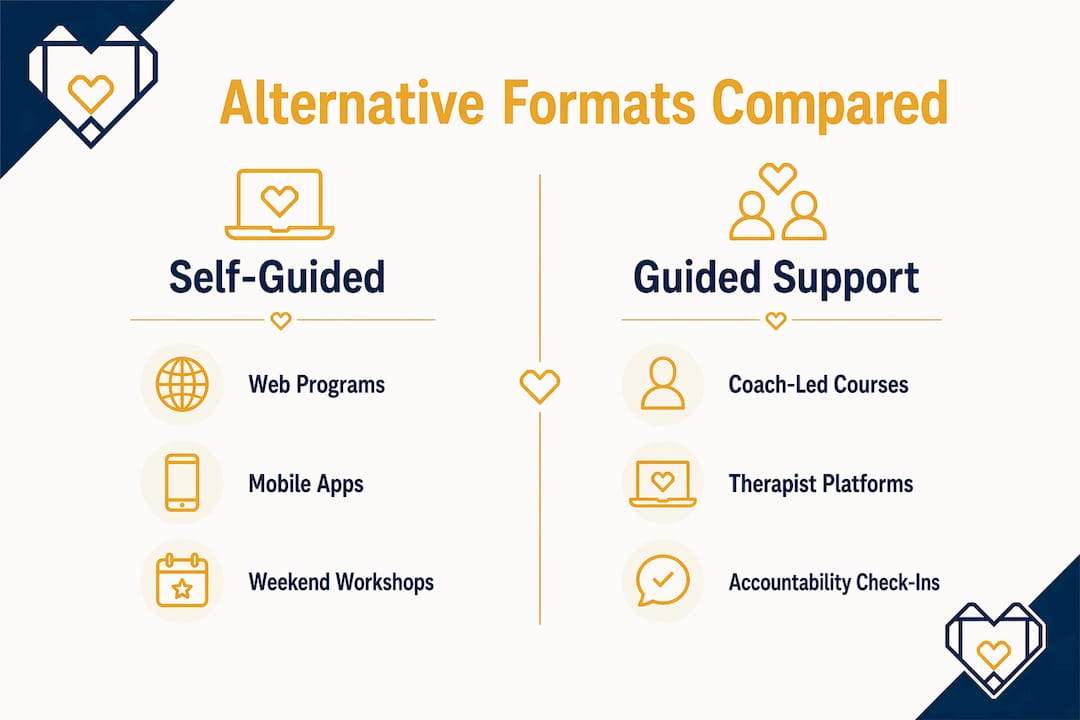
Apps are uniquely positioned for real-time conflict support: they deliver structured prompts during an argument, not 48 hours later in a therapy recap. Therapist-matching platforms like WithTherapy use intake-based matching to pair couples with clinicians by specialty and style, which cuts the trial-and-error of finding someone trained in attachment or EFT. One-time programs such as OurRelationship ($79–$249) suit couples who want clinical evidence behind the curriculum without an ongoing subscription.
How to pick the right alternative for your couple
Start here: the decision comes down to five factors: severity of conflict, whether you need real-time tools or reflective processing, budget, desire for human accountability, and timeframe.
Questions to ask any program or provider:
- Does it filter or match by modality (EFT, Gottman, attachment-based)?
- Are coaches or therapists licensed, and what are their credentials?
- What is the refund or trial policy?
- How does the platform handle data retention and third-party sharing?
- Is there mobile access and asynchronous options for different schedules?
- Is there a community forum or peer group for ongoing accountability?
Red flags that mean you need licensed clinical care, not a skills program:
- Active trauma, PTSD, or abuse in the relationship
- Substance use affecting the partnership
- Suicidal ideation or safety concerns
- A clinical diagnosis requiring medication management
Decision flow:
- Need to stop a fight right now → app with real-time prompts
- Want to build lasting communication skills → structured course with check-ins (see online coaching for couples)
- Want fast, concentrated progress → weekend intensive or workshop
- Clinical diagnosis, trauma, or attachment disorder → licensed clinician via a matching platform
- Unsure whether you need therapy or education → read when to seek couples therapy first
What do these alternatives actually provide?
Self-guided research-backed programs
Programs like OurRelationship are web-based, one-time-payment options developed from university research. You work through structured modules covering communication patterns, conflict cycles, and repair skills. No live sessions, but the curriculum is evidence-grounded. Best for couples who want clinical credibility at a fixed cost and can stay self-motivated.
App-based real-time tools
The primary differentiator between an app and a therapist is real-time guidance versus retrospective analysis. Apps deliver scripted prompts during or immediately after a conflict, which is something weekly therapy cannot replicate. Lasting (iOS and Android) offers 300+ guided sessions and monthly live workshops with licensed therapists at roughly $15/month on a six-month plan. Paired focuses on daily micro-connection through questions and games. Neither replaces clinical care, but both build consistent habits.

Coach-led courses
Coach-led formats add human accountability to self-guided content. A coach reviews your progress, assigns practice-based homework, and checks in between sessions. This matters: guided self-help with human accountability tends to outperform unguided self-help for relationship skill-building, largely because accountability reduces drop-off. High-achieving couples especially benefit from coaches who assign challenging, practice-oriented homework rather than only empathetic listening. Couplesfightschool’s communication conflict resolution course is structured around this model.
Weekend intensives and workshops
Concentrated formats often produce faster measurable change than months of weekly sessions for motivated couples. A weekend intensive compresses skill-building, conflict repair, and practice into 2–3 days with a facilitator. The benefits of couples communication workshops include immediate application and real-time feedback. Cost runs higher ($500–$2,000+), but the time investment is lower than six months of weekly sessions.
Therapist-matching platforms
BetterHelp connects couples with over 30,000 licensed therapists and lets you note attachment, EFT, or IFS training preferences during intake. Prepare/Enrich is a structured premarital and couples assessment tool administered by a certified facilitator, widely used by counselors and clergy. The Gottman Institute offers workshops, online courses, and a therapist directory filtered by Gottman-method training level. WithTherapy uses AI-powered matching to connect you with therapists by specialty, style, and location. Matching by modality and relational focus reduces friction and increases the odds of a good fit from session one.
When is a program enough, and when do you need a clinician?
Guided self-help paired with human check-ins tends to outperform purely unguided approaches for relationship skill-building. The reason is straightforward: accountability reduces drop-off, and practice-based repetition builds habits that stick. Bibliotherapy research consistently shows better adherence and outcomes when a human is in the loop, even briefly.
That said, programs have a ceiling. A skills curriculum works well when the core problem is communication patterns, conflict cycles, or emotional distance without an underlying clinical diagnosis. When trauma, abuse, active addiction, or a mental health condition is driving the relationship distress, a licensed clinician is not optional.
Pro Tip: Schedule a 15-minute accountability check-in with your partner every week while working through a self-guided program. Couples who review their practice together, rather than completing modules solo, retain skills significantly longer. Pair this with coping strategies from resources like mental health support tools to manage stress between sessions.
Key Takeaways
Structured programs with human accountability consistently outperform solo self-guided work for couples who want lasting communication skills without formal clinical therapy.
| Point | Details |
|---|---|
| Accountability drives results | Guided self-help with check-ins outperforms unguided approaches for relationship skill-building. |
| Format determines speed | Weekend intensives produce faster change; structured courses build durable skills over several weeks. |
| Filter by modality | Ask any platform whether you can filter by EFT, Gottman, or attachment-based training before committing. |
| Know the clinical line | Trauma, abuse, active addiction, or safety concerns require a licensed clinician, not a skills program. |
| Couplesfightschool | Offers structured courses, coach check-ins, and the F.I.G.H.T. Plan® framework for conflict repair and skill-building. |
Why a skills-first approach often moves faster than weekly therapy
Most couples who come looking for therapy alternatives don’t actually need clinical diagnosis. They need repetitive, skills-focused practice. Weekly therapy is retrospective by design: you reconstruct last Tuesday’s argument from memory and process it. That’s valuable for deep emotional work, but it’s slow for behavior change.
A skills-first, practice-oriented approach produces faster, repeatable behavior changes for many couples because the practice happens in real life, not in a recap. The F.I.G.H.T. Plan® framework at Couplesfightschool is built around exactly this: structured communication tools, emotional regulation steps, and scripted repair sequences that couples practice between sessions, not just during them. Couples stuck in the same fight cycle for years often see a shift within weeks when they switch from talking about the problem to practicing a different response to it. High-achieving couples, in particular, tend to respond well to a homework-heavy, skill-building model because it matches how they learn in every other area of their lives.
Couplesfightschool: where to start for conflict repair and skill-building
If the alternatives above feel like a lot to sort through, Couplesfightschool gives you a clear starting point. The Stop the Fighting course is built for couples who want structured practice and real scripts for conflict moments, not just theory. It’s a practical first step before committing to a longer program or weekly therapy.
What you get:
- Structured exercises built around the F.I.G.H.T. Plan® framework
- Communication scripts for de-escalation and repair
- Workshop and coaching options for human accountability
- Resources for relationship skills every married couple needs
Founded by licensed mental health professionals Carlos Todd and Natasha Pemberton-Todd, Couplesfightschool serves dating, married, engaged, and high-conflict couples who want practical tools, not just insight. Book a coaching intro or start the short course today at couplesfightschool.com.
Where to learn more: authoritative resources and next steps
- Couplesfightschool: Stop the Fighting course — structured conflict resolution curriculum with scripted exercises
- Online coaching for couples — overview of coach-led accountability options and how to schedule an intro
- Couples therapy workbook — guided home practice resource for self-directed couples
- WithTherapy — AI-powered therapist matching by specialty, style, and location
- Gottman.com alternatives — comparison of curriculum-based approaches using Gottman-method techniques
- Communication workshops guide — explains workshop outcomes and when intensives outperform weekly sessions
- When to seek couples therapy — helps you recognize red flags and decide when clinical care is the right call
- NYCEFT therapist directory — find EFT-trained therapists for attachment-focused clinical work
- Supporting a partner through mental health challenges — practical guidance for couples navigating stress and mental wellness alongside relationship work
Recommended
- Best Online Couples Therapy Alternatives for Long-Distance Relationships – Couples Fight School
- Top 4 DeeperConnecting.com Alternatives 2026
- StripeM-Inner