
Create a Shared Vision for Marriage: A Practical Guide

A shared vision for your marriage is a one-paragraph, present-tense statement that describes how you want to live together as a couple — the values you act on, the rhythms you keep, and the way you treat each other on ordinary days. To start right now, each of you writes your personal vision for 10 minutes, then you compare notes and draft one combined statement together.
Three steps you can complete in the next 60 minutes:
- Write separately. Each partner spends 10 minutes writing what a great marriage looks and feels like to them, using present-tense, positive language (“We make time for each other every week” rather than “We stop ignoring each other”).
- Share and listen. Take turns reading your drafts aloud without interruption. Notice where they overlap and where they diverge.
- Synthesize. Draft one paragraph together that captures the overlap and honors the differences. That draft is your couple vision statement.
Research published in Frontiers in Psychology found that participants self-reported 60.1% of goals as joint, while independent raters classified only 30.9% as truly joint. That gap matters: when goals look shared on the surface but aren’t behaviorally coordinated, goal progress stalls. A written, observable vision closes that gap. Frameworks from Imago Relationship Therapy, The Couples Institute, and Couplesfightschool’s F.I.G.H.T. Plan® all start from the same premise: get the vision on paper before you try to solve anything.
Table of Contents
- Why does a shared vision actually change your marriage?
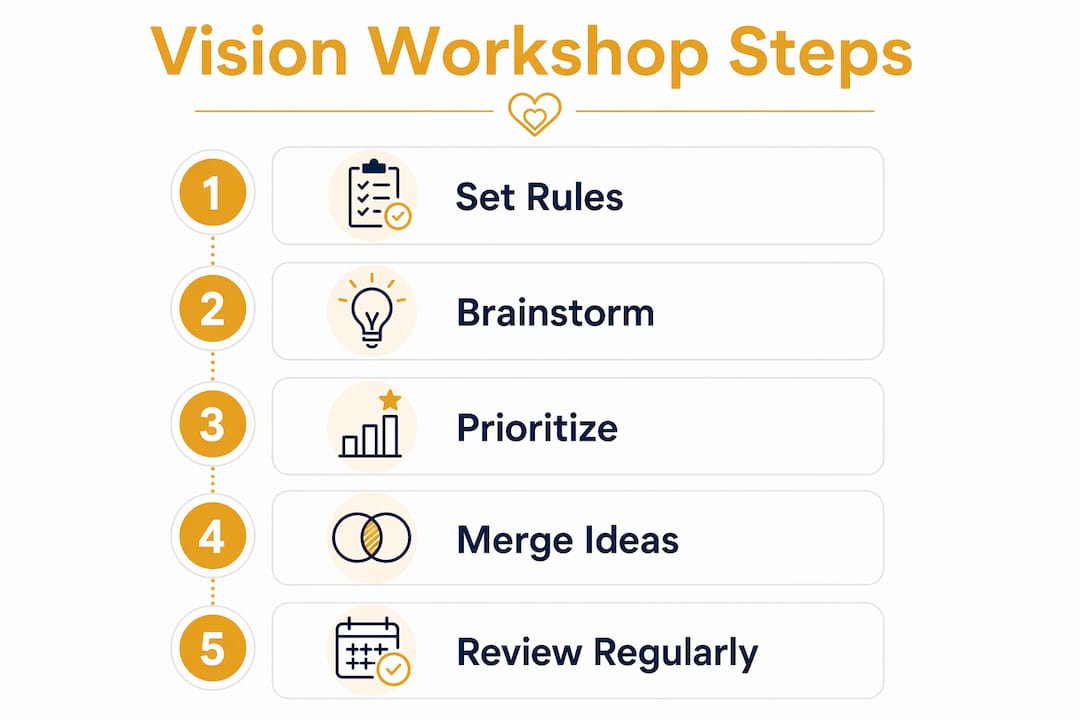
- How to run a 60–90 minute vision workshop together
- Ready-to-use templates and sample vision statements
- How do you keep the vision alive after the first session?
- What goes wrong, and what to say when you disagree
- What does the research say about shared goals and marriage?
- Key Takeaways
- Why the “drudge work” phase is where most couples actually grow
- Couplesfightschool can help you build this together
- Useful sources and further reading
Why does a shared vision actually change your marriage?
Most couples operate on assumptions. You assume your partner wants the same things you do, or that you’ll figure it out as you go. A joint vision for couples replaces those assumptions with explicit agreements, and the downstream effects show up fast.

Clarity on daily decisions. When you know your shared priorities, smaller choices get easier. Should you say yes to that weekend trip with friends or protect family time? The vision answers it. Calendar conflicts, financial trade-offs, parenting rhythms — all of these become easier to navigate when you have a shared reference point.
More energy for the relationship. Ambiguity is exhausting. Couples who know where they’re headed together spend less mental energy relitigating the same arguments and more energy actually moving forward. That’s not a soft benefit — a longitudinal study found that goal coordination within couples predicted better goal attainment one year later, and that higher attainment was linked to greater life satisfaction for both partners.
Unity during transitions. Job changes, new babies, relocations, empty nests — life transitions are where marriages either deepen or drift. A shared vision acts as a navigational tool during those moments, giving both partners a “we” to return to when individual pressures pull in different directions.
The benefits couples report most often:
- Fewer avoidable arguments about priorities that were never discussed
- Clearer financial decisions because values are explicit
- Stronger teamwork during parenting and career transitions
- A sense of being on the same team rather than managing separate agendas
One practical note: broad wishes like “wanting a better marriage” don’t produce these benefits. Specificity does. The more observable and measurable your shared goals, the more likely you are to actually pursue them together rather than just feel good about having them.
How to run a 60–90 minute vision workshop together
You don’t need a therapist in the room to do this well. You need a timer, two pens, and a willingness to stay curious rather than defensive. Here’s a timed agenda you can run this weekend.

| Phase | Time | What You Do |
|---|---|---|
| Set the container | — | Agree on ground rules: no phones, no problem-solving yet, curiosity only |
| Individual reflection | 15 min | Each partner writes privately (see prompts below) |
| Partner A shares | 10 min | Partner B listens without interrupting or reacting |
| Partner B shares | 10 min | Partner A listens without interrupting or reacting |
| Find the overlap | 10 min | Together, circle themes that appear in both drafts |
| Draft shared statement | 15 min | Write one paragraph together using the template in Section 4 |
| Set 90-day goals | 10 min | Agree on 1–3 measurable first steps and who owns each |
| Schedule next check-in | — | Put a date on the calendar before you close |
Individual reflection prompts
Write for 10–15 minutes without editing yourself. Use these as starting points:
- Describe a day in our marriage that feels exactly right. What are we doing? How are we treating each other?
- What values do I most want our relationship to stand for?
- What does “us at our best” look like in five years?
- What do I need from this relationship to feel fully alive in it?
Sharing and synthesis prompts
- “The part of your vision that resonated most with me was…”
- “One thing I heard that surprised me was…”
- “Where I see us overlapping is…”
- “One place where our visions feel different is… and I’m curious what’s behind that for you.”
When priorities clash
Therapists at The Couples Institute recommend protecting the creative phase entirely before shifting to implementation. Postpone “how will that happen?” until after the vision is formed. If you jump to logistics too early, you strangle the aspiration before it has a chance to breathe.
Roles during the session:
- Recorder: One partner writes the shared draft (rotate this role at future sessions).
- Timekeeper: The other partner watches the clock so neither phase runs over.
- Scheduler: Before you leave the table, one person puts the next check-in on the calendar.
Pro Tip: If one partner goes quiet or seems to shut down, pause and say: “I want to hear what’s true for you, even if it’s different from mine.” Silence often means “I’m afraid my answer will disappoint you” — not “I don’t care.” Give it 60 seconds before moving on.
Ready-to-use templates and sample vision statements
Fill-in-the-blank vision template
Write in present tense. Use action verbs. Describe what you do, not what you avoid.
Example filled in:
We are a couple who leads with kindness even when we’re frustrated. We share a meal together without phones at least five nights a week. When things get hard, we take a short break and come back to the conversation within the hour. We make time for adventure because it keeps us curious about each other. We support each other’s careers, and we grow together by reading and discussing one book every two months.
Three sample vision statements
Connection-first couple:
We are a couple who chooses each other every day. We check in every evening for 10 minutes, put our phones away during dinner, and say “I love you” before we sleep. When conflict comes, we slow down instead of escalating. We protect our friendship as fiercely as we protect our family.
Family and parenting focus:
We are partners and parents who operate as a team. We hold a weekly family meeting on Sunday evenings, divide household responsibilities fairly, and present a united front with our kids. We carve out one date night every two weeks, because our marriage is the foundation our family stands on.
Purpose and career alignment:
We are a couple who supports each other’s ambitions without losing sight of our shared life. We review our finances and career goals quarterly, celebrate each other’s wins loudly, and renegotiate responsibilities when seasons change. Our marriage grows alongside our individual growth.
90-day goal sheet
| Vision theme | 90-day goal | Who leads | By when |
|---|---|---|---|
| Connection | Schedule and protect two date nights per month | Partner A books, Partner B confirms | End of this week |
| Communication | Complete one conflict-skills session together | Both | Within 30 days |
| Finances | Create a shared monthly budget review | Partner B drafts, Partner A reviews | — |
| Individual support | Each partner names one personal goal and shares it | Both | This session |
Phrasing rules to remember:
- Present tense: “We speak kindly” not “We will try to be nicer”
- Positive language: “We listen to understand” not “We stop interrupting”
- Observable behaviors: describe what someone watching you would actually see
- Avoid vague abstractions: “connection” needs a behavior attached to it (“we share dinner without phones”)
The Imago-informed practice of writing individually first, then merging, is worth following here too. Write your personal fill-in before you sit down together. You’ll arrive with something real to contribute rather than defaulting to whatever your partner says first.
How do you keep the vision alive after the first session?
Writing the vision is the easy part. The harder work is making it a living document rather than a PDF you forget about. Here’s a cadence that works without requiring heroic effort.
Weekly micro-check (10–15 minutes): Pick one recurring time, Sunday evening or Wednesday after dinner, and ask two questions: “What went well this week in our marriage?” and “What’s one thing we want to do differently next week?” That’s it. No agenda, no deep dive. Just a pulse check.
Monthly planning touchpoint (30 minutes): Review your 90-day goals. Are you on track? Does anything need to be adjusted? This is also the time to handle logistics that affect your shared vision: the calendar, finances, upcoming transitions.
Quarterly review (60–90 minutes): Pull out the vision statement and read it together. Does it still reflect who you are and where you’re headed? Update the 90-day goal sheet. Celebrate what you’ve accomplished. This is also a good moment to use intimacy-building activities that reinforce the connection your vision describes.
Annual vision retreat (half day or full day): Once a year, get out of your normal environment. A hotel room, a friend’s cabin, a long hike. Revisit the full vision. Ask: “Who have we become this year, and who do we want to be next year?” Rewrite the vision if it needs it.
A simple checklist for keeping the vision visible:
- Post a printed copy somewhere you both see it (bathroom mirror, inside a kitchen cabinet)
- Add the quarterly review as a recurring calendar event right now
- Keep the 90-day goal sheet somewhere accessible, not buried in a folder
- Set a phone reminder for the weekly check-in until it becomes automatic
Time budget: The weekly check-in costs roughly 10 minutes. The monthly touchpoint costs 30. That’s under an hour a month for the minimum viable upkeep. Most couples can find that. The annual retreat takes more planning, but even a half-day away together pays dividends far beyond the vision work itself.
What goes wrong, and what to say when you disagree
Common mistakes
The most frequent failure isn’t conflict. It’s vagueness. A vision that says “we want to be happy and connected” gives you nothing to act on. Happiness isn’t a behavior. Connection isn’t a calendar entry. Every abstract value needs a concrete behavior attached to it before it does any work.
Other pitfalls to avoid:
- Skipping individual reflection. If you go straight to a joint draft, the louder or more confident partner shapes the vision and the other partner quietly agrees. That’s not a shared vision; it’s a polite capitulation.
- Immediate compromise that erases identity. A vision should stretch both of you, not flatten you into a lowest-common-denominator statement. If your first draft sounds like nobody in particular wrote it, start over.
- Treating the vision as a contract for changing your partner. The Couples Institute explicitly warns against symbiotic requests — using the vision as a vehicle to demand your partner become a different person. A healthy vision describes the relationship you’re building together, not the partner you wish you had.
Two conflict scripts
When priorities clash:
When one partner feels pressured:
Turning a stuck negotiation into an experiment
When you genuinely can’t agree, propose a 30-day trial instead of a permanent decision. “Let’s try this for one month and check in on how it’s working.” A micro-goal with a built-in review date removes the pressure of forever and gives both partners real data to work with.
When to seek professional support: If your vision conversations consistently end in shutdown, contempt, or one partner leaving the room, that’s a signal the conversation needs a skilled third party. A therapist trained in Imago Relationship Therapy or a coach through a program like Couplesfightschool can help you get unstuck without the session becoming another fight. Expect a first session to focus on safety and communication ground rules before vision content.
What does the research say about shared goals and marriage?
The case for creating a joint vision isn’t just intuitive. It’s supported by peer-reviewed research and clinical frameworks developed over decades.
A study published in Frontiers in Psychology tracked 118 older couples and found that externally-rated joint goals predicted greater goal progress and lower allostatic load, but only among couples with little over-reporting. In other words, goals that both partners genuinely held in common produced measurable health and progress benefits. Goals that only felt shared did not. The implication for couples doing vision work: make your agreements observable and trackable, not just emotionally resonant.
A separate longitudinal study found that goal coordination predicted higher goal attainment one year later, and that attainment fully mediated the relationship between coordination and life satisfaction. Coordinating your goals doesn’t just feel good. It produces outcomes that then produce satisfaction.
What therapists recommend:
- Write the vision in present tense with positive, observable language. Change “we don’t yell” to “we speak kindly even during disagreements.” This isn’t just stylistic; it primes the brain toward the behavior you want rather than the one you’re avoiding.
- Use the individual-first-then-merge sequence. Imago founders recommended each partner write a personal vision separately before coming together, then spending an hour creating a shared version and hanging it somewhere visible.
- Protect the creative phase. Therapists advise against asking “how will that happen?” during vision creation. Feasibility questions come after the vision is formed, not during.
- Name the unglamorous tasks. The Couples Institute notes that couples often abandon visions when they hit the drudge work phase — the repetitive, unsexy tasks the vision requires. Explicitly listing those tasks and assigning them during the planning session predicts greater follow-through.
How the F.I.G.H.T. Plan® fits in:
Couplesfightschool’s F.I.G.H.T. Plan® addresses the communication and repair skills that make vision work sustainable. A shared vision sets the destination; the F.I.G.H.T. Plan® gives couples the tools to navigate the inevitable conflicts that arise on the way there. The two work together: vision work without communication skills tends to collapse under the first serious disagreement, and communication skills without a shared direction can feel like managing conflict for its own sake.
For couples exploring emotional resilience as part of their vision work, building the capacity to stay regulated during hard conversations is as important as the vision content itself.
Key Takeaways
A shared marriage vision works only when it is written in observable, present-tense language, reviewed on a regular cadence, and supported by the communication skills to repair conflict along the way.
| Point | Details |
|---|---|
| The perception gap is real | Research found 60.1% of goals were self-reported as joint, but only 30.9% were externally rated as truly joint — write observable agreements to close that gap. |
| Goal coordination pays off | Longitudinal research shows coordinated goals predict better attainment one year later, which in turn drives higher life satisfaction for both partners. |
| Individual writing comes first | Write your personal vision separately before merging; skipping this step lets one partner’s voice dominate the shared draft. |
| Upkeep is the real work | A weekly 10-minute check-in plus a quarterly review is the minimum cadence to keep a vision alive and relevant. |
| Couplesfightschool supports the full process | The F.I.G.H.T. Plan® and Couplesfightschool’s courses and coaching give couples the communication and repair tools that make a shared vision sustainable. |
Why the “drudge work” phase is where most couples actually grow
Most couples expect the vision session to feel inspiring. And it usually does. What they don’t expect is what comes next: the Tuesday night when nobody wants to do the weekly check-in, the quarterly review that keeps getting rescheduled, the moment when the vision statement starts to feel like a chore rather than a compass.
That phase is not a sign that something went wrong. It’s the phase where the vision either becomes real or stays decorative. The Couples Institute calls these the drudge tasks — the unglamorous, repetitive work that every meaningful vision requires. Couples who name those tasks explicitly and agree on who handles them are far more likely to persist than couples who assume motivation will carry them through.
The other thing worth saying plainly: you don’t have to get this perfect on the first try. A vision that’s 70% right and actually lived is worth more than a perfect vision that lives in a drawer. Start with the draft you have. Review it in 90 days. Revise it. The process of returning to it together is itself a relationship practice.
If your partner is reluctant to engage, that’s worth addressing directly rather than waiting for the right moment. There are practical ways to invite a hesitant partner into this kind of work without it feeling like an ultimatum.
Couplesfightschool can help you build this together
The vision work in this guide is designed to be done on your own. But if you want a structured path with expert support, Couplesfightschool offers courses, coaching, and workbooks built around the F.I.G.H.T. Plan® — the same framework that underpins the communication and repair skills your vision needs to survive real life.
The couples therapy workbook gives you guided exercises you can work through at your own pace, including reflection prompts, conflict scripts, and goal-setting templates. If you’d rather work with a coach directly, online coaching for couples connects you with a licensed professional who can facilitate your vision session, help you navigate disagreements, and keep you accountable to the goals you set. For couples who want a full program, the relationship skills course covers communication, emotional regulation, and repair in a structured format you can complete together. Pick the format that fits your schedule and your starting point, then take the next step today.
Useful sources and further reading
The following sources informed this guide. Each is annotated with what it covers and why it’s worth reading.
-
Joint Goals in Older Couples: Associations With Goal Progress, Allostatic Load, and Relationship Satisfaction — Frontiers in Psychology (peer-reviewed research). The primary source for the 60.1% vs. 30.9% self-report vs. external-rating finding. Essential reading for understanding why observable, trackable goals outperform vague shared intentions.
-
Flourishing Together: The Longitudinal Effect of Goal Coordination on Goal Progress and Life Satisfaction in Romantic Relationships — Peer-reviewed longitudinal study. Documents the full mediation chain: goal coordination → goal attainment → life satisfaction. Strongest evidence base for why the vision-to-goals step matters.
-
Vision Setting for Couples — The Couples Institute — Therapy framework. Covers what makes a vision meaningful and measurable, warns against symbiotic requests, and introduces the concept of drudge-work planning. Directly informs the pitfalls section.
-
Relationship Vision Exercise — Couples Learn — Practical guide. Describes the Imago-informed individual-first-then-merge sequence and the recommendation to post the vision somewhere visible. Useful for the workshop and templates sections.
-
Creating a Relationship Vision — Steffen Counseling Services — Therapist guidance. Reinforces the principle of protecting the creative phase before shifting to implementation planning.
-
Sharing Dreams and Goals: Creating an Emotional Connection — Purdue Extension — University extension resource (research-informed). Covers journaling prompts, goal categories, and the emotional-connection rationale for shared vision work. Based on research by John Gottman, Sue Johnson, and Howard Markman.
-
Couplesfightschool — Relationship Skills and Courses — Practical programs. Courses, workbooks, and coaching built around the F.I.G.H.T. Plan® for couples who want structured support implementing their vision.
Recommended
- How to Strengthen the Friendship Foundation in Marriage
- How to Convince Spouse to Take Marriage Course with You
- StripeM-Inner